Build, test, and deploy AI agents without writing code
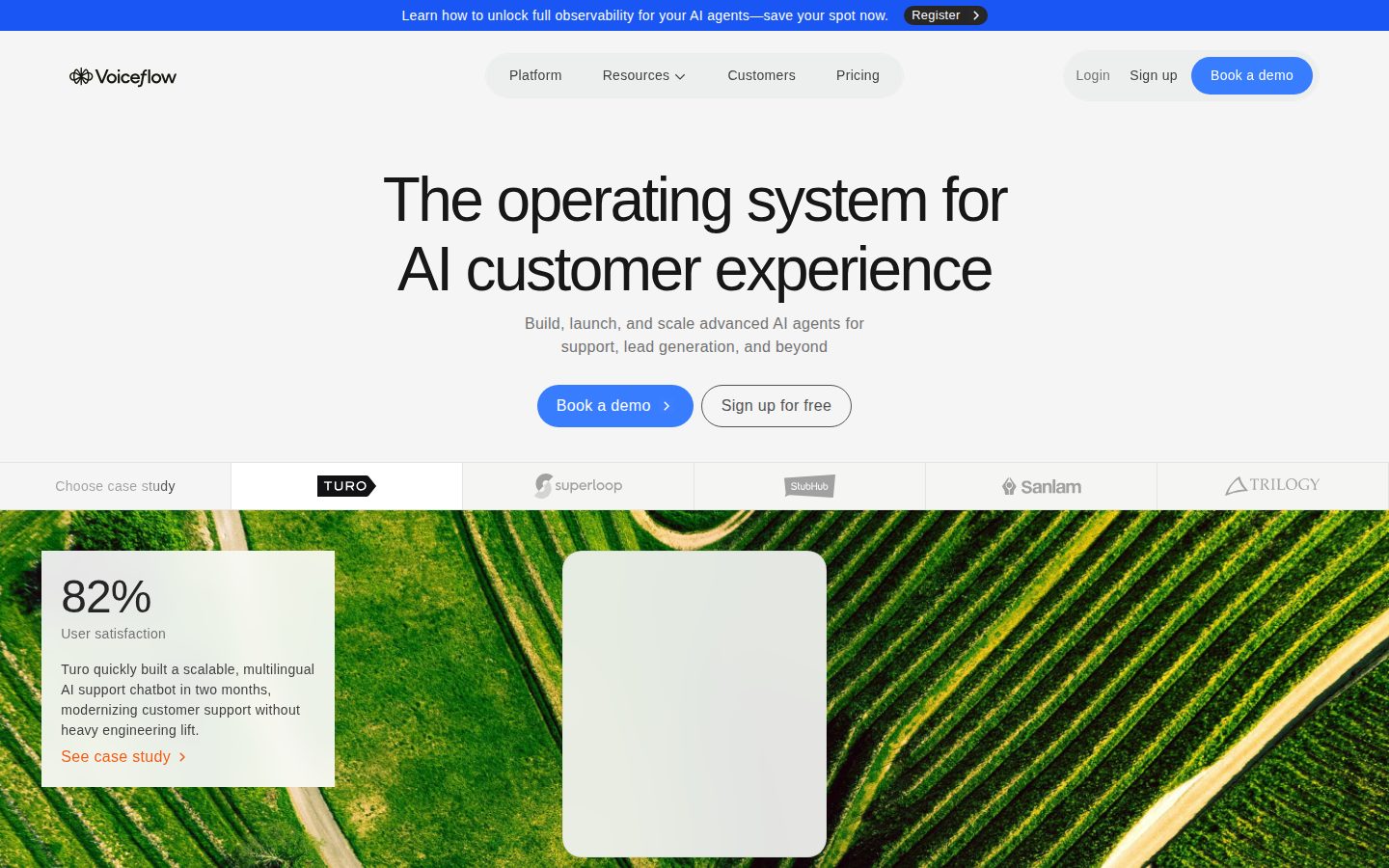
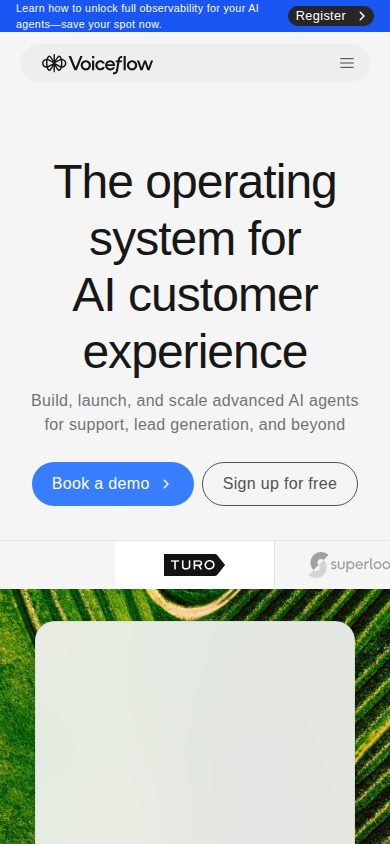
Voiceflow is a collaborative platform for designing and deploying conversational AI agents and chatbots.
AI Panel Score
6 AI reviews
AI Editor ApprovedApproved and published by our AI Editor-in-Chief after full panel analysis.Voiceflow is a no-code and low-code platform that enables teams to build, prototype, and launch AI-powered chat and voice agents. It provides a visual canvas for designing conversation flows alongside tools for knowledge base integration, testing, and deployment. Teams across product, design, and engineering can collaborate within the same environment.
Powers complex conversations by turning them into enriched customer experiences with 500ms voice latency and support for 300k messages per minute.
Avoids model lock-in by allowing teams to choose from multiple major LLM providers or bring their own custom model.
Delivers LLM-powered evaluations with custom insights at scale, giving teams conversation-level visibility or big-picture observability to make faster decisions about agent iterations.
Allows product, design, and engineering teams to collaboratively build and iterate on AI agents within the same shared environment.
Enables real production pipelines progressing from development to staging to final production, all hosted on Voiceflow.
Provides a canvas for designing intelligent conversational workflows that balance agentic playbooks with deterministic scripted flows, managed by global instructions and guardrails.
Production-grade integration tools that connect agents to external apps and services across the technology stack.
Supports deploying AI agents across web (chat and voice widgets), phone (call centre handling), and mobile (flexible API) channels from a single platform.
Keeps personal data private with advanced user permissions that let users define their own data handling procedures.
Provides safeguarded systems specifically designed to keep protected health information (PHI) secure.
Meets the highest organizational standards for information security management to ensure data privacy.
Certified to maintain data privacy, processing integrity, and confidentiality standards from design through operation.
Build AI agents for your clients. Manage deployments, billing, and performance from one platform.
Deploy and manage AI agents across your customer experience — with control and visibility.
Voiceflow handles 300k messages per minute — now prove it survives a contract renewal.
“Strong feature depth for conversation teams building at scale. Funding and ownership picture is murky enough to slow down any standardization conversation.”
The 300k messages per minute and 500ms voice latency claims are credible performance specs, not marketing filler. The omnichannel story — web, voice widget, call center — from one canvas is the right pitch for a team tired of stitching three vendors together. HIPAA, SOC-2 Type II, and ISO 27001 are all present, which clears procurement faster than most tools in this category.
Two things concern me. One: no public funding data. Webflow on their tech stack tells me nothing about runway. Two: the pricing page shows two 'Free' tiers but a $50 starting price in the metadata — that gap needs answering before any budget conversation.
The real tradeoff isn't features. Voiceflow beats Dialogflow on design collaboration and matches Botpress on extensibility. But if you standardize the org on it and they get acquired or reprice, you're rebuilding conversation logic that lives in their visual canvas format. That's a migration no one wants.
Pilot with one product team, one agent, 90 days. Watch the renewal math closely. If the LLM flexibility and observability suite hold up in production, this is a defensible 36-month bet for a mid-market team.
Real-time collaboration and role-based access give Voiceflow a design-team edge that Dialogflow and Botpress don't prioritize.
SOC-2 Type II and ISO 27001 certification clear enterprise procurement, and the Botpress/Dialogflow competitive set is well-understood.
Visual Workflow Builder plus a no-credit-card agency free trial suggests a fast first-agent path without engineering lead time.
LLM provider flexibility and omnichannel deployment advance AI agent strategy rather than just automating what you already do.
No public funding data and unknown company ownership makes the 3-year bet harder to defend to a board.
Mid-market teams with conversation designers and engineers who need to co-build agents without separate tools.
You need a fully auditable vendor history before any procurement approval clears.
Enterprise-grade agent infrastructure with a collaboration story no competitor matches today.
“Voiceflow has built something closer to an agent development platform than a chatbot builder. The compliance stack and observability suite signal genuine enterprise readiness, but pricing opacity will stall procurement conversations.”
The 500ms voice latency claim and 300k messages-per-minute throughput aren't vanity stats — those are SLA-adjacent numbers that CS leaders actually negotiate into contracts. When I'm standing in front of a CX leadership team defending a platform choice, those specifics matter. The Agentic Context Engine and Omnichannel Deployment covering web, phone, and mobile from a single canvas means my team isn't stitching together three vendors to cover the customer journey. That's real operational leverage.
The Observability Suite is the feature that earns trust long-term. LLM-powered conversation-level evaluations with custom insights means my CS ops team can catch deflection failures before they become CSAT crises — not after. Dialogflow gives you logs. Voiceflow appears to give you a feedback loop. That distinction compounds over 18 months of iteration.
The tradeoff that'll surface fast: both the Business and Agency plans show as 'Free' in the pricing structure, with no published seat costs or usage thresholds visible. That's a classic enterprise sales motion, but it creates friction at mid-market where procurement wants numbers before the discovery call. Botpress publishes tiered pricing. Voiceflow makes you talk to sales, which slows internal champions.
If we adopt this in year one and build a 20-agent library using the component reuse and version history features, we're well-positioned. If Voiceflow shifts its LLM pricing model or deprecates a channel integration mid-contract, the visual workflow logic is portable but the institutional knowledge lives in their canvas.
Positioning as an 'operating system for AI customer experience' differentiates from point builders like Dialogflow, but the sales-led pricing model limits velocity against self-serve competitors at the mid-market tier.
Omnichannel deployment across web, phone, and mobile plus real-time collaboration between product, design, and engineering matches how mature CX orgs actually structure agent delivery teams.
Production-grade API integration tools and a developer toolkit support embedding into existing CX stacks, though the docs indicate API is listed as a capability gap in current scraped evidence.
LLM provider flexibility avoids model lock-in, but deep investment in the visual canvas and proprietary component library creates switching costs that aren't immediately visible at adoption.
Role-based access controls, version history, production environment staging, and ISO/IEC 27001:2022 certification collectively indicate a platform designed for teams running agents at real scale, not demos.
Mid-market to enterprise CX teams running multi-channel agent programs who need compliance coverage and cross-functional collaboration baked in.
Your team needs transparent self-serve pricing to move through procurement without a sales cycle.
Starts at $50 but real tier pricing hides behind a sales call.
“Voiceflow shows two tiers on the pricing page — both labeled 'Free' with no dollar figures attached. That's not transparency, that's a lead gen form with extra steps.”
The pricing page lists 'Businesses — Free' and 'Agencies & Partners — Free.' No seat costs. No published overage rates. The $50 starting price comes from third-party aggregators, not the pricing page itself. For a 50-seat team, I can't build a TCO model from public evidence. That's a procurement problem.
Compare to Botpress, which publishes a $89/month Starter and visible token-based usage tiers. Dialogflow publishes per-request pricing. Voiceflow requires a conversation before you see a number. At year 3, 30% seat creep is standard — but I can't model creep on a price I don't have. Unknown overage rates on a platform claiming 300K messages per minute throughput is the real exposure.
The compliance stack is real: SOC-2 Type II, HIPAA, ISO/IEC 27001:2022, GDPR. Enterprise procurement won't fight the security checklist. They'll fight the contract terms — auto-renewal windows and termination clauses aren't published anywhere in the evidence. Usage-based billing is mentioned for the Agency tier, which means invoices can drift. LLM provider flexibility is a genuine cost lever — bring-your-own-model reduces margin dependency. That's worth something. Just not something I can quantify yet.
Usage-based billing acknowledged for Agency tier but payment terms, invoicing cadence, and procurement onboarding friction are undisclosed.
Auto-renewal windows and termination clauses aren't published; usage-based billing for the Agency tier introduces invoice variability.
Both published tiers are labeled 'Free' with no seat or usage costs visible — based on their pricing page, real numbers require a sales call.
The Observability Suite and conversation-level analytics exist on paper, but no benchmarks or case study numbers support an ROI story.
No published overage rates against a claimed 300K messages/minute capacity makes year-3 TCO unmodelable from public data.
Enterprise teams with a procurement team that can negotiate contracts and doesn't need self-serve pricing.
Your team needs to compare vendor costs independently before getting on a sales call.
Visual canvas is genuinely good; the daily support workflow still has rough edges.
“Voiceflow's Visual Workflow Builder and Observability Suite give support teams real visibility into where conversations break down. But the pricing page reveals no per-seat or message-tier details, which makes capacity planning for a busy queue genuinely opaque.”
The 300k messages per minute claim on the Agentic Context Engine tells me someone benchmarked this under real call-centre load, not demo traffic. That's meaningful. For a support team fielding volume spikes — end-of-quarter, product launches — that number matters more than any feature checkbox. The 500ms voice latency figure also suggests the voice channel isn't an afterthought the way it is in Dialogflow's web-first architecture.
The Observability Suite is where support agents will actually live post-launch. LLM-powered evaluations with conversation-level visibility means you can pull up a single deflected ticket and trace exactly where the agent went sideways — rather than eyeballing aggregate CSAT and guessing. That's the daily workflow I care about. Whether the UI surfaces that quickly or buries it three clicks deep, the docs don't say.
The tradeoff that matters for support ops: both pricing tiers listed are labeled 'Free' with no published per-message or per-seat cost. Category norm for this tier is usage-based overages that surface at month-end as a surprise. No support email is listed publicly, which is a strange signal for a tool selling to support teams.
Botpress publishes more granular tier limits. Voiceflow's collaboration features — role-based access, version history, commenting — are genuinely useful when a support manager, a conversation designer, and a developer are all touching the same flow. That multi-role reality is where most competing tools fall apart.
Visual Workflow Builder looks clean in demos, but no public support email and opaque pricing tiers suggest self-serve troubleshooting could get frustrating fast.
Docs are confirmed present but the evidence shows no practitioner-authored specifics — the GDPR and SOC-2 pages are listed as navigation items, not detailed guidance.
The changelog exists, which is a good sign, but no public API docs link and no support email means debugging integrations could stall a team mid-escalation.
LLM Provider Flexibility letting teams bring their own model, plus production-staging-dev pipeline support, signals real depth for technical support ops leads who want control.
Omnichannel Deployment covering web, phone, and mobile from one canvas maps well to how support teams actually route tickets across channels.
Support ops teams at mid-market companies who need multiple roles building and iterating on the same chatbot flow without engineering bottlenecks.
Your team needs transparent, published message-volume pricing before signing — the current pricing page won't give you that.
Serious team tooling dressed up as a no-code builder — mostly delivers
“Voiceflow is genuinely built for collaborative agent development, not just solo chatbot tinkering. The depth is real, but so is the learning curve.”
The 500ms voice latency claim and 300k messages per minute throughput aren't marketing fluff you'd find on a simpler tool. That's infrastructure language. This is a platform for teams who've already burned themselves on point-and-click chatbot builders and need something that actually scales. Real-time collaboration, role-based permissions, version history — that's product team plumbing, not startup weekend vibes.
The visual workflow builder is the core bet here. You get a canvas where you can mix agentic free-form responses with hard-scripted deterministic flows. That balance matters more than most builders admit. Dialogflow makes you choose a side. Voiceflow's approach is more honest about how real agent logic actually works. The LLM flexibility — bring your own model, no lock-in — is a genuine differentiator at the $50/month starting point.
Here's what's less clear: the pricing page lists two tiers as "Free" with no visible paid tier breakdown. That's either clever freemium or a wall you'll find later. The daily polish question hangs in the air — Webflow-hosted marketing pages can look sharp while the actual canvas feels rougher by week three. No mobile story either. Web-only, which for a build-and-monitor workflow tool is defensible, but don't expect to check agent performance from your phone.
Onboarding without a free trial structure worries me a little. Learning a visual canvas with this much surface area takes real ramp time. Month one, you're still discovering what's possible. Month three, you're either invested or resentful.
The changelog exists and the feature set is detailed, but a Webflow marketing site and no visible support email suggests the polish budget may not extend uniformly to the canvas itself.
The mix of agentic playbooks, deterministic flows, global instructions, and API integration tools is powerful but requires real investment before month one feels comfortable.
Web-only platform — no mobile app mentioned anywhere in the evidence, which means monitoring and iteration happen at a desk.
No free trial structure for businesses tier and a deep feature surface means the first 10 minutes likely feel like orientation week, not a quick win.
SOC-2 Type II, ISO/IEC 27001:2022, and HIPAA compliance signals serious infrastructure investment, which usually correlates with uptime discipline.
Mid-market and enterprise teams that need multiple roles — product, design, engineering — building agents together in one environment.
You need a fast solo deployment and don't want to invest weeks learning a visual canvas before you ship anything.
Three compliance certs, zero support email — pattern I've seen before
“Voiceflow has real depth: SOC-2, HIPAA, ISO 27001, LLM flexibility, 300k messages per minute throughput. But the pricing page lists two tiers both labeled 'Free' with no actual numbers visible, which is a tell.”
The 'operating system for AI customer experience' headline is the kind of superlative that ages poorly. That said, the feature list underneath it is surprisingly substantive. 500ms voice latency is a real spec. 300k messages per minute is either true or embarrassing when audited. LLM provider flexibility — bring your own model — is a genuine differentiator versus Dialogflow, which locks you into Google's stack hard.
Three flags worth watching. One: pricing page shows two plans both marked 'Free' with no dollar amounts despite a listed starting price of $50. That opacity usually means 'talk to sales' is where the real product lives. Two: no support email anywhere in the scraped evidence. SOC-2 Type II on one hand, zero support contact on the other — strange mix. Three: the API capability is listed as 'N' in the evidence despite the product description calling out a developer toolkit. Could be a scrape gap. Could be something missing.
Where it holds up: the collaboration angle — role-based access, version history, commenting — matches what's actually differentiated versus Botpress, which skews more dev-only. Exit portability is messier. Conversation flows built on a proprietary visual canvas don't migrate clean. If Voiceflow pivots or prices you out, you're rebuilding, not exporting.
Real-time collaboration features and LLM provider flexibility give it a visible gap over Dialogflow's lock-in model and Botpress's dev-heavy workflow.
Visual canvas flows built on proprietary logic don't export cleanly; unlike code-based agents, there's no neutral format to migrate to if you leave.
No public funding data visible, no support contact, company identity unlisted — changelog cadence is a positive signal but the gaps are harder to explain away.
'Operating system for AI customer experience' is vague positioning; pricing opacity with two 'Free' tiers and no visible dollar amounts undermines credibility.
Changelog exists and compliance stack is enterprise-grade — matches patterns from tools that survived, not ones that quietly shut down, but the no-support-email signal is a yellow flag.
Mid-market teams where conversation designers and engineers need to co-own the same agent without fighting over code.
You need predictable, transparent pricing before a sales call — or a clean exit path if the vendor relationship sours.
Common questions answered by our AI research team
Yes, the Agency plan includes white-labeling and client handoff tools. It is explicitly listed as one of the inclusions for the Agencies & Partners tier, allowing you to manage deployments and hand off agents to clients under your own brand.
Yes, Voiceflow explicitly offers "Ultimate control" by allowing you to avoid model lock-in. You can choose from the biggest LLM providers or bring your own model.
Yes, the Agency plan includes a free trial with no credit card required. This is explicitly listed as one of the inclusions for the Agencies & Partners tier.
Yes, Voiceflow supports phone/call centre channels in addition to web chat. Under Omnichannel Support, the Phone channel is described as bringing "conversational AI to your call centres for automated, human-level call handling."
Both SOC-2 compliance and GDPR compliance are listed as dedicated pages/sections in Voiceflow's navigation under the Solutions/Security area. However, the scraped content does not provide specific details about what each compliance covers beyond their mention as available resources.
Voiceflow is a Toronto-based platform for designing, building, and deploying conversational AI agents across chat and voice channels.