AI-native cybersecurity platform for endpoint, identity, and cloud protection
CrowdStrike is a cybersecurity platform for organizations requiring endpoint protection, identity security, and cloud workload defense.
AI Panel Score
6 AI reviews
Reviewed
AI Editor ApprovedApproved and published by our AI Editor-in-Chief after full panel analysis.In practice, security teams deploy the Falcon agent to endpoints across their environment and connect cloud accounts and identity providers to the platform. From a unified console, analysts can monitor alerts, investigate incidents, hunt for threats, and trigger automated or manual response actions across all covered surfaces without switching between disparate tools.
Falcon's distinguishing capabilities include AI-driven threat detection that correlates activity across endpoints, identities, and cloud workloads simultaneously. The Next-Gen SIEM module handles log ingestion and management alongside detection, reducing the need for a separate SIEM product. The managed detection and response (MDR) service layer provides 24/7 analyst coverage for organizations that lack internal SOC capacity. Threat intelligence is embedded directly into the platform in the form of adversary profiles and indicators, rather than delivered as a separate feed.
CrowdStrike targets mid-market and enterprise organizations, particularly those in regulated industries or with distributed infrastructure. Pricing is not publicly listed and is typically negotiated by contract; organizations can request a free trial through the website. Competitors in the endpoint and broader cybersecurity platform space include Microsoft Defender, SentinelOne, Palo Alto Networks Cortex, and Trellix.
The Falcon platform is delivered as a cloud-native SaaS service. The endpoint agent runs on Windows, macOS, and Linux. Cloud security modules integrate with AWS, Azure, and Google Cloud. APIs are available for SIEM integrations, SOAR workflows, and custom automation.

Monitors AI services and large language models (LLMs) deployed in the cloud, detects misconfigurations, and identifies vulnerabilities to enable secure AI innovation.
A generative AI tool trained on CrowdStrike expert knowledge that enables users to triage detected threats with the speed, consistency, and scale of AI.
A family of AI-powered engines that groups events and alerts into prioritized insights to increase analyst efficiency while surfacing adversary tactics, techniques, and procedures (TTPs).
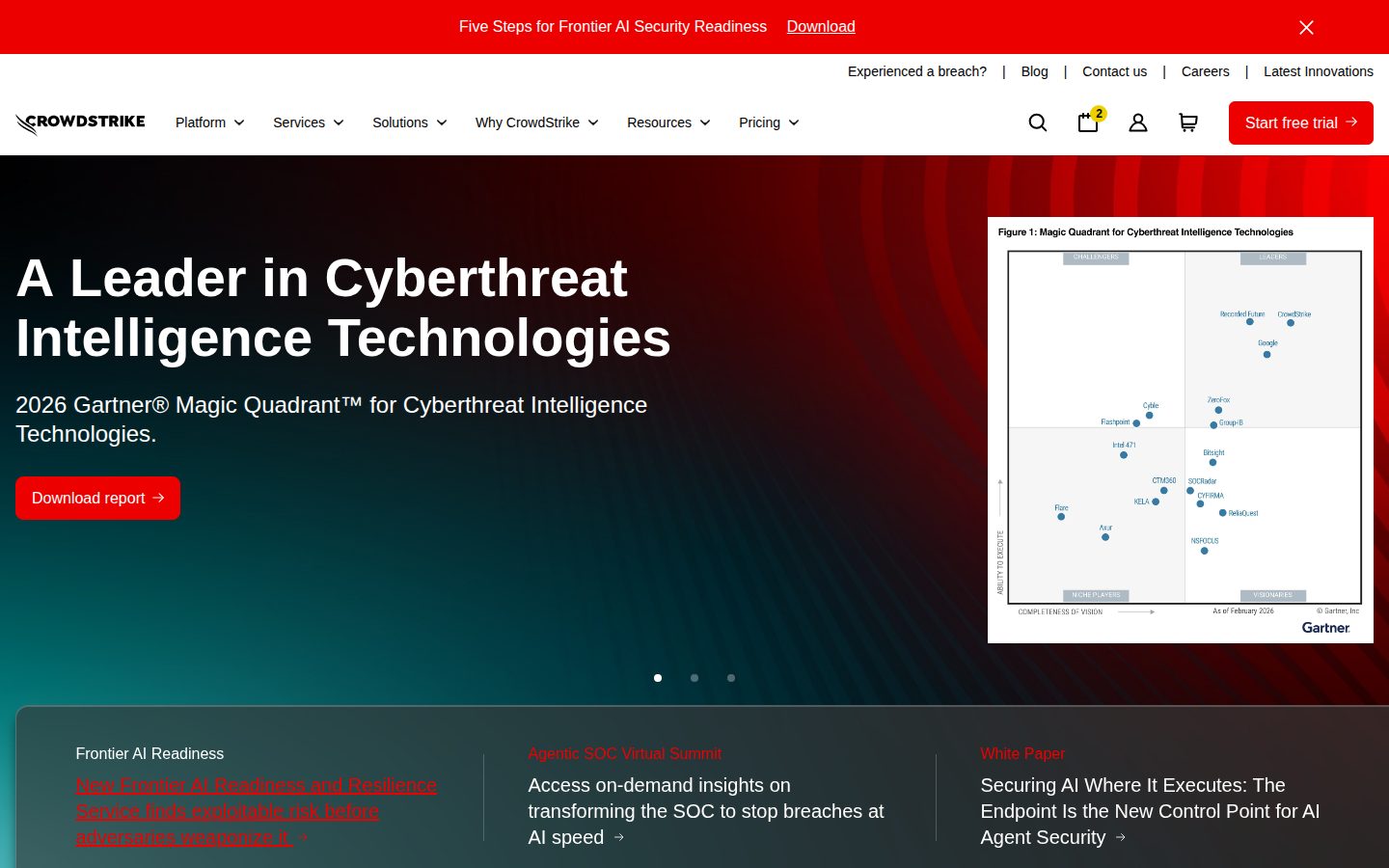
Provides detailed profiles on over 245 adversary groups along with malware analysis capabilities, including automated sandboxing for rapid threat investigation and IOC querying.
A next-generation SIEM that delivers unified visibility and AI-powered detection across environments, including third-party EDRs such as Microsoft Defender, built on an open and extensible platform.
Enables security teams to discover, classify, and protect data in all states — at rest or in motion — as it flows through the cloud estate and across endpoints.
Delivers comprehensive visibility and protection across the entire cloud estate — infrastructure, applications, data, and AI models — from a single unified platform.
Detects and stops identity-driven attacks in real time using advanced user behavior analytics and risk-based access decisions, operating inline with every authentication flow including Microsoft Entra ID.
Correlates signals from multiple data sources — including cloud, identity, and third-party security tools — to improve visibility and accelerate incident investigation beyond traditional endpoints.
A human-led threat hunting service backed by the Falcon platform and real-time intelligence, continuously monitoring for security incidents to detect and outmaneuver adversaries 24/7.
Combines machine learning, AI, and behavior detection to detect and block unknown attacks that cannot be detected by conventional antivirus solutions.
A 24/7 MDR service where CrowdStrike's expert team carries out the entire management, prevention, monitoring, and incident response process on behalf of the customer, uniting automation, adaptive AI, and human oversight.
Security essentials for small teams — next-gen antivirus and device control. Priced per device, up to 100 devices.
Enhanced protection — adds endpoint detection and response plus threat intelligence. Priced per device.
Advanced protection — expert-led threat hunting, identity protection, and Next-Gen SIEM. Priced per device.
Fully managed detection and response — 24/7 expert-led MDR with the CrowdStrike Breach Prevention Warranty. Contact sales for pricing.
CrowdStrike is the default enterprise security bet — expensive, proven, and defensible.
“Public company, 245+ adversary profiles, and a platform that replaces four separate tools. The board won't question the choice — the CFO might question the invoice.”
NYSE-listed, global SOC coverage, and a Falcon platform that ships EDR, CNAPP, Next-Gen SIEM, and MDR under one agent. That's not marketing consolidation — that's real procurement simplification. SentinelOne and Microsoft Defender compete here, but neither has OverWatch's human-led hunting layer baked in at this depth.
Charlotte AI and CrowdStrike Signal give analysts AI-assisted triage without bolting on a third-party tool. Falcon Go starts at $59.99 per device annually, but enterprise contracts are negotiated — no public ceiling. Opaque pricing on the high end is the tradeoff. You won't know total cost until you're already in the room.
Three questions before signing: What's the exit cost if you consolidate fully onto Falcon? Does your SOC have capacity to operate it, or do you need Falcon Complete MDR? And can you pilot with a defined surface before committing the whole estate? Pilot it. Don't standardize until the renewal math lands.
Peers in regulated industries are already on Falcon; showing up without comparable coverage is the riskier position.
Default enterprise pick — the board recognizes the name; the 2024 outage is known but hasn't structurally damaged enterprise trust.
Single-agent deployment and a 15-day free trial help, but full platform value takes months of tuning across cloud and identity surfaces.
Falcon unifies EDR, SIEM, CNAPP, and identity protection — this advances security posture, it doesn't just swap a point tool.
Publicly traded, global operations, and a platform with 12+ active product lines — they'll exist in three years.
Mid-market and enterprise teams in regulated industries that need endpoint, cloud, and identity coverage without managing five separate vendor relationships.
Your environment is small, lightly regulated, and Microsoft Defender already covers what you actually need.
The default enterprise security platform when breach prevention and consolidated visibility are non-negotiable.
“Falcon unifies EDR, CNAPP, CSPM, SIEM, identity threat detection, and MDR under a single agent and console — that's real platform consolidation, not marketing. At enterprise scale, this is the strongest publicly-evidenced security stack available.”
245+ documented adversary profiles embedded natively, not delivered as a separate threat intel feed. Charlotte AI and CrowdStrike Signal represent genuine AI-layer work — triage acceleration and alert prioritization built on the detection corpus, not a chatbot skin over generic LLMs. AI-SPM monitoring LLMs and AI services in the cloud is ahead of where most competitors even have a product opinion.
The architecture matters here: single agent, cloud-native telemetry, detection correlated across endpoints, identities, and cloud workloads simultaneously. Falcon Next-Gen SIEM ingesting third-party EDRs including Microsoft Defender means you're not forced to rip existing investments out. That's the right integration posture for a CISO inheriting a mixed environment. Falcon Complete MDR covers the SOC capacity gap that kills mid-market security programs.
The real constraint is vendor concentration. If we adopt Falcon across EDR, SIEM, CNAPP, and identity, a platform-level incident — and July 2024 established that risk is real — affects every detection surface simultaneously. Pricing is opaque; no public contract benchmarks means negotiation leverage depends entirely on deal size. SentinelOne and Palo Alto Cortex are credible alternatives, but Falcon's threat intelligence depth and adversary profiling remain the differentiator at enterprise scale.
Against SentinelOne, Palo Alto Cortex, and Microsoft Defender, Falcon's adversary intelligence depth and unified platform breadth give it the clearest category-leader position in enterprise EDR and XDR.
Single console covering endpoint, identity, cloud, and SIEM is exactly how enterprise security teams want to operate — Falcon OverWatch and Falcon Complete address the SOC staffing gap directly.
Native AWS, Azure, and GCP integrations plus SOAR and SIEM APIs, and Next-Gen SIEM ingesting Microsoft Defender signals, means Falcon fits into mixed-vendor environments without forcing a full rip-and-replace.
Platform consolidation accelerates detection velocity, but full-stack Falcon dependency creates a single point of operational failure, as July 2024 demonstrated at scale.
245 adversary profiles, AI-SPM for LLM monitoring, and Charlotte AI trained on CrowdStrike's own detection corpus reflects genuine craft depth, not feature-checklist AI.
Enterprise or regulated mid-market organizations that want consolidated endpoint, identity, and cloud detection under a single platform with optional fully managed SOC coverage.
Your organization needs transparent, predictable per-seat pricing before executive budget approval.
$7.99/device entry point, but enterprise pricing is a black box
“CrowdStrike Falcon is the endpoint security category benchmark. The TCO math is nearly impossible to model without a sales call.”
Falcon Go publishes at $7.99/device monthly or $59.99 annually. That's the last number you'll see. Enterprise tiers — where 50-seat teams actually land — are negotiated contracts with no published rates. 50 devices × $60/year = $3K baseline, but Falcon Enterprise adds EDR and threat hunting on top. Add Next-Gen SIEM, Falcon OverWatch, and Falcon Complete MDR. Year 3 all-in for a mid-market org likely runs $150K–$400K. No public data confirms that range.
The feature depth is real: 245 adversary profiles in Falcon Adversary Intelligence, Charlotte AI for triage, AI-SPM monitoring LLMs in cloud — this isn't a point solution. SentinelOne and Palo Alto Cortex compete here, but CrowdStrike's integrated MDR via Falcon Complete is a genuine differentiator for teams without SOC capacity.
The procurement problem: no pricing page for enterprise, no published auto-renewal windows, no termination-for-convenience language visible publicly. Budget owners can't model this without a rep. That's a procurement friction score, not a product score.
Contact-only enterprise pricing plus multi-module structure creates high procurement friction and extended sales cycles.
No public auto-renewal terms, cancellation policy, or term length data; negotiated enterprise contracts typically favor the vendor.
Falcon Go at $7.99/device is the only published number; enterprise contract pricing requires a sales engagement.
Breach prevention and SOC consolidation are measurable outcomes; Falcon Complete MDR displaces headcount cost, which finance teams can quantify.
Module sprawl — SIEM, MDR, OverWatch, Identity, DSPM — makes 3-year TCO unmodelable from public materials alone.
Mid-market and enterprise security teams consolidating endpoint, identity, and cloud tools under one contract.
You need to model TCO before talking to a rep.
CrowdStrike Falcon: The Platform That Actually Earns Its Consolidation Pitch
“245+ adversary profiles embedded natively, XDR correlating across endpoints, identity, and cloud from a single console. This isn't a bundle — it's a coherent architecture.”
Single-agent deployment across Windows, macOS, and Linux with cloud account connectors for AWS, Azure, and GCP. Day three looks like this: alerts are triaged in one console, Charlotte AI surfaces the TTP context you'd otherwise pivot to a threat intel feed to find, and Falcon OverWatch is already hunting in the background. That's genuinely different from the SentinelOne workflow where threat intel lives in a separate tab.
The friction shows up at the integration layer. No public API docs visible in the scraped evidence — that's a concern for SOAR teams who need to validate automation before signing a contract. Next-Gen SIEM ingesting third-party EDRs including Microsoft Defender is a real win for hybrid environments, but opaque pricing means you're negotiating before you know your total stack cost. Falcon Go starts at $59.99/device annually, but enterprise modules aren't listed anywhere public.
Power-user depth is strong — CrowdStrike Signal's AI prioritization, inline identity protection with Entra ID, and AI-SPM monitoring LLM deployments show a team building for 2025 threats, not 2019. The tradeoff: smaller security teams get real value from Falcon Complete MDR, but they're also most exposed to the pricing opacity problem.
Unified console with Charlotte AI for triage and OverWatch running continuously means daily analyst workflow stays inside one pane of glass — rare for a platform this broad.
Blog is live but docs weren't surfaced in evidence — category norm for enterprise security platforms skews toward gated documentation, which adds friction for engineers evaluating integrations.
No changelog visible and no public pricing page for enterprise tiers means procurement and version-tracking are recurring friction points for security ops leads.
AI-SPM for LLM misconfiguration detection, Falcon Identity Protection inline with every auth flow, and 245+ adversary profiles show genuine depth for experienced threat hunters and detection engineers.
API availability for SOAR and SIEM integration is documented in the product description, but no public API docs were found — SOAR engineers will want to validate that before commit.
Enterprise and mid-market security teams that want EDR, CNAPP, identity protection, and SIEM consolidated under one agent and one contract.
Your team needs transparent, self-serve pricing or public API documentation before entering a sales conversation.
245 adversary profiles and a unified console — this is the real deal
“CrowdStrike Falcon is category-leading enterprise security that consolidates what used to be five separate tools. The tradeoff is opacity on price and a learning curve that will humble you.”
Falcon Go at $7.99/device monthly is the entry door, but most organizations buying CrowdStrike are negotiating contracts, not filling shopping carts. That pricing opacity is a real friction point. You'll spend weeks in sales calls before you know what you're actually paying. Compared to SentinelOne or Microsoft Defender — which at least gesture toward public pricing — that's a deliberate choice, and not one that favors the buyer.
What you get for the pain: Charlotte AI triaging threats in plain language, 245 named adversary profiles baked directly into your console, and a Next-Gen SIEM that replaces a whole separate product. The 15-day free trial with no credit card is genuinely useful — enough time to feel whether the single-agent architecture actually delivers.
The learning curve is real. This isn't a tool you open and figure out. Month one you're reading docs and asking questions. Month three you're probably still calibrating detection tuning. But the platform breadth — endpoints, identity, cloud, mobile — means once it's dialed in, you're not tab-switching between four vendors to understand one incident.
CrowdStrike Signal's AI-powered alert grouping and Charlotte AI's natural language triage suggest the console was designed by people who've actually worked an alert queue at 2am.
The platform breadth covering EDR, CNAPP, SIEM, and identity simultaneously is powerful by month three but genuinely steep in weeks one and two without dedicated security staff.
Android and iOS Mobile Device Protection is a real feature, not a checkbox — inline authentication monitoring puts it ahead of most competitors in this dimension.
A no-credit-card 15-day trial is the right call, but enterprise-grade depth means the first 10 minutes feel like orientation week, not a welcome mat.
Cloud-native SaaS architecture with consistent cross-platform agent coverage (Windows, macOS, Linux) signals a team that has sweated infrastructure reliability as a core competency.
Mid-market and enterprise security teams who want to consolidate endpoint, identity, and cloud protection under one platform and one agent.
You're a small team expecting to be up and running in a day without dedicated security expertise on staff.
245 adversary profiles and a real track record — this one's survived the graveyard
“CrowdStrike Falcon is the closest thing cybersecurity has to a durable platform winner. Real moat, real shipping history, real MDR layer — not vaporware.”
Category has bodies everywhere. Cylance got absorbed. Carbon Black got absorbed. Trellix is essentially a zombie brand. CrowdStrike is still standing and still shipping. Charlotte AI and the Next-Gen SIEM aren't just renamed features — they're structural additions. The 245 adversary profiles in Falcon Adversary Intelligence is the kind of specific number that signals real investment, not marketing copy.
The tradeoff is pricing opacity. $7.99/device for Falcon Go is real, but enterprise contracts are fully negotiated — no public floor. That's uncomfortable for budget planning and creates lock-in leverage on renewals. SentinelOne and Microsoft Defender publish tiered pricing. CrowdStrike doesn't.
Exit portability is the honest concern. The Falcon agent is proprietary. Correlated intelligence, custom detections, historical hunt data — none of that travels. If you're deep in Falcon Complete MDR after 18 months, leaving is painful. Factor that in before signing.
Falcon Next-Gen SIEM ingesting Microsoft Defender data natively, inline identity protection against Entra ID flows, and embedded adversary intelligence are real gaps vs. SentinelOne and Palo Alto Cortex.
Proprietary Falcon agent, no portable detection logic, and MDR dependency mean migration off this platform — especially Falcon Complete — is genuinely painful.
CrowdStrike Holdings is publicly traded, has named enterprise contracts across regulated industries, and shows multi-module expansion — about as safe a 3-year bet as this category offers.
'Agentic Security Platform' and 'stop breaches' are the kind of superlatives that age poorly — but the feature list is specific and the 245 adversary group count is verifiable, which partially redeems it.
While competitors got acquired or went quiet, CrowdStrike has shipped Charlotte AI, AI-SPM, and Next-Gen SIEM as distinct modules — changelog absence is a flag, but product breadth suggests active development.
Mid-market to enterprise orgs in regulated industries that want a single vendor across endpoint, cloud, and identity without running a separate SIEM.
You need transparent, predictable per-seat pricing and a clean exit path if the vendor relationship sours.
Common questions answered by our AI research team
Falcon Go costs $7.99 per device billed monthly, or $59.99 per device billed annually.
Falcon Enterprise adds Endpoint Detection and Response (continuous endpoint visibility with automatic threat prioritization) and Threat Intelligence & Hunting (elite expert threat hunting) on top of Falcon Pro's Firewall Management.
Yes, a 15-day free trial is available with no credit card required.
Yes, Mobile Device Protection detects malicious activity and prevents unauthorized access on both Android and iOS devices.
Yes, FalconComplete Next-Gen MDR provides 24/7 expert-led, AI-accelerated managed detection and response (MDR), with optional add-ons like Next-Gen Identity Security and Next-Gen SIEM.
Company
CrowdStrike Holdings, Inc.Founded
2011Pricing
From $8/moFree Trial
Available


CrowdStrike is a cybersecurity company headquartered in Austin, TX, offering cloud-native endpoint protection, threat intelligence, and incident response through its Falcon platform.