Cloudflare logo

Cloudflare Review

Visit

Global network for security, performance, and developer infrastructure

Cloudflare is a cloud network platform for securing, accelerating, and building internet-connected applications and services.

Cloudflare·Founded 2009·From $20/moFree PlanAI DevOpsAI CloudAI ComplianceAI Security

AI Panel Score

8.3/10

6 AI reviews

Reviewed

About Cloudflare

Users connect their domains or networks to Cloudflare by updating DNS records or deploying network tunnels. Once traffic flows through Cloudflare's network, security rules, caching policies, firewall logic, and routing optimizations apply at the edge before requests reach origin servers. Most configuration is done through a web dashboard or REST API, with changes propagating globally within seconds.

Beyond the core CDN and WAF, Cloudflare offers a developer platform that includes Cloudflare Workers (serverless compute running at the edge), R2 object storage with no egress fees, D1 serverless SQL databases, KV and Durable Objects for stateful storage, and AI-specific tooling including Workers AI for GPU inference, AI Gateway for observability, and Vectorize for vector search. These components are designed to interoperate so developers can build and deploy full-stack applications entirely on Cloudflare's infrastructure. Argo Smart Routing, Load Balancing, and Magic Transit extend performance and network-level protection for more complex architectures.

Cloudflare serves a wide range of users — from individual developers on a free plan to large enterprises with custom contracts. The Free plan covers basic CDN, DDoS protection, and DNS. Paid plans start at the Pro tier for small businesses and scale through Business and Enterprise tiers with additional WAF rules, analytics, SLAs, and support. Competitors in the CDN and security space include Akamai, Fastly, and AWS CloudFront; in the zero-trust segment, competitors include Zscaler and Palo Alto Networks; in edge compute, Fastly Compute and AWS Lambda@Edge are comparable offerings.

Cloudflare exposes a full REST API for programmatic management of all resources and maintains extensive developer documentation at developers.cloudflare.com. The platform is accessed entirely via web browser for configuration; deployed applications can target web, and Cloudflare's 1.1.1.1 DNS resolver also has iOS and Android apps. Enterprise customers can integrate via Terraform, direct BGP peering, or physical interconnects through Cloudflare Network Interconnect.

Features

AI

  • AI Agents Framework

    Agents framework and orchestration tools that allow users to run chosen models and deploy new AI agents quickly.

  • Edge AI Deployment

    Builds and deploys AI applications everywhere across Cloudflare's global network.

  • Remote MCP Servers

    Builds, deploys, and secures access for remote MCP servers so agents can access the features of applications.

Core

  • CDN (Content Delivery Network)

    Ultra-fast CDN that accelerates performance for websites, apps, and AI-enabled applications across 330+ cities in 125+ countries.

  • Cloudflare One (SASE)

    Agile SASE platform that connects workforce, AI agents, apps, and infrastructure with zero trust access and composable architecture.

  • Global Cloud Network

    Intelligent global cloud network spanning 330+ cities in 125+ countries, including mainland China, offering 60+ cloud services and blocking 215B cyber threats per day.

  • Serverless Code Deployment

    Builds serverless applications and deploys them instantly across the globe for speed, reliability, and scale.

Security

  • Bot Protection

    Stops bot attacks in real time by harnessing data from millions of websites protected by Cloudflare.

  • DDoS Protection

    Protects public-facing subnets using Cloudflare's massive 477 Tbps network capacity that absorbs and filters attacks.

  • Generative and Agentic AI Security

    Secures workforce AI tools and public-facing applications to enable safe AI adoption.

  • WAF (Web Application Firewall)

    Industry-leading WAF protection for websites, apps, APIs, and AI workloads.

  • Zero Trust Access

    Provides granular, least privilege access to internal applications and infrastructure for modernized remote access.

Preview

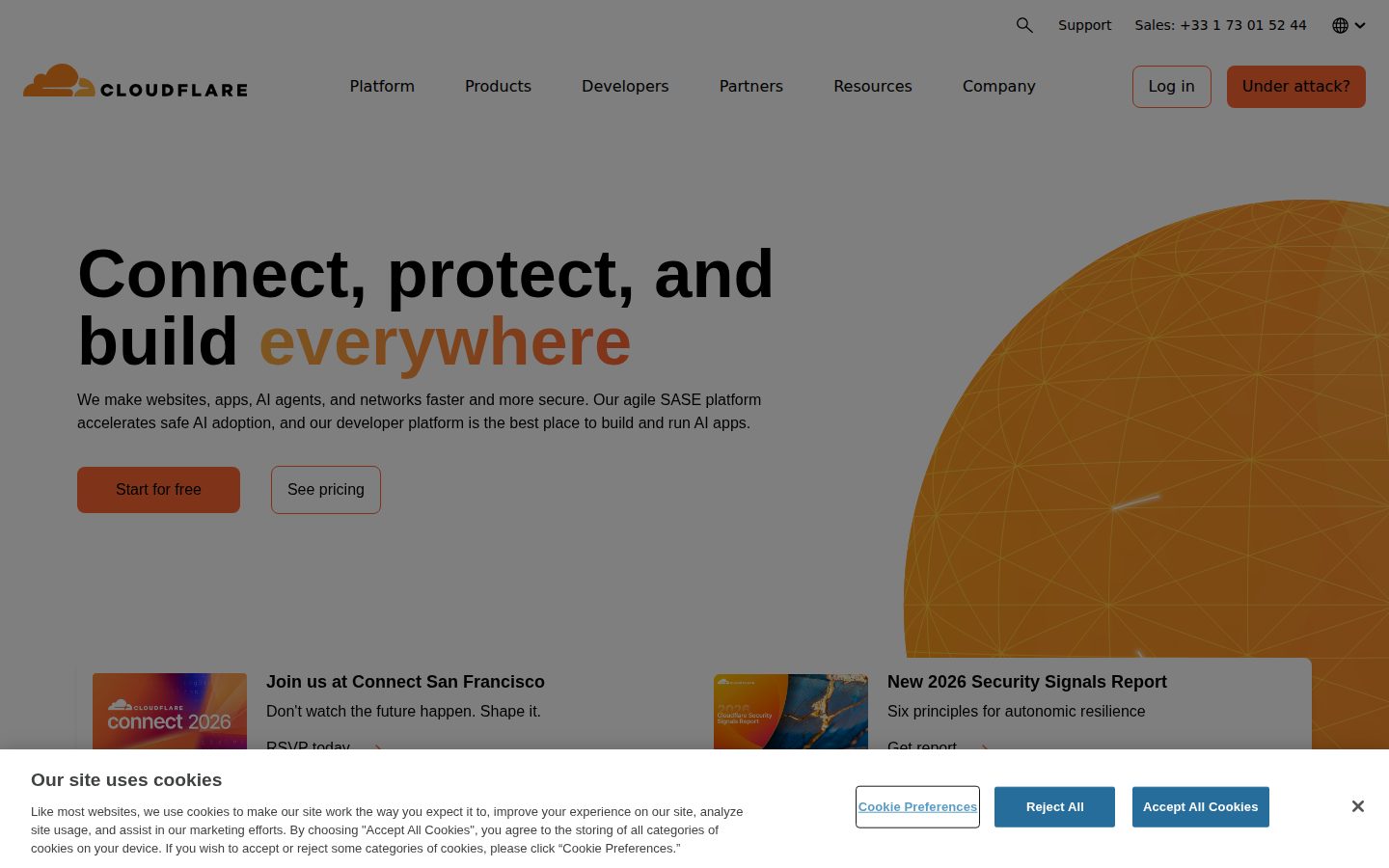
Cloudflare desktop previewCloudflare mobile preview

Pricing Plans

Free

Free

Basic plan for personal projects and getting started with Cloudflare

  • CDN with global network
  • DDoS protection
  • Free SSL/TLS
  • Fast DNS resolution

Pro

Contact sales

For professional websites and small businesses needing enhanced security and performance

  • Everything in Free
  • Web Application Firewall (WAF)
  • Enhanced DDoS protection
  • Image optimization

Business

Contact sales

For business-critical websites requiring advanced features and SLA guarantees

  • Everything in Pro
  • Advanced WAF rules
  • Bot management
  • Priority support

Enterprise

Contact sales

Custom solutions for large organizations with complex requirements

  • Everything in Business
  • Custom security policies
  • Dedicated support
  • Zero Trust / Cloudflare One
  • Magic Transit network-level protection
  • Custom contract and SLA

AI Panel Reviews

The Decision Maker

The Decision Maker

Strategic bet, vendor viability, timing, adoption approval
8.6/10

Cloudflare's edge moat is real, but the data-plane lock-in is the only board question worth asking.

Cloudflare has been public on the NYSE since September 2019 and runs a 330-city network that now includes Workers AI GPU inference and R2 storage with zero egress fees. The decision is no longer vendor viability — it's how much of the data plane to hand to a single provider.

Defending a Cloudflare line item to the board is the easy part of any infra review. NYSE: NET, public since September 2019, profitable on operating cash flow. The 3-year viability question answers itself.

The harder call is scope. Cloudflare One bundles Zero Trust, WAF, and DDoS through the same 330-city network — and Workers AI runs GPU inference at the edge alongside R2 at $0.015 per GB with zero egress. That's a real moat against AWS CloudFront, S3, and Lambda for any team tired of egress invoices.

But the catch is lock-in. Once D1, Workers, and R2 own the data plane, leaving means a rewrite, not a migration. Fastly stays the cleaner second source. Pilot Workers AI on one inference workload. Standardize the security stack only after the 90-day Enterprise quote lands.

Competitive Positioning8.5

Peers route through Cloudflare; not using it requires a justification, not a default.

Reputation Risk8.8

Defending Cloudflare to the board is the easy version of any infra conversation.

Speed to Value8.0

DNS flip plus dashboard config delivers same-week wins; Enterprise contracts take longer.

Strategic Fit8.3

Workers AI, R2, and Cloudflare One advance edge and Zero Trust posture, not just CDN cost.

Vendor Viability9.2

Public on NYSE since September 2019, profitable on operating cash flow, 17 years in market.

Pros

  • Public-company viability with profitable operating cash flow removes the 3-year vendor question.
  • R2 at $0.015 per GB with zero egress is a real cost story against S3 for media and AI workloads.
  • Cloudflare One consolidates Zero Trust, WAF, and DDoS through one 330-city network.
  • Workers AI puts GPU inference at the edge in 180+ cities since 2023 launch.

Cons

  • D1, Workers, and R2 lock data-plane and compute together; leaving is a rewrite.
  • Enterprise pricing is opaque until sales engages, slowing the buying motion.
  • Fastly Compute and AWS Lambda@Edge stay viable second sources for portability hedges.

Right for

Engineering leaders who want one network for security and edge compute.

Avoid if

Teams committed to a multi-cloud data plane on AWS or GCP.

The Domain Strategist

The Domain Strategist

Craft and strategy in the product's domain — adapts identity per category, same lens
8.5/10

Zero-egress R2 and Workers AI on H100s in 180+ cities make Cloudflare the edge-platform default.

R2's zero-egress pricing and Workers AI on H100s in 180+ cities reframe Cloudflare from CDN vendor to edge platform. The 3-year catch is Workers' V8 isolate runtime — code targets Cloudflare primitives, not portable AWS Lambda.

R2 charges nothing for egress while S3 charges $0.09 per GB after the first 100 GB free. For a Head of Platform sizing a 3-year storage commitment, that pricing inversion isn't a discount — it's the wedge that breaks AWS lock-in at the data layer.

The architectural picture extends past storage. Workers AI runs NVIDIA H100 GPUs in 180+ cities, AI Gateway handles LLM caching and observability, and Cloudflare One ships zero-trust access against Zscaler and Netskope. The Free plan plus paid tiers from $20/month Pro give developer-led adoption a runway most enterprise vendors envy.

But the catch is the platform bet itself. Workers' V8 isolate runtime isn't AWS Lambda — code targets Cloudflare's primitives, and migrating off is non-trivial. The 330+ city network and Magic Transit defend the moat; the lock-in lives at the runtime layer, not the data.

Category Positioning8.7

330+ city network plus Cloudflare One zero-trust positions this as the edge-platform category leader.

Domain Fit8.6

Developer-led adoption with REST API, Terraform, and BGP peering matches how senior platform teams actually work.

Integration Surface8.3

Full REST API, Terraform provider, and Cloudflare Network Interconnect cover most enterprise stacks.

Long-term Implications8.0

Workers' V8 isolate runtime creates real runtime-layer lock-in over a 3-year horizon.

Strategic Depth8.5

Zero-egress R2 and edge-GPU Workers AI are real category-defining bets, not feature parity.

Pros

  • R2 zero-egress at $0.015/GB collapses S3's $0.09/GB egress bill for data-heavy apps.
  • Workers AI runs NVIDIA H100 GPUs across 180+ cities for low-latency inference at the edge.
  • Cloudflare One ships zero-trust against Zscaler and Netskope from the same control plane.
  • Free plan plus $20/month Pro tier drives developer-led adoption into enterprise contracts.

Cons

  • Workers' V8 isolate runtime isn't portable to AWS Lambda or Azure Functions.
  • Enterprise tier pricing is opaque without sales engagement.
  • R2 is pricier than Backblaze B2 or Wasabi for cold-storage-only workloads.

Right for

Platform teams who need global edge compute and zero-egress storage.

Avoid if

Engineers who require AWS-native runtimes for existing Lambda codebases.

The Finance Lead

The Finance Lead

Money, total cost of ownership, contracts, procurement math
8.3/10

R2 ships $0.015/GB storage and zero egress fees while S3 charges $0.09/GB out.

R2 storage runs $0.015/GB with no egress fees against S3 Standard's $0.023 plus $0.09/GB out. Application tiers ship Free, Pro at $25/month, Business at $250, with Workers Paid metered at $5/month plus $0.30 per additional million requests.

R2 lists $0.015/GB stored with zero egress. S3 Standard sits at $0.023/GB plus $0.09/GB out for the first 10TB. A workload serving 50TB/month from object storage saves roughly $4,500/month on egress alone — that's the procurement story.

Application tiers are honest: Free, Pro at $25/month, Business at $250/month, Enterprise on contract. Annual commit drops those to $20 and $200. Workers Paid starts at $5/month with 10M requests included, then $0.30 per million. AWS Lambda@Edge runs $0.60 per million.

The catch is per-zone billing. Cloudflare bills by domain, not account — a five-domain Business setup is $1,250/month on monthly terms. Enterprise pricing for Magic Transit and Cloudflare One stays a sales call. But three visible tiers and a free plan that ships real DDoS protection let procurement work without an NDA.

Billing & Procurement8.2

Credit-card self-serve through Business at $250/month; per-zone billing is the line-item risk to model.

Contract Flexibility7.6

Monthly Pro and Business carry no commitment; annual saves 20% but Enterprise remains custom contract.

Pricing Transparency8.6

R2, Workers, Pro, and Business all carry published per-unit prices; only Enterprise stays NDA.

ROI Clarity8.0

Egress saved and DDoS attacks absorbed are measurable line items; Workers meter is auditable per million requests.

Total Cost of Ownership8.4

R2 zero-egress versus S3 $0.09/GB saves thousands monthly at modest scale — industry-leading for object-storage TCO.

Pros

  • R2 zero-egress pricing eliminates the line item that dominates S3 invoices.
  • Pro at $25/month and Business at $250/month require no sales call.
  • Workers Paid starts at $5/month with 10M requests included before $0.30/M overage.
  • Free plan ships real DDoS protection and global CDN, not a 14-day trial.

Cons

  • Per-zone billing multiplies cost across multi-domain portfolios.
  • Enterprise pricing for Magic Transit and Cloudflare One stays NDA-only.
  • SLA-backed phone support gates at Business tier or higher.

Right for

Teams who self-host high-egress workloads on object storage.

Avoid if

Buyers who need bundled phone support inside published tiers.

The Domain Practitioner

The Domain Practitioner

Daily hands-on reality in the product's domain — adapts identity per category, same lens
8.3/10

Workers V8 isolates ship to 330+ cities with sub-5ms cold starts that Lambda can't match.

Cloudflare Workers run V8 isolates across 330+ edge cities with sub-5ms cold starts, and R2 ships an S3-compatible API at $0.015/GB with zero egress. The catch is the 128MB memory ceiling and CPU-time limits that force chunking for any heavy compute job.

wrangler deploy ships a Workers script to 330+ cities in seconds — V8 isolates spin in under 5ms, not Lambda's container boot. For an engineer pushing edge functions hourly, that's not a perk; it's the only reason this stack makes sense for latency-bound APIs.

R2's S3-compatible API at $0.015/GB and zero egress means the migration from AWS S3 is literally an endpoint URL change in the SDK config. D1 is still SQLite under the hood — fine for read-heavy edge state, but cross-region writes go through a primary, so the geo-distributed write story isn't there yet.

AI Gateway proxies OpenAI and Anthropic calls with caching, retries, and per-key analytics — observability that took a separate tool last year. However, Workers' 128MB memory cap and CPU-time limits force chunking on heavy jobs, and Fastly Compute@Edge still wins for raw WASM throughput.

Day-3 Reality8.2

wrangler deploy propagates globally in seconds and V8 isolates remove the cold-start ritual that defines Lambda-based workflows.

Documentation Practitioner-Fit8.5

developers.cloudflare.com ships working examples for every primitive — Workers, R2, D1, Durable Objects.

Friction Surface7.8

The 128MB Worker memory cap and CPU-time ceiling force chunking patterns that aren't in the demo path.

Power-User Depth8.4

Workers, R2, D1, KV, Durable Objects, Queues, and Workers AI interoperate as a stack rather than disconnected services.

Workflow Integration8.3

R2's S3-compatible API means existing AWS SDK code swaps endpoints rather than rewriting calls.

Pros

  • V8 isolates eliminate the cold-start tax that plagues Lambda-based edge stacks.
  • R2's zero-egress pricing at $0.015/GB and S3-compatible API make migration off AWS S3 mechanical.
  • AI Gateway adds caching and observability to LLM calls without needing a separate proxy layer.
  • developers.cloudflare.com docs include working examples for every primitive in the stack.

Cons

  • Workers' 128MB memory and CPU-time limits force chunking on heavy compute jobs.
  • D1's primary-region write model means geo-distributed writes still route to one region.
  • Fastly Compute@Edge still wins for raw WASM throughput on CPU-heavy workloads.

Right for

Engineers who ship latency-sensitive edge APIs.

Avoid if

Teams who need long-running compute jobs.

The Power User

The Power User

Daily human experience, onboarding, polish, learning curve, reliability
8.2/10

Cloudflare's Wrangler CLI and Smart Placement give power users a real edge runtime until binding sprawl bites.

Wrangler ships a TypeScript-first deploy story and Smart Placement auto-locates Workers near the backend. The catch is keeping eight overlapping storage and compute primitives straight as a project grows.

The Wrangler CLI is what makes the platform feel like a real developer tool, not a dashboard with extras. ``wrangler deploy`` pushes a Worker to 330+ cities in seconds, tail streams logs back from the edge, and the TypeScript types for bindings actually match what you wired up.

Smart Placement is the quiet power move. Turn it on and Cloudflare measures latency and parks the Worker near your origin — 4-8x faster on backend-heavy workloads, no config required. R2 with no egress fees reads as a drop-in replacement for AWS S3 once you're paying real money elsewhere on data transfer.

The tradeoff is sprawl. Workers, Durable Objects with SQLite, D1, KV, R2, Queues, Vectorize, Browser Run — every binding is its own mental model, and the dashboard hides where one ends and the next begins. Lambda@Edge has fewer primitives but a flatter learning curve.

Daily Polish8.3

Wrangler types match bindings, tail streaming works, and the CLI feels built by people who ship Workers themselves.

Learning Curve7.6

First hour is fast with Wrangler, but month three you are mapping eight primitives in your head to know which one to reach for.

Mobile Parity7.5

Edge platform aimed at developers; 1.1.1.1 has iOS and Android apps but the build surface is web-only by design.

Onboarding Experience7.8

Free plan plus wrangler init gets a Worker live in minutes, though figuring out which storage primitive to pick takes longer.

Reliability Feel8.7

A 330+ city network handling 477 Tbps of capacity behaves like infrastructure, not a product demo.

Pros

  • Wrangler CLI ships TypeScript types that match your deployed bindings without manual codegen.
  • Smart Placement auto-locates Workers near origins for 4-8x latency wins with zero config.
  • R2 storage has no egress fees, a real cost win over AWS S3 once traffic scales.
  • Free plan covers Workers, R2, D1, and Vectorize generously enough for serious side projects.

Cons

  • Eight overlapping storage and compute primitives create real cognitive sprawl past month three.
  • Dashboard navigation between Workers, D1, R2, and Queues feels stitched together rather than designed.
  • Browser Run on the paid plan caps at 10 requests per second as of March 2026.

Right for

Developers who want a TypeScript-first edge runtime with strong primitives.

Avoid if

Teams who need a single-product surface without juggling many bindings.

The Skeptic

The Skeptic

Contrarian. Watch-outs, deal-breakers, broken promises, category patterns
7.9/10

Public, profitable, 34% growth — but June 12, 2025 showed what depending on one network looks like.

Cloudflare is the rare cloud platform that's both indie-developer-loved and a $614M-per-quarter public company. The Workers ecosystem is real — so is the blast radius when the network blinks.

On June 12, 2025, Workers KV failed 91% of requests for two and a half hours. Access, WARP, Workers AI, and Turnstile went with it. The cause was a third-party storage dependency Cloudflare is now migrating onto R2. Blast radius is big.

Credit where earned. The network is real — 477 Tbps, 330+ cities, profitable at scale, Q4 2025 at $614M on 34% YoY growth. Developers like Workers, R2 with zero egress fees, and Cloudflare One. But D1 caps at 10 GB per database with one writer per Durable Object — fine for per-tenant sharding, not a Postgres replacement. AWS RDS this is not.

Exit story is uneven. Static sites and CDN — easy. Apps wired into Workers, Durable Objects, and Queues — lock-in Akamai or Fastly never asked you to take. Growth decelerating to 28-29% for 2026. Strong moat. Price the network risk.

Competitive Differentiation8.0

R2 zero-egress pricing and single-control-plane breadth across security plus compute is hard to match at Akamai or Fastly.

Exit Portability7.0

CDN and DNS portable in hours; Workers, Durable Objects, and D1 adoption creates real lock-in without an obvious migration target.

Long-term Viability8.0

Q4 2025 revenue $614M at 34% YoY, but 2026 guidance decelerates to 28-29% — strong-survivor profile with growth-rate watch.

Marketing Honesty8.0

Concrete verifiable claims — 477 Tbps capacity, 330+ cities, 215B threats blocked daily — back up the Connectivity Cloud framing.

Track Record Match8.5

Public since 2019, profitable at scale, survived CDN consolidation and category shifts that buried Fastly's edge-compute lead.

Pros

  • Profitable, public, $614M Q4 2025 revenue at 34% YoY growth — rare among infrastructure vendors at this scale.
  • R2 object storage with zero egress fees is a concrete cost differentiator versus AWS S3.
  • Single control plane across CDN, WAF, zero-trust, and Workers edge compute reduces vendor sprawl.
  • Free tier and $20/month Pro tier make the platform genuinely accessible for personal and small business projects.

Cons

  • June 12, 2025 Workers KV incident took down Access, WARP, Workers AI, and Turnstile — concentrated blast radius is real.
  • D1 caps at 10 GB per database with single-writer Durable Object — no managed Postgres or RDS equivalent.
  • Deep Workers and Durable Objects adoption creates ecosystem lock-in that CDN-only vendors like Akamai never imposed.

Right for

Teams who want one network for security, CDN, and edge compute.

Avoid if

Teams who need AWS-depth managed databases and ML services.

Buyer Questions

Common questions answered by our AI research team

Features

Does Cloudflare's SASE architecture support zero trust access for AI agents, or is it limited to human users and traditional applications?

The content states that Cloudflare One's SASE platform supports connecting 'your workforce, AI agents, apps, and infrastructure,' indicating that zero trust access extends to AI agents, not just human users and traditional applications.

Security

How does Cloudflare's WAF, DDoS, and bot protection work together to secure AI-enabled apps specifically?

The content mentions that Cloudflare uses its 'industry-leading WAF, DDoS, and bot protection to protect' websites and AI-enabled apps, but does not provide specific details on how these three components work together technically for AI-enabled apps specifically.

Integration

Is Cloudflare One's SASE platform composable enough to integrate with our existing network infrastructure, or does it require a full migration?

The content describes Cloudflare One as a 'composable, programmable platform' with a 'SASE architecture unified by design,' but does not specify whether it requires a full migration or can integrate with existing network infrastructure.

Setup

What does the onboarding process look like for connecting workforce and infrastructure to Cloudflare One — is there a guided 10-step setup journey available?

The content references a '10-step SASE journey' as a related resource, suggesting a guided setup process exists, but does not provide details on what the onboarding steps entail or how workforce and infrastructure are connected.

Also in AI DevOps