GRC platform for compliance operations and risk management
Hyperproof is a governance, risk, and compliance (GRC) platform for technology, healthcare, and fintech organizations.
AI Panel Score
6 AI reviews
Reviewed
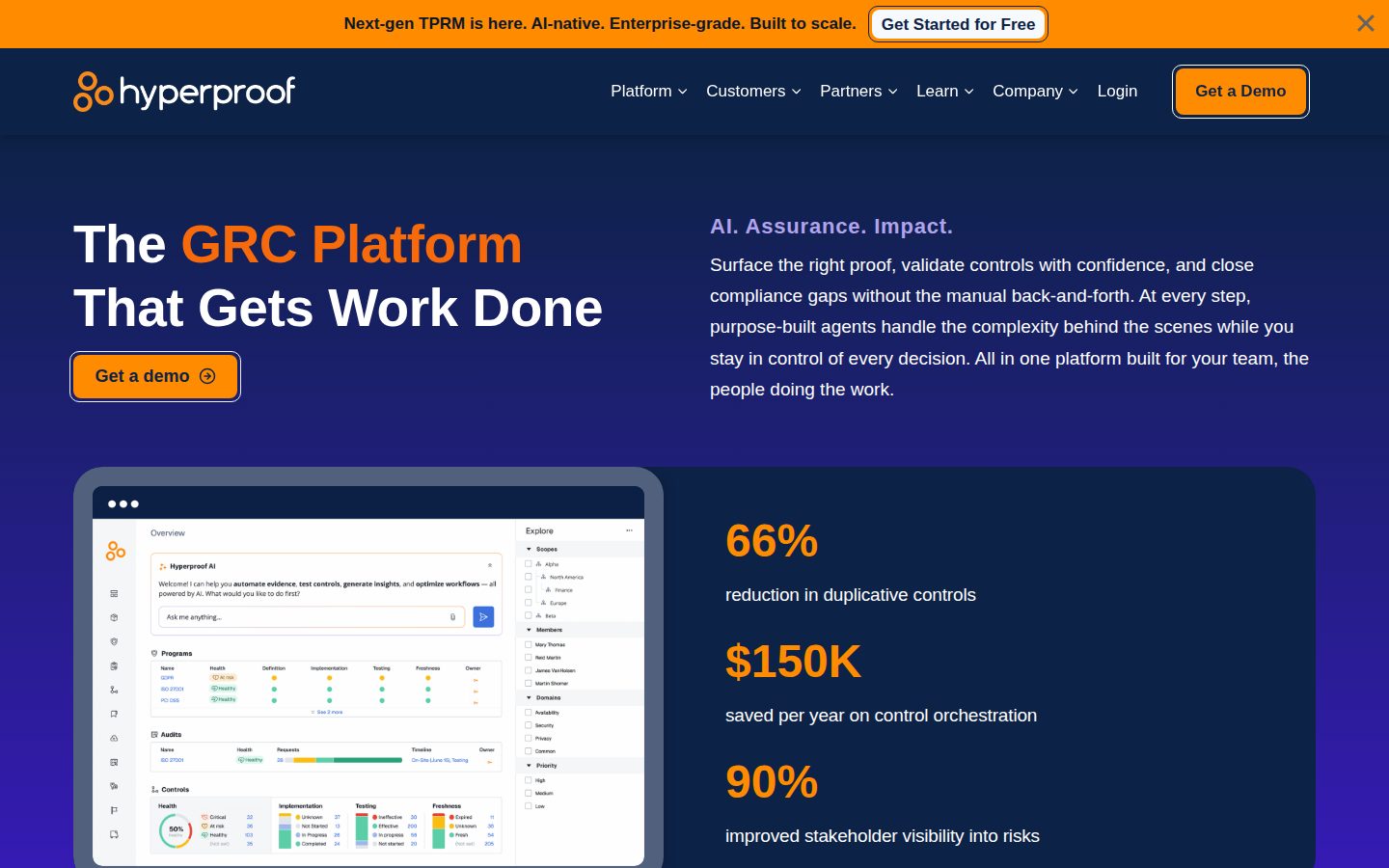
In practice, users build out compliance programs by selecting applicable frameworks (such as SOC 2, ISO 27001, or HIPAA) and mapping controls across them. Evidence is collected automatically through integrations with existing tools, reducing the manual effort of gathering screenshots and spreadsheets. Teams assign tasks, track control owners, and monitor compliance status through a centralized workspace rather than email chains and shared drives.
Hyperproof highlights several specific capabilities on its website: Hypersyncs and Livesyncs for automated, continuous evidence collection from connected systems; an AI-native third-party risk management module for assessing vendor risk; and a policy management feature for creating, distributing, and tracking policy attestations. Integration categories include HRIS, ticketing, CRM, vulnerability management, and applicant tracking systems, with named connectors to tools like BambooHR, ADP Workforce Now, and others.
Hyperproof targets compliance, security, and risk teams primarily in technology, healthcare IT, and fintech sectors. It competes in the GRC software category alongside products such as Vanta, Drata, OneTrust, and Tugboat Logic. Pricing is not publicly listed on the website; prospective customers are directed to contact the company for a quote, indicating an enterprise or mid-market sales model.
The platform is web-based and supports API access, with a documented best-practice workshop available for the Hyperproof API. A partner directory lists consulting and implementation partners including Aprio and Cyber Watch Systems, suggesting deployment support is available through channel partners.

Uses AI to automate and streamline the assessment and management of third-party vendor risks within the compliance program.
Automatically collects compliance evidence from connected systems via Hypersync integrations, reducing manual evidence-gathering effort.
Delivers a purpose-built compliance workflow for fintech companies to manage industry-specific regulatory frameworks and audit readiness.
Offers a specialized compliance workflow for healthcare organizations to streamline adherence to healthcare IT regulatory requirements.
Maps controls across multiple compliance frameworks simultaneously to eliminate duplicative work, delivering up to a 66% reduction in redundant controls.
Provides tools to create, manage, and maintain organizational compliance policies, keeping them aligned with audit requirements.
Provides a dedicated compliance workflow tailored for technology companies to manage their specific regulatory and security framework requirements.
Exposes a Hyperproof API that allows organizations to programmatically interact with the platform to extend and automate compliance workflows.
Integrates with HRIS platforms such as BambooHR, ADP Workforce Now, and BambooHR to pull employee and workforce data relevant to compliance controls.
Provides real-time data synchronization between Hyperproof and external systems to keep compliance evidence and status continuously up to date.
Connects with external task and project management tools so compliance tasks can be assigned and tracked within existing workflows.
Connects with vulnerability management tools to ingest security findings and link them to compliance controls and evidence requirements.
AI-powered GRC platform for compliance, risk, and security workflows. Pricing available via contact/demo request.
Hyperproof is a credible GRC bet for mid-market teams drowning in audit spreadsheets.
“140+ pre-built frameworks and 200+ integrations make this a feature-complete GRC platform. No public pricing means every deal is a negotiation, which I don't love.”
The 66% reduction in duplicative controls claim is either marketing or a real engineering win — Hypersyncs and Livesyncs suggest they've actually built the plumbing, not just the dashboard. FedRAMP Moderate authorization is a signal that serious security teams have already signed off on the infrastructure. That's worth something when you're defending the vendor choice to a CISO.
The tradeoff: Vanta and Drata eat Hyperproof's lunch on brand recognition with founders and seed-stage teams. But if you're mid-market, running SOC 2 plus ISO 27001 plus HIPAA simultaneously, multi-framework control mapping is where Hyperproof pulls ahead.
No public pricing is the only flag I'd raise with the board. Hidden pricing usually means the number changes based on how much they think you'll spend. Pilot the integrations first — specifically the HRIS connectors — before you're locked into a contract.
140+ frameworks is the largest claimed library in the category — a defensible differentiator against Vanta for multi-framework programs.
Credible category player competing against OneTrust and Drata — won't raise board eyebrows, won't impress them either.
200+ integrations including BambooHR and vulnerability management tools suggest evidence collection automation kicks in fast if your stack is supported.
Multi-framework control mapping directly advances compliance maturity rather than just digitizing existing spreadsheet work.
FedRAMP Moderate authorization and a named partner channel including Aprio suggest durable infrastructure, but no public funding data means runway is unknown.
Mid-market tech, fintech, or healthcare teams running three or more compliance frameworks simultaneously who need automated evidence collection.
You're a small team running a single SOC 2 program where Vanta's lighter footprint and transparent pricing will close faster.
140+ frameworks, continuous evidence sync, and real control-mapping depth make Hyperproof a serious GRC bet.
“Hyperproof is built for compliance teams running multi-framework programs across tech, healthcare, and fintech — not for checkbox buyers. The Hypersyncs and Livesyncs architecture treats evidence collection as infrastructure, which is the right instinct for any team that's survived a SOC 2 renewal on spreadsheets.”
The 66% reduction in duplicative controls claim isn't marketing fluff — it points to a genuine cross-framework mapping engine, which is the hardest operational problem in GRC. Running SOC 2 alongside ISO 27001 and HIPAA simultaneously without that mapping layer means your team reperforms the same control work three times. That's a real cost, and Hyperproof's architecture addresses it structurally, not cosmetically.
The AI-native third-party vendor risk module and 200+ integrations — including HRIS connectors like ADP Workforce Now — tell me someone on the product team has actually sat through a vendor review cycle. FedRAMP Moderate authorization signals the platform can survive a serious security review, which matters if your customer base includes federal buyers or regulated financial institutions.
The tradeoff is pricing opacity — no public tiers, contact-only sales, no free trial. If you're a mid-market compliance team with budget scrutiny, you'll spend 2-3 discovery calls before knowing if this fits your procurement cycle. Vanta and Drata both publish pricing, which lowers their evaluation friction considerably.
Hyperproof sits above Vanta and Drata on enterprise depth while competing directly with OneTrust on framework breadth, with FedRAMP as a meaningful differentiator.
Hypersyncs, Livesyncs, control owners, and auditor collaboration workflows mirror how mature compliance programs actually operate.
200+ integrations across HRIS, vulnerability management, ticketing, and CRM covers the core compliance evidence stack without requiring custom builds.
140+ pre-built frameworks and FedRAMP Moderate authorization give the platform room to grow with your regulatory footprint, but pricing opacity creates renewal leverage risk.
Cross-framework control mapping with a documented 66% redundancy reduction is architecture-level thinking, not feature-level.
Mid-market to enterprise compliance teams running three or more simultaneous frameworks who need evidence collection automated at the infrastructure level.
You're a seed-stage startup needing a fast SOC 2 Type I and a predictable monthly bill.
140+ frameworks, 200+ integrations, zero public pricing — classic enterprise opacity
“Hyperproof has serious GRC depth: multi-framework control mapping, Hypersyncs, Livesyncs, AI-driven vendor risk. No price on the website means procurement starts blind.”
No pricing page. No free trial. Contact sales. That's 3 friction points before line 1 of a PO. Category norm for enterprise GRC, but Vanta publishes tiers. Drata publishes tiers. Hyperproof doesn't. Budget planning is guesswork until a demo call.
50-seat compliance team in fintech or healthcare IT — figure $30K–$80K/year based on category comps, possibly higher with add-ons. Year 3 math: assume 15% annual contract escalation plus implementation partner fees through Aprio or Cyber Watch Systems. All-in 3-year cost likely lands $120K–$280K. Wide range because no invoice evidence exists.
The 66% reduction in duplicative controls claim is specific enough to model against. 140+ frameworks and 200+ integrations are real procurement differentiators versus Vanta's narrower library. The tradeoff: opaque pricing and no self-serve trial means the sales cycle is long and the switching cost is high once you're mapped.
No self-serve, no free trial, channel-partner deployment adds cost — procurement friction is above average for this category.
No public contract terms; enterprise sales model typically means annual commits and negotiated auto-renewal windows — nothing disclosed.
No pricing page, no published tiers — contact-only model, per their website.
The 66% reduction in duplicative controls is a measurable claim; audit-readiness workflows and Hypersync automation are quantifiable labor savings.
No public rates; implementation partners and 140+ framework depth suggest a $120K–$280K 3-year range with no ceiling confirmation.
Mid-market and enterprise compliance teams running 3+ frameworks who need automated evidence collection and can absorb an enterprise sales cycle.
You need transparent pricing or a self-serve trial before engaging a vendor.
140+ frameworks, Hypersyncs, and real audit collaboration — but pricing stays hidden
“Hyperproof is a mature GRC platform built for compliance teams running multi-framework programs at scale. The multi-framework control mapping and automated evidence collection are the daily workhorses; everything else orbits those two.”
The 66% reduction in duplicative controls claim is specific enough to take seriously. For a team running SOC 2 alongside ISO 27001 and HIPAA simultaneously — which is most fintech and healthcare IT shops — control overlap is where compliance hours bleed out. Hypersyncs and Livesyncs handling continuous evidence collection means auditors get current artifacts, not last-quarter screenshots. That's the difference between an audit sprint and a steady-state program.
The 200+ integrations covering HRIS, ticketing, and vulnerability management is genuinely useful. BambooHR and ADP Workforce Now pulling employee data directly into controls removes a whole category of manual reconciliation. FedRAMP Moderate authorization signals the platform can operate under real security scrutiny, not just checkbox GRC. The AI-native vendor risk module is newer territory — docs indicate automation but don't surface the methodology, which matters when you're defending assessments to a regulator.
No public pricing is the daily friction. Every budget cycle, every renewal conversation requires going back through sales. Vanta and Drata both publish tiers. For a compliance officer trying to build a business case internally, that's real drag. The changelog is also absent from public-facing docs — hard to track what changed before an audit cycle.
Hypersyncs and Livesyncs reduce daily evidence-gathering grind, but absence of a public changelog means tracking platform changes mid-audit cycle requires vendor contact.
A best-practice API workshop is documented, which signals practitioner intent, but changelog absence and thin methodology docs on AI vendor risk are gaps.
No public pricing and no free trial mean procurement friction starts before the platform is even in use.
API access, 140+ pre-built frameworks, and FedRAMP Moderate authorization indicate headroom for advanced compliance programs beyond basic audit prep.
200+ integrations across HRIS, ticketing, and vulnerability management suggest genuine workflow fit rather than one-way data dumps.
Mid-market to enterprise compliance teams running overlapping regulatory frameworks across tech, fintech, or healthcare IT who need continuous audit readiness rather than annual sprint mode.
You need transparent pricing upfront or a self-serve trial to build an internal business case without sales involvement.
140+ frameworks, zero public pricing — serious tool for serious compliance teams
“Hyperproof is a feature-complete GRC platform that actually reduces duplicative work rather than just promising to. No free trial and no pricing page means you're committing to a sales conversation before you see anything.”
The 66% reduction in redundant controls claim is specific enough to take seriously. Multi-framework control mapping is the kind of feature that looks like a checkbox until you've spent a week manually reconciling SOC 2 against ISO 27001 in a spreadsheet. Hypersyncs and Livesyncs for continuous evidence collection are the right answer to the eternal 'screenshot and upload' problem that makes compliance teams miserable. 200+ integrations including BambooHR and ADP means the evidence collection actually connects to where your people data lives.
The tradeoff is access. No pricing page, no free trial, no sandbox. Vanta and Drata let you poke around and get a feel before committing. Hyperproof wants a discovery call first. Day one means waiting, not exploring. That's fine if your compliance team is buying deliberately, not great if you're a scrappy fintech trying to move fast.
Web-only platform. Mobile parity is essentially nonexistent for a tool this workflow-heavy — which is category-normal but still worth naming. The AI-native third-party risk management module is genuinely interesting if vendor risk is your current headache.
No changelog is public so it's hard to track how actively the small stuff gets fixed, but the Hypersync and Livesync architecture suggests someone thought seriously about daily friction.
140+ pre-built frameworks help teams get oriented fast, but partner-led implementation via firms like Aprio hints the ramp is real.
Web-only platform — for compliance work this complex, mobile is essentially read-only at best.
No free trial, no sandbox, requires a sales call — day one is a calendar invite, not a product.
FedRAMP Moderate authorization for Hyperproof Gov suggests the infrastructure is taken seriously, which usually correlates with platform stability.
Mid-market compliance or security teams in tech, healthcare, or fintech running multiple frameworks simultaneously who want automated evidence collection and don't mind a sales-led buying process.
You want to try before you buy, or you're a solo founder chasing a single SOC 2 who'd be better served by Drata or Vanta's self-serve tiers.
140+ frameworks, zero public pricing — classic enterprise GRC playbook
“Hyperproof is a credible mid-market GRC platform with real differentiators. The opacity around pricing and funding makes a 3-year bet harder to justify than it should be.”
Three tells up front. One: no changelog visible. Two: no pricing page. Three: the meta description leads with '66% reduction in duplicative controls' — that's a suspiciously round stat. Could be real. Could be a demo scenario. I'd press them on methodology before citing it internally.
The actual feature set is solid. Hypersyncs and Livesyncs for continuous evidence collection is a genuine differentiator versus Vanta's more periodic sync model. The 200+ integrations claim and FedRAMP Moderate authorization are verifiable signals — those aren't easy to fake. Multi-framework control mapping across 140+ pre-built frameworks is the core pitch, and it's credible.
What's missing: no public funding data, no changelog cadence, no trial. Exit portability is rough — compliance evidence libraries built inside proprietary platforms rarely export cleanly. Drata and Vanta have the same problem. If Hyperproof goes quiet, you're migrating screenshots and control mappings manually. Plan for it.
Livesyncs for continuous evidence collection and AI-native third-party risk management module are credible gaps versus Vanta and Drata's lighter TPRM offerings.
Compliance evidence and control mappings built inside a proprietary system rarely export cleanly — category-wide problem, but Hyperproof offers no public data portability guarantees.
No public funding data, no changelog visible, and a contact-only sales model limit external confidence signals — partner directory and FedRAMP auth partially offset.
The '66% reduction in duplicative controls' stat appears without methodology; aspirational framing without verification markers.
FedRAMP Moderate authorization and 140+ framework library suggest a team that has shipped real compliance infrastructure, not vaporware.
Mid-market tech, fintech, or healthcare IT teams running multiple compliance frameworks simultaneously who need continuous evidence automation.
You need transparent pricing before a sales call or want a trial before committing budget.
Common questions answered by our AI research team
Hyperproof supports 140+ pre-built frameworks, the largest framework library in the compliance market.
Yes, Hyperproof Gov operates in a FedRAMP Moderate authorized environment, delivering rigorous, scalable compliance workflows for high-security organizations.
Hyperproof offers 200+ powerful integrations to streamline and scale compliance work.
Yes, Hyperproof uses AI to automate vendor assessments, centralize third-party insights, and enforce accountability across business units.
Yes, Hyperproof connects evidence to audit requests and enables secure collaboration with auditors to demonstrate readiness with precision and speed.


Hyperproof is a cloud-based governance, risk, and compliance (GRC) platform headquartered in Bellevue, WA, that centralizes compliance operations and control management for organizations.