MetricStream logo

MetricStream Review

Visit

AI-first connected GRC platform for governance, risk, and compliance

MetricStream is an integrated governance, risk, and compliance (GRC) management software platform for enterprises.

Metricstream·Founded 1999·Contact for pricingAI ComplianceAI AnalyticsAI Security

AI Panel Score

7.2/10

6 AI reviews

Reviewed

AI Editor Approved

About MetricStream

MetricStream is used by risk, compliance, audit, and cybersecurity teams to manage tasks such as risk and control self-assessments (RCSA), policy lifecycle management, regulatory change tracking, control testing, and audit planning and fieldwork. Users interact with configurable dashboards, heat maps, and risk scorecards to monitor key risk and performance indicators, while workflows route assessments, issues, and remediation tasks to the appropriate stakeholders with audit trails maintained throughout. A low-code/no-code App Studio lets organizations customize or extend the platform's applications without heavy development work.

The platform is built around a "Connected GRC" architecture intended to unify data that would otherwise sit in separate risk, compliance, audit, and third-party risk applications, so information entered once (such as a control or an incident) can be reused across modules. MetricStream AI adds domain-specific assistants and agents for risk, compliance, audit, and cyber functions that surface insights and can take action within workflows. Other named capabilities include continuous control monitoring, cyber risk quantification (translating cyber risk into financial terms), operational resilience planning, and a marketplace of pre-built apps, connectors, and content. Open APIs support integration with ERP, ITSM, HR, and other enterprise systems, and the platform is available through MetricStream Cloud in SaaS and hybrid deployment models.

MetricStream targets large, regulated enterprises, with named use cases spanning banking and financial services, insurance, healthcare, life sciences, energy, utilities, technology, and telecom, and role-specific tooling for Chief Risk Officers, Chief Compliance Officers, Chief Audit Executives, CISOs, and sourcing leaders. It also offers modules mapped to specific regulatory frameworks including SOX, HIPAA, PCI, NIST, ISO 27000, CCPA, and UK Corporate Governance Code requirements. Pricing is not published and is provided on request; competitors in the GRC software category include tools such as ServiceNow GRC, SAP GRC, IBM OpenPages, Diligent, Archer (RSA), and LogicGate.

Features

AI

  • AI & Machine Learning

    Applies AI-powered capabilities for risk prediction, anomaly detection, automated compliance monitoring, and intelligent insights.

  • MetricStream AI

    Purpose-built GRC assistants and agents for risk, compliance, audit, and cyber that sense, advise, and act with deep domain context.

Analytics

  • Analytics & Reporting

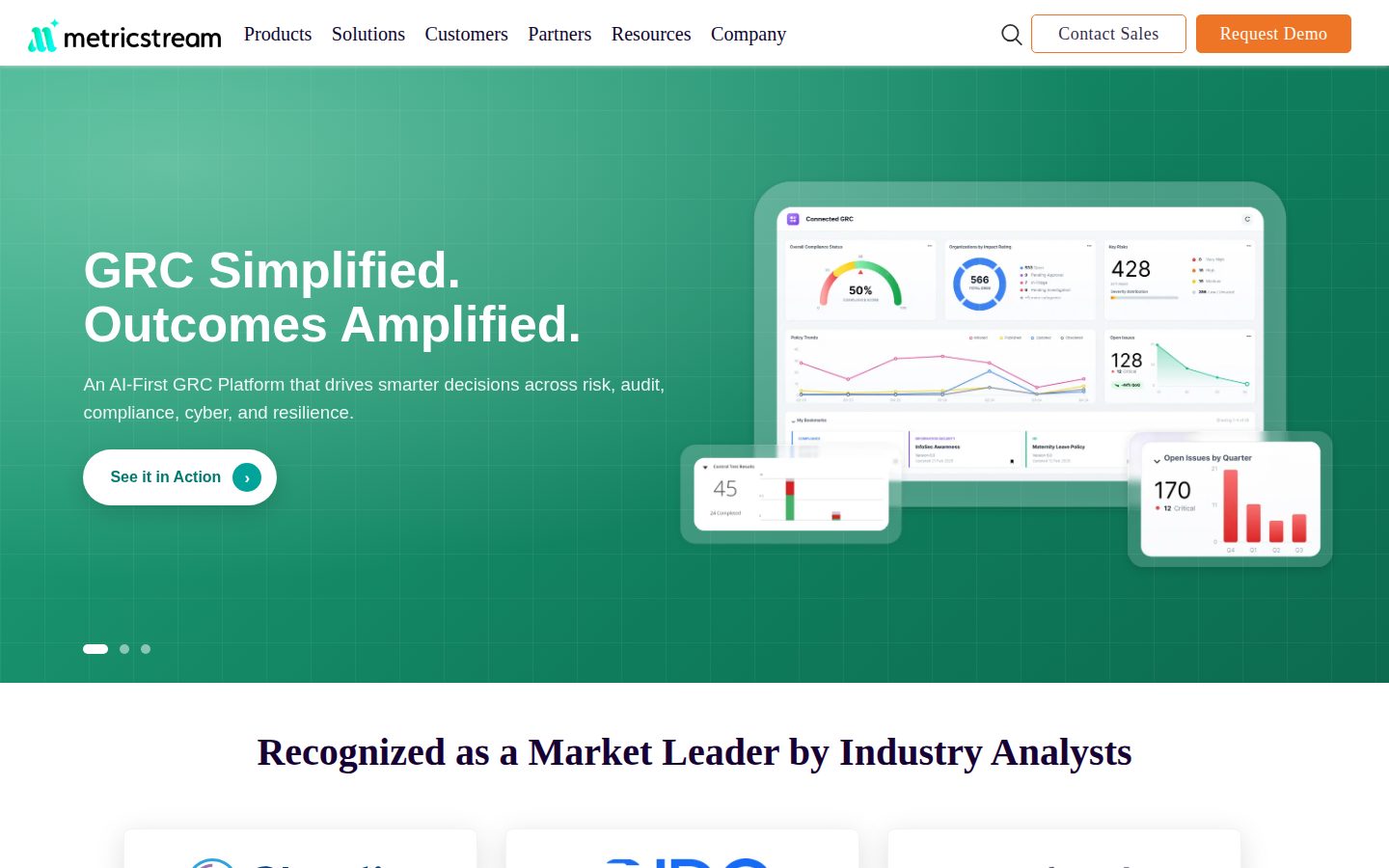
    Provides dashboards, heat maps, risk scorecards, and custom reporting for real-time visibility into GRC data.

Automation

  • Continuous Control Monitoring

    Automates control testing and monitoring in real time across IT and business processes.

  • Regulatory Change Management

    Monitors global regulatory changes, assesses their impact, and updates compliance programs accordingly.

Core

  • Case & Incident Management

    Captures, investigates, and resolves incidents and compliance cases with full audit trails.

  • Connected GRC

    Breaks down organizational silos by connecting risk, compliance, audit, and business performance data on one platform.

  • Enterprise Risk Management

    Identifies, assesses, monitors, and mitigates risks across the organization using risk registers and heat maps.

  • Internal Audit Management

    Manages the end-to-end audit lifecycle including planning, fieldwork, issue tracking, and reporting.

  • Third Party Management

    Manages the full third-party risk lifecycle from onboarding through ongoing assessment to offboarding.

Customization

  • App Studio

    Low-code/no-code application builder for customizing and extending the MetricStream platform.

Integration

  • APIs & Integrations

    Open APIs to connect MetricStream with ERP, ITSM, HR, and other enterprise systems.

  • Marketplace

    Offers pre-built apps, connectors, and content that extend the platform's out-of-the-box capabilities.

Mobile

  • Mobility

    Mobile-friendly tools that let users manage risk and compliance tasks from anywhere.

Preview

MetricStream desktop previewMetricStream mobile preview

Pricing Plans

Contact Sales

Contact sales

MetricStream is an enterprise GRC (Governance, Risk & Compliance) platform sold via custom, quote-based contracts rather than published self-serve plans. Pricing requires contacting MetricStream sales; estimates from third-party analyst sites suggest costs typically starting in the tens of thousands of dollars annually and scaling into the hundreds of thousands or more for large enterprises, depending on modules, named users, and deployment scope.

  • Modular GRC solutions (Risk, Compliance, Audit, Policy, Vendor/Third-Party Risk, Business Continuity, Cyber/IT GRC)
  • Named-user based licensing, priced per module
  • Custom implementation, integration, and configuration for enterprise needs
  • No free trial or free tier
  • Deployment cost quoted alongside subscription/module costs

AI Panel Reviews

The Decision Maker

The Decision Maker

Strategic bet, vendor viability, timing, adoption approval
7.6/10

Old-guard GRC platform with real AI layered in, priced for enterprises that already budget for compliance.

MetricStream has decades in the GRC category and named modules covering audit, third-party risk, and cyber. The AI features are real but pricing opacity and long implementation cycles are the cost of enterprise-grade breadth.

No published pricing, third-party estimates put this in the tens of thousands annually, scaling into hundreds of thousands. That's a multi-year contract, not a pilot. The App Studio and Connected GRC architecture suggest they've built for depth, not speed.

This is a category-defining incumbent, not a startup bet. Question isn't whether MetricStream survives three years, it's whether your risk and audit teams actually adopt the AI agents instead of falling back to spreadsheets anyway.

Competitors like ServiceNow GRC and Archer play the same enterprise game. Choosing MetricStream over them is defensible to a board; choosing MetricStream over doing nothing is the real decision. Named-user licensing per module means costs creep as you scale coverage.

Competitive Positioning7.5

Competes directly with ServiceNow GRC and Archer (RSA) in a market where peers already run one of these.

Reputation Risk8.0

Established category player with SOX, HIPAA, PCI framework mappings reads as safe to a board and auditors.

Speed to Value6.5

No free trial, quote-based pricing, and named-user licensing per module point to a long implementation runway.

Strategic Fit7.5

Connected GRC and continuous control monitoring genuinely advance compliance posture, not just replace spreadsheets.

Vendor Viability8.0

Long-established GRC vendor with named enterprise customers across banking, healthcare, and energy verticals.

Pros

  • Connected GRC architecture unifies risk, audit, and compliance data instead of siloed tools
  • Named regulatory framework modules for SOX, HIPAA, PCI, NIST reduce mapping work
  • App Studio lets teams customize workflows without heavy dev cycles

Cons

  • Pricing hidden entirely behind sales contact, no self-serve tier to test
  • No free trial means the first real evaluation happens mid-contract
  • Implementation and configuration costs stack on top of subscription fees

Right for

Large regulated enterprises in banking, healthcare, or energy replacing spreadsheet-based risk registers.

Avoid if

Skip it if you need fast time-to-value or lack budget for six-figure annual contracts.

The Domain Strategist

The Domain Strategist

Craft and strategy in the product's domain — adapts identity per category, same lens
8.0/10

A defensible platform of record for regulated GRC programs, if you can absorb the implementation cost.

MetricStream is a mature Connected GRC architecture built for RCSA, audit, policy, and third-party risk under real frameworks like SOX, HIPAA, and NIST. The tradeoff is depth versus deployment burden — this is a multi-quarter program, not a tool rollout.

Named-user licensing per module, quote-based, third-party estimates starting in the tens of thousands annually scaling into six figures. That pricing structure tells me exactly who this is built for: enterprises with a CRO, CCO, and CAE already in seats, not a compliance team of three trying to kill spreadsheets cheaply. Modules mapped to SOX, HIPAA, PCI, NIST, ISO 27000, CCPA, and UK Corporate Governance signal genuine regulatory fluency, not generic risk-scoring theater.

The Connected GRC architecture — one control or incident entered once, reused across risk, audit, and third-party modules — is the right shape for how audit committees actually want evidence presented: one system of record, one audit trail. App Studio's low-code extensibility matters over a 3-year horizon because regulatory frameworks shift and you don't want to wait on vendor roadmap for every new control mapping.

Against ServiceNow GRC and Archer, MetricStream's cyber risk quantification and operational resilience modules are differentiators. My concern is agentic AI acting inside workflows — I want human sign-off gates documented before any agent closes a control test unsupervised.

Category Positioning8.0

Sits alongside ServiceNow GRC and Archer as enterprise-tier, ahead of point tools on framework coverage.

Domain Fit8.3

RCSA, policy lifecycle, and audit fieldwork map directly to how CCOs and CAEs structure real programs.

Integration Surface8.0

Open APIs into ERP, ITSM, and HR plus a connector marketplace support real enterprise stack fit.

Long-term Implications7.7

Named-user, per-module licensing locks in architecture and cost trajectory for years once configured.

Strategic Depth8.2

Continuous control monitoring and cyber risk quantification go beyond dashboard-and-checklist GRC tooling.

Pros

  • Framework-mapped modules for SOX, HIPAA, NIST, ISO 27000, CCPA reduce mapping work for audit committees
  • Connected GRC design avoids duplicate control entry across risk, audit, and third-party modules
  • App Studio low-code extensibility adapts to new regulatory requirements without vendor dependency

Cons

  • No published pricing forces a sales-cycle evaluation before cost visibility
  • Agentic AI acting inside workflows needs documented human sign-off controls, not assumed
  • Enterprise-scale licensing and deployment cost put it out of reach for mid-market compliance teams

Right for

Regulated enterprises with dedicated CRO, CCO, and CAE functions consolidating multiple point tools onto one system of record.

Avoid if

Avoid if you need a fast, low-cost deployment with published pricing and a lean compliance team.

The Finance Lead

The Finance Lead

Money, total cost of ownership, contracts, procurement math
6.2/10

No price on the page. Third-party estimates say tens of thousands to start.

Named-user licensing per module, quoted case by case. Procurement will need three calls before seeing a real number.

No pricing page. Contact Sales only. Third-party analyst estimates peg entry cost in the tens of thousands annually, scaling to hundreds of thousands for large enterprises. That range alone tells you this isn't SMB software.

TCO math is hard without a base price. Named-user licensing, priced per module — Risk, Audit, Third-Party, Cyber GRC each stack separately. Add implementation and integration costs, quoted alongside subscription. Year 3 for a 50-person compliance team easily clears six figures once modules and configuration are counted.

No free trial. No published tiers. Compare to ServiceNow GRC or Archer — same category, same opacity, standard for enterprise GRC. App Studio and the Marketplace add real customization value, but you're negotiating blind. Procurement will need weeks, not a signature.

Billing & Procurement5.0

No self-serve onboarding; named-user licensing sold via sales cycle typical of ServiceNow GRC and SAP GRC deals.

Contract Flexibility5.0

No public term or renewal data; enterprise GRC contracts in this category are custom-negotiated, category norm is multi-year lock-in.

Pricing Transparency2.5

No published plans; only 'Contact Sales' with third-party cost estimates.

ROI Clarity6.0

Continuous Control Monitoring and cyber risk quantification give measurable output, but no published benchmarks or case metrics.

Total Cost of Ownership4.5

Per-module, named-user licensing plus quoted implementation costs stack quickly across Risk, Audit, Cyber modules.

Pros

  • Connected GRC unifies risk, compliance, audit data on one platform
  • App Studio allows low-code customization without dev spend
  • Named-user per-module licensing scales with actual use

Cons

  • No published pricing anywhere
  • No free trial to validate fit before contract
  • Module-based licensing makes true all-in cost hard to forecast

Right for

Large regulated enterprises in banking, insurance, or healthcare needing SOX, HIPAA, or NIST-mapped GRC modules.

Avoid if

Avoid if you need transparent pricing before committing budget approval.

The Domain Practitioner

The Domain Practitioner

Daily hands-on reality in the product's domain — adapts identity per category, same lens
7.6/10

Connected GRC is the right architecture — but the audit trail on the AI agents themselves is thin.

Deep module coverage for RCSA, policy lifecycle, and control testing, mapped to frameworks I actually cite in board reports — SOX, HIPAA, PCI, NIST, ISO 27000. What's missing from the public evidence is how MetricStream AI's agentic actions get logged and challenged during an exam.

Risk register, control library, third-party lifecycle, audit fieldwork — all on one data model instead of six spreadsheets and a SharePoint folder. That's the pitch that actually matters to me, not the AI layer. Regulatory change tracking that auto-maps impact to my compliance profile is the feature I'd pilot first.

My real concern is MetricStream AI agents that 'sense, advise, and act' inside workflows. Examiners ask for model governance documentation now — who validated the agent's control-testing logic, what's the override process, where's the audit trail on its own decisions. None of that is in the evidence provided.

Pricing is quote-only, tens of thousands scaling to hundreds of thousands annually per third-party estimates, no free trial. Fine for a bank or insurer with procurement already built for this; a real gap versus ServiceNow GRC or Archer if you need to benchmark cost before committee sign-off.

Day-3 Reality7.5

Configurable dashboards and heat maps suggest real workflow tooling, not a demo shell, per the feature list.

Documentation Practitioner-Fit6.5

No public docs or pricing page in the evidence (docs=N, pricing-page=N) — hard to judge if guidance is written for RCSA practitioners or sales.

Friction Surface7.0

Quote-only pricing and no free trial means procurement friction before any team ever touches the product.

Power-User Depth8.0

App Studio low-code builder plus open APIs into ERP/ITSM/HR gives room to extend beyond out-of-box modules.

Workflow Integration7.8

Connected GRC architecture reuses a single control or incident record across risk, audit, and compliance modules — matches how my team actually escalates issues.

Pros

  • Named framework mapping (SOX, HIPAA, PCI, NIST, ISO 27000, CCPA) cuts manual crosswalk work
  • Connected GRC model eliminates duplicate data entry across risk, audit, and third-party modules
  • App Studio and open APIs support real customization for enterprise IT environments

Cons

  • No published pricing or trial makes early-stage evaluation slow for a compliance committee
  • Public evidence doesn't address model governance or audit trail for the AI agents themselves
  • Enterprise cost scale (tens of thousands to six figures annually) prices out mid-market compliance teams

Right for

Large regulated enterprises in banking, insurance, or healthcare replacing spreadsheet-based risk registers with one connected platform.

Avoid if

You need transparent pricing or a self-serve trial before looping in procurement and legal.

The Power User

The Power User

Daily human experience, onboarding, polish, learning curve, reliability
6.6/10

Powerful GRC brain, but the first ten minutes will feel like an implementation kickoff meeting.

MetricStream connects risk, audit, and compliance data that usually lives in fifteen spreadsheets. But there's no free trial, no published pricing, and the learning curve is measured in weeks, not hours.

No free trial, no pricing page, contact sales. That tells you who this is for before you even see a screen. Third-party estimates peg this at tens of thousands a year minimum, scaling into six figures. This isn't a tool you poke at on a Tuesday afternoon to see if you like it.

The feature list is genuinely deep. Continuous control monitoring, cyber risk quantification, an App Studio for low-code customization, a marketplace of pre-built connectors. That's real breadth, comparable to ServiceNow GRC or Archer. But breadth like that comes with a learning curve shaped like a cliff. Month three probably feels great once workflows are configured. Week one is going to feel like homework, with a consultant nearby.

Mobile is listed as "mobility," not a real app experience described in detail, which for a platform managing incident response and audits from anywhere raises a flag. Solid bones, heavy setup, unclear day-to-day feel from public materials alone.

Daily Polish6.0

Feature list is dense and enterprise-grade, but no evidence of attention to micro-copy or empty states, and no changelog to show iteration.

Learning Curve6.2

App Studio and modular architecture reward long-term investment but the breadth (RCSA, audit, third-party, cyber) means a steep ramp.

Mobile Parity5.5

"Mobility" is mentioned as a feature but with no detail versus web, unlike named competitor Diligent's dedicated board apps.

Onboarding Experience5.0

No free trial and quote-based sales mean the first real interaction is a sales call, not a product.

Reliability Feel6.8

Audit trails and workflow routing suggest solid engineering, but no public uptime or error-state evidence.

Pros

  • Connected GRC architecture avoids re-entering the same control or incident across modules
  • App Studio allows low-code customization without heavy dev work
  • Deep regulatory framework coverage including SOX, HIPAA, PCI, NIST

Cons

  • No free trial or published pricing, so evaluating fit takes a sales cycle, not a sandbox
  • Mobile experience described only vaguely as "mobility"
  • Enterprise-scale complexity likely means a long, consultant-heavy implementation

Right for

Large regulated enterprises in banking, insurance, or healthcare consolidating risk, audit, and compliance off spreadsheets.

Avoid if

Avoid if you're a smaller team wanting to self-serve, test-drive, or see pricing before talking to sales.

The Skeptic

The Skeptic

Contrarian. Watch-outs, deal-breakers, broken promises, category patterns
6.9/10

Archer survived twenty years on this exact pitch. MetricStream needs to.

Old-guard GRC platform repainted with an AI-first headline. The bones are real, the AI story is mostly vocabulary.

"AI-first Connected GRC" is the H1. No pricing page, no docs link, no changelog. Third-party estimates put contracts in the tens of thousands to hundreds of thousands annually — this isn't a self-serve buy, it's a procurement cycle with legal in the room.

The category itself is old and stable. Archer (RSA), IBM OpenPages, SAP GRC, ServiceNow GRC — this is a graveyard-resistant space because ripping out a risk register at a bank is a multi-year project nobody wants to own twice. MetricStream fits that pattern more than it disrupts it. "MetricStream AI" agents for risk, audit, cyber sound like a rebrand of existing automation, not a new architecture.

Exit portability is the real cost. Named-user licensing, per-module pricing, App Studio customizations — all of that is sunk cost if you leave. Fine if you're a bank planning to stay a decade. Bad if you're not sure yet.

Competitive Differentiation6.0

Connected GRC and cyber risk quantification are named, but ServiceNow GRC and Diligent claim similar ground.

Exit Portability5.0

Named-user licensing plus App Studio customization signals real lock-in over an 18-month horizon.

Long-term Viability7.5

Enterprise footprint across banking, healthcare, energy suggests real revenue, though no funding or team data is public here.

Marketing Honesty6.0

"AI-first" headline sits atop features that read as standard workflow automation with an AI label added.

Track Record Match7.5

Matches the durable-incumbent pattern of Archer and OpenPages rather than a flashy startup pitch.

Pros

  • Named regulatory framework modules (SOX, HIPAA, NIST, ISO 27000) reduce mapping work for regulated industries
  • Connected GRC data model avoids re-entering the same control across audit, risk, and compliance modules

Cons

  • No published pricing — buyers negotiate blind against six-figure estimates
  • AI agent claims are broad ("sense, advise, and act") with little concrete detail on what's genuinely new versus rebranded automation

Right for

Large regulated enterprises in banking or healthcare ready for a multi-year GRC commitment.

Avoid if

You want transparent pricing or a low-commitment way to test the AI claims before signing.

Buyer Questions

Common questions answered by our AI research team

Features

How does MetricStream use AI for compliance monitoring?

MetricStream takes an AI-first approach to compliance, automatically ingesting regulatory updates, mapping your compliance profile, understanding impact, simplifying policy management, testing controls, and managing cases and incidents for continuous compliance.

Features

Can MetricStream automate internal audit fieldwork?

Yes. MetricStream uses AI to automate audit fieldwork, highlight control gaps, and generate audit reporting and recommendations, so teams can focus on remediation rather than paperwork.

Features

Does MetricStream help manage third-party risk assessments?

Yes. MetricStream automates third-party onboarding, monitoring, and assessments with AI, giving real-time intelligence and visibility into third- and fourth-party risk and compliance posture to strengthen ecosystem trust.

Features

Can MetricStream detect IT and cyber risks in real time?

Yes. MetricStream's AI-first cyber GRC identifies and assesses IT and cyber risks with automated summarization of risk exposure, validating controls, aligning with security frameworks, and enforcing policies proactively.

Features

Does MetricStream replace spreadsheets for risk registers?

Yes. MetricStream replaces siloed spreadsheets and point tools with shared risk registers, control libraries, and dashboards on a single platform connecting risk, compliance, audit, and governance data.

Also in AI Compliance