Middesk logo

Middesk Review

Visit

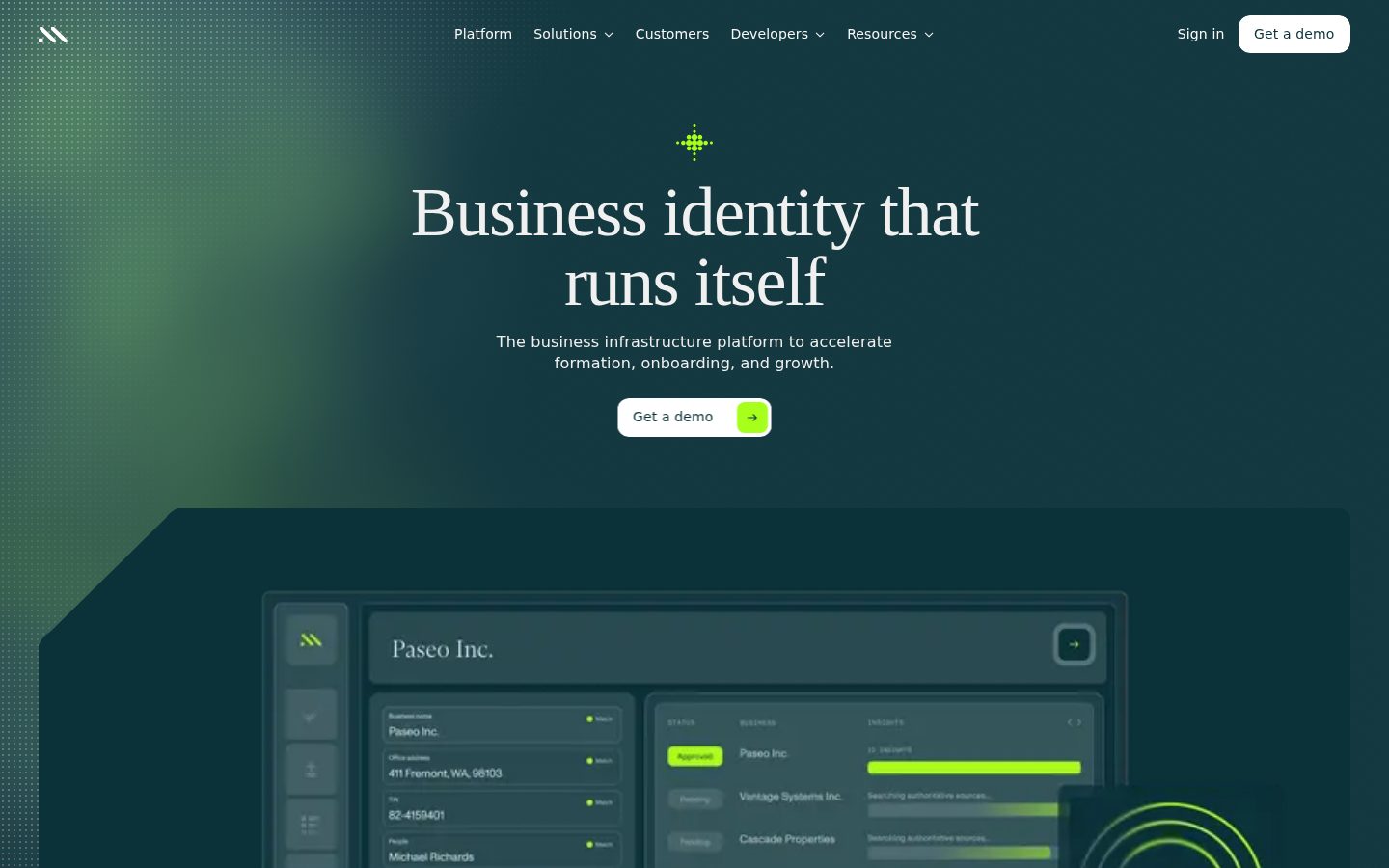
Business identity verification and onboarding infrastructure for financial platforms

Middesk is a business identity and KYB (Know Your Business) platform for banks, fintechs, lenders, and financial platforms.

Middesk, Inc.·Founded 2018·Contact for pricingAI ComplianceAI AnalyticsAI Finance

AI Panel Score

8.0/10

6 AI reviews

Reviewed

About Middesk

In practice, Middesk integrates into a financial platform's onboarding flow and handles business identity verification end-to-end. When an application comes in, Middesk pulls entity data from government registries and other authoritative sources, runs it through fraud and risk models, and either resolves the application automatically or flags it for human review. The goal is that analysts only see edge cases — not every submission.

The platform covers four distinct functional areas: KYB (Know Your Business) verification, fraud prevention, underwriting support, and business registration. The fraud module uses purpose-built machine learning models alongside AI agents that map ownership networks and digital footprints to detect synthetic identities. The underwriting component provides entity data and lifecycle intelligence to support credit modeling, including UCC filing management. The registration product handles state and federal agency filings on behalf of businesses embedded within the platform.

Middesk is built for regulated industries — specifically banks, fintechs, lenders, and financial platforms where compliance and auditability are requirements. The platform is SOC 2 Type II certified and maintains audit-friendly records explaining why individual businesses were approved or declined. Competitors in the KYB and business verification space include Persona, Socure, LexisNexis Risk Solutions, and Enigma. Pricing is not publicly listed; prospective customers must request a demo to obtain pricing details.

Middesk is a web-based platform and offers API integration for embedding verification and registration capabilities directly into customer-facing products. The company reports verifying 7 million businesses annually and processing over $100 billion in revenue flows through its infrastructure.

Features

AI

  • Fraud Prevention

    Uses purpose-built ML models combined with AI agents to detect synthetic identities, map ownership networks, and investigate digital footprints to surface high-risk entities before exposure.

  • Ownership Network Mapping

    AI agents investigate and map ownership networks to identify connected entities and surface relationship-based risk before it becomes exposure.

Analytics

  • Risk Intelligence Conclusions

    Transforms raw data signals into decision-ready conclusions and resolved answers backed by evidence, replacing inconclusive scores with actionable outcomes.

  • Underwriting Intelligence

    Provides entity data and lifecycle intelligence to sharpen credit models, enabling lenders to price risk more accurately and protect exposure through UCC filings.

Automation

  • Autonomous Workflows

    Executes end-to-end onboarding and verification decisions automatically, routing only exceptions to human analysts rather than scoring and passing every case for manual review.

Core

  • Address Validation

    Validates business addresses against authoritative sources, improving accuracy from around 70% to nearly 100% and eliminating manual proof-of-activation reviews.

  • Business Registration

    Registers businesses with state and federal agencies directly within the customer's platform so they can hire, operate, and grow without being referred to external services.

  • Continuous Data Refresh

    Aggregates data from 400+ government and authoritative sources into a single, continuously refreshed record for every business entity.

  • KYB (Know Your Business) Verification

    Automatically verifies business identity by pulling data from 400+ government and authoritative sources and makes onboarding decisions without requiring manual review of every application.

  • Ongoing Monitoring

    Continuously monitors business identity across the customer lifecycle as part of a single system covering verification, fraud, registration, and monitoring.

Security

  • Audit-Friendly Decision Records

    Stores the reasoning behind every approval or decline decision so teams can understand and explain outcomes long after the decision was made.

  • SOC 2 Type II Compliance

    Implements rigorous controls that protect the security, availability, and privacy of customer-sensitive data in accordance with SOC 2 Type II standards.

Preview

Middesk desktop previewMiddesk mobile preview

Pricing Plans

Contact Sales

Contact sales

Custom pricing for banks, fintechs, lenders, and platforms needing business verification, fraud prevention, underwriting, and registration infrastructure.

  • KYB verification with automated decision-making
  • Fraud prevention with ML models and AI agents
  • Underwriting with entity data and lifecycle intelligence
  • Business registration with state and federal agencies
  • 400+ government and authoritative data sources
  • SOC 2 Type II compliant with audit-friendly data

AI Panel Reviews

The Decision Maker

The Decision Maker

Strategic bet, vendor viability, timing, adoption approval
8.2/10

7 million verifications a year, autonomous decisions, and a clean compliance story.

Middesk owns a narrow lane — KYB and business identity for regulated fintechs — and executes it well. The autonomous workflow model is the real differentiation: analysts see exceptions, not every submission.

Seven million businesses verified annually and $100B in revenue flows through the infrastructure. That's not a startup pitch — that's a live production number. Against Persona, Socure, and LexisNexis, Middesk's edge is the autonomous decision layer, not just the data breadth. The 400+ source aggregation is table stakes in this category; routing only exceptions to humans isn't.

The audit-friendly decision records matter more than most teams realize at purchase. When a regulator asks why you approved or declined an entity, you need that answer in writing. SOC 2 Type II plus explainable decisions is a defensible stack for any bank or fintech under BSA scrutiny.

The tradeoff: no public pricing, no free trial, and international coverage is still incoming as of April 2026. You're buying a strategic infrastructure vendor, not a plug-and-play SaaS tool. That's the right call for a mature fintech — not the right call if you're still figuring out your onboarding volume.

Competitive Positioning8.0

Ownership network mapping via AI agents is a concrete differentiator versus Socure and LexisNexis, which lean heavier on scores than resolved decisions.

Reputation Risk8.0

SOC 2 Type II certification and audit-friendly decision records make this an easy story to tell regulators and the board.

Speed to Value7.5

API integration and autonomous workflows can cut manual review queues fast, but contact-only pricing and no trial means the sales cycle adds lead time.

Strategic Fit8.5

Autonomous KYB workflows advance onboarding velocity and compliance posture simultaneously — this isn't cost-cutting, it's infrastructure modernization.

Vendor Viability8.0

7M annual verifications and $100B in processed revenue flows suggest real scale, though no public funding stage or headcount data is available.

Pros

  • Autonomous workflows route only exceptions to analysts — not every submission
  • 400+ government and authoritative sources continuously refreshed
  • Audit-friendly decision records built for regulatory scrutiny
  • Ownership network mapping catches synthetic identity risk before exposure

Cons

  • No public pricing — budget planning requires a sales conversation
  • International verification not yet live as of April 2026
  • No free trial, so you're committing blind on fit before piloting

Right for

A fintech or bank that needs KYB compliance baked into its onboarding infrastructure and can't afford manual review at scale.

Avoid if

You're pre-product-market-fit and still guessing at onboarding volume — this is infrastructure spend, not experimentation budget.

The Domain Strategist

The Domain Strategist

Craft and strategy in the product's domain — adapts identity per category, same lens
8.4/10

Middesk's autonomous KYB decisioning closes the manual review loop most compliance teams still can't escape.

7 million business verifications annually across 400+ authoritative sources isn't a demo claim — that's production-grade data infrastructure. The audit-friendly decision records and SOC 2 Type II certification mean I can defend every approval or decline to an examiner without rebuilding the case file from scratch.

The autonomous workflow architecture is the right call for regulated onboarding. Most KYB platforms still score and pass — they hand analysts a number and walk away. Middesk's model routes only exceptions to human review, which means my analysts are spending time on actual risk, not rubber-stamping clean files. That's a structural improvement to how compliance teams should operate.

The fraud module's ownership network mapping and synthetic identity detection are purpose-built for the exposure patterns regulators actually ask about — beneficial ownership chains, shell structures, digital footprint anomalies. Socure and LexisNexis Risk Solutions both play in this space, but neither ships the registration product alongside verification. That single-platform coverage matters for embedded fintech builds where we'd otherwise be stitching two vendors together.

The real constraint is international coverage — the docs indicate it's arriving summer 2026, which means any cross-border portfolio today has a gap. Pricing opacity is a secondary concern; custom contracts are standard in this category, but budget forecasting without a published rate card creates procurement friction. Adopt this if your book is U.S.-domiciled; build your international KYB bridge for now.

Category Positioning8.5

Combining KYB, fraud, underwriting intelligence, and business registration in one platform gives Middesk a wider compliance surface than point solutions like Persona or Enigma.

Domain Fit9.0

Autonomous exception-routing, UCC filing management, and ongoing monitoring map precisely to how regulated compliance programs are actually structured — not how vendors imagine them.

Integration Surface8.2

Web platform plus API surface with documented integration paths fits fintech stack patterns cleanly, though no public changelog makes it harder to track breaking changes.

Long-term Implications7.8

Deep API integration into onboarding flows creates meaningful switching cost by year two; international gap is the three-year wildcard depending on portfolio growth.

Strategic Depth8.7

Continuous data refresh across 400+ sources combined with audit-friendly decision records shows architecture built for examiner scrutiny, not just operational speed.

Pros

  • Autonomous decisioning routes only exceptions to analysts — structurally better than score-and-pass competitors
  • Audit-friendly records with stored reasoning satisfy examiner documentation requirements without post-hoc reconstruction
  • Ownership network mapping and synthetic identity detection target the exact fraud patterns regulators are focused on
  • Single platform covers verification, fraud, registration, and monitoring — reduces vendor surface in a regulated stack

Cons

  • International KYB coverage absent until summer 2026 — a real gap for cross-border lending portfolios
  • No public pricing creates procurement friction when building internal business cases
  • No public changelog makes it difficult to track model or data-source changes that could affect decisioning consistency

Right for

Banks and fintechs running high-volume U.S. business onboarding who need defensible, automated KYB decisions with examiner-ready audit trails.

Avoid if

Your portfolio has significant international business verification requirements today and can't wait on a mid-2026 roadmap commitment.

The Finance Lead

The Finance Lead

Money, total cost of ownership, contracts, procurement math
7.2/10

7 million verifications annually, zero published prices — budget blind.

Middesk covers KYB, fraud, underwriting, and registration in one platform backed by 400+ data sources. No pricing page means every deal starts with a sales call.

No published rates. That's the first number worth knowing. Competitors like Persona and Socure also obscure pricing, so this is category norm — not a red flag unique to Middesk. But it means your Year 1 budget is a guess until procurement closes the deal. Factor 6-8 weeks of sales cycle cost before a contract lands.

The platform's autonomous workflow feature is the ROI lever. If analysts currently review every submission, rerouting 80%+ to automated decisions has measurable labor math. 5 analysts × $80K fully loaded = $400K/year. Even 40% reduction is $160K annually. That's a quantifiable offset — if Middesk delivers the exception-routing they claim.

Tradeoff: international verification isn't live yet, per a April 2026 announcement. Any platform with cross-border onboarding needs can't rely on Middesk today. No free trial, no free plan, contact-only pricing, and no published auto-renewal terms. Procurement friction is high. Budget 90 days minimum for a clean close.

Billing & Procurement4.0

No free trial, no self-serve, no published invoicing model — every new buyer pays a full sales cycle tax before seeing a number.

Contract Flexibility4.5

No public auto-renewal terms, no termination-for-convenience language visible — standard enterprise hostage structure based on available evidence.

Pricing Transparency2.5

No pricing page, no tiers, no per-verification rate — contact sales only, same as Persona and Socure.

ROI Clarity7.0

Autonomous workflows routing exceptions instead of full manual review gives procurement a real labor-cost offset to model against the contract value.

Total Cost of Ownership5.0

400+ data sources and four functional modules suggest a meaningful per-verification or platform fee, but Year 3 cost is unmodelable without a signed contract.

Pros

  • 400+ authoritative sources in a single continuously refreshed record — meaningful data breadth for KYB accuracy
  • Autonomous workflows reduce manual analyst load — measurable labor offset for pricing negotiation
  • SOC 2 Type II plus audit-friendly decision records satisfies regulated-industry procurement requirements
  • 7 million verifications annually signals production-grade infrastructure, not early-stage risk

Cons

  • Zero pricing transparency — no sticker, no tier, no per-unit rate published
  • International verification not live as of April 2026 — cross-border platforms can't rely on it today
  • No free trial or self-serve path — procurement friction is high before any ROI is visible
  • No published contract terms — auto-renewal windows and exit clauses unknown until legal review

Right for

US-focused fintechs or lenders with high-volume business onboarding and budget for enterprise contract negotiation.

Avoid if

Your platform needs international KYB coverage today or your procurement team requires published pricing before engaging a vendor.

The Domain Practitioner

The Domain Practitioner

Daily hands-on reality in the product's domain — adapts identity per category, same lens
8.2/10

Middesk makes autonomous KYB decisions defensible — audit trail included, pricing opaque

Middesk pulls from 400+ government sources and routes only exceptions to analysts, which is exactly how a modern KYB program should run. SOC 2 Type II certification and audit-friendly decision records mean examiner conversations don't start from scratch.

The autonomous workflow is the centerpiece. Applications resolve without touching an analyst's queue, and when a regulator asks why entity X was approved, the audit-friendly decision records answer that question without a forensic dive into spreadsheets. That's not a demo feature — that's a daily operational need. Address validation jumping from ~70% to nearly 100% accuracy also matters: manual proof-of-activation reviews are a queue killer.

The continuous data refresh across 400+ sources and ongoing monitoring in a single system is a genuine differentiator over point-in-time tools like LexisNexis Risk Solutions. The fraud module's ownership network mapping tackles synthetic identity risk at the entity graph level, not just the application surface. International coverage is publicly flagged as coming summer 2026 — that's a real gap for any platform onboarding non-US entities today.

No public pricing is the compliance team's procurement headache. Budget conversations with finance require numbers, and 'request a demo' delays the internal approval cycle. Docs exist per the evidence, but no changelog is visible — version transparency matters when you're relying on automated decisioning for regulated workflows.

Day-3 Reality8.1

Autonomous decisioning and exception-only routing suggest analysts aren't drowning in queue volume after onboarding, but no changelog makes it hard to track what changed in the models affecting your approval rates.

Documentation Practitioner-Fit7.5

Docs are confirmed present and API documentation exists, but no changelog visibility raises questions about how transparently model or data source changes are communicated to compliance teams.

Friction Surface7.8

Audit-friendly records and continuous monitoring reduce daily firefighting, but the absence of public pricing and no free trial means procurement friction before you even log in.

Power-User Depth8.0

UCC filing management, ownership network mapping, and lifecycle intelligence for credit modeling suggest real depth beyond basic KYB verification for analysts who push into it.

Workflow Integration8.4

API integration lets Middesk embed directly into the onboarding flow rather than sitting as a parallel tool, which is how compliance infrastructure should work.

Pros

  • Audit-friendly decision records survive examiner scrutiny without manual reconstruction
  • Autonomous workflows route exceptions only — analysts work exceptions, not every file
  • 400+ authoritative sources with continuous refresh beats point-in-time verification
  • SOC 2 Type II certified with fraud detection at the entity graph level

Cons

  • No public pricing slows internal budget approvals
  • International verification not available until summer 2026 — documented gap
  • No visible changelog makes model or data source changes opaque to compliance teams
  • No free trial means you're committing before you've stress-tested the exception rate

Right for

Banks, fintechs, and lenders that need defensible, automated KYB decisions at volume with a clean audit trail for examiners.

Avoid if

Your onboarding includes significant non-US entity volume before summer 2026 — the international gap is real.

The Power User

The Power User

Daily human experience, onboarding, polish, learning curve, reliability
8.1/10

KYB infrastructure that actually makes decisions instead of dumping scores on your analysts

Middesk handles business identity verification end-to-end, with autonomous workflows that route only exceptions to humans. Seven million verifications a year, 400+ data sources — this isn't a toy.

The thing that stands out is what Middesk is explicitly not doing. It's not handing your compliance team a risk score and walking away. The Autonomous Workflows feature actually makes the call — approve, decline, escalate — and only surfaces the weird ones for human eyes. That's a real workflow change. Anyone who's watched analysts grind through every application manually knows how exhausting that is by Wednesday.

Address Validation going from roughly 70% accuracy to nearly 100% is a specific, believable number. The audit-friendly decision records are smart design for regulated industries — you need to explain a decline six months later, and having the reasoning stored is exactly the kind of thing that saves you in an exam. Compared to Persona or LexisNexis, Middesk feels more infrastructure-native, built for embedding rather than standalone portals.

The real tradeoff: no pricing transparency, no free trial, web-only. International coverage is reportedly coming summer 2026, but it's not here yet. And for a tool this embedded in your onboarding flow, you're going in somewhat blind on cost.

Daily Polish7.5

Docs and API exist, but no changelog is public — hard to know if the team is sweating daily details or shipping quietly.

Learning Curve7.8

API-first design with proper docs suggests teams who can integrate will get there, but the autonomous workflow model requires genuine process rethinking upfront.

Mobile Parity5.5

Web-only platform with no mentioned mobile experience; for a monitoring and compliance tool, that's not a dealbreaker but it's a gap.

Onboarding Experience6.5

No free trial, no self-serve pricing, demo-only entry — getting started feels like clearing security just to see the lobby.

Reliability Feel8.2

SOC 2 Type II, 7 million annual verifications, and $100B in revenue flows through the infrastructure — the foundation feels solid.

Pros

  • Autonomous Workflows make actual decisions — not just scores — routing only exceptions to analysts
  • 400+ government and authoritative data sources continuously refreshed
  • Audit-friendly decision records built for regulated industries
  • SOC 2 Type II certified with a real compliance story

Cons

  • No pricing transparency — custom quotes only, which adds weeks to buying decisions
  • International business verification not available until summer 2026
  • No free trial or self-serve access to evaluate fit
  • Web-only with no mobile experience mentioned

Right for

Fintechs, lenders, and banks that need KYB compliance embedded in their onboarding flow and want to stop routing every application to a human analyst.

Avoid if

You're a smaller operation without compliance infrastructure needs or you need international KYB coverage before late 2026.

The Skeptic

The Skeptic

Contrarian. Watch-outs, deal-breakers, broken promises, category patterns
7.8/10

7 million verifications annually, no pricing page — classic enterprise infrastructure play

Middesk looks like real infrastructure, not a demo product. The coverage story is credible. The opacity story is familiar.

Three tells on the marketing. One: 'runs itself' is the kind of headline that ages poorly if autonomous workflows miss edge cases — and they always have edge cases. Two: no changelog visible, so shipping cadence is unverifiable. Three: international coverage is 'coming this summer,' announced April 2026 — so global buyers are still waiting. These aren't dealbreakers. They're watches.

The substance is harder to dismiss. 400+ authoritative sources, SOC 2 Type II, audit-friendly decision records — that's the right checklist for regulated buyers. Persona and Socure compete here, but Middesk's pitch is autonomous workflows routing only exceptions, not just scoring every case and dumping it on analysts. If that holds up operationally, it's a real differentiator.

Exit portability is the honest gap. No pricing transparency, API-dependent integration, proprietary data layer across 400+ sources — migration off this isn't clean. You're not locked in the way legacy LexisNexis buyers are, but you're not walking away clean either. Know that going in.

Competitive Differentiation7.8

Autonomous decision workflows vs. Persona's and Socure's score-and-hand-off model is a real architectural distinction, though the international gap (pending summer 2026) limits differentiation for global platforms.

Exit Portability5.5

API integration helps, but the continuous data refresh layer across 400+ proprietary sources means your decision logic and audit history are deeply coupled to Middesk's infrastructure.

Long-term Viability7.5

No public funding data visible, but the scale numbers and SOC 2 Type II certification suggest an operating business — no changelog makes shipping cadence a blind spot.

Marketing Honesty7.0

'Runs itself' and 'onboarding that runs itself' are aspirational framings — autonomous workflows are real, but every KYB platform has exceptions that don't run themselves.

Track Record Match8.0

7 million business verifications annually and $100B in revenue flows processed are concrete numbers that distinguish this from vaporware KYB startups — pattern matches surviving infrastructure players, not shutdowns.

Pros

  • 400+ authoritative sources with continuous refresh — not a static database
  • Audit-friendly decision records satisfy regulated industry requirements cleanly
  • Autonomous workflow routing is a genuine architectural differentiator vs. score-only competitors
  • SOC 2 Type II certified — table stakes for banks, but it's actually here

Cons

  • No pricing transparency means budget conversations start blind
  • International business verification still pending as of April 2026
  • No visible changelog — can't verify shipping cadence independently
  • Deep platform coupling makes exit expensive, not impossible

Right for

Regulated fintechs or lenders who need autonomous KYB decisions with full audit trails and can negotiate enterprise contracts.

Avoid if

You need international coverage now, or you can't negotiate pricing without a public anchor.

Buyer Questions

Common questions answered by our AI research team

Features

How many data sources does Middesk pull from?

Middesk pulls from 400+ government and authoritative sources to verify business identity and resolve decisions automatically.

Security

Is Middesk SOC 2 Type II certified?

Yes, Middesk is SOC 2 Type II compliant, with rigorous controls protecting the security, availability, and privacy of customer-sensitive data.

Features

Can Middesk make onboarding decisions without manual review?

Yes, autonomous workflows make decisions without manual review, routing only exceptions to human analysts.

Features

Does Middesk support international business verification?

International business verification coverage is coming to Middesk this summer, per a product release announced April 22, 2026.

Integration

What industries is Middesk built for?

Middesk is built for banks, fintechs, lenders, and platforms operating in regulated industries where compliance and accuracy are critical.

Product Information

Platforms

web

About Middesk, Inc.

Middesk is a business identity and verification platform based in San Francisco that provides KYB compliance, business onboarding, and risk assessment tools for financial services companies.

Resources

Documentation
API
Blog

Also in AI Compliance