Auth0 logo

Auth0 Review

Visit

Identity and access management platform for developers

Auth0 is a cloud-based identity and access management platform for web and mobile applications.

Auth0·Founded 2013·From $23/moFree PlanFree TrialAI DevOpsAI CloudAI ComplianceAI Security

AI Panel Score

8.0/10

6 AI reviews

Reviewed

AI Editor Approved

About Auth0

Auth0 is a cloud-based identity and access management (IAM) platform that provides authentication and authorization services for web, mobile, and API applications. The platform abstracts the complexity of identity management by offering pre-built authentication flows, user management interfaces, and security protocols through APIs and SDKs.

The platform supports multiple authentication methods including username/password, social logins (Google, Facebook, Twitter), enterprise connections (Active Directory, LDAP, SAML), and multi-factor authentication. Auth0 handles user registration, login, password reset, and profile management while providing developers with customizable login experiences and security features like anomaly detection and breached password protection.

Auth0 serves developers, IT teams, and organizations of all sizes who need to implement secure authentication without building identity infrastructure from scratch. The platform offers features like single sign-on (SSO), role-based access control, user analytics, and compliance with security standards including SOC 2, GDPR, and HIPAA.

The service competes in the identity-as-a-service market alongside providers like Okta, Microsoft Azure AD, and Amazon Cognito. Auth0 differentiates itself with developer-focused tools, extensive customization options, and support for modern authentication standards like OAuth 2.0, OpenID Connect, and SAML 2.0.

Features

AI

  • Agent Skills for Claude Code

    Pre-built Auth0 agent skills designed to work with Claude Code for AI-assisted Auth0 integration.

  • Auth0 MCP Server

    An AI-native developer tool for integrating Auth0 into applications using the Model Context Protocol.

Analytics

  • Agent Experience Score

    A scoring system that measures how well AI coding agents integrate Auth0, evaluated across 60 configurations with 5 AI models and 12 frameworks.

Core

  • Auth0 CLI

    A command-line interface tool for deploying and monitoring Auth0 configurations.

  • Authentication and Authorization Platform

    A platform that handles authentication and authorization for users and AI agents across applications.

  • Flexible Pricing

    Scalable pricing tiers that support applications from 1 to 1,000,000+ users and AI agents.

Security

  • SSO and JWT Authentication

    Support for Single Sign-On and JSON Web Token authentication as part of identity infrastructure.

Support

  • Case Studies

    Real-world examples documenting how companies use Auth0 to solve identity and authentication challenges.

  • Changelog and Release Notes

    Platform release notes and updates tracking changes to the Auth0 product over time.

  • Documentation and Tutorials

    Comprehensive documentation including sample code, articles, tutorials, and API reference available in structured and full-content formats.

Preview

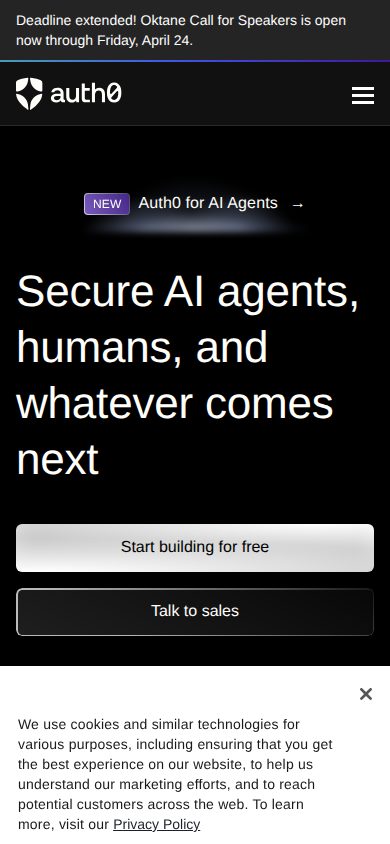
Auth0 mobile preview

Pricing Plans

Free

Free

Free plan supporting up to 25,000 monthly active users

  • Up to 25,000 MAUs
  • Passwordless auth
  • Unlimited social connections
  • 1 Enterprise Connection
  • 5 Organizations

Essentials

$35/monthly

Entry paid tier with enhanced limits and MFA support

  • Higher auth and API limits
  • Pro multi-factor authentication
  • Role-based access per organization
  • 10 Organizations
  • External audit log streaming
Popular

Professional

$240/monthly

Mid-tier with custom database support and enterprise auth features

  • Enhanced attack protection
  • Custom user database
  • Enterprise MFA
  • Cross-app SSO
  • Security Center access

Enterprise

Contact sales

99.99% SLA with advanced security and dedicated support

  • Custom user and SSO tiers
  • 99.99% SLA
  • Enterprise rate limits
  • Private deployment options
  • Enterprise admin support

AI Panel Reviews

The Decision Maker

The Decision Maker

Strategic bet, vendor viability, timing, adoption approval
8.3/10

Five years post-acquisition, Auth0's AI agent identity pivot is what the board will actually ask about.

Okta closed the Auth0 acquisition in May 2021 for $6.5 billion, so vendor existence isn't the question anymore. The 2026 question is whether the Auth0 MCP Server and Agent Experience Score are real product or analyst-bait.

The acquisition closed five years ago. Okta paid $6.5 billion in stock, and Auth0 still runs as its own brand inside the parent. Vendor existence is settled. What replaced it is harder.

The pivot worth scrutinizing is AI agent identity. The Auth0 MCP Server and Agent Experience Score — measured across 60 configurations and 5 AI models — say the brand is repositioning for the agent stack, not just human SSO. Stytch is making the same play with sharper docs but no enterprise SAML. WorkOS sits one tier above on B2B compliance. Auth0 has depth, but the AI-native pieces are early.

The catch is the parent's incentives. Okta's workforce business is the cash cow, and customer identity was 25% of revenue at acquisition. Pilot the MCP Server on one app for 90 days. Don't standardize until the agent roadmap survives a CFO review.

Competitive Positioning7.8

Still the default dev-first customer IdP, but newer entrants like Stytch and WorkOS are sharper at the edges.

Reputation Risk8.5

Auth0 inside Okta is a name no CIO has to defend twice to the board.

Speed to Value8.0

Quickstart claims 5-minute integration with 30+ SDKs; the happy path holds.

Strategic Fit8.0

Customer identity is core, but the AI agent extensions via MCP Server are still early product.

Vendor Viability9.0

Acquired by public Okta in 2021 for $6.5 billion; vendor-existence risk is closed.

Pros

  • Public parent Okta eliminates vendor-existence risk for board-level decisions.
  • Free tier covers 25,000 MAUs — enough room to pilot real apps before contract talks.
  • Auth0 MCP Server and Agent Experience Score signal a real bet on AI agent identity, not slideware.
  • 30+ SDKs plus SOC 2, GDPR, and HIPAA coverage match enterprise procurement defaults.

Cons

  • Customer identity is 25% of Okta's revenue, so roadmap priority can shift toward workforce identity.
  • The Free-to-Professional jump means past 25,000 MAUs the bill becomes a negotiation, not a number.
  • AI agent identity competitors like Stytch and WorkOS ship sharper developer experience on net-new flows.

Right for

Engineering leaders who need enterprise customer identity from a known vendor.

Avoid if

Solo developers who want flat per-MAU pricing past the free tier.

The Domain Strategist

The Domain Strategist

Craft and strategy in the product's domain — adapts identity per category, same lens
8.3/10

The 2021 Okta acquisition kept Auth0's developer-first identity layer intact, still its strongest case.

Auth0's strategic story is that Okta bought it for $6.5 billion in 2021 and left the product alone, so the developer-grade IdP your engineers actually want to use is still the same one. The constraint is now pricing, where the curve from $240/month Professional to custom Enterprise is steep enough to matter past a few hundred thousand MAU.

Auth0 lives inside Okta now, and that reshapes the bet. The 2021 acquisition for $6.5 billion kept the products separate — Auth0 stayed the developer-first IdP, Okta Workforce stayed enterprise SSO. The OAuth 2.0 and OIDC work that made Auth0 the default for engineering teams is intact.

The substrate worth naming is Actions — server-side hooks that let you customize every login step in JavaScript without rebuilding the app. Clerk has tighter React DX but thinner enterprise SAML. Amazon Cognito is cheaper at scale but the federation model fights you. Microsoft Entra ID matches the enterprise depth at half the developer ergonomics.

The catch is the pricing curve. Free covers 25,000 MAU, but Professional at $240/month assumes small user bases — past a few hundred thousand actives you land in custom Enterprise territory where the bill stops being predictable. That's the tax for letting Okta own your identity primitive.

Category Positioning8.4

The developer-first IdP inside the enterprise IAM leader — a position competitors like Clerk and Amazon Cognito haven't matched.

Domain Fit8.5

Shaped exactly how senior identity engineers work — APIs, SDKs, hooks, audit logs — not a console-first IT product.

Integration Surface8.6

30+ SDKs, audit log streaming to Datadog and Splunk on Essentials at $35/month, and standard OAuth/OIDC/SAML coverage.

Long-term Implications7.6

Living under Okta means roadmap priorities trend enterprise, and the Professional-to-Enterprise pricing jump compounds over a 3-year horizon.

Strategic Depth8.4

OAuth 2.0, OIDC, and SAML 2.0 implementations are reference-grade, with Actions extending the login pipeline rather than working around it.

Pros

  • OAuth 2.0, OIDC, and SAML 2.0 implementations are battle-tested and standards-compliant.
  • Actions hooks make customizing the login pipeline a config change, not a fork.
  • 30+ SDKs cover every mainstream framework, with five-minute integration as the documented norm.
  • Audit log streaming to Datadog and Splunk is included from Essentials at $35/month.

Cons

  • Pricing curve from Professional at $240/month to custom Enterprise is steep past a few hundred thousand MAU.
  • Strategic dependence on Okta means roadmap priorities now reflect a parent company's enterprise focus.
  • HIPAA compliance is a paid Enterprise add-on, not standard.

Right for

Engineering-led teams who need a customizable IdP without building it.

Avoid if

Cost-sensitive teams running high MAU counts at consumer scale.

The Finance Lead

The Finance Lead

Money, total cost of ownership, contracts, procurement math
7.5/10

Free covers 25,000 MAUs, but B2C Professional hits $1,600/month at 10K — the curve is the cost.

Auth0's free tier scales to 25,000 MAUs, then paid plans price per active user with sharp jumps. Essentials at $35/month is a sticker — at 7,000 MAUs you're paying $525/month, and B2B doubles every line.

The pricing model rewards reading the MAU curve, not the tier names. Free covers 25,000 MAUs — generous on paper. Past that, B2C Essentials lists at $35 but bills $70 at 1,000 MAUs and $700 at 10,000.

Run year-3 on a B2C app crossing 30,000 MAUs: Professional caps near that, then forces Enterprise — opaque rate, custom MSA. AWS Cognito Lite charges $0.0055 per MAU above 10K free; the same 30K load runs near $110/month. Auth0 wraps Adaptive MFA and Attack Protection in-tier; Cognito does not.

The tradeoff is predictability. Enterprise has no published rate, B2B roughly doubles B2C at every MAU step, and the BAA is gated above Professional. Negotiate the MAU ramp in writing before signing.

Billing & Procurement7.5

Credit-card and invoice paths are standard; Okta consolidation since the 2021 deal lets shared MSAs cover both SKUs.

Contract Flexibility7.5

Monthly billing on Essentials and Professional with no auto-renewal lock until Enterprise.

Pricing Transparency7.5

Three of four tiers list public prices with a working MAU calculator; Enterprise is opaque.

ROI Clarity8.0

Five-minute integration with 30+ SDKs replaces months of custom auth work; SOC 2 and GDPR compliance ship in-tier.

Total Cost of Ownership7.0

Predictable to 10K MAUs, but B2C Professional at $1,600/month and B2B doubling drives sharp 3-year jumps.

Pros

  • Free tier covers 25,000 MAUs — a real on-ramp, not a 30-day trial.
  • Three of four tiers carry public list prices with a working MAU calculator on the pricing page.
  • Adaptive MFA and Attack Protection ship in-tier on Professional, not as paid add-ons.
  • Five-minute integration with 30+ SDKs cuts implementation cost versus a custom auth build.

Cons

  • B2B pricing roughly doubles B2C at every MAU step — same product, different sticker.
  • HIPAA BAA is gated above Professional and Enterprise has no published rate.
  • Costs jump sharply past 10,000 MAUs and AWS Cognito Lite undercuts the per-MAU rate at scale.

Right for

Developer teams who need enterprise SSO and compliance without building identity from scratch.

Avoid if

Cost-sensitive B2C apps who scale past 30,000 MAUs on tight margins.

The Domain Practitioner

The Domain Practitioner

Daily hands-on reality in the product's domain — adapts identity per category, same lens
8.1/10

The 30+ SDKs and Universal Login redirect get you authenticating in an afternoon, not a sprint.

Auth0 ships Quickstarts for Next.js, Express, .NET, Spring, and most other backends, so integration is mostly copy-paste of an SDK init plus auth middleware. The friction shows up later when you customize Universal Login pages, write Actions, or move past 25,000 MAU into Professional pricing.

`npm i @auth0/nextjs-auth0`, paste the env vars, wrap your handler — login works. The five-minute Quickstart claim is roughly honest for the happy path across 30+ SDKs. Compare bringing up FusionAuth in Docker: longer setup, but you own the box.

The catch is what comes after the demo. Universal Login is a redirect to auth0.com or your custom domain, and customizing the login page beyond colors means Liquid templates and the New Universal Login config — not React. Actions replaced Rules in November 2024; the Monaco editor is fine, but the JS still runs in Auth0's sandbox, not your repo.

`a0deploy` exports tenant config to YAML for git diffs — the right shape for environments. However, the jump from Free's 25,000 MAU to Professional's $240/month for 500 actives is where Supabase Auth and Clerk look cheaper for early-stage apps.

Day-3 Reality8.0

SDK quickstarts deliver login fast; customization past colors means Liquid templates and the New Universal Login config.

Documentation Practitioner-Fit8.4

The 30+ framework Quickstarts and per-SDK code samples read like the people who maintain the SDKs wrote them.

Friction Surface7.6

Login-page customization and the Free-to-Professional pricing jump are the recurring daily fights.

Power-User Depth8.5

Actions, custom domains, Adaptive MFA, organizations, and Universal Login templates scale from prototype through enterprise.

Workflow Integration7.8

`a0deploy` exports YAML for git, but Actions code still lives in Auth0's sandbox rather than your repo.

Pros

  • 30+ Quickstart SDKs make first-login integration genuinely a 5-minute job for common backend stacks.
  • Universal Login as a hosted redirect side-steps embedded-form OWASP and PCI scope.
  • `a0deploy` exports tenant config to YAML, so environments diff and review like code.
  • Actions replaced Rules in November 2024 with a Monaco editor and full npm package access.

Cons

  • Customizing the login page past colors means Liquid templates and the New Universal Login config, not React.
  • The Free-to-Professional jump from $0 to $240/month for 500 MAU is steep for early-stage apps.
  • Actions JS still runs in Auth0's sandbox, not your repo, so testing and version control split between two systems.

Right for

Backend engineers who need OAuth and SSO without rolling their own identity layer.

Avoid if

Solo developers who fit inside the free tiers of Supabase Auth or Clerk.

The Power User

The Power User

Daily human experience, onboarding, polish, learning curve, reliability
8.1/10

Auth0's free tier covers 25,000 MAUs, which is generous until you actually try to leave it.

Universal Login is the part that actually saves you weeks — server-rendered, ten lines of code, done. The catch is the price cliff between Free and Essentials, which lands harder than the docs let on.

Most of these platforms make you build the login screen yourself and wire SSO and password-reset flows in later. Auth0's Universal Login just hands you the whole flow — server-rendered, dropped into a Next.js or Express app in maybe ten lines. The docs claim 5 minutes to integration; for a basic flow that's honest, not marketing.

The dashboard does what dashboards should. Clean tenant switcher, audit logs that stream to Datadog and Splunk on the $35 Essentials plan, Actions for hooking server-side JavaScript into login events. Firebase Auth is cheaper at the small end but the federation story falls apart the second you need real SAML.

But the pricing curve is the catch most reviews skip. Free covers 25,000 MAU and Essentials is $35/month, then Professional jumps to $240 with custom database support. Past a few hundred thousand actives you land in contact-sales Enterprise territory. Generous front door. Steep middle.

Daily Polish8.0

The dashboard, tenant switcher, and Universal Login flows feel built by people who use them.

Learning Curve7.5

First hour is fast but Actions, custom databases, and rules add real depth at month three.

Mobile Parity7.5

Backend identity infrastructure where mobile parity is not the relevant axis.

Onboarding Experience8.5

30+ SDKs and quickstarts back up the 5-minute integration claim for basic flows.

Reliability Feel8.3

99.99% SLA on Enterprise plus 13 years of production track record under Okta ownership.

Pros

  • Universal Login drops a production-ready auth flow into your app in about ten lines of code.
  • Free tier supports 25,000 MAU with no time limit, which is rare in the identity-as-a-service market.
  • 30+ SDKs and quickstarts cover almost every framework you would actually use.
  • Audit log streaming to Datadog and Splunk lands on the $35 Essentials plan, not Enterprise.

Cons

  • Pricing jumps from $35 Essentials to $240 Professional with no middle tier for growing apps.
  • Past a few hundred thousand MAUs you are in custom Enterprise pricing territory with no published numbers.
  • MFA and RBAC require leaving the free tier, which catches many production deployments off-guard.

Right for

Developers who need production identity infrastructure without building it from scratch.

Avoid if

Solo builders who plan to scale past 25,000 active users on a tight budget.

The Skeptic

The Skeptic

Contrarian. Watch-outs, deal-breakers, broken promises, category patterns
7.8/10

Strong product, strong category position — but Auth0's been an Okta line item since 2021, not a standalone vendor.

Eugenio Pace and Matias Woloski built developer-first IAM into a $210M-raised business before Okta acquired it. The product is solid; the question is whether you're comfortable letting Okta own your identity primitive.

Auth0 launched in 2013 from Bellevue and Buenos Aires, raised $210M across six rounds, then Okta absorbed it. The brand survived. The independence didn't. That changes which question matters most.

Adaptive MFA and Bot Detection are real product — bundled in-tier rather than priced as upsells, which WorkOS hasn't matched on the SSO-only side. Keycloak is the open-source escape hatch if you have a platform team to run it. Most teams don't. That's why Auth0 still wins build-vs-buy through Series C.

The catch is parent risk. Okta's October 2023 support-system breach hit every customer-support user across Workforce and CIC; Auth0's case-management was carved out, but vendor concentration is the real watch now, not the auth flow itself.

Competitive Differentiation7.5

Clear developer-first niche but the segment is compressing fast against WorkOS, Stytch, and Clerk on different axes.

Exit Portability6.8

OAuth 2.0 and OIDC are standards so flows port, but Actions, Liquid templates, and tenant config are Auth0-specific work to redo.

Long-term Viability8.2

Okta paid $6.5B and the changelog cadence is visible, but customer concentration risk under a single parent is the watch.

Marketing Honesty7.8

The 5-minute integration claim and 30+ SDK coverage match real practitioner reports — landing page voice is grounded.

Track Record Match8.5

Thirteen years old, profitable $6.5B exit, still shipping under Okta — this is the survival case in the IAM graveyard.

Pros

  • Adaptive MFA, Bot Detection, and Breached Password Protection bundled in-tier on Essentials at $35/month — not gated as upsells.
  • Standards-based on OAuth 2.0, OIDC, and SAML 2.0 — the protocols port even if the tenant config does not.
  • Free tier covers 25,000 MAUs, which is genuinely generous for prototyping and Series A apps.
  • Okta acquisition closed at $6.5B in May 2021 — Auth0 is durably funded inside a public parent, not at runway risk.

Cons

  • Vendor concentration risk — Auth0 sits inside Okta, and Okta's October 2023 support-system breach put parent reputation in play.
  • Pricing curve gets opaque past Professional — past a few hundred thousand MAUs you negotiate Enterprise with no published rate.
  • Custom Actions and Liquid template work doesn't port to Keycloak or WorkOS — the deeper you customize, the harder you exit.

Right for

Engineering teams who need production-ready auth in days.

Avoid if

Teams who refuse to consolidate identity onto Okta.

Buyer Questions

Common questions answered by our AI research team

Pricing

How much does the Professional plan cost per month?

The Professional plan costs $240/month, covering up to 500 monthly active users. It includes everything in Essentials plus existing user database logins, Enterprise MFA, Enhanced Attack Protection, and M2M Tokens as an add-on.

Features

Does Auth0 support passwordless login out of the box?

Yes, Passwordless Authentication is included on all plans, starting with the Free tier. It is listed as a core featured capability alongside Adaptive MFA and bot detection.

Security

Is Auth0 HIPAA compliant?

HIPAA compliance is available via a Business Associate Agreement (BAA) as an enterprise add-on. Auth0 also supports PCI compliant environments through the same add-on offering.

Setup

How long does it take to integrate Auth0 into an app?

Auth0 can be integrated into any app in just 5 minutes. It provides 30+ SDKs & Quickstarts and requires only a few lines of code, supporting any language or framework.

Integration

Can Auth0 stream audit logs to Splunk or Datadog?

Yes, audit log streaming to Datadog, Splunk, AWS, Azure, and more is available on the Essentials plan and above.

Also in AI DevOps