Orgvue logo

Orgvue Review

Visit

Model workforce change before you commit to it

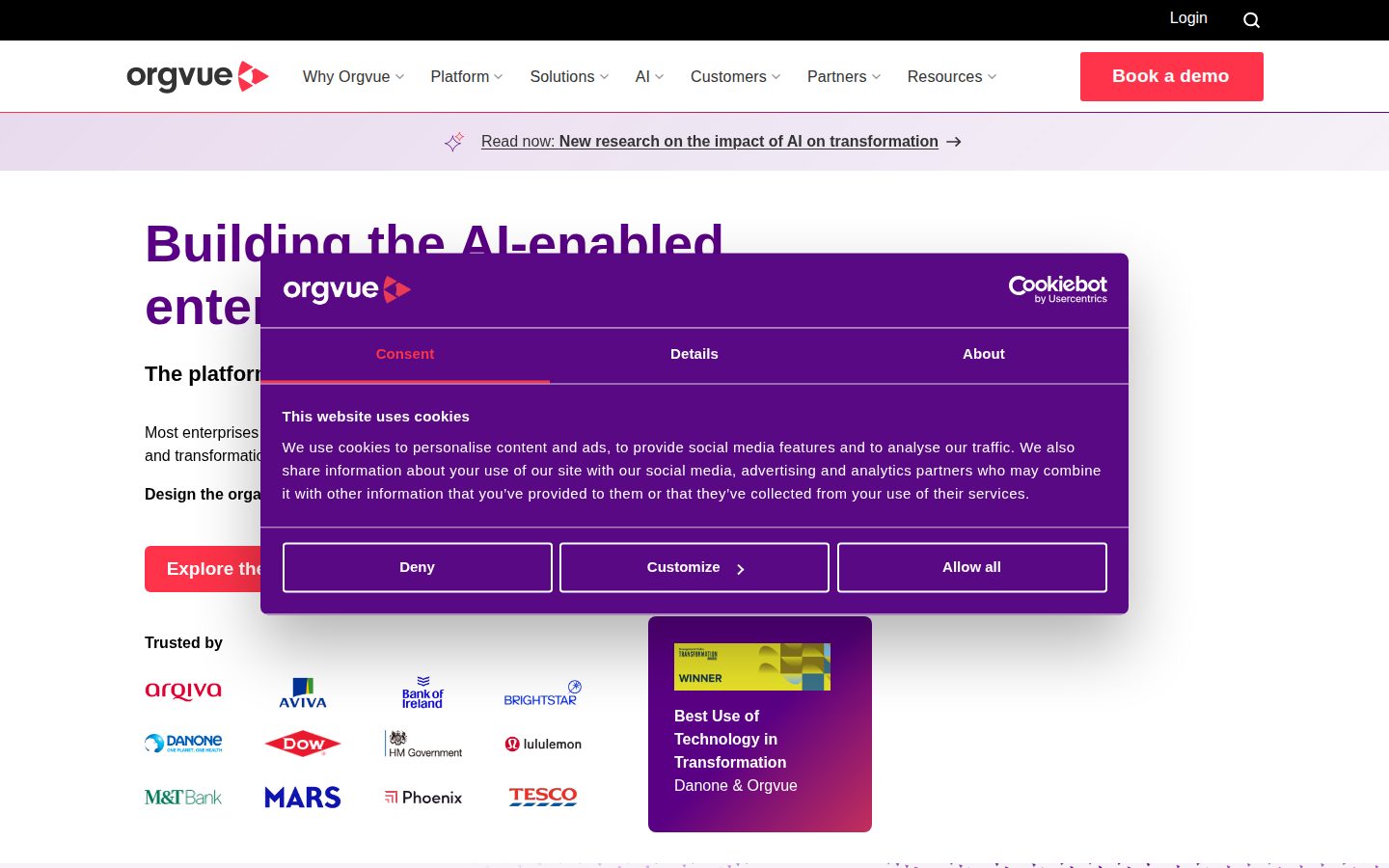
Orgvue is a strategic workforce transformation platform for enterprise HR, finance, and organizational design teams.

AI Panel Score

7.5/10

6 AI reviews

Reviewed

About Orgvue

In practice, users bring together workforce data—headcount, roles, costs, skills—and use Orgvue to visualize the current state of their organization, then build and compare alternative structural designs. The platform supports scenario modeling across common workforce events including restructurings, mergers and acquisitions, and strategic workforce planning cycles. Teams can test changes against cost and capability constraints before any decisions are finalized.

Orgvue's platform is organized around four core activities: analyze, design, plan, and monitor. Specific capabilities include job architecture management, which structures roles in a standardized, scalable taxonomy to support defensible decisions; AI and automation potential assessment, which models how automation may affect roles and tasks; and M&A integration planning, which harmonizes workforce data from multiple organizations and tracks synergy realization. The AI layer, Henshaw, is embedded across these workflows rather than offered as a separate module.

Orgvue targets large enterprises, particularly those with complex org structures undergoing recurring workforce change. It is positioned for HR strategy, workforce planning, and organizational effectiveness functions working alongside finance. Pricing is not publicly listed and is offered on a contact-sales basis. Competitors in the organizational design and workforce planning software category include Workday Adaptive Planning, SAP SuccessFactors, Anaplan, and specialized tools such as Nakina and Veritiv.

Orgvue is a web-based SaaS platform. It includes a documented workspace environment for end users, a support knowledge base, and a trust center covering compliance certifications, data residency, and live platform status. A professional services offering is available to support implementation and transformation delivery.

Features

AI

  • Henshaw AI

    An integrated AI layer that surfaces workforce insights and supports analysis across workforce workflows including role- and task-level assessments.

Analytics

  • Cost Reduction Planning

    Provides tools to model and optimize workforce spend while identifying which capabilities to protect during cost reduction programs.

  • M&A Workforce Modeling

    Supports integration planning for mergers and acquisitions by harmonizing workforce data and tracking synergies across combined organizations.

  • Scenario Modeling

    Allows teams to model and compare multiple organizational or workforce scenarios before committing to restructuring, cost reduction, or transformation programs.

Automation

  • AI and Automation Potential Assessment

    Assesses automation impact at the role and task level to help organizations plan workforce transformation in response to AI adoption.

Core

  • Job Architecture

    Structures roles and job architecture within the platform to support scalable, defensible workforce decisions across the organization.

  • Organizational Design

    Enables teams to analyze, design, and restructure the organization with visibility into roles and costs before execution.

  • Platform Status Monitoring

    Offers live availability and uptime transparency for the Orgvue platform so customers can monitor service status in real time.

  • Strategic Workforce Planning

    Aligns workforce capacity, skills, and costs to business strategy through structured planning workflows within the platform.

  • Workforce Restructuring Support

    Delivers visibility into roles and costs and enables scenario comparison to guide restructuring decisions before execution.

Security

  • Compliance and Security Controls

    Provides documented security controls, compliance standards, data residency options, and a trust center portal for customer security reviews.

Support

  • Professional Services

    Expert-led implementation services that help teams deploy Orgvue and deliver workforce transformation outcomes faster.

Preview

Orgvue desktop previewOrgvue mobile preview

Pricing Plans

Orgvue Platform

Contact sales

Enterprise-grade organizational design and workforce planning platform for large enterprises, HR, Finance, and Operations leaders. Pricing is not publicly listed and requires contacting Orgvue sales for a custom quote tailored to organizational size and use case.

  • Organizational design and workforce planning
  • Scenario modeling and digital twin environment
  • Data integration from HR, Finance, and Operations systems (e.g., Workday, SAP SuccessFactors)
  • AI-enabled workforce intelligence and decision support
  • Interactive org charts and data visualizations (heatmaps, histograms, scatter plots)
  • Workforce transformation and post-M&A integration support
  • Strategic and operational workforce planning
  • Skills gap analysis and talent intelligence
  • Activity-based costing and workforce benchmarking
  • Enterprise-grade cloud security and compliance

AI Panel Reviews

The Decision Maker

The Decision Maker

Strategic bet, vendor viability, timing, adoption approval
7.8/10

Serious enterprise org design tooling, but opaque pricing slows every deal.

Orgvue targets the structural workforce decisions that Workday and SAP don't really solve. No public pricing and no trial means every evaluation is a sales process.

The four-module frame — analyze, design, plan, monitor — is the right architecture for enterprises running recurring restructures or M&A integration. Henshaw AI doing role- and task-level automation potential scoring is genuinely useful, not cosmetic. That's a capability Anaplan doesn't touch at this depth.

The tradeoff: no free trial, no pricing page, no changelog. You're going in blind on cost, and the professional services dependency suggests time-to-value measured in quarters, not weeks. That's defensible for a $50M+ transformation program. It's hard to justify for a one-time reorg.

Vendor viability is the open question. No public funding data, no headcount signal, no Series visible. They've been in market long enough to have a trust center and documented compliance controls, which suggests real enterprise traction. But I'd want three reference customers before I signed.

Competitive Positioning7.5

Job architecture management and M&A workforce harmonization in one platform is a real differentiator versus point tools like Anaplan or standalone HRIS analytics.

Reputation Risk8.0

Positioned alongside Workday Adaptive Planning and SAP SuccessFactors — board won't raise an eyebrow at this category choice.

Speed to Value6.0

No free trial, contact-only pricing, and a professional services offering signals implementation measured in months, not days.

Strategic Fit8.5

Scenario modeling plus Henshaw AI automation-potential scoring advances org strategy, not just cost tracking — that's directionally right for any enterprise facing AI-driven workforce change.

Vendor Viability6.5

No public funding data and no disclosed team size — trust center and API availability suggest enterprise maturity, but runway is unverifiable.

Pros

  • Henshaw AI scores automation potential at the role and task level — not just headline workforce cost
  • M&A workforce harmonization and synergy tracking built in, not bolted on separately
  • Single platform covering org design and workforce planning closes a gap Workday leaves open
  • Trust center, data residency options, and compliance controls reduce security review friction

Cons

  • No public pricing — every deal starts with a sales cycle
  • No free trial means zero hands-on validation before committing
  • Professional services dependency likely extends time-to-value past one quarter
  • No public funding or team size data — viability requires a direct reference check

Right for

Large enterprises running recurring restructures or post-M&A integration who need org design and workforce planning in one auditable platform.

Avoid if

You need fast deployment without a professional services engagement or you can't get three live reference customers on the phone first.

The Domain Strategist

The Domain Strategist

Craft and strategy in the product's domain — adapts identity per category, same lens
8.1/10

Enterprise org design architecture with genuine AI depth, not just a dashboard wrapper.

Orgvue connects job architecture, scenario modeling, and automation potential assessment in one platform — a stack most enterprises are stitching together from three separate tools. The Henshaw AI layer embedded across workflows, not bolted on as a module, signals architectural intent that Workday Adaptive Planning and Anaplan haven't matched at this layer.

Four structured activities — analyze, design, plan, monitor — mapped to a coherent data model including headcount, roles, costs, and skills. That's not just product marketing; that's a schema decision someone made deliberately. The job architecture management capability implies a normalized role taxonomy underneath, which is the right foundation for defensible restructuring decisions at enterprise scale.

The API surface is documented and the trust center covers data residency — two non-negotiables for any enterprise CTO signing off on workforce data leaving the firewall. No changelog and no pricing page are gaps: if I can't see version history, I can't assess release velocity or stability trajectory.

If we adopt this, in three years we have a workforce data layer that's genuinely hard to migrate off — role taxonomies and scenario histories compound fast. That's lock-in risk, but it's also moat value if the vendor relationship holds. No free trial means procurement cycles will be long.

Category Positioning8.2

Sits above point solutions like Nakina and ahead of general planners like Anaplan on org design depth, with Henshaw differentiating on AI automation potential analysis.

Domain Fit8.5

The analyze-design-plan-monitor framework maps directly to how organizational effectiveness and HRBP teams structure transformation programs.

Integration Surface7.8

Documented integrations with Workday and SAP SuccessFactors plus an API surface cover the enterprise HR stack, though changelog absence makes integration stability hard to assess.

Long-term Implications7.6

Role taxonomy and scenario history create compounding data lock-in — valuable if the vendor relationship holds, expensive if it doesn't.

Strategic Depth8.4

Role- and task-level automation potential assessment via Henshaw, plus job architecture management, indicates platform depth well beyond headcount dashboards.

Pros

  • Henshaw AI embedded across workflows, not siloed — role and task-level automation assessment is genuinely differentiated
  • Job architecture management as a core module implies a normalized taxonomy schema built for enterprise governance
  • Trust center with data residency options clears the security review bar for most enterprise CTOs
  • API-documented integration with Workday and SAP SuccessFactors reduces the data pipeline build burden

Cons

  • No public pricing and no free trial means long procurement cycles with no low-risk entry point
  • No changelog makes release velocity and stability impossible to assess from the outside
  • Workforce data and role taxonomies create real migration cost after 18-24 months — switching isn't cheap
  • Professional services dependency at implementation suggests the product isn't fully self-service for complex orgs

Right for

Large enterprises running recurring workforce transformations — M&A, restructuring, or strategic planning cycles — where org design and workforce planning are currently separate processes.

Avoid if

Your org is under 1,000 employees or needs a fast, low-touch deployment without a professional services engagement.

The Finance Lead

The Finance Lead

Money, total cost of ownership, contracts, procurement math
6.2/10

Zero public pricing. Enterprise-only. Henshaw AI won't tell you what it costs.

Orgvue is a serious enterprise workforce planning platform. The pricing model makes TCO modeling impossible without a sales call.

No pricing page. No trial. No free plan. Contact-sales only. That's 4 red flags before procurement even opens a ticket. Competitors Workday Adaptive Planning and Anaplan publish tier structures. Orgvue doesn't. That asymmetry costs buyers negotiating leverage.

The feature set is real: scenario modeling, Henshaw AI for role- and task-level automation assessment, M&A workforce harmonization, job architecture. These are enterprise-grade capabilities. Professional services are available — expect that line item to run 20-40% of contract value at typical implementation complexity. Year 3 TCO on a 500-employee deployment could land anywhere from $300K to $800K. No public data to narrow that range.

ROI story is structurally hand-wavy without a benchmark. Restructuring savings are measurable in theory — headcount costs are numbers. But without published case study data or output metrics, finance can't build a pre-sale business case. That's a procurement friction problem, not a capability problem.

Billing & Procurement3.8

No self-serve, no trial, professional services required — procurement friction is high and vendor onboarding cost is unquantified.

Contract Flexibility4.0

No public contract terms; category norm for enterprise SaaS is annual auto-renewal with 60-90 day exit windows — assume that here.

Pricing Transparency1.5

No pricing page, no published tiers, no starting price — contact-sales only with zero public anchors.

ROI Clarity5.5

Scenario modeling and cost reduction planning are measurable in principle, but no published benchmark data or outcome metrics to anchor a pre-sale business case.

Total Cost of Ownership3.5

Professional services add-on plus opaque licensing makes 3-year TCO unmodelable from public materials alone.

Pros

  • Scenario modeling and Henshaw AI are purpose-built for enterprise restructuring decisions
  • M&A workforce harmonization is a differentiated feature vs general HR platforms
  • Single platform covers org design and workforce planning — reduces integration cost
  • API available, which suggests Workday and SAP SuccessFactors data integration is real

Cons

  • Zero pricing transparency — no sticker, no tier, no ballpark
  • Professional services dependency inflates TCO unpredictably
  • No free trial means no technical validation before contract
  • ROI case requires internal effort to build — vendor provides no published benchmarks

Right for

Large enterprises running recurring workforce transformations, M&A integrations, or org redesigns where workforce data is complex and decisions are high-stakes.

Avoid if

Your team needs to model TCO before a sales call or lacks budget for a multi-year enterprise contract with professional services.

The Domain Practitioner

The Domain Practitioner

Daily hands-on reality in the product's domain — adapts identity per category, same lens
7.8/10

Serious org design power for enterprise teams willing to do the setup work

Orgvue connects organizational design and strategic workforce planning in one platform — scenario modeling, job architecture, M&A harmonization, all present. Contact-only pricing signals enterprise positioning, which shapes every expectation about onboarding speed and daily self-service.

The scenario modeling workflow is the core reason you're here. Model a restructuring, compare it against cost and capability constraints, don't commit until you've stress-tested it. That's a genuine workflow gap that Workday Adaptive Planning doesn't close well at the org-design layer. Henshaw AI embedded across workflows — not bolted on as a separate tab — suggests someone thought about where insights actually need to surface during daily planning cycles.

Day three is where contact-sales products show their shape. No free trial, no public pricing, no changelog visible. That means onboarding timeline is vendor-controlled, and power-user depth is gated behind professional services. The docs exist, but without practitioner-authored changelogs, it's hard to know whether the knowledge base stays current or runs six months behind the product.

The job architecture module and automation potential assessment at role and task level are differentiated. That's not category-standard. Anaplan does financial workforce modeling; Orgvue does structural org design with AI-layer automation scoring. Real tradeoff: this tool rewards teams with dedicated workforce planning functions. Solo HR generalists or lean people teams will fight the complexity daily.

Day-3 Reality7.2

No free trial and professional services dependency suggests day-three experience is heavily shaped by implementation quality, not product intuitiveness.

Documentation Practitioner-Fit6.5

Support knowledge base exists but no changelog is visible; docs=N in evidence flags limited self-serve technical documentation depth.

Friction Surface6.8

No changelog and no self-serve trial means friction is front-loaded and opaque — daily friction post-implementation is unknown from public evidence.

Power-User Depth8.2

Job architecture management, M&A workforce harmonization, and task-level automation scoring via Henshaw point to real advanced-use ceiling, not feature-width theater.

Workflow Integration8.0

Four-workflow structure (analyze, design, plan, monitor) maps directly to how enterprise org design teams actually sequence transformation work.

Pros

  • Scenario modeling and org design in one platform — not two tools duct-taped together
  • Henshaw AI embedded across workflows, not siloed
  • Task- and role-level automation potential scoring is genuinely differentiated
  • M&A integration planning with synergy tracking addresses a real enterprise gap

Cons

  • No free trial and contact-only pricing means every evaluation is vendor-mediated
  • No visible changelog makes it hard to track product velocity
  • Professional services dependency raises time-to-value questions for lean teams
  • Documentation depth unclear — knowledge base exists but practitioner-authored depth is unconfirmed

Right for

Large enterprise HR strategy or workforce planning teams running recurring restructurings, M&A integrations, or multi-year transformation programs.

Avoid if

You need a self-serve trial to validate fit or lack a dedicated workforce planning function to absorb implementation complexity.

The Power User

The Power User

Daily human experience, onboarding, polish, learning curve, reliability
8.1/10

Enterprise org design done seriously, but you'll need a guide to get started

Orgvue does the hard stuff — M&A workforce modeling, scenario comparison, job architecture at scale — in one platform. Not cheap, not simple, but built for the problems it solves.

Scenario modeling before you commit to a restructuring is genuinely useful. Most enterprises are still doing this in Excel and PowerPoint, switching between Workday data exports and leadership decks. Orgvue's four-workflow structure — analyze, design, plan, monitor — plus the Henshaw AI layer for role- and task-level automation assessment is a real answer to a real problem. The digital twin framing isn't just marketing; it's the actual use case.

The tradeoff is access. No free trial, no pricing page, contact sales only. You're not wandering in and figuring it out. Compared to Anaplan or Workday Adaptive Planning, which at least give you a pricing anchor, Orgvue asks for a meeting before you even know if it fits your budget. That's an enterprise gate, not a product confidence issue — but worth naming.

Daily polish is hard to assess without hands-on access. The trust center and compliance documentation exist, which enterprise buyers require. Web-only platform means mobile is likely read-only at best. For a tool used in quarterly planning cycles rather than daily, that's probably fine. But first-time users should expect a services-assisted ramp, not a self-serve unlock.

Daily Polish7.2

The platform status monitoring and trust center exist, which signals operational care, but no changelog is public and micro-copy quality can't be independently assessed.

Learning Curve6.8

Job architecture, M&A workforce modeling, and scenario modeling across four core workflows is a lot of surface area — the professional services offering exists for good reason.

Mobile Parity5.5

Web-only platform with no mobile mention — for quarterly workforce planning cycles this is tolerable, but it's still a real gap if executives want access on the road.

Onboarding Experience6.5

No free trial, no self-serve entry point, and professional services are positioned as standard — first ten minutes are likely a guided call, not product discovery.

Reliability Feel7.8

Live platform status monitoring and documented compliance controls suggest the team has thought about uptime transparency for enterprise buyers.

Pros

  • Scenario modeling and org design in one platform instead of spreadsheet-and-slide chaos
  • Henshaw AI does role- and task-level automation potential analysis, not just org chart visualization
  • M&A workforce integration planning is a specific, hard capability that most competitors don't lead with
  • Trust center and compliance documentation built for enterprise security reviews

Cons

  • Zero pricing transparency — contact sales before you know if it fits
  • No free trial means no low-risk way to evaluate fit before committing
  • Web-only with no mobile story
  • Professional services dependency makes time-to-value longer than self-serve tools

Right for

Large enterprises running recurring workforce transformations, M&A integrations, or cost reduction programs who need defensible scenario modeling with HR and finance together.

Avoid if

You're a mid-market company hoping to self-serve your way to an answer — the onboarding ramp and opaque pricing will frustrate you before you see value.

The Skeptic

The Skeptic

Contrarian. Watch-outs, deal-breakers, broken promises, category patterns
7.2/10

Solid niche tool for enterprise org design — three things I'd verify before signing

Orgvue fills a real gap between workforce planning and org design that Workday Adaptive Planning and Anaplan don't quite close. Contact-only pricing and no changelog are yellow flags for a platform asking for enterprise trust.

No public pricing. No changelog. No free trial. That's three opacity signals before I get to the product. Could be intentional enterprise positioning. Could be a team that doesn't ship fast enough to show a changelog. Can't tell from the outside.

What's actually here looks defensible. The Henshaw AI layer doing role- and task-level automation potential assessment is specific enough to be real — that's not vague 'AI-powered insights' copy. M&A workforce harmonization is a genuine wedge. Anaplan does planning, SAP SuccessFactors does HR records, but neither owns the org design layer where restructuring decisions actually get modeled. That gap is Orgvue's territory.

The exit story is the uncomfortable part. No API docs visible publicly, no data portability language, professional services required for implementation. If this goes sideways in 18 months, extraction gets messy. Worth asking hard questions before signing any multi-year deal.

Competitive Differentiation7.8

The org design plus workforce planning integration is a genuine gap — Workday and Anaplan both exist, neither owns the structural redesign workflow Orgvue targets.

Exit Portability5.5

No public data export documentation, professional services dependency for implementation, and no visible API docs make migration risk real and unquantifiable.

Long-term Viability6.5

No changelog visible, no public funding round listed, trust center exists which is table stakes — team signal is thin from what's public.

Marketing Honesty7.5

Tagline 'model workforce change before you commit to it' is functional, not hyperbolic — matches what Scenario Modeling and Organizational Design features actually do.

Track Record Match6.8

Specialized enterprise HR analytics tools have a mixed survival rate — Nakina is in the graveyard, Visier survived by going broad; Orgvue's focus is a bet either way.

Pros

  • Henshaw AI does role- and task-level automation assessment — specific, not marketing fluff
  • M&A workforce harmonization is a real enterprise use case with no obvious dominant owner
  • Trust center with compliance certs and data residency shows enterprise readiness
  • Org design plus planning in one platform is genuinely differentiated from Workday or SAP

Cons

  • No public pricing — impossible to benchmark value without a sales call
  • No changelog visible — shipping cadence is unverifiable
  • No free trial means zero low-risk evaluation path
  • Exit portability unclear — professional services dependency raises migration cost if you leave

Right for

Large enterprises running recurring restructuring or M&A cycles who need org design and workforce planning in one place.

Avoid if

Your organization needs transparent pricing, fast self-serve evaluation, or a clean data exit path.

Buyer Questions

Common questions answered by our AI research team

Features

Can Orgvue model workforce restructuring scenarios?

Orgvue lets teams model workforce restructuring scenarios and compare options before executing restructuring, cost reduction, or transformation programs.

Features

What does the Henshaw AI layer do?

Henshaw is Orgvue's integrated AI layer that surfaces workforce insights and supports role- and task-level analysis of automation potential across the organization.

Features

Does Orgvue support automation potential analysis by role?

Yes, Orgvue supports automation potential analysis at both the role and task level through its Henshaw AI layer.

Features

Are organizational design and workforce planning in one platform?

Yes, Orgvue connects organizational design and workforce planning in a single integrated platform.

Features

Can Orgvue compare options before executing a transformation program?

Yes, Orgvue enables teams to model scenarios and compare options before executing any transformation program.

Product Information

  • Company

    Orgvue
  • Founded

    2008
  • Pricing

    Contact for pricing

Platforms

web

About Orgvue

Orgvue is a London-based SaaS platform for organizational design and workforce planning, enabling enterprises to model, analyze, and restructure their workforce using data visualization and scenario modeling.

Resources

API
Blog

Also in AI Workforce Analytics