Sendbird logo

Sendbird Review

Visit

AI customer experience platform for enterprise chat and support

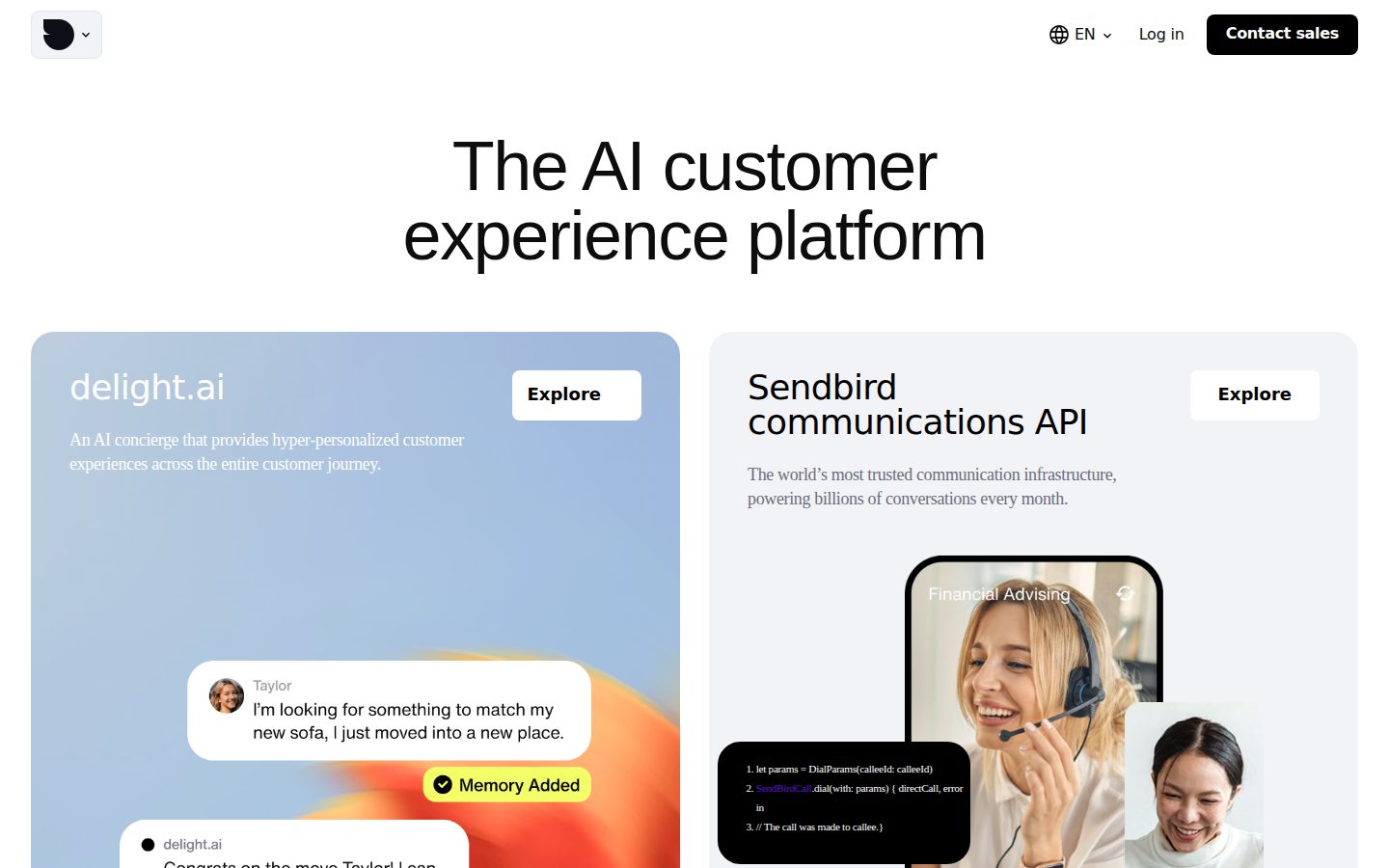
Sendbird is an AI-powered customer experience platform for enterprises building chat, support, and messaging into their applications.

Sendbird·Founded 2013·From $349/moFree TrialAI Customer SupportAI ChatbotsCommunication Tools

AI Panel Score

7.8/10

6 AI reviews

Reviewed

AI Editor Approved

About Sendbird

Sendbird is built around a set of developer-facing SDKs and a cloud-hosted messaging infrastructure. Developers integrate chat, voice, or video into their apps using platform SDKs (iOS, Android, web), then manage channels, users, and messages through a REST API and dashboard. The product ships prebuilt UI kits to accelerate front-end implementation without requiring teams to build messaging components from scratch.

Beyond messaging infrastructure, Sendbird includes an AI Agent product that automates customer support conversations across messaging channels. Specific capabilities include hallucination detection, sentiment analysis, activity trails for audit transparency, scorecards for evaluating agent performance, and Actionbooks (structured SOPs that guide AI behavior beyond static decision trees). The platform also includes a Business Messaging product for templated notifications and sequences, an Advanced Moderation layer using AI and human review, and a live streaming product with integrated messaging.

Sendbird targets enterprises and mid-market companies building customer-facing products — common verticals include e-commerce, healthcare, fintech, and on-demand services. It competes with platforms like Twilio, Stream, and Intercom depending on the use case. Pricing is available publicly on the Sendbird website; the product offers a free trial and paid tiers scaled by usage and features.

The platform supports web, iOS, and Android clients. Infrastructure includes a global edge proxy architecture to reduce messaging latency across regions. Integrations include Salesforce, Sprinklr, and third-party AI model providers. The Platform API allows server-side control over channels, users, and moderation actions.

Features

AI

  • AI Agent

    Automates customer conversations and support across messaging channels, with capabilities for multi-turn conversations, escalation handling, and proactive outreach.

  • Hallucination Detection

    Automatically detects AI agent hallucinations in real time to improve accuracy and trustworthiness in customer support responses.

Analytics

  • AI Agent Activity Trails

    Tracks and logs AI agent decisions in detail to provide transparency and auditability for enterprise customer support operations.

  • AI Agent Scorecards

    Evaluates AI agent performance in customer support using structured scorecards to measure quality and outcomes.

  • Sentiment Analysis

    Analyzes user emotions during AI agent interactions to provide support teams with insights into customer sentiment.

Automation

  • Business Messaging

    Manages notification channels, message templates, and sequences for effective outbound and transactional messaging to customers.

Core

  • Live Streaming

    Enables real-time live streaming events with integrated messaging features, SDKs, and server-side control through a Platform API.

  • Real-Time Chat SDKs & UI Kits

    Provides developers with SDKs, UI kits, and APIs to build and manage real-time chat experiences in web and mobile applications.

  • Voice & Video Calls

    Integrates real-time voice and video call functionality into applications using Sendbird's Call SDK and Platform API.

Integration

  • Support Chat Connectors (CRM Integration)

    Integrates Sendbird Chat with CRM platforms like Salesforce to enhance customer service workflows through Support Chat Connectors.

Security

  • Advanced Moderation

    Optimizes chat safety and compliance by combining AI and human insights to detect and manage harmful or non-compliant content.

Support

  • Desk (Live Chat & Ticket Management)

    Provides a customer support product with live chat, ticket management, and performance analytics accessible via the Sendbird Dashboard and SDK.

Preview

Sendbird desktop previewSendbird mobile preview

Pricing Plans

Free Trial

Free

Experiment with chat features, no credit card required

  • Up to 1,000 MAU
  • Up to 20 peak concurrent connections
  • Unlimited messages/month
  • 6 months message retention
  • Community support
  • No overages allowed

Starter

$349/monthly

Get started with chat for up to 5K MAU, billed annually ($399/month billed monthly)

  • Messaging essentials
  • Basic moderation
  • Ticketed support
  • Business messaging included (30K free in-app messages)
  • Overages may apply
Popular

Pro

$499/monthly

Grow your business with advanced features for up to 5K MAU, billed annually ($599/month billed monthly)

  • All Starter features
  • Auto message translation
  • Data export
  • AI image moderation
  • Supergroup channel
  • Business messaging included (30K free in-app messages)

Enterprise

Contact sales

Full powered platform with custom pricing for millions of MAU; contact sales for pricing

  • Select from all features
  • Dedicated or shared server
  • Various levels of support
  • Extended message retention
  • Add-on products (e.g., Advanced Moderation)
  • Business messaging included (30K free in-app messages)

AI Panel Reviews

The Decision Maker

The Decision Maker

Strategic bet, vendor viability, timing, adoption approval
8.1/10

Sendbird is the infrastructure play for enterprises building chat into their product.

Serious developer toolkit with a growing AI layer on top. $349/month entry point is accessible, but real enterprise deals are custom-priced and opaque.

Nine global AWS regions. HIPAA, SOC 2, ISO 27001. UIKit ships prebuilt components so teams aren't building chat from scratch. That's a mature platform, not a startup demo. Hallucination Detection and Actionbooks are specific enough to suggest real product thinking, not feature-list padding.

The tradeoff: Sendbird is infrastructure first, AI second. If you're buying primarily for AI-driven support automation, Intercom has a head start on the CX side. Sendbird wins when you're embedding messaging into your own product and want AI layered on top of that, not the other way around.

Viability looks solid. They've been in market long enough to land healthcare and fintech customers, which don't sign without compliance audits. Pilot at the $499/month Pro tier. If AI Agent performance holds, the Enterprise conversation is worth having.

Competitive Positioning7.9

Sits between Twilio (raw infrastructure) and Intercom (support-first) — that middle position is genuinely differentiated for product teams embedding chat natively.

Reputation Risk8.5

Clean compliance posture and named CRM integrations like Salesforce make this a defensible board conversation.

Speed to Value7.8

UIKit and prebuilt SDKs compress front-end build time significantly, but AI Agent tuning and CRM integration will add weeks before full payback.

Strategic Fit8.0

Advances teams building customer-facing products; adds AI Agent automation and Actionbooks on top of core messaging infrastructure rather than just replacing email.

Vendor Viability8.2

Nine-region AWS deployment, HIPAA/SOC 2/ISO 27001 certifications, and enterprise healthcare and fintech clients signal durability — compliance-heavy sectors don't renew weak vendors.

Pros

  • Hallucination Detection and AI Agent Scorecards are concrete, not vague — rare in this category
  • Nine AWS regions plus HIPAA/SOC 2 coverage handles regulated industry requirements
  • UIKit and platform SDKs cut real engineering time on messaging front-ends
  • Salesforce connector and Sprinklr integration cover enterprise CRM workflows

Cons

  • Enterprise pricing is fully opaque — contact sales with no floor published
  • AI Agent layer is newer and less proven than Intercom's support automation
  • No free plan; $349/month Starter is reasonable but commits you before you've validated at scale
  • Changelog isn't publicly available, making it hard to track shipping velocity

Right for

Product teams at mid-market or enterprise companies embedding native chat into their application who need compliance coverage from day one.

Avoid if

You want a turnkey support inbox tool and don't have engineers to integrate SDKs.

The Domain Strategist

The Domain Strategist

Craft and strategy in the product's domain — adapts identity per category, same lens
8.2/10

Enterprise-grade messaging infrastructure with an AI support layer that ops leaders can actually audit.

Sendbird isn't a helpdesk — it's infrastructure with a CS brain built on top. For enterprises embedding support directly into their product experience, that distinction matters enormously.

Hallucination detection, activity trails, and Actionbooks are the features that tell me someone on the Sendbird product team has sat in a CS org during an AI rollout and watched it go sideways. Those aren't demo features — they're the scaffolding a VP of CS needs to defend AI-handled conversations to a compliance team or an angry enterprise customer. Scorecards for AI agent performance close the loop on quality management in a way that Intercom's AI layer still hasn't matched cleanly.

The $499/month Pro tier caps at 5K MAU, which means any meaningful customer base hits the Enterprise tier fast — and Enterprise is contact-sales pricing. That's a real budgeting constraint for mid-market CS leaders who need predictable SaaS line items. HIPAA compliance with BAA support and 9 global AWS regions signals this is built for the verticals where compliance isn't optional: healthcare, fintech, on-demand.

If we adopt Sendbird, in 3 years we've built our entire in-app support surface on their SDK and messaging infrastructure — the switching cost is significant. That's not a reason to avoid it; it's a reason to validate the enterprise roadmap before signing. Teams that need a standalone helpdesk should look at Intercom instead.

Category Positioning8.2

Sendbird sits between Twilio's raw infrastructure and Intercom's helpdesk UX — a differentiated position for product-led support.

Domain Fit8.0

Activity trails, scorecards, and sentiment analysis map directly to how CS teams measure and manage support quality.

Integration Surface8.0

Native Salesforce connector and Sprinklr support cover the dominant CS and CCaaS stacks for enterprise buyers.

Long-term Implications7.5

SDK-level integration creates deep lock-in — the messaging layer is hard to replace once it's embedded in the product.

Strategic Depth8.5

Actionbooks and hallucination detection show platform-level thinking about AI governance, not just feature parity.

Pros

  • Hallucination detection and activity trails give CS leaders the audit infrastructure to run AI support responsibly
  • Actionbooks replace static decision trees with structured SOPs — closer to how real escalation workflows operate
  • HIPAA, SOC 2, and ISO 27001 compliance opens healthcare and fintech verticals without a custom compliance build
  • 9 AWS regions mean global enterprise deployments don't require latency compromises

Cons

  • Pro tier caps at 5K MAU for $499/month — enterprise-scale pricing is opaque until you're in a sales conversation
  • No free plan; free trial limits at 1,000 MAU, which is too small to stress-test a real support volume
  • SDK-first architecture assumes engineering bandwidth that not every CS org has ready at procurement time

Right for

Product-led enterprises in healthcare, fintech, or on-demand that need compliance-grade, in-app AI support embedded directly in their customer experience.

Avoid if

Your team needs a standalone helpdesk with no engineering involvement — Intercom or Zendesk will deploy faster with less lift.

The Finance Lead

The Finance Lead

Money, total cost of ownership, contracts, procurement math
7.2/10

$349/month entry point, but Enterprise pricing disappears behind a sales call

Sendbird publishes 3 tiers with real numbers. The moment you need millions of MAU, the price goes dark.

Starter at $349/month annually, Pro at $499/month. Both cap at 5K MAU. That's the published math. 50-seat dev team building a mid-market app: Pro tier plus seat creep on support tooling lands around $8-10K/year before overages. Year 3 with MAU growth almost certainly triggers Enterprise pricing — and that number is a negotiation, not a line item.

Enterprise tier lists as "free" on the pricing page. That's not a price, that's a placeholder. Advanced Moderation, extended retention, and AI Agent capabilities appear to be add-ons at that tier. No published overage rate for MAU beyond 5K. Compare to Twilio, which publishes per-message rates openly — Sendbird's TCO ceiling is harder to model.

HIPAA BAA, SOC 2, ISO 27001 are confirmed. Nine AWS regions documented. Hallucination detection and AI Agent Scorecards are named features that give procurement something concrete to point at. The compliance story is solid. The contract flexibility story is untested — no public auto-renewal or termination terms found.

Billing & Procurement7.0

Annual vs monthly pricing delta is published ($349 vs $399 for Starter); procurement can anchor on that, but Enterprise requires full sales engagement.

Contract Flexibility5.5

No public auto-renewal window, termination clause, or minimum term length found in available evidence.

Pricing Transparency6.0

Starter and Pro are published clearly; Enterprise pricing is hidden and Advanced Moderation is listed as an add-on with no public rate.

ROI Clarity7.5

AI Agent Scorecards and Activity Trails are named, measurable features that give teams concrete performance data to justify spend.

Total Cost of Ownership6.5

No published overage rate above 5K MAU; year 3 TCO for growing apps is unmodelable without a sales call.

Pros

  • Starter and Pro tiers fully published — no sales call for sub-5K MAU
  • HIPAA, SOC 2, ISO 27001 compliance documented — procurement checklist clears faster
  • Hallucination detection and scorecards are concrete, auditable AI features
  • 9 AWS regions published by name — data residency questions answerable

Cons

  • Enterprise tier has no published price — TCO ceiling is opaque
  • No public overage rate above 5K MAU — invoice risk is real
  • No visible auto-renewal or cancellation terms in public materials
  • Advanced Moderation is an add-on — sticker price understates all-in cost

Right for

Mid-market product teams embedding chat or AI support who stay under 5K MAU and need HIPAA compliance.

Avoid if

Your MAU will exceed 5K within 18 months and you need a modelable 3-year cost before signing.

The Domain Practitioner

The Domain Practitioner

Daily hands-on reality in the product's domain — adapts identity per category, same lens
7.8/10

Enterprise-grade chat infrastructure that support agents will fight to configure daily

Sendbird ships serious infrastructure — hallucination detection, AI scorecards, Salesforce connectors — built for devs first and support agents second. The power is real; the daily friction is too.

Actionbooks replacing static decision trees is the right call. Structured SOPs that actually guide AI behavior means fewer runaway escalations and less manual cleanup on Monday morning. Hallucination detection running in real-time is the kind of safety net that makes you trust the AI queue instead of auditing every third ticket. Activity trails for audit transparency — that's compliance and QA in one shot. For a support org in fintech or healthcare, that matters before day three even arrives.

The workflow fit depends heavily on who owns the tool. If engineering sets it up, support agents get a clean Desk dashboard with live chat and ticket management. If support owns setup, the SDK-first architecture will create constant dependency tickets. At $499/month for just 5K MAU, Pro pricing scales hard against Intercom's per-seat model for growing teams.

Docs indicate deep capability — 9 AWS regions, HIPAA BAA, Salesforce connector — but whether those docs read like practitioners wrote them or architects wrote them is the real day-three question. Power users get scorecards and sentiment analysis. New agents may never find them without a dedicated enablement push.

Day-3 Reality7.2

AI scorecards and activity trails are genuinely useful post-demo, but SDK-first architecture means support agents depend on engineering for most configuration changes.

Documentation Practitioner-Fit7.6

Docs flag is Y and the feature naming (Actionbooks, UIKit) suggests real product thinking, but no changelog means support agents can't track what changed after incidents.

Friction Surface6.8

No changelog visible in the evidence, pricing scales steeply at 5K MAU, and overages may apply — three weekly friction sources that compound over a billing cycle.

Power-User Depth8.2

Hallucination detection, sentiment analysis, scorecards, and Advanced Moderation give a power-user support ops lead serious tooling that competitors like Intercom don't match out of the box.

Workflow Integration7.5

Salesforce connector and Desk ticket management fit existing CRM workflows, but the platform-API-heavy design demands dev involvement for anything beyond baseline.

Pros

  • Hallucination detection in real-time — rare at this tier, meaningful for trust in automated queues
  • Activity trails cover audit and QA simultaneously, critical for HIPAA and fintech verticals
  • Salesforce connector is native, not a Zapier workaround
  • 9 global AWS regions means latency isn't a daily complaint from regional teams

Cons

  • SDK-first architecture puts support agents at the mercy of engineering backlogs for config changes
  • $499/month Pro plan caps at 5K MAU — grows expensive fast compared to per-seat models like Intercom
  • No public changelog means post-incident root cause work gets harder when something breaks
  • Free plan caps at 1,000 MAU with community support only — too thin for real pre-sales evaluation

Right for

Mid-market to enterprise teams in fintech, healthcare, or e-commerce who have engineering resources and need compliant, auditable AI support infrastructure.

Avoid if

Your support team owns tooling without dedicated engineering support and needs a low-friction, no-SDK setup day one.

The Power User

The Power User

Daily human experience, onboarding, polish, learning curve, reliability
8.1/10

Enterprise-grade messaging infrastructure with serious AI chops, at a price to match

Sendbird is the kind of platform you bring in when you're done duct-taping Twilio together. $349/month gets you started, but the real story is enterprise custom pricing where the AI Agent features actually live.

The infrastructure story here is genuinely strong. Nine AWS regions, HIPAA compliance with BAA support, SDKs for iOS, Android, and web, plus prebuilt UIKit components so your dev team isn't building chat bubbles from scratch. That's not table stakes — that's a platform that someone actually spec'd out for production use. The hallucination detection on the AI Agent layer is a real differentiator; that feature alone tells you the team has shipped AI in customer support long enough to get burned by it.

The onboarding gap is real, though. No free plan means the free trial at 1,000 MAU is your only on-ramp, and Actionbooks and scorecards are the kind of features that need time to configure. Day three, you're probably still reading docs.

Compared to Intercom, Sendbird is more infrastructure than finished product — you're building on top of it, not just turning it on. That's a tradeoff. Right team, right use case, it's the smarter long-term bet.

Daily Polish7.8

UIKit and prebuilt components suggest real attention to the daily dev workflow, but no changelog publicly available makes it hard to track how often rough edges get sanded down.

Learning Curve7.0

Docs are available and the platform API gives server-side control, but the breadth — chat, AI Agent, moderation, live streaming, business messaging — means month three is when it finally clicks.

Mobile Parity8.2

Dedicated iOS and Android SDKs with voice and video call support indicates mobile is a first-class citizen, not a responsive web wrapper.

Onboarding Experience6.9

Free trial caps at 1,000 MAU with no credit card required, which is a decent on-ramp, but the feature depth of AI Agent and Actionbooks means first-hour clarity is probably a stretch.

Reliability Feel8.5

Global edge proxy architecture across 9 AWS regions and SOC 2/ISO 27001 certifications signal infrastructure teams that take uptime seriously.

Pros

  • Hallucination detection on AI Agent is a genuinely mature feature you won't find at this tier elsewhere
  • 9 global AWS regions plus HIPAA/SOC 2/ISO 27001 — enterprise compliance story is solid
  • Prebuilt UIKit means dev teams skip the boring parts and ship faster
  • Salesforce connector plus AI Agent escalation handling works as an actual CRM workflow, not just a webhook

Cons

  • No free plan — the 1,000 MAU trial is tight for anything resembling a real test
  • AI Agent scorecards and Actionbooks are powerful but clearly need significant setup time
  • Pricing jumps fast: $499/month Pro is still only 5K MAU, and millions of MAU means a sales call
  • More developer platform than plug-and-play support tool — teams without engineering resources will feel it

Right for

Mid-market and enterprise product teams embedding customer support chat directly into their own app.

Avoid if

You want a no-code support tool you can turn on this afternoon without an engineering sprint.

The Skeptic

The Skeptic

Contrarian. Watch-outs, deal-breakers, broken promises, category patterns
7.4/10

Mature infra play with real AI layer — but the exit story is messy

Sendbird has been in the messaging infrastructure game long enough to have survived several hype cycles. The AI Agent additions look substantive, not cosmetic — hallucination detection and Actionbooks aren't features you slap on overnight.

Three tells. One: no changelog visible in the scraped evidence — for a dev-facing platform, that's a yellow flag on shipping cadence. Two: 'AI customer experience platform' is the kind of superlative that ages poorly. Three: pricing jumps from $499/month at 5K MAU to 'contact sales' — that gap hides real cost at scale.

Where it earns credit: the feature set is genuinely broad. HIPAA compliance with BAA support, SOC 2, nine AWS regions, Salesforce connector, hallucination detection — this isn't Twilio with a chatbot duct-taped on. The AI Agent layer with scorecards and activity trails signals actual enterprise thinking, not a demo feature.

The exit story is the real risk. Deep SDK integration across iOS, Android, and web means migration off Sendbird isn't a config change — it's a rebuild. Compare that to Intercom, where you're mostly replacing a widget. If direction shifts in 18 months, you're paying to rewrite.

Competitive Differentiation7.2

Hallucination detection and Actionbooks are concrete differentiators vs. Stream (infra-only) and Intercom (support-first), though the gap vs. Twilio's full platform is narrower.

Exit Portability4.5

Deep SDK integration across iOS, Android, and web means switching costs are a rewrite, not a migration — no lightweight abstraction layer mentioned in the docs evidence.

Long-term Viability7.0

No public funding data visible, no changelog in scraped evidence — but 9 AWS regions, HIPAA/SOC2/ISO27001 compliance, and enterprise pricing tiers suggest an operational organization, not a garage startup.

Marketing Honesty6.5

Landing page leans on 'trusted by enterprises worldwide' without named customers visible — aspirational framing with thin proof points on the public page.

Track Record Match7.8

Category survivors like Twilio built durable businesses on infrastructure-first models — Sendbird's SDK-plus-AI layering matches that pattern more than the failed 'chat widget' startups.

Pros

  • HIPAA, SOC 2, ISO 27001, GDPR compliance covers healthcare and fintech buyers out of the box
  • Hallucination detection and AI Agent activity trails are enterprise-grade features, not checkbox items
  • 9 AWS regions with global edge proxy — real latency story for international products
  • UIKit cuts front-end build time meaningfully for SDK integrators

Cons

  • No changelog visible — hard to verify shipping cadence for a dev-facing product
  • SDK-deep architecture makes exit expensive — migration is a rebuild
  • Pricing cliff between $499/month Pro and 'contact sales' Enterprise hides real costs at scale
  • No API docs link in scraped evidence for an API-first product — that's a gap in public transparency

Right for

Mid-market to enterprise teams embedding chat natively into their product who need compliance, AI support automation, and don't want to build infra from scratch.

Avoid if

You want a support widget you can swap out in a sprint — lock-in here is real and migration is a rebuild.

Buyer Questions

Common questions answered by our AI research team

Pricing

How much does the Pro chat plan cost per month?

The Pro plan for 5K MAU costs $499/month billed annually, or $599/month billed monthly. Overages may apply.

Security

Does Sendbird support HIPAA compliance?

Yes, Sendbird is HIPAA compliant with BAA (Business Associate Agreement) support, alongside SOC 2, ISO 27001, and GDPR compliance.

Integration

Can Sendbird integrate with Salesforce?

Yes, Sendbird integrates with Salesforce via a dedicated Salesforce connector, and its AI Agent layer also integrates with CRM platforms including Salesforce.

Setup

Which AWS regions can I deploy Sendbird in?

Sendbird supports 9 global AWS regions: Oregon (USA), North Virginia (USA), central Canada, Frankfurt (Germany), Mumbai (India), Seoul (South Korea), Singapore, Tokyo (Japan), and Sydney (Australia).

Features

Does Sendbird include built-in UI components for chat?

Yes, Sendbird includes UIKit — a set of pre-built UI components for creating a modern in-app messaging experience in minutes.

Also in AI Customer Support