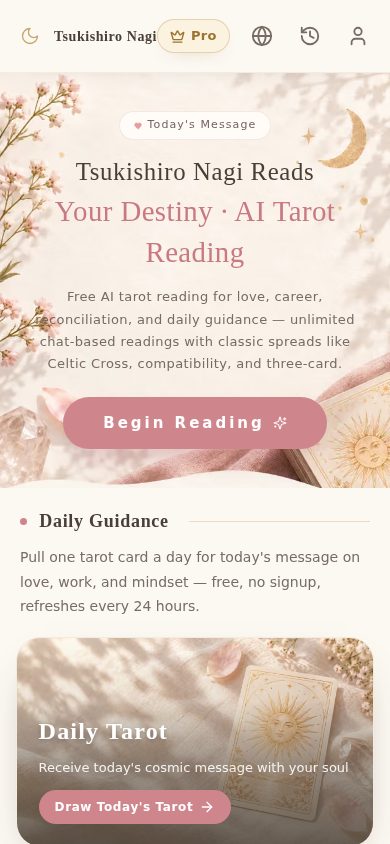
Unmei Tarot logo

Unmei Tarot Review

Visit

Free AI tarot readings for love, career, and daily guidance

Unmei Tarot is a chat-based AI tarot reading service for questions about love, career, and daily life.

AI Panel Score

6.8/10

6 AI reviews

Reviewed

Facts checked against unmei-tarot.com

About Unmei Tarot

Unmei Tarot presents tarot readings through a chat interface where users interact with an AI persona called Tsukishiro Nagi. Rather than displaying a static card draw, the service frames the reading as a conversation, letting users ask about specific situations such as love, reconciliation, compatibility, career, or broader life questions and receive guidance in response.

The site highlights support for multiple spread types, including the Celtic Cross and other professional-level layouts, suggesting readings can range from quick daily guidance to more structured, multi-card interpretations. The readings are described as free, positioning the chat-based format and AI-driven delivery as the core differentiators from traditional tarot reading formats.

The service is aimed at individuals seeking guidance on personal topics like relationships and career through an accessible, no-cost chat tool.

Features

AI

  • Advanced Reconciliation Analysis

    A Pro feature that gives deeper insight into the possibility and timing of reconciling a broken relationship.

  • Chat Follow-Up Questions

    Lets users ask follow-up questions about any part of their reading, similar to sitting with a human reader in person.

  • Conversational AI Tarot Reading

    An AI reader (Tsukishiro Nagi) shuffles a full 78-card Rider-Waite-Smith deck and interprets each card upright or reversed, in its spread position, against the user's specific question, delivered as a chat conversation rather than a static list.

  • Reversed Card Interpretation

    Interprets cards that appear reversed in context (e.g., blocked energy, inward expression, caution) rather than as a simple opposite meaning.

Core

  • 16-Card Annual Forecast (Gate of Dreams)

    Delivers a Pro, cinematic year-ahead forecast built from 16 cards to decode the coming year's destiny.

  • Career & Decision Spreads

    Offers Either-Or Decision and Career Path spreads to help with career direction and binary life choices.

  • Celtic Cross Spread

    Provides a classic multi-card tarot spread for deep analysis of complex life matters.

  • Daily Tarot Pull

    Lets users draw one free card per day for guidance on love, work, and mindset, with no signup required and a refresh every 24 hours.

  • Hexagram Spread

    Uses a six-pointed star layout to deliver a 360-degree reading of a situation.

  • Horseshoe Spread

    Lays out a seven-card timeline reading for comprehensive life guidance.

  • Love & Relationship Spreads

    Includes reconciliation, compatibility, relationship forecast, and interpersonal-matters spreads focused on romantic and relational questions.

  • Multilingual Support

    Provides readings in English, Japanese, Korean, and Chinese.

  • Multiple Tarot Spreads

    Offers a range of spread formats including one-card, three-card, Yes or No, compatibility, reconciliation, Horseshoe, Hexagram, and Celtic Cross for different question types.

Security

  • Account-Linked Private Readings

    Ties questions and readings to a user's account so they are kept private and never shared, while anonymous readings are not stored beyond the session.

Support

  • Tarot Knowledge Library

    Offers written guides and articles on tarot card meanings, symbolism, and beginner topics such as 'Tarot for Beginners' and individual card breakdowns.

Preview

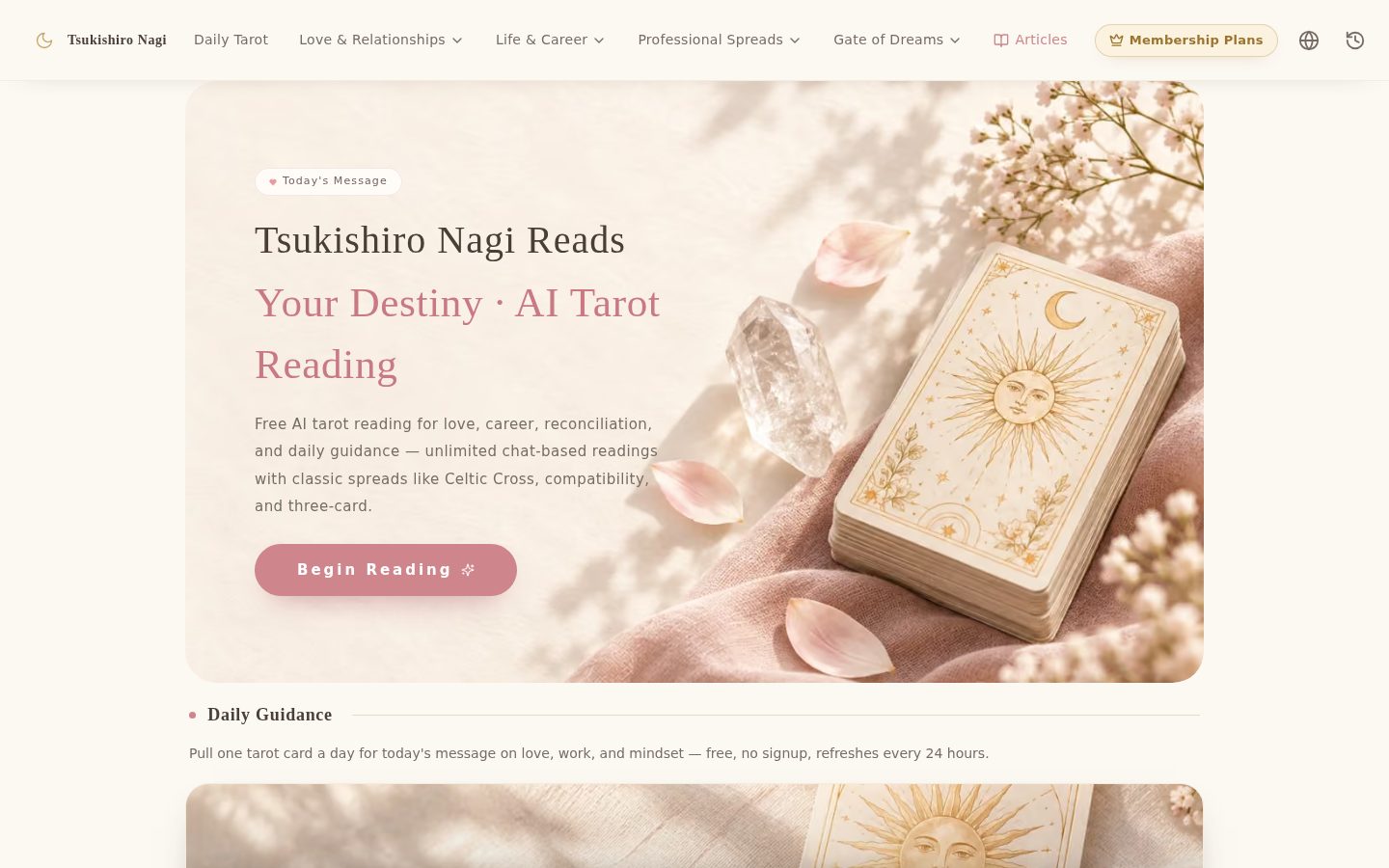
Unmei Tarot desktop previewUnmei Tarot mobile preview

AI Panel Reviews

The Decision Maker

The Decision Maker

Strategic bet, vendor viability, timing, adoption approval
6.8/10

A free daily tarot pull with a named persona, but no board will ever ask about this vendor.

“Unmei Tarot is a chat-based reading tool with a free daily card and a deep bench of paid spreads. Fine for what it is, but it's not a business tool.”

One free card a day, no signup. That's a real hook, and the Celtic Cross, Hexagram, and 16-card Gate of Dreams spreads show someone built out the catalog with intent. Reversed-card interpretation in context, not just flipped meaning, is a nice detail most AI tarot clones skip.

Two things I can't check: pricing on the Pro tiers, and whether Tsukishiro Nagi is one model or a maintained product. Multilingual support across English, Japanese, Korean, and Chinese suggests real build effort, not a weekend wrapper.

This isn't a strategic bet for any company. It's a consumer novelty app with a privacy note about account-linked readings never being shared. Fun category, zero relevance to enterprise buying.

Competitive Positioning7.0

The 16-card Gate of Dreams forecast and contextual reversed-card reading go further than a basic one-card draw bot, which is the obvious lightweight alternative.

Reputation Risk6.0

Account-linked readings are kept private and anonymous sessions aren't stored, which is a reasonable baseline, but there's no compliance detail for anything beyond casual use.

Speed to Value7.5

The free daily pull with no signup delivers instant payoff, which is the whole point of this category.

Strategic Fit2.0

This is a consumer entertainment chatbot; it has no plausible fit for a company's tooling stack.

Vendor Viability6.5

Feature depth across 10+ spreads and four languages suggests active build, but I couldn't find a changelog or roadmap to confirm ongoing shipping.

Pros

  • Free daily one-card pull with no signup required
  • Wide spread variety including Celtic Cross, Hexagram, and a 16-card annual forecast
  • Reversed cards interpreted contextually rather than as flat opposites
  • Supports English, Japanese, Korean, and Chinese

Cons

  • No visible pricing for Pro-tier spreads like Advanced Reconciliation Analysis
  • Entirely a consumer novelty, with no path to business relevance
  • Can't confirm how actively the product is maintained beyond the feature set

Right for

Someone wanting a free, chat-style tarot pull for personal curiosity.

Avoid if

Skip it if you're evaluating this for any kind of business or team use case.

The Domain Strategist

The Domain Strategist

Craft and strategy in the product's domain — adapts identity per category, same lens
6.8/10

A pleasant one-off chat experience, not a relationship I'd want to manage support escalations around.

“Unmei Tarot is built for a single emotional touchpoint, not an ongoing account relationship. That's fine for the product it's trying to be, but it leaves real gaps if users start treating Tsukishiro Nagi like a recurring confidant.”

From a retention lens, I look at Account-Linked Private Readings and ask what happens when a user comes back six months later expecting continuity. The feature ties readings to an account for privacy, but I can't tell if there's any reading-history view, trend summary, or journal — the connective tissue that turns a one-off session into a habit loop. That matters because tarot users often return during emotional spikes (breakups, job changes), and a service with no visible memory layer forces every reconciliation or career question to start cold.

The Chat Follow-Up Questions feature is the strongest signal here — it mimics sitting with a human reader, which is the right instinct for reducing the "I didn't understand my reading" drop-off that plagues static card-draw tools. But I don't see an escalation path if a user is in real distress over a relationship reading; there's no human-in-the-loop or support contact model visible.

For a free, anonymous-friendly tool, that's an acceptable tradeoff. For anything handling vulnerable emotional moments at scale, it's a gap worth watching.

Category Positioning7.5

Multilingual support across English, Japanese, Korean, and Chinese plus a cinematic 16-card annual forecast differentiates it from single-spread chat novelties.

Domain Fit6.5

The conversational follow-up format matches how people actually process tarot guidance, but there's no visible mechanism for repeat-user continuity or care escalation.

Integration Surface6.5

Account-linked privacy is a baseline trust feature, but I found no sign of CRM-style history, reminders, or lifecycle touchpoints that would retain a returning user.

Long-term Implications6.0

Adopting this as a user creates a session-based habit, not a relationship, since anonymous readings aren't stored beyond the session.

Strategic Depth7.0

A 78-card Rider-Waite-Smith deck with contextual reversed-card interpretation and an 8-spread library shows real craft investment beyond a novelty chatbot.

Pros

  • Chat Follow-Up Questions lets users probe a reading conversationally instead of re-reading a static result
  • Reversed-card interpretation is contextual, which reduces confusing or contradictory guidance
  • Four-language support gives it reach beyond a single-market audience

Cons

  • No visible reading-history or trend view for returning users, which limits habit formation
  • No apparent escalation path for users in genuine emotional distress over relationship or career readings
  • Pro-tier gating details like pricing for Advanced Reconciliation Analysis aren't clear to me

Right for

Someone who wants a quick, private, emotionally low-stakes tarot chat without creating an ongoing account relationship.

Avoid if

Avoid if you're evaluating this as a tool meant to build long-term user retention or handle emotionally sensitive support moments.

The Finance Lead

The Finance Lead

Money, total cost of ownership, contracts, procurement math
6.8/10

Free daily card, Pro tier with no visible number attached.

“Daily one-card pull is free, no signup. Pro spreads like the 16-card Gate of Dreams forecast exist behind a wall I can't price.”

Free daily pull, no signup. That's the entire billing model I can confirm. Everything past it — Advanced Reconciliation Analysis, Gate of Dreams, the deeper Celtic Cross reads — sits behind a Pro label with no dollar figure attached that I could find.

TCO math is impossible without a number. $0/month for daily guidance is real. What Pro costs at 50 readings a year, I can't model. I'd need the actual price before recommending a budget.

No contract terms visible either — term length, auto-renewal, cancellation. Consumer app, so likely month-to-month or one-time unlock, but that's a guess, not a fact. Compare to any subscription app with a public rate card: procurement friction here is low only because there's nothing to procure yet.

Billing & Procurement7.0

No sign-up required for daily use, which removes procurement friction entirely for the free tier.

Contract Flexibility6.5

No subscription terms, auto-renewal windows, or cancellation process visible; likely low-stakes but unconfirmed.

Pricing Transparency5.5

Free daily tier is clear; Pro tier pricing for features like Advanced Reconciliation Analysis isn't visible anywhere I could find.

ROI Clarity6.0

Value is personal guidance, not a measurable business outcome — ROI math doesn't apply the way it does for work tools.

Total Cost of Ownership5.0

Can't build a 3-year cost model with zero Pro pricing data; free tier alone costs $0 but caps at one card a day.

Pros

  • Daily one-card pull costs $0 with no signup required
  • Four languages reduces per-market localization spend

Cons

  • Pro tier pricing for features like the 16-card Gate of Dreams forecast isn't visible
  • No contract terms or cancellation process I could confirm

Right for

Someone who wants a free daily card pull with zero billing commitment.

Avoid if

You need a fixed Pro-tier price before budgeting for repeated use.

The Domain Practitioner

The Domain Practitioner

Daily hands-on reality in the product's domain — adapts identity per category, same lens
6.8/10

Fine for a quick tarot chat, but there's no ticket trail if a user comes back upset

“Unmei Tarot reads like a self-serve chatbot with zero human-in-the-loop safety net. For my seat, that's the whole review.”

Looking at this from a support angle: the whole product is unattended chat. Tsukishiro Nagi handles love, career, and reconciliation questions with no mention of a handoff to a human, a contact form, or a ticket queue anywhere in the flow I could find. For a novelty card pull that's fine. For someone mid-breakdown asking about reconciliation at 2am, there's no visible off-ramp.

The account-linked privacy model is the one piece that reads support-aware — readings tied to an account persist, anonymous ones don't outlive the session, which at least gives me something to point to if a user asks "where did my data go." But I'd want a visible privacy policy link in the chat itself, not just referenced in an FAQ answer, before I'd feel good fielding that question myself.

Multilingual coverage across English, Japanese, Korean, and Chinese is solid groundwork, but four languages with no stated support contact in any of them is a gap I'd flag immediately.

Day-3 Reality6.5

The daily free pull is a nice repeat hook, but nothing in the product suggests what happens when a user has a complaint or a billing confusion on a Pro spread.

Documentation Practitioner-Fit7.0

The Tarot Knowledge Library with beginner guides and card breakdowns is the kind of self-serve content that deflects basic 'what does this card mean' questions before they become a chat.

Friction Surface6.5

Chat Follow-Up Questions reduces one kind of friction — re-asking for clarification — but the account-vs-anonymous data split could itself generate confused tickets about lost readings.

Power-User Depth6.8

Spread variety from one-card to the 16-card Gate of Dreams forecast scales well for engaged users, but I found nothing about account recovery or dispute handling at the deeper, presumably paid, tiers.

Workflow Integration5.5

There's no indication of a support queue, help center, or escalation path integrated into the chat experience itself.

Pros

  • Tarot Knowledge Library can deflect basic card-meaning questions without a human touching them
  • Account-linked privacy model gives a clear, simple answer to 'is my reading private'
  • Four-language chat coverage without needing separate regional support staffing

Cons

  • No visible contact method, help center, or escalation path if a user is dissatisfied with a reading
  • No stated process for what happens to a paid Pro reading if the session errors out mid-conversation

Right for

Someone building light-touch self-serve content around a low-stakes consumer chatbot with minimal support overhead expectations.

Avoid if

You need any visible human escalation path for users who react badly to emotionally loaded relationship or career readings.

The Power User

The Power User

Daily human experience, onboarding, polish, learning curve, reliability
7.1/10

Chatty tarot that's good for killing five minutes, less sure of itself at ten.

“Unmei Tarot wraps a full 78-card deck in a chat persona that lets you argue with your own reading. Whether that holds up past the first few sessions depends on things I can't see from outside the chat window.”

The core trick here is good: instead of a flat card image and a paragraph, you get Tsukishiro Nagi as a chat partner, and the Chat Follow-Up Questions feature means you can push back on a reading instead of just staring at it. That's the right instinct for a tarot product — the format should feel like sitting across from someone, not reading a fortune cookie.

Where I get nervous is the first ten minutes. A free daily pull is frictionless, but the moment you want a Celtic Cross or the 16-card Gate of Dreams forecast, you're in Pro territory with no price I could find, and no sense of what the chat does if your connection drops mid-reading. For a conversational format, that's exactly the moment reliability matters most.

Mobile isn't mentioned as its own thing, which for a chat-first product is a decent sign — chat usually travels fine. But a tool this personal lives or dies on whether month three feels different from day one, and right now I can't tell if it does.

Daily Polish7.0

The daily one-card pull with a 24-hour refresh is a nice small-habit mechanic, but I can't see how later-session error states or copy are handled.

Learning Curve7.3

The spread range from one-card to the 16-card annual forecast scales naturally, but the Tarot Knowledge Library is the only signal of structured learning past casual use.

Mobile Parity7.0

Chat formats tend to travel well to mobile by nature, though I found no explicit mobile app or feature parity notes to confirm it beyond the browser.

Onboarding Experience7.8

No signup needed for the free daily pull is a genuinely low-friction start, though the jump into Pro spreads looks less guided.

Reliability Feel6.3

A mid-conversation error in a multi-card paid reading has no visible resolution path that I could confirm, which matters more in chat than in a static draw.

Pros

  • Full 78-card Rider-Waite-Smith deck interpreted in context, not just drawn and labeled
  • Chat follow-up lets you dig into a specific card instead of re-reading the whole spread
  • Free daily pull with zero signup lowers the bar to just try it

Cons

  • No visible pricing for Pro spreads like the Gate of Dreams forecast
  • Unclear what happens to a paid reading if the chat session errors out
  • Entirely novelty-use, no deeper utility beyond the reading itself

Right for

Someone who wants a quick, free daily tarot check-in without creating an account.

Avoid if

Avoid if you want firm pricing and reliability guarantees before committing to Pro spreads.

The Skeptic

The Skeptic

Contrarian. Watch-outs, deal-breakers, broken promises, category patterns
6.2/10

Free daily card pull. 78-card deck. Nothing about who's behind it.

“Unmei Tarot stacks a wide spread library onto a chat persona with a Japanese name, but I can't find who runs this or what Pro actually costs. Fine for a free spin, risky if you're attached to your reading history.”

Tsukishiro Nagi is a good hook — named persona, full Rider-Waite-Smith deck, upright and reversed interpretation. That's more texture than most AI-tarot novelty sites bother with. The spread list (Celtic Cross, Hexagram, Horseshoe, Gate of Dreams) reads like someone who actually knows tarot built the taxonomy, not just scraped Wikipedia.

But I couldn't find a company page, a changelog, or a pricing table. Account-linked readings are private, per their own privacy answer, which is a real claim with a real mechanism behind it. Good. Still, no visible owner behind an AI persona giving relationship and career guidance is the kind of gap I'd want closed before trusting it with anything I'd mind losing.

Competitively this lane is full of astrology-chatbot clones; nothing here names an alternative to contrast against, so I can't tell you what makes this the one to pick over the others.

Competitive Differentiation5.8

A persona name and multilingual coverage (English, Japanese, Korean, Chinese) help, but nothing in their materials names what they're beating or why.

Exit Portability5.5

Readings are tied to an account with no export or history view mentioned, so whatever you've built up stays locked in if you leave.

Long-term Viability5.8

No changelog, no company info, no support channel I could find — could be actively run, could be a one-person site, I genuinely can't tell.

Marketing Honesty6.8

The free-daily-pull claim checks out per their own FAQ, but Pro-tier claims like the 16-card forecast have no visible pricing to test them against.

Track Record Match6.5

Reversed-card and full-deck claims are specific enough to be checkable, which is more than most tarot bots offer, but there's no track record beyond the feature list itself.

Pros

  • Full 78-card deck with contextual reversed-card logic, not a coin flip
  • Four-language coverage is a real, checkable claim
  • Account-linked privacy model has an actual stated mechanism

Cons

  • No visible company or team information behind the persona
  • No pricing table for Pro spreads like the Gate of Dreams forecast
  • No reading-history export mentioned if you want to leave

Right for

Someone who wants a free, well-structured tarot chat and doesn't mind the Pro tier being a black box.

Avoid if

You want to know who's running the service or what it costs before committing to a Pro spread.

Buyer Questions

Common questions answered by our AI research team

Pricing

Is Unmei Tarot free to use?

Yes, daily tarot is free forever with no sign-up required. Yes or No Tarot, One Card Tarot, and How Do They Feel Tarot let you read the first half of your reading free, while deeper spreads include a free daily allowance before moving to Pro tiers.

Features

What tarot spreads are available?

Spreads range from a free daily one-card pull and three-card past-present-future reading up to compatibility, reconciliation, Either-Or Decision, Career Path, Horseshoe, Hexagram, Celtic Cross, and a 16-card annual forecast called Gate of Dreams.

Features

Does it use reversed tarot cards?

Yes. Cards appear upright or reversed, and reversed meanings are interpreted in context — typically as blocked energy, an inward expression, or a need for caution — rather than as a strict opposite of the upright meaning.

Features

What languages does Unmei Tarot support?

Unmei Tarot is available in English, Japanese, Korean, and Chinese.

Security

Is my reading history kept private?

Readings tied to your account are never shared, and anonymous readings aren't stored beyond your current session. Full details are covered in the privacy policy.

Product Information

  • Company

    Unmei Tarot
  • Pricing

    Freemium
  • Free Plan

    Available

Platforms

web

About Unmei Tarot

Unmei Tarot offers free, chat-based AI tarot readings through a persona called Tsukishiro Nagi, covering topics such as love, career, and compatibility.

Also in AI Chatbots