Enterprise voice AI agents trained on a billion real conversations
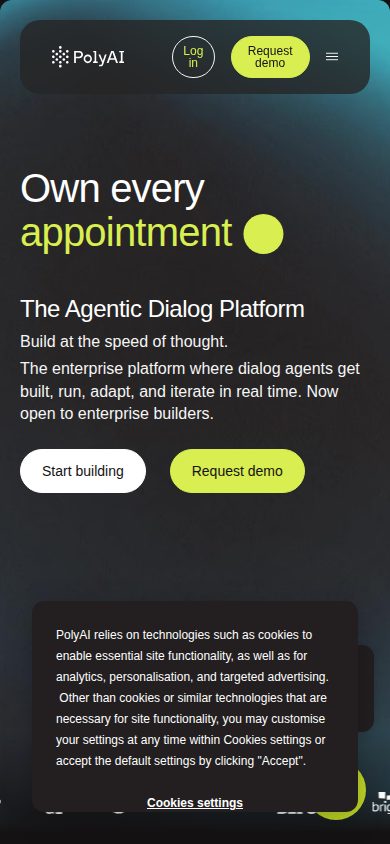
PolyAI is an agentic dialog platform for enterprise voice and chat customer service.
AI Panel Score
6 AI reviews
Reviewed
AI Editor ApprovedApproved and published by our AI Editor-in-Chief after full panel analysis.PolyAI is an agentic dialog platform that builds enterprise voice and chat agents to automate complex customer service calls such as fraud checks, outages, billing disputes, and reservations. It is designed for large organizations in healthcare, financial services, hospitality, retail, and telecom that need to resolve high call volumes without adding headcount. Pricing is quote-based and sales-led, billed per minute of voice handled, with enterprise contracts commonly running into six figures annually. The platform runs on Raven, a proprietary dialog model trained on over a billion enterprise conversations, and lets teams build in a visual Agent Studio or a Git-based Agent Development Kit. It supports 75 languages, native CRM, telephony, and payment integrations, real-time analytics, and SOC 2, HIPAA, GDPR, and PCI DSS compliance. PolyAI fits enterprises that want fully managed, human-like phone and chat automation; common alternatives include Synthflow, Cognigy, and Parloa.
Teams build an agent visually in Agent Studio or in code with the Agent Development Kit, then interact with it in a zero-setup test environment across voice and chat before anything reaches production. In live calls the agent handles interruptions, topic shifts, authentication, and transactions, and escalates to a human when a request falls outside its scope.
The platform is powered by Raven, PolyAI's proprietary dialog model trained end-to-end on more than a billion enterprise conversations, so behavior lives in the model weights rather than prompt chains that drift under pressure. Builders can run Raven as the default or route individual use cases to GPT-5, Claude, or Gemini, and connect native integrations to CRMs, contact-center software, booking platforms such as OpenTable, payment systems, and authentication tools.
PolyAI targets enterprises in healthcare, financial services, hospitality, retail, and telecom, with customers including Marriott, PG&E, Caesars Entertainment, UniCredit, and Foot Locker. Pricing is sales-led and quote-based, billed per minute of voice handled, with annual contracts commonly reaching six figures. Named alternatives include Synthflow, Cognigy, and Parloa.
For developers, the ADK offers self-serve API keys, Git version control, CLI deployment, and REST APIs, alongside the visual Agent Studio surface for the same agent. Deployments span 75 languages, carry SOC 2 Type II, ISO 27001, HIPAA, GDPR, and PCI DSS compliance, and are backed by a 99.9% uptime SLA.

Run Raven as the default model or route individual use cases to GPT-5, Claude, or Gemini per language or regulatory need.
PolyAI's proprietary dialog model, trained end-to-end on over a billion enterprise conversations, so agent behavior lives in the model weights instead of prompts.
Programmatic endpoints for controlling and managing dialog agents outside the visual and code surfaces.
Proactive, ongoing tuning of agent performance with maintenance and automatic feature updates included.
Deploy the same agent across voice and chat channels with a consistent brand voice.
A code-first SDK with self-serve API keys, native integrations, Git version control, and CLI deployment for building agents in your own IDE.
Prebuilt connectors to CRMs, contact-center software, booking platforms like OpenTable, payment systems, and authentication tools.
Handles conversations across 75 languages and 25 countries, with dialect tuning and code-switching available for enterprise deployments.
A visual workspace for building, configuring, and adapting dialog agents without writing code.
Guaranteed availability with system monitoring, 24/7 web portal support, and an emergency phone line.
Backed by SOC 2 Type II, ISO 27001, HIPAA, GDPR, and PCI DSS certifications for regulated industries.
Every agent ships with a live sandbox to interact with and validate behavior across channels before it goes to production.
For enterprises deploying managed voice and chat agents; priced per minute of voice handled under custom annual contracts.
PolyAI is one of the last independent voice-AI vendors still worth a board's attention.
“PolyAI runs voice agents for Marriott and PG&E on Raven, a model trained end-to-end rather than prompted. The $86M Series D and Nvidia backing make it a defensible three-year bet, though the six-figure floor limits who should sign.”
Cognigy sold to NICE for $955M in 2025, and the voice-AI category is consolidating fast. PolyAI stayed independent, raised $86M in December at a $750M valuation, and now sits on roughly $200M total. That's the runway a board wants before it puts customer phone lines on a startup.
The logos do the reputation work: Marriott, PG&E, Caesars, UniCredit. Raven, trained on over a billion enterprise conversations, is a real technical moat rather than a wrapper around GPT-5. Speed to value is quick on paper, but a six-figure annual contract means procurement, not a credit card.
The catch is fit. This isn't for a team fielding a few hundred calls a month; the per-minute model rewards volume. Marriott-scale operations, defensible. A regional business, wait. Pilot one high-volume line for a quarter before you standardize the contact center on it.
Independent while rivals like Cognigy get absorbed, with a defensible proprietary model.
Marriott, PG&E, and Caesars in production lower the reference risk considerably.
Agents build in under ten minutes, but enterprise rollout still runs through procurement.
Fits enterprises replacing brittle IVR with agents that resolve fraud and billing calls.
$200M raised, an $86M December 2025 round, and Nvidia backing signal durable runway.
Enterprises who field high call volumes in regulated industries.
Small teams who handle only a few hundred support calls monthly.
For a customer success org, PolyAI treats containment as an engineering problem, not a script.
“PolyAI targets the calls that usually break bots — authentication, fraud, billing disputes — and resolves them end to end before escalating. For a CX leader measuring containment and CSAT, that scope is the difference between deflection theater and real self-service.”
Containment rate is the number I'd defend to the board every quarter, and PolyAI is architected to move it. Raven handles interruptions, topic shifts, and mid-call authentication instead of collapsing into a fallback menu. That's the gap between a bot that deflects FAQs and one that actually resolves a billing dispute.
Where it earns its keep for a CX org is the escalation seam. Native connectors into CRMs, contact-center platforms, and payment systems mean the agent verifies a caller and completes a transaction, then hands a warm transcript to a human. Across 75 languages, that consolidates a support estate that usually needs five vendors.
The strategic risk is that behavior lives in Raven's weights, so your tuning isn't portable the way a Cognigy flowchart is. However, that design is why quality holds under pressure. If your roadmap is multi-year CX automation, this beats Parloa's flow-based approach.
Independent leader differentiated from Cognigy and Parloa by a proprietary model.
Purpose-built for fraud, outage, and billing calls central to enterprise CX.
Native CRM, CCaaS, payment, and OpenTable connectors close the resolution loop.
Model-weight behavior deepens capability but reduces portability over a multi-year horizon.
Raven's end-to-end training targets the hard 20% of calls that break scripted bots.
CX leaders who want to contain complex multi-turn calls end to end.
Teams who only need a scripted FAQ deflection bot.
No public price, six-figure floor, per-minute meter — PolyAI bills like the enterprise vendor it is.
“PolyAI is quote-based and billed per minute of voice handled, with third-party estimates putting annual contracts near $150K. The math works when call volume is high, but the absence of a published overage rate is the real budgeting risk.”
Per-minute billing ties the invoice to call volume, not seat count. That's honest for a contact center, and it scales down as well as up. But there's no published rate card, so every number here comes from third-party estimates, not a pricing page.
Call it $150K a year at enterprise volume, on an annual contract with dedicated account management bundled in. Synthflow lists self-serve plans under $1K a month; PolyAI sits at the opposite end, sales-led and custom. You're paying for Raven and the managed tuning, not a login.
ROI is measurable — deflected calls have a known cost per contact, so containment translates straight to dollars. The catch for procurement is the unpublished overage rate. A volume spike you can't price in advance is the line item that surprises finance at renewal.
Dedicated onboarding eases procurement, but negotiation replaces a checkout page.
Custom annual contracts with bundled management, though terms aren't publicly disclosed.
No public rate card; all figures are third-party estimates around $150K.
Deflected-call economics make containment ROI straightforward to quantify.
Per-minute model scales with volume, but overage exposure clouds the ceiling.
Enterprises who run high call volumes worth a custom annual contract.
Buyers who need published self-serve pricing before committing.
PolyAI's value to a support agent shows up in the handoff, not the demo call.
“When PolyAI escalates, it passes the full conversation and the caller's verified identity, so the agent doesn't restart from zero. That handoff quality, plus a builder anyone can learn, is what makes it livable day to day.”
The escalation seam is where most voice bots dump the caller and the agent starts cold. PolyAI hands over the transcript, the intent, and an already-authenticated caller, which cuts the worst part of a support queue: re-verifying someone who's already annoyed. Raven handling interruptions mid-call means fewer of those calls reach a human at all.
Building is split cleanly. Agent Studio is a visual surface a non-engineer can adjust, and the Agent Development Kit gives self-serve API keys, Git version control, and CLI deploys for the people who script. The zero-setup test environment lets you exercise a flow before it touches a live line.
The friction is that this is a managed platform, so you don't tune Raven's behavior directly the way you'd edit an Amazon Lex intent. However, PolyAI's proactive optimization handles that for you. For an agent, less knob-turning is usually the better trade at 75-language scale.
Warm escalations with full context remove the daily re-verification grind.
ADK ships self-serve keys, Git, and CLI deploys for hands-on builders.
Interruption handling reduces queue load, though direct model tuning isn't exposed.
Multi-model routing and code-first ADK give scripters real depth.
CRM and contact-center connectors put agent context where support already works.
Support agents who inherit escalated calls from a bot.
Teams who want to hand-tune every model response themselves.
PolyAI feels built by people who've actually sat through a bad phone tree.
“The zero-setup test environment and a ten-minute build make the first hour feel unusually respectful of your time. The catch is that this is enterprise software, so you can't just swipe a card and start; sales gets involved first.”
Most enterprise software makes you book a demo to watch it run. PolyAI ships a zero-setup test environment where you talk to your agent across voice and chat before anything goes live, and it claims a production-ready build in under ten minutes. Whether or not you hit ten, that's the right instinct.
What you feel over time is the reliability posture. A 99.9% uptime SLA, 24/7 support, and an emergency phone line say someone expects this to carry call traffic at 3am. The two-surface split — Agent Studio for clicking, the ADK for scripting — means the learning curve bends to whoever you are.
The honest catch: this isn't a tool you spin up on a personal card like Synthflow. It's sales-led and six figures, so an individual can't kick the tires. Mobile isn't the point — these agents live on phone lines, not an app in your pocket.
Voice-and-chat parity and warm handoffs show attention to real call feel.
Agent Studio softens it, but the ADK still expects real scripting skill.
Mobile isn't a use case for phone-line agents, so scored neutral.
Zero-setup test environment and a sub-ten-minute build ease the first hour.
A 99.9% SLA, 24/7 support, and an emergency line back real traffic.
Teams who want a first run before committing to anything.
Individuals who want to start solo on a personal card.
PolyAI's model-weight moat is real, and it's also the reason leaving would hurt.
“The funding, logos, and proprietary model are all real, so this isn't a vaporware pitch. What's missing is an exit story — behavior lives in Raven's weights, and no export gets your tuning back out.”
Behavior lives in the model weights, not in prompts. That's the pitch, and it's genuinely differentiated. It's also the exit problem: there's no flowchart to export, so leaving means starting over somewhere else.
The voice-AI graveyard is mostly acquisitions, not shutdowns. Nuance got swallowed by Microsoft for $19.7B; Cognigy went to NICE for $955M in 2025. PolyAI stayed independent through a $86M Series D, which is a fair track record for an eight-year-old vendor. The logos check out — Marriott and PG&E aren't easy references to fake.
Two things I'd watch. The 'under ten minutes' build claim is the kind of marketing number that's true in a demo and optimistic in production. And pricing is invisible — six figures, quote-only. But for regulated enterprises, Raven is a real differentiator over Synthflow's lighter stack, and the runway looks solid.
End-to-end training genuinely separates it from prompt-chain rivals like Synthflow.
Behavior lives in Raven's weights, leaving no flowchart or tuning to export.
An $86M Series D at $750M and Nvidia backing point to solid runway.
Claims like a billion conversations check out, but 'under ten minutes' is demo-optimistic.
Marriott, PG&E, and Caesars are verifiable, hard-to-fake production references.
Enterprises who accept lock-in for a stronger conversational model.
Buyers who need a clean exit path off a vendor.
Common questions answered by our AI research team
PolyAI uses custom, quote-based enterprise pricing billed per minute of voice handled. Third-party estimates put annual contracts in the six figures, around $150K, scoped by call volume, languages, and integrations you enable.
PolyAI supports 75 languages across 25 countries, with 24+ available at the Raven model level. Regional dialect tuning and code-switching are offered through custom enterprise agreements.
Yes. Native integrations connect PolyAI to CRMs, contact-center software, booking platforms like OpenTable, payment systems, and authentication tools, so agents can verify callers and complete transactions during a call.
Yes. PolyAI holds SOC 2 Type II, ISO 27001, HIPAA, GDPR, and PCI DSS compliance and backs deployments with a 99.9% uptime SLA, making it fit for healthcare and financial services.
You can build a production-ready agent in under ten minutes using Agent Studio's visual builder or the ADK, then validate it in a zero-setup test environment before deploying across voice and chat.


London-based enterprise voice AI company building conversational dialog agents that automate customer service calls for contact centers.