WorkFusion logo

WorkFusion Review

Visit

AI Agents that review and resolve financial crime compliance alerts

WorkFusion is an AI Agent platform for financial crime compliance teams at banks and financial institutions.

AI Panel Score

7.1/10

6 AI reviews

Reviewed

AI Editor Approved

About WorkFusion

WorkFusion's AI Agents are deployed alongside existing compliance teams to take over repetitive alert review and investigation work. In practice, this means the AI Agents ingest alerts from sanctions screening, transaction monitoring, or KYC processes, apply Level 1 review logic to every alert, and escalate only the cases that require human judgment. Each decision comes with a documented narrative and audit trail so compliance staff and regulators can review how the AI Agent reached its conclusion.

The platform is built around eliminating false-positive alert backlogs rather than tuning detection systems to reduce them. WorkFusion states its AI Agents can review alerts in seconds regardless of volume, are enhanced with generative AI to increase straight-through processing rates up to 95%, and are designed for explainability aligned with model risk management (MRM) requirements. The company reports typical onboarding and training timelines of 4-6 weeks for new deployments. Specific product areas include sanctions and PEP screening, adverse media monitoring, transaction screening for OFAC/AML adjudication, enhanced due diligence, transaction monitoring, and KYC onboarding, along with custom AI Agents for other back-office functions such as customer service or billing.

WorkFusion is aimed at banks, financial institutions, and their compliance, risk, and operations teams, particularly those handling high volumes of AML, sanctions, and KYC alerts. The company states it is used by 10 of the top 20 banks and cites customers including Scotiabank, Deutsche Bank, LPL Financial, and Raymond James. Pricing is not published and is handled through direct sales; the product competes in the financial crime compliance and RegTech automation space alongside vendors such as NICE Actimize, ComplyAdvantage, and Napier AI.

The platform is SOC 2 certified and delivered as a software solution integrated into a bank's existing compliance workflows and case management systems, though the website does not detail specific technical integration requirements or deployment architecture.


Features

AI

  • AML Compliance AI Agents

    Incorporates AI Agents into the AML compliance team to perform Level 1 alert reviews and Level 2 investigations.

  • Adverse Media Monitoring

    Streamlines investigations of negative news mentions to reduce the risk of regulatory penalties.

  • Explainable AI Decisioning

    Generates decisions aligned with Model Risk Management (MRM) standards that explain how the AI derived each adjudication.

  • GenAI-Enhanced Narrative Generation

    Uses generative AI to accelerate straight-through-processing rates up to 95% and produce narratives beyond current template-based formats.

  • Sanctions Screening AI Agent

    Automatically reviews and adjudicates sanctions and name/PEP screening alerts to help adhere to BSA/OFAC requirements while scaling capacity.

  • Transaction Monitoring

    Enables earlier and faster escalation of potentially suspicious alerts to mitigate financial crime risk.

  • Transaction Screening

    Adjudicates false-positive sanctions alerts in near real-time as an automated OFAC/AML expert focused on flagging risky transactions.

Automation

  • Know-Your-Customer (KYC) Automation

    Reduces manual work and lowers risk in customer onboarding by automating KYC review steps for a faster onboarding experience.

  • Level 1 Alert Review Automation

    Instantly reviews every alert and applies Level 1 logic to every decision, eliminating alert backlogs regardless of volume.

Core

  • Entity Data Matching for Perpetual Screening

    Automates entity data matching for ongoing perpetual screening, enabling volume growth without adding headcount, as used by Raymond James.

Customization

  • Custom AI Agents for Other Business Areas

    Provides custom AI Agents tailored to needs beyond compliance, including customer service, billing & invoices, and data analysis.

Security

  • Audit Trail & Regulator-Ready Documentation

    Documents every alert decision with detailed narratives and complete audit trails intended to satisfy regulator review.

Preview

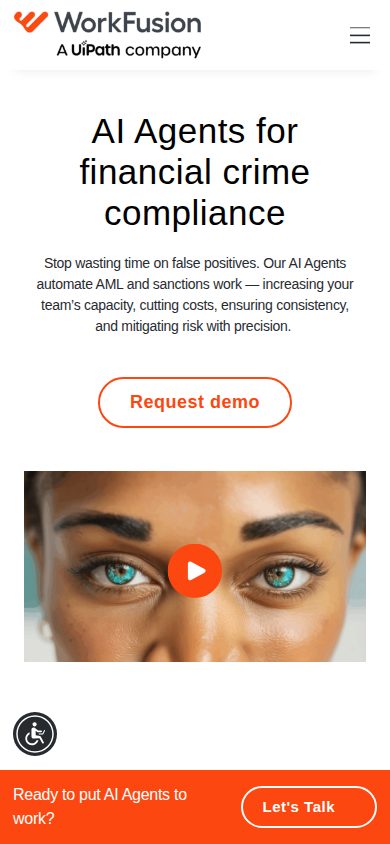
WorkFusion desktop previewWorkFusion mobile preview

Pricing Plans

Contact Sales

Contact sales

WorkFusion is an enterprise-focused provider of AI-powered automation and AML/KYC compliance solutions (e.g., Smart IQ, AML compliance robots). It does not publish list pricing publicly; costs vary based on the specific product modules selected (document processing, sanctions screening, KYC, transaction monitoring), deployment scale, data volume, and contract length. Prospective buyers must contact WorkFusion's sales team for a custom quote.

  • Custom quote based on modules selected (e.g., AML compliance robots, Smart IQ document intelligence)
  • Enterprise-scale deployment for banks, fintechs, and large organizations
  • Tailored implementation and integration support
  • Volume-based and usage-based pricing negotiated per contract

AI Panel Reviews

The Decision Maker

The Decision Maker

Strategic bet, vendor viability, timing, adoption approval
7.8/10

Ten of the top 20 banks already use it. That's not a pilot signal, that's a market.

WorkFusion automates Level 1 and Level 2 compliance review with audit trails built for regulators. Long enterprise sales cycle, no published pricing, but the customer list does the talking.

Scotiabank, Deutsche Bank, LPL Financial, Raymond James. Ten of the top 20 banks, per their own claim. That's not a startup hoping banks show up someday — that's a vendor already inside the regulatory perimeter, which matters more than any feature list.

Two questions. Does explainable AI aligned to Model Risk Management actually hold up under an examiner's questioning? And does 95% straight-through processing hold at your alert volume, or is that a best-case number from a reference customer? No pricing page, no free trial — this is a six-to-seven-figure sales cycle, not a swipe-the-card decision.

Competitors here are NICE Actimize, ComplyAdvantage, Napier AI. WorkFusion's pitch is adjudication, not just detection — a real differentiator if the audit trail holds up in an exam. SOC 2 certified, 4-6 week onboarding claimed. Compliance leadership won't get fired for shortlisting this one.

Competitive Positioning8.0

Adjudication-not-just-flagging positioning differentiates from NICE Actimize and ComplyAdvantage in a crowded RegTech field.

Reputation Risk8.0

Deutsche Bank and Scotiabank as reference customers make this a defensible, not sketchy, choice for a board.

Speed to Value7.5

4-6 week onboarding claim is fast for enterprise compliance software, if it holds outside marketing copy.

Strategic Fit7.0

Mostly cost and headcount reduction on existing alert volume, not new capability — though KYC and adverse media coverage extend reach.

Vendor Viability7.5

No public funding data, but tenure and a top-tier bank customer base suggest real staying power.

Pros

  • Named enterprise customers across top-20 banks lend real credibility
  • Audit trail and MRM-aligned explainability built for regulator review, not just internal use
  • Fast claimed onboarding (4-6 weeks) versus typical compliance software rollouts

Cons

  • No published pricing means every deal starts as a negotiation with no anchor
  • 95% STP figure is a vendor claim, not an independent audit
  • No free trial, so evaluation depends entirely on sales-led POC

Right for

Banks and financial institutions drowning in false-positive alert backlogs who need documented, regulator-ready decisions at scale.

Avoid if

Skip if you need transparent pricing or a self-serve trial before committing procurement time.

The Domain Strategist

The Domain Strategist

Craft and strategy in the product's domain — adapts identity per category, same lens
7.6/10

Regulator-ready narratives are the right instinct, but the model risk file will be the real test.

WorkFusion automates Level 1/L2 alert adjudication with audit trails aligned to MRM expectations. My exam-readiness concern isn't the AI — it's whether our validation function can keep pace with it.

Ten of the top 20 banks as customers, plus Scotiabank and Deutsche Bank named publicly — that's real regulatory mileage, not vaporware. The framing of explainability aligned to Model Risk Management standards tells me someone on their team has sat through an OCC or Fed exam before.

My question isn't whether the AI can adjudicate a sanctions hit. It's whether my MRM team can validate a GenAI narrative generator pushing 95% straight-through processing without creating a second, harder-to-explain black box. SOC 2 certification covers data security; it says nothing about model governance documentation I'll need for annual validation.

Four-to-six week onboarding is fast for AML tooling, faster than most core replacements, but that speed only helps if the audit trail holds up under an examiner's second look. Compared to NICE Actimize or ComplyAdvantage, WorkFusion is betting on adjudication depth over detection tuning — a real strategic tradeoff, not a wash.

Category Positioning7.9

Named alongside NICE Actimize and Napier AI, but differentiates on adjudication rather than detection tuning.

Domain Fit8.0

Built around alert backlog elimination, matching how AML operations teams actually triage volume.

Integration Surface6.8

No published API or docs, and deployment architecture is unspecified beyond 'integrated into existing case management.'

Long-term Implications7.0

95% STP creates efficiency but concentrates institutional judgment inside a vendor's model, a 3-year governance dependency.

Strategic Depth7.8

L1/L2 adjudication with documented narratives goes beyond flagging tools like ComplyAdvantage's core screening.

Pros

  • Named customers at top-20 bank scale (Scotiabank, Deutsche Bank)
  • Explainability framing built around MRM validation needs
  • 4-6 week onboarding is fast relative to core AML system change

Cons

  • No published pricing or integration architecture detail
  • GenAI narrative generation adds a new model governance burden, not just efficiency
  • SOC 2 covers security, not model risk documentation examiners will ask for

Right for

Banks with mature MRM functions ready to validate a GenAI adjudication layer, not just a screening tool.

Avoid if

Avoid if your model risk validation team can't yet handle explainability review of generative narrative output.

The Finance Lead

The Finance Lead

Money, total cost of ownership, contracts, procurement math
6.4/10

Zero pricing. Zero tiers. Zero benchmark for your CFO to model against.

No published number, anywhere. Enterprise sales-quote model, standard for the category, expensive to evaluate.

No pricing page. No tiers. Just 'contact sales' — same as ComplyAdvantage, same as NICE Actimize. Category norm, not a red flag by itself.

But it means real TCO work: modules (sanctions, KYC, transaction monitoring) priced separately, volume-based, negotiated per contract. A bank running 50,000 alerts/month has no way to model year-1 cost, let alone year 3. Onboarding runs 4-6 weeks — that's implementation cost before you've adjudicated a single alert. No number attached to that either.

ROI story leans on 95% straight-through-processing. Real metric, if audited. But no case study with dollar figures, no cost-per-alert-reviewed comparison. 10 of top 20 banks use it — Scotiabank, Deutsche Bank, Raymond James named as customers. That's credibility. It's not a cost model.

Procurement friction will be high. Budget for a 6-month sales cycle, not a signup form.

Billing & Procurement5.0

Enterprise direct-sales model, standard for RegTech, but no invoicing or payment terms published.

Contract Flexibility5.5

No term length, renewal, or cancellation terms disclosed anywhere in evidence.

Pricing Transparency3.0

No list pricing, no tiers, module-based quotes only per the pricing page text.

ROI Clarity6.5

95% STP claim is measurable in principle but no dollar-denominated case study provided.

Total Cost of Ownership5.0

4-6 week onboarding plus per-module, volume-based pricing makes 3-year cost unmodelable from public evidence.

Pros

  • 10 of top 20 banks as reference customers
  • Audit trail and MRM-aligned explainability built into the workflow
  • 4-6 week onboarding, fast for enterprise compliance software

Cons

  • No published pricing at any tier
  • 3-year TCO impossible to model without a sales call
  • No stated contract term, renewal, or cancellation policy

Right for

Banks with existing AML alert backlogs and budget for a full enterprise procurement cycle.

Avoid if

You need a comparable number before your first sales call, like you'd get from ComplyAdvantage's published tiers.

The Domain Practitioner

The Domain Practitioner

Daily hands-on reality in the product's domain — adapts identity per category, same lens
6.9/10

Regulator-ready narratives sound great in the pitch deck; my exam file needs proof, not a promise.

WorkFusion automates Level 1 review and produces audit trails aligned to MRM expectations, which is the right instinct. But an examiner asking me to walk through model validation will want more than a vendor's word for it.

Ten of the top 20 banks is a real reference set, and Scotiabank, Deutsche Bank, and Raymond James on the customer list carries weight in a due-diligence file. The 95% straight-through processing claim, though, is the number I'd push back on in a vendor risk committee meeting — that figure needs a validation study behind it, not a website stat, before I let it into a board deck.

Explainability aligned to MRM standards is the correct framing for OCC and Fed model risk expectations, and the audit trail with per-decision narratives is what an exam team actually asks for during a targeted review. SOC 2 is table stakes at this point — ComplyAdvantage and NICE Actimize customers expect the same.

No published pricing, no free trial, sales-cycle-only access. That's normal for enterprise AML tooling, but it means my team can't pilot-test the explainability output against a real alert queue before contract signature. Four-to-six week onboarding is fast for this space, which raises its own change-management questions for a model governance committee.

Day-3 Reality6.5

The exam-file question — does the explainability output survive a real examiner — can't be answered before contract signature.

Documentation Practitioner-Fit6.5

MRM-aligned explainability framing is correct for OCC and Fed expectations, but there's no public documentation to verify against.

Friction Surface6.0

No pilot access means the vendor risk committee reviews claims, not evidence.

Power-User Depth7.0

Audit trails with documented narratives are what a targeted exam review actually asks for.

Workflow Integration7.5

Level 1 review automation with per-decision narratives maps onto how AML teams actually clear backlogs.

Pros

  • Reference set with real weight: 10 of the top 20 banks, including Scotiabank and Deutsche Bank
  • Per-decision audit narratives match what exam teams request
  • Explainability framed to MRM standards, the right posture for OCC and Fed review

Cons

  • 95% STP claim lacks a validation study — a website stat, not board-deck evidence
  • No pilot path to test explainability output against a real alert queue
  • 4-6 week onboarding is fast enough to raise its own change-management questions

Right for

Bank compliance teams with the governance muscle to validate vendor claims through a formal procurement cycle.

Avoid if

Avoid if your model risk committee requires hands-on validation evidence before contract signature.

The Power User

The Power User

Daily human experience, onboarding, polish, learning curve, reliability
6.8/10

Sounds great in the deck, but there's no demo, no docs page, and no way to poke at it yourself.

WorkFusion promises AI agents that adjudicate compliance alerts, not just flag them. Can't tell you what day one feels like because nobody outside a bank sales call gets to see it.

No free trial, no docs page, no pricing page. Just 'contact sales' and a claim of 4-6 weeks onboarding. For a tool this deep in a bank's workflow, that's normal for enterprise RegTech, but it means my usual day-3 test doesn't apply. I can't tell you if the empty state is a screenshot or the real thing, because there's nothing public to click through.

The pitch is strong: Level 1 review, GenAI narratives, 95% straight-through processing, audit trails aimed at regulators. Compared to NICE Actimize or ComplyAdvantage, WorkFusion's angle is 'stop tuning the detection engine, just clear the backlog it creates.' That's a real difference, worth something if it works at scale.

But mobile isn't mentioned anywhere, and 'web' as the only platform for a compliance analyst tool is probably fine. The real question is whether the explainable narratives hold up under actual regulator scrutiny, not marketing copy. SOC 2 certified is a decent floor. Not a ceiling.

Daily Polish5.5

Nothing public to click through — can't tell if the empty state is a screenshot or the real thing.

Learning Curve6.5

The 4-6 week onboarding claim stands in for any public learning path.

Mobile Parity6.0

Web-only and unmentioned — probably fine for a compliance analyst tool.

Onboarding Experience5.0

No trial, no docs page — day one is a bank sales call, not the product.

Reliability Feel7.0

SOC 2 plus regulator-aimed audit trails is a decent floor, not a ceiling.

Pros

  • Clear differentiated pitch: adjudicate and clear the backlog, don't just flag
  • GenAI narratives and audit trails aimed squarely at regulators
  • SOC 2 certification as a baseline

Cons

  • No free trial, no docs page, no pricing page — nothing public to evaluate
  • 95% straight-through-processing claim is unverifiable from outside
  • Whether narratives survive actual regulator scrutiny is the open question

Right for

Bank compliance teams comfortable evaluating enterprise RegTech entirely through a sales-led process.

Avoid if

You need to poke at a product yourself before believing the deck.

The Skeptic

The Skeptic

Contrarian. Watch-outs, deal-breakers, broken promises, category patterns
6.9/10

Old company, new AI Agent branding. Same alert-backlog pitch since the RPA days.

WorkFusion's been around since RPA was the buzzword; now it's AI Agents. Customer names are real, but the pricing page and technical detail are not.

Three tells. One: '95% straight-through processing' — the kind of number vendors love and regulators distrust. Two: no docs, no API, no changelog listed. Three: pricing page doesn't exist, just 'contact sales.' Category norm for enterprise RegTech, but it hides how fast this thing actually ships updates.

The customer list is the strongest signal here — Scotiabank, Deutsche Bank, Raymond James, 10 of top 20 banks. That's not a startup claim, that's a decade-old vendor claim. WorkFusion predates the current AI-agent wave; it rebranded from RPA-era 'compliance robots.' Pattern match: durable niche player, not hype-cycle flash.

Exit portability is the real worry. Alert adjudication logic and audit trail history live inside WorkFusion's system. Leaving after 18 months means rebuilding institutional decision history somewhere else — NICE Actimize, ComplyAdvantage, Napier AI all have the same lock-in shape. SOC 2 helps trust, not portability. Fair bet for banks already committed to multi-year compliance infrastructure. Riskier if you want optionality.

Competitive Differentiation6.8

Adjudication-not-just-flagging is a real distinction from screening tools, but NICE Actimize and Napier AI push similar agent stories now.

Exit Portability5.5

No API or docs listed; adjudication history and audit trails likely locked into WorkFusion's case management layer.

Long-term Viability7.2

Long operating history and top-20 bank penetration outweigh the lack of public funding or changelog data.

Marketing Honesty6.5

95% STP and 'seconds regardless of volume' are aspirational superlatives without published benchmarks.

Track Record Match7.8

Named customers like Deutsche Bank and Scotiabank suggest real enterprise traction, not vaporware.

Pros

  • Named enterprise customers across major banks
  • Broad coverage: sanctions, KYC, transaction monitoring, adverse media
  • SOC 2 certified, audit trail built for regulator review

Cons

  • No published pricing, docs, or API — sales-gated evidence only
  • 95% STP claim unverified by any public benchmark
  • Exit path unclear once alert history lives inside the platform

Right for

Banks already running multi-year compliance infrastructure who want alert adjudication, not just detection.

Avoid if

Avoid if you need transparent pricing or an easy exit path within two years.

Buyer Questions

Common questions answered by our AI research team

Features

What tasks do WorkFusion's AI Agents perform?

WorkFusion's AI Agents perform Level 1 alert reviews and Level 2 investigations across sanctions screening, adverse media monitoring, enhanced due diligence, transaction monitoring, and KYC, reviewing and adjudicating alerts like a trained analyst rather than just flagging them.

Setup

How long does WorkFusion take to onboard?

Onboarding is fast, typically taking just 4–6 weeks with minimal training time required.

Security

Does WorkFusion provide audit trails for regulators?

Yes. WorkFusion's AI Agents document every decision with detailed narratives and complete audit trails designed to be regulator-ready.

Features

Can WorkFusion explain its AI decisions?

Yes. WorkFusion uses explainable AI aligned with Model Risk Management (MRM) practices so users can understand how the AI derives its decisions.

Features

Does WorkFusion use GenAI to write narratives?

Yes. WorkFusion is enhanced with GenAI to accelerate automation rates up to 95% STP and go beyond current template-based narratives, reducing error rates.

Product Information

  • Company

    WorkFusion
  • Founded

    2010
  • Pricing

    Contact for pricing

Platforms

web

About WorkFusion

WorkFusion is a New York-based company that builds AI agents for financial institutions to automate anti-money laundering and sanctions compliance processes.

Resources

Blog

Also in AI Compliance