Zowie logo

Zowie Review

Visit

AI agent platform for customer service, deployed in production at enterprise scale

Zowie is an AI agent platform for building and running customer-facing agents across chat, email, and voice.

AI Panel Score

7.2/10

5 AI reviews

Reviewed

About Zowie

Zowie is used to build, deploy, and monitor AI agents that handle customer conversations across chat, email, and voice. CX teams work in Agent Studio, a single environment where they configure agents using Flows (deterministic, compiled processes for tasks like refunds or identity verification where every branch is predefined) or Playbooks (plain-language instructions the AI interprets dynamically, similar to briefing a new hire). A managed RAG pipeline called Knowledge connects to systems like Zendesk, Salesforce, Kustomer, Freshdesk, Intercom, and custom APIs to ground agent responses without requiring model fine-tuning. An Orchestrator component reads customer intent, assigns the appropriate agent, and adapts to the channel in use, logging each routing decision.

Beyond agent construction, Zowie includes tooling for quality control and integration. Supervisor automatically evaluates every interaction, whether handled by AI agents, human agents, or third-party systems, using custom scorecards and real-time issue detection. Traces expose the full reasoning chain behind each AI decision rather than just a conversation transcript. Tester supports regression testing by simulating conversations and running test suites before releases. Agent Connect allows in-house AI agents, third-party vendors, and human teams to be connected via REST API, A2A protocol, or SDKs, so multiple agents and systems can operate under one orchestration layer.

Zowie is aimed at enterprise customer service organizations, particularly in insurance, debt collection, and commerce, where it advertises regulated-conversation support with audit trails and stated go-live timelines of six to eight weeks. Pricing is not published; prospective customers are directed to book a demo, indicating a contact-based sales model. Named customers include Monos, InPost, Decathlon, Payoneer, and Booksy. Comparable platforms in the AI customer service agent category include Ada, Intercom Fin, and Decagon.

Zowie is offered in three deployment modes sharing the same codebase and feature set: Cloud (fully managed), Private Cloud (deployed in the customer's VPC but Zowie-managed), and On-prem, with air-gapped installations available. The platform states compliance with SOC 2, GDPR, HIPAA, EU AI Act, and DORA.

Features

AI

  • Orchestrator

    Runtime that reads customer intent, assigns the right agent, adapts to the channel, and logs every routing decision with a 91% first-try resolution rate and 120ms average assignment time.

  • Playbooks

    Plain-language process guidance that the AI interprets per conversation, letting teams brief the agent like a new hire instead of scripting every path.

Analytics

  • Supervisor

    Automatically evaluates every interaction across AI agents, human agents, and third-party systems using custom scorecards, real-time issue detection, and coaching workflows.

  • Traces

    Provides a complete reasoning-chain audit trail behind each AI decision, covering intent classification, agent assignment, knowledge retrieval, and action execution.

Automation

  • Flows

    Deterministic, compiled execution paths for processes that cannot go wrong, such as refunds, claims, and identity verification, where every branch and action is defined up front.

  • Tester

    Runs regression testing for AI agents by simulating real conversations and executing test suites to catch failures before every release.

Core

  • Agent Studio

    Single build environment where CX teams create agents using Flows, Playbooks, and Knowledge RAG without engineering for most tasks.

  • Chat Channel

    AI chat agent that holds full conversations, takes action in connected systems, and hands off to human agents with full context intact.

  • Email Channel

    AI email agent that manages complete email threads by reading history, taking action, and resolving issues without human intervention.

  • Voice Channel

    AI voice agent that holds real conversations, takes action mid-call, and escalates to humans with context when needed.

Integration

  • Agent Connect

    Connects in-house AI agents, third-party vendors, and human teams via REST API, A2A protocol, or SDKs into one operational fabric.

  • Knowledge (RAG)

    Managed retrieval-augmented generation pipeline that connects to Zendesk, Salesforce, Kustomer, Freshdesk, Intercom, website content, and custom APIs to deliver 98% answer accuracy without fine-tuning.

Preview

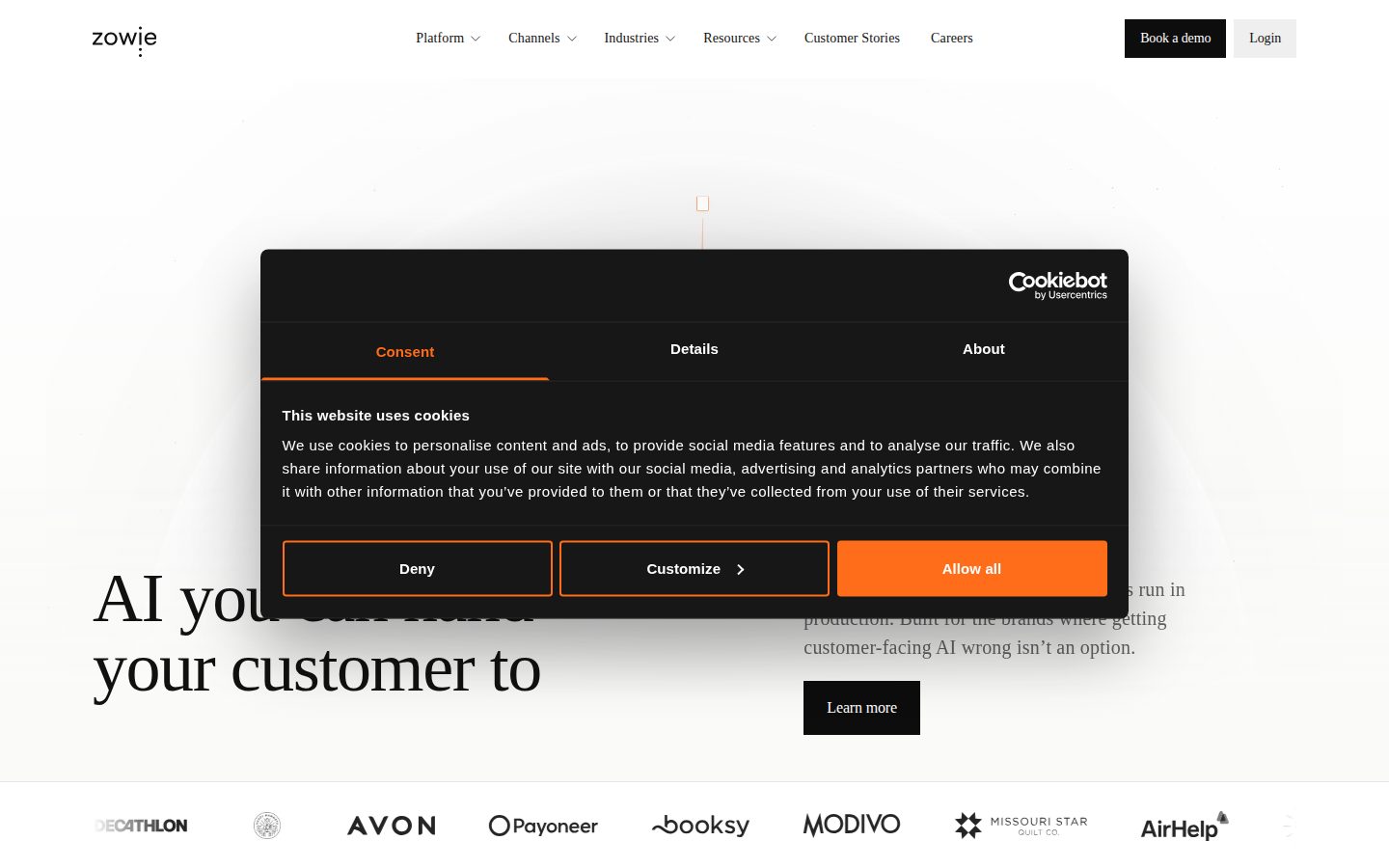
Zowie desktop previewZowie mobile preview

Pricing Plans

Contact Sales

Contact sales

Zowie is an enterprise AI agent platform with no public pricing listed; prospective customers book a demo to discuss deployment options (Cloud, Private Cloud, or On-prem) and pricing tailored to their use case.

  • Full lifecycle AI agent platform: build, orchestrate, deploy, and quality-control
  • Orchestrator runtime with 91% first-try resolution
  • Agent Studio with Flows, Playbooks, and Knowledge RAG
  • Supervisor for automated QA and coaching across all interactions
  • Multi-channel deployment across Chat, Email, and Voice
  • SOC 2, GDPR, HIPAA, EU AI Act, and DORA compliant deployment options

AI Panel Reviews

The Decision Maker

The Decision Maker

Strategic bet, vendor viability, timing, adoption approval
7.6/10

Real enterprise traction, no price tag, real question of who else is asking these customers hard questions.

Named customers, a 6-week go-live for a regulated insurer, and an audit trail feature most competitors don't have. No public pricing means every deal starts as a negotiation.

Monos, InPost, Decathlon, Payoneer. That's not a logo wall you fake. And the split between Flows (deterministic, for refunds and identity checks) and Playbooks (plain-language, AI-interpreted) is the right architecture for regulated industries — insurance, collections, commerce — where 'the AI improvised' isn't a defense you want to give a regulator.

Two things stand out. Traces gives you a reasoning-chain audit, not just a transcript — that's the EU AI Act answer nobody else in this review set has built cleanly. Supervisor scoring every interaction, human or AI, is a real ops upgrade, not just automation theater.

No published pricing, no free trial. Contact-sales-only means procurement cycles, and against Ada, Intercom Fin, and Decagon, you're negotiating blind. Pilot it in a regulated line of business first, not company-wide.

The Domain Strategist

The Domain Strategist

Craft and strategy in the product's domain — adapts identity per category, same lens
8.1/10

Flows plus Playbooks finally give CX leaders a QA architecture they can defend to legal and the board.

Zowie builds the governance layer most AI agent vendors skip: Supervisor scoring every interaction, Traces logging every decision. That's what makes it deployable in regulated books of business, not just marketing sites.

Deterministic Flows for refund and identity-verification logic, Playbooks for the fuzzy stuff. That split matches how I actually staff a floor: some processes cannot be improvised, some need judgment. Ada and Intercom Fin lean conversational-first; Zowie leans process-first, which is the right instinct for insurance and collections work where a wrong branch creates a compliance incident, not just a bad CSAT.

Supervisor scoring 100% of interactions, human and AI, is the QA capability I've wanted for a decade. Traces answering 'why did it do that' during an audit or chargeback dispute is the difference between defending a decision and guessing at one.

Three-year risk: contact-only pricing means budget forecasting stays opaque, and six-to-eight week go-lives assume real integration bandwidth from IT. Named accounts (InPost, Decathlon, Payoneer) suggest this holds at scale, but it's a build, not a plug-in.

Category Positioning8.0

Positioned above Ada and Intercom Fin for regulated CX, competing more directly with Decagon on governance depth.

Domain Fit8.5

Flows vs. Playbooks mirrors real escalation-tier thinking: rigid processes vs. judgment calls.

Integration Surface8.0

Native connectors to Zendesk, Salesforce, Kustomer, Freshdesk, and Intercom cover most existing helpdesk stacks.

Long-term Implications7.8

Agent Connect and open LLM choice reduce lock-in, but contact-only pricing complicates 3-year budget planning.

Strategic Depth8.4

Supervisor and Traces provide production-grade QA and audit depth most competitors treat as an afterthought.

Pros

  • Supervisor scores 100% of interactions including human agents, not just AI
  • Traces gives auditable reasoning chains for regulated industries
  • Flows/Playbooks split matches real-world escalation-tier decision making
  • Deployment flexibility across Cloud, Private Cloud, and On-prem with air-gapped option

Cons

  • No published pricing forces a sales cycle before budget conversations can start
  • 6-8 week go-live assumes dedicated IT integration resources
  • Voice channel is newer than chat/email and has less proof depth in evidence

Right for

Enterprise CX orgs in regulated or high-stakes verticals like insurance, collections, or commerce needing audit-ready AI agents.

Avoid if

You need transparent self-serve pricing or a fast pilot without a multi-week integration commitment.

The Finance Lead

The Finance Lead

Money, total cost of ownership, contracts, procurement math
5.8/10

Zero published pricing. Six-week go-live claim, but the invoice math is a black box.

No pricing page, no tiers, no free trial. Contact-based sales for three deployment modes — Cloud, Private Cloud, On-prem — each priced differently, presumably.

No pricing page. Capabilities table confirms it. One tier: Contact Sales. That's not a tier, that's a form.

Compare to Intercom Fin, which publishes per-resolution pricing. Ada does the same. Zowie makes procurement book a demo before seeing a number. For enterprise buyers already running SOC 2 and HIPAA reviews, that's not unusual — but it adds weeks before finance even sees a draft contract.

TCO is unknowable from public materials. Three deployment modes — Cloud, Private Cloud, On-prem — likely carry different cost structures, and on-prem/air-gapped installs typically add infrastructure and services cost finance teams underestimate by 20-30%. Six-to-eight week go-live is stated, not priced. No published overage rate for usage past whatever the contract defines. That's the real risk: not the sticker, the invoice you can't predict, and the renewal term you'll negotiate blind.

Billing & Procurement4.5

Contact-based sales model with 6-8 week go-live adds procurement cycle time before cost is even known.

Contract Flexibility5.0

No auto-renewal or term-length data published; enterprise contact-sales deals are typically negotiable but undisclosed.

Pricing Transparency2.0

No pricing page, single 'Contact Sales' plan, no published tiers.

ROI Clarity7.0

91% first-try resolution and 98% answer accuracy are concrete, measurable claims tied to named features (Orchestrator, Knowledge).

Total Cost of Ownership4.5

Three deployment modes (Cloud, Private Cloud, On-prem) with no cost baseline to model 3-year spend.

Pros

  • Named metrics: 91% first-try resolution, 120ms assignment time, 98% answer accuracy
  • Compliance breadth (SOC 2, HIPAA, GDPR, EU AI Act, DORA) reduces vendor-review friction
  • Traces gives auditable decision logs, useful for regulated-industry procurement sign-off

Cons

  • No pricing page, no tiers, no free trial to test before contract
  • TCO impossible to model without a quote
  • On-prem/air-gapped option likely adds infrastructure cost not reflected anywhere public

Right for

Enterprise CX teams in regulated industries who can absorb a multi-week sales cycle before seeing a number.

Avoid if

You need a comparable quote against Ada or Intercom Fin without booking three demos first.

The Domain Practitioner

The Domain Practitioner

Daily hands-on reality in the product's domain — adapts identity per category, same lens
7.6/10

Traces and Supervisor look like they were built by people who've had to defend an escalation to a regulator.

Zowie's Flows-versus-Playbooks split matches how I actually triage tickets: some things must never deviate, some need judgment. The audit trail depth (Traces, Supervisor scorecards) is the kind of thing you only appreciate after your third angry chargeback dispute.

Day-3 reality: the Flows/Playbooks split is the right mental model. Deterministic paths for refunds and ID verification, plain-language briefing for the fuzzy stuff — that's how I'd actually explain a process to a new hire, not how most bots force you to script everything as a decision tree. Supervisor scoring every interaction (not just AI ones) means QA isn't a separate spreadsheet exercise anymore.

Friction surface is hard to judge without hands-on time — no free trial, no public pricing, contact-sales only. That's a real gap for a support team lead trying to build a business case before looping in procurement. Six-to-eight week go-live is honest but that's still a quarter of planning before an agent touches a real ticket.

Traces logging intent classification, agent assignment, and action execution is the feature I'd actually use daily when a customer disputes what the AI told them. Compare that to Intercom Fin's more opaque resolution reporting — this is built for regulated conversations, insurance and collections specifically. Tradeoff: power clearly favors enterprise CX orgs with dedicated ops headcount, not small teams wanting quick self-serve setup like Ada offers.

The Power User

The Power User

Daily human experience, onboarding, polish, learning curve, reliability
6.8/10

Powerful guts, but you can't touch it or price it until you book a call

Zowie's got the enterprise plumbing down: Flows, Playbooks, Traces, a Supervisor grading every chat. What I can't tell from a website is whether day 3 with this thing feels like using a tool or babysitting one.

No pricing page, no free trial, nothing you can click into. Just 'book a demo.' For a platform claiming a 91% first-try resolution rate and 98% answer accuracy, that's a lot of trust to ask for before you've touched anything. Compare that to how Intercom Fin at least lets you see usage-based pricing up front.

The feature list is the strong part. Flows for stuff that can't go wrong, Playbooks for stuff that can flex, Traces so you can actually see why the AI did what it did instead of just reading a transcript after the fact. That's the kind of thing that matters at month three, not week one, when someone in compliance asks why a refund got approved.

Six to eight week go-lives, SOC 2 and HIPAA and EU AI Act compliance, on-prem and air-gapped options — this is built for insurance and debt collection, not a five-person startup. Ada and Decagon play in the same lane. Whether Agent Studio feels like homework or a welcome mat, I genuinely can't say without a login.

Daily Polish6.5

Supervisor and Traces suggest real attention to detail in QA, but no public screenshots or demo footage to confirm micro-copy quality.

Learning Curve7.0

Agent Studio lets teams brief agents like a new hire via Playbooks, but Flows still require defining every branch up front.

Mobile Parity5.0

Platform listed as web-only with no mobile app or responsive claims in the evidence.

Onboarding Experience5.5

Contact-sales-only with no free trial means the first ten minutes is a sales call, not the product.

Reliability Feel7.8

Separate deterministic decision engine for policy plus Tester regression suites is a serious answer to drift and pre-release breakage.

Pros

  • Traces give a full reasoning-chain audit trail, not just a transcript
  • Flows plus Playbooks split rigid and flexible logic cleanly
  • On-prem and air-gapped options for regulated industries like insurance

Cons

  • No published pricing or free trial, contact-sales only
  • No mobile experience mentioned anywhere in the evidence
  • Named customers skew heavily enterprise, unclear fit for smaller CX teams

Right for

Regulated enterprise CX teams in insurance, collections, or commerce who need audit trails and can handle a six-to-eight week rollout.

Avoid if

You want to try before you buy or need pricing without a sales call.

Buyer Questions

Common questions answered by our AI research team

Features

What's the difference between Flows and Playbooks?

Flows are deterministic workflows for processes that cannot go wrong, like refunds, claims, or identity checks, executed exactly per your rules. Playbooks are plain-language guidance the AI interprets per conversation, giving it flexibility for less rigid scenarios.

Integration

Can I use my own LLM or voice provider with Zowie?

Yes. Zowie is an open platform where you can pick any LLM and any voice provider, and swap them without rewriting what you've built. You can also connect agents your team built elsewhere or agents from your vendors onto the same platform.

Features

How does Zowie prevent AI decisions from drifting?

Zowie runs a separate decision engine for your business rules, distinct from the language model that talks to customers. Decisions are determined by your policies rather than by what the language model decides that day, so they don't drift even if the model does.

Security

What does the Traces feature actually log?

Traces provide a full reasoning-chain audit trail behind each AI decision, covering intent classification, agent assignment, knowledge retrieval, and action execution, so you can see what the AI does, when it does it, and why.

Setup

How long does it take to deploy Zowie in production?

A leading insurer went live in production in 6 weeks, from kickoff to deployment in front of customers, for a regulated insurance use case.

Also in AI Customer Support