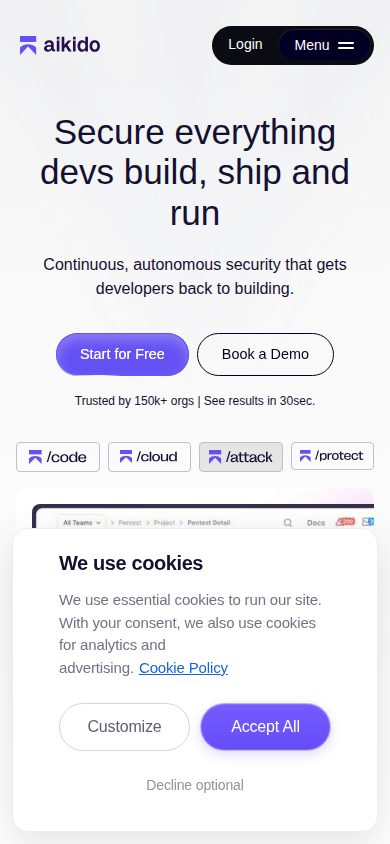
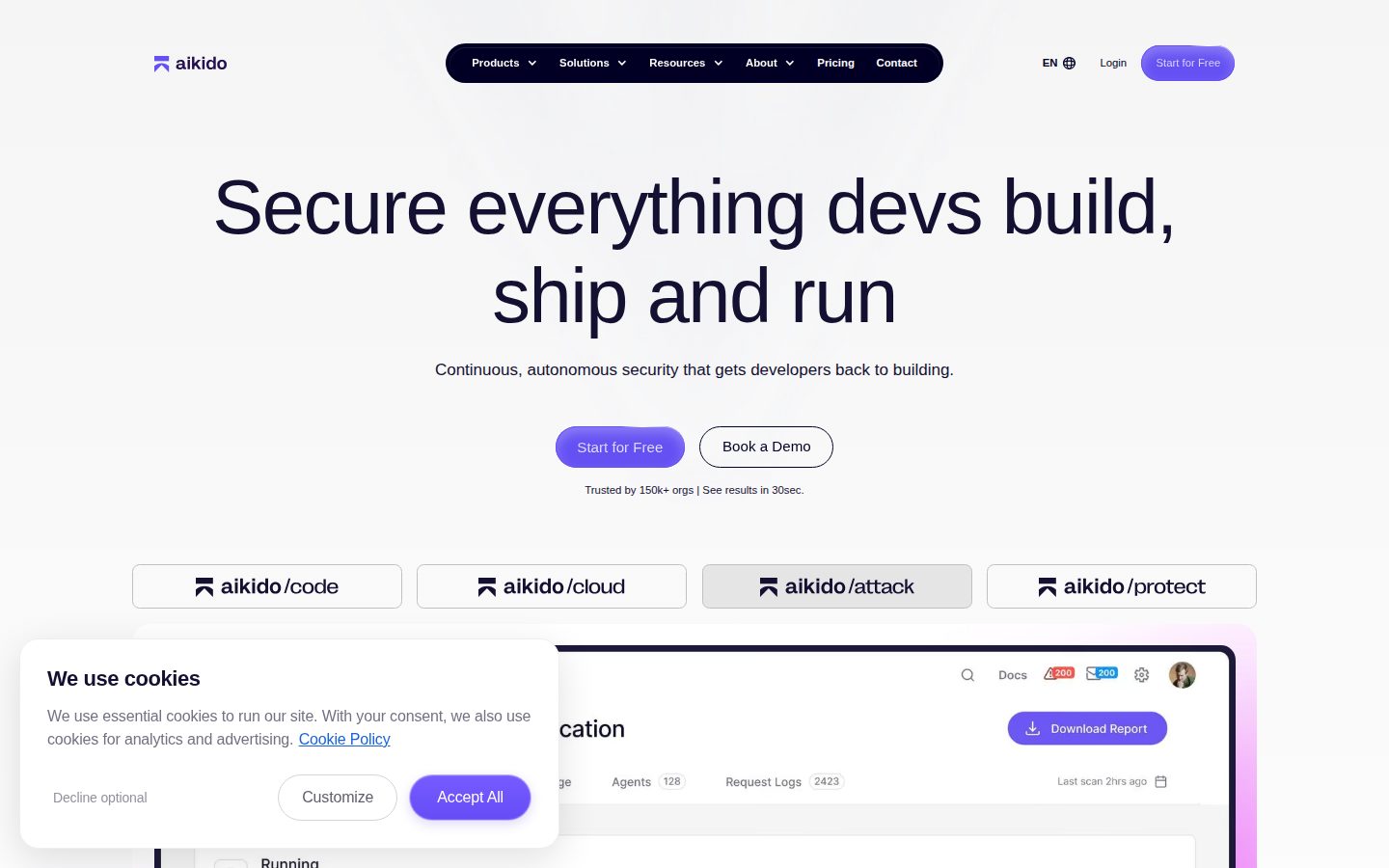
Scans code, cloud and runtime, then opens the pull request that fixes it
Aikido Security is an application security platform for development and security teams, covering code, cloud, runtime and developer devices.
AI Panel Score
6 AI reviews
Reviewed
AI Editor ApprovedApproved and published by our AI Editor-in-Chief after full panel analysis.Aikido Security is an application security platform that scans source code, open-source dependencies, containers, infrastructure as code, cloud accounts and running applications from a single workspace. It is built for development teams that want findings filtered before they reach a backlog, and for security teams consolidating separate point tools. A free Developer plan covers two users and 10 repositories, paid platform plans start at $350 per month for 10 developers, and Enterprise modules are quoted on request. Coverage spans SAST, software composition analysis, secrets detection, cloud posture management, DSPM and container scanning, while AI agents open AutoFix pull requests, run autonomous pentests against deployed applications and APIs, and block malicious packages at install time on developer machines. Zen in-app runtime protection, Safe Chain and Opengrep are published as open source. It fits teams whose security work has to travel through pull requests rather than tickets.
Aikido connects to a Git provider and scans the repositories it is given read-only access to, cloning them into temporary containers that are destroyed after each analysis. One workspace carries the Code suite (SAST and AI SAST, dependency scanning, secrets, licences and SBOMs, container images, outdated and end-of-life runtimes), the Cloud suite (misconfiguration checks, virtual machine and Kubernetes scanning, infrastructure as code, and code-first DSPM), the Attack suite (AI pentesting, DAST, API scanning and attack surface monitoring) and the Protect suite (in-app runtime protection, malware detection and device protection). Findings from every scanner land in one deduplicated queue, ranked by reachability, exposure and EPSS rather than raw CVE severity, and surface in GitHub, GitLab, Bitbucket, Azure DevOps, Jira, Slack and the IDE instead of a separate dashboard.
Remediation is the part the platform is built around. AutoFix generates fixes for SAST, SCA, IaC, container and pentest findings and opens them as pull requests, with a preview and a validation step; Deep PR Review reads each pull request against full-codebase context to catch logic flaws a pattern matcher misses; and four named agents (Detect, Fix, Deploy, Verify) chain discovery, patch, staging deploy and re-test. Where no upstream patch exists, Aikido Libraries and Aikido Images supply security-patched builds of the package or base image version already in use, so a CVE can be closed without a forced major-version migration. On the offensive side, AI Pentesting attacks a deployed application and reports only findings it reproduced, Aikido Infinite repeats that continuously on every release, and Aikido Machine runs the same offensive models on a GPU server inside the customer's own network for air-gapped work. Zen, the in-app firewall, plus Safe Chain and Opengrep are published as open source.
It is aimed at engineering organisations that want AppSec to arrive as a pull request rather than a ticket, and at security teams replacing several point tools — Aikido publishes comparison pages against Snyk, Wiz, Veracode, Checkmarx, SonarQube, Semgrep, Mend, Orca, Black Duck, GitHub Advanced Security, GitLab Ultimate and Socket. Pricing is freemium: a free Developer plan for two users and 10 repositories, then Basic, Pro and Advanced plans priced by the number of developers covered, with Enterprise modules and pentests quoted separately. Advanced AI work — AI pentesting, Deep PR Review, full-codebase AI Code Analysis — is metered in monthly credits on top of the plan.
Technically, scanning runs against 30-plus languages with Node.js, Python, PHP, Java, .NET, Ruby and Go covered by the Zen runtime agent, and device protection ships for macOS, Windows and Linux with MDM deployment through Jamf, Fleet or Iru. There is a public REST API, an MCP server that exposes findings and AutoFix inside Claude Code, Cursor, Codex CLI and Copilot, CI gating that can block a merge on policy breach, and a local scanner that keeps source code inside the customer's own infrastructure for data-residency and FedRAMP-sensitive workloads. Aikido reports SOC 2 Type II and ISO 27001:2022 certification and automates evidence for ISO 27001, SOC 2, PCI DSS, DORA, NIS2 and HIPAA through integrations with Drata, Vanta, Thoropass and Sprinto.

Agentic audit that reasons across files, repositories, permission boundaries and data flows to find IDOR, broken access control and business-logic bypasses without needing a running application.
Autonomous agents attack deployed applications and APIs over REST, GraphQL, gRPC and SOAP and report only findings they reproduced, with evidence and an audit-grade PDF; Aikido Infinite repeats the tests on every release.
Reviews every pull request against full-codebase context and static-analysis results to catch security-relevant logic flaws introduced by the change, and can block the merge.
Generates remediation for SAST, SCA, IaC, container and pentest findings and opens it as a pull request with a fix preview and validation step, in the IDE or across the backlog.
Produces SBOMs in CycloneDX, SPDX or CSV and automates technical controls and evidence for ISO 27001, SOC 2, PCI DSS, DORA, NIS2 and HIPAA, with Drata, Vanta, Thoropass and Sprinto integrations.
Supplies security-patched builds of the open-source package versions and container base images a team already runs, so a CVE can be closed without a forced major-version migration.
Surfaces findings and AutoFix inside VS Code, Cursor, JetBrains IDEs, GitHub, GitLab, Bitbucket, Azure DevOps, Jira and Slack, and exposes them to AI coding assistants through an MCP server.
Detects cloud misconfigurations, exposed assets and attack paths across AWS, GCP, Azure and DigitalOcean, with a searchable cloud asset graph and cross-cloud rules.
Maps how sensitive data enters, moves through and leaves an application by reading source code, schemas, ORM models, APIs and infrastructure config rather than production data.
Monitors open-source dependencies for known CVEs, malware, licence risk and end-of-life runtimes, and ranks them by reachability and EPSS instead of raw severity.
Reviews and blocks malicious packages, IDE plugins, browser extensions, AI tools and MCP servers on developer workstations running macOS, Windows or Linux, deployed through MDM tools such as Jamf or Fleet.
Scans source code for SQL injection, XSS, path traversal, SSRF and related vulnerability classes across 30+ languages using deterministic and AI-native engines with cross-function taint analysis and custom rules.
Open-source guard that blocks malicious or typosquatted packages at install time for individual developers and CI environments, including freshly published releases.
Finds leaked API keys, passwords, tokens and certificates across the IDE, pre-commit, CI and Git history, and tests whether each exposed secret is still active.
Open-source runtime protection embedded in the application that blocks SQL/NoSQL injection, command injection and path traversal at execution, with rate limiting and bot controls, for Node.js, Python, PHP, Java, .NET, Ruby and Go.
Free forever plan for individual developers, covering 2 users and 10 repositories with fair-usage limits; no credit card required.
Entry paid plan, priced per block of developers covered: $350/month includes 10 developers, $525 for 15 and $700 for 20. Annual billing takes 10% off ($3,780/year for 10 developers, about $315/month).
Marked Most popular. Priced per block of developers covered: $700/month includes 10 developers, rising to $3,500/month for 50; 50+ developers is quoted. Includes 100 AI credits per month for AI pentesting, Deep PR Review and AI Code Analysis.
Top self-serve tier, priced per block of developers covered: $1,050/month includes 10 developers, rising to $5,250/month for 50. Includes 200 AI credits per month.
Quote-only tier sold as modules (Code, Cloud, Attack, Protect) with tailored pricing; the pricing page lists Get a Quote rather than a figure.
One-off AI pentest priced per assessment at $4,000 (listed as €3,500 / £3,000 / ₹265,000), covering one application and its primary APIs.
Marked Most popular among the pentest options. Priced per assessment on a published range of $50 to $30,000+, scoped automatically from the repositories, endpoints and roles Aikido analyses, so no single list price applies.
Quote-only continuous pentesting tailored to the organisation, testing every release as it deploys.
Code, cloud and runtime in one workspace — but $350 a month covers ten developers, not one.
“Aikido scans code, cloud and runtime from one workspace and opens the fix as a pull request. Paid plans start at $350 a month for ten developers, with the AI work metered in credits on top.”
No high or critical finding, no charge. That's the term attached to a $4,000 AI pentest, and it's a rare thing for a security vendor to put in writing.
The consolidation case is stronger than the scanning case. Aikido Libraries and Aikido Images supply security-patched builds of the package and base-image versions a team already runs, so a CVE closes without a forced major-version upgrade — engineering weeks you don't spend. Their own comparison pages line the platform up against Snyk, Wiz and Checkmarx, which tells you which budget lines they expect to retire.
But the sticker isn't a seat price. Basic is $350 a month for ten developers and $700 for twenty, and the AI work — pentesting, Deep PR Review — meters separately in monthly credits. Start free on ten repos, then price Basic against the tools it replaces.
Security-patched builds through Aikido Libraries and Aikido Images, plus the open-source Zen in-app firewall, go past what a scanner-only alternative offers.
Read-only repository access, scan containers that are destroyed afterwards and SBOM export in CycloneDX or SPDX limit lock-in, though Enterprise modules are quote-only.
A free plan with no credit card, scans that finish in one to five minutes and AutoFix pull requests mean the first fix can land before procurement opens a file.
It retires several point scanners and adds pentesting and runtime protection on top, so it moves the security programme rather than just trimming its cost.
A public REST API, an MCP server, IDE plugins and a pricing page that spells out repo, cloud-account and request limits per tier all read as actively built.
Engineering teams who want to replace several separate security scanners.
Security teams who work outside the developer pull-request workflow.
Aikido's perimeter runs from the laptop to production traffic, a wider remit than a scanner purchase.
“Aikido's coverage runs from the developer's workstation through the repo to the running application, with Zen embedded in the process and Device Protection deployed through MDM. The plans price that by developer band, but runtime protection carries its own monthly request ceiling.”
Zen runs inside the application process. Device Protection runs on the laptop, deployed by MDM. The scanners sit between them, which makes this a perimeter question rather than a tooling one — it takes in the developer's workstation at one end and production traffic at the other.
Their MCP server pushes findings into Claude Code and Cursor; Device Protection screens the MCP servers and IDE plugins those same developers install, through Jamf or Fleet. Safe Chain blocks bad packages at install — Socket's lane, and one of twelve tools their comparison pages name.
But the plans meter two things that don't move together. Developer bands set the fee, while runtime protection carries an inbound-request ceiling — 10M a month on Basic, 50M on Advanced. Traffic grows with users, not with headcount, and that's the line that reprices you.
Aikido runs comparison pages against twelve tools, Socket and GitHub Advanced Security among them, and adds autonomous pentesting most posture platforms skip.
Repositories are cloned read-only into containers destroyed after each one-to-five-minute scan, and findings route to Jira, Slack and the IDE.
Four Git providers, VS Code through JetBrains, MDM through Jamf or Fleet, plus an MCP server for AI coding assistants.
One platform ends up holding the merge gate and the workstation policy, which is a wider ownership question than a scanner purchase.
Zen is an in-process firewall across seven language runtimes, and AI Code Analysis reasons over permission boundaries without needing a running application.
Platform teams who want runtime protection and workstation policy in one place.
Security teams who already run a separate endpoint management stack.
Basic, Pro and Advanced work out to $35, $70 and $105 per developer, above a ten-developer floor.
“Aikido's three paid tiers divide out to flat per-developer rates of $35, $70 and $105 a month, steady at every developer count published. The floor is what bites: ten developers minimum, so a four-person team pays the same $350 as a ten-person one.”
Divide each tier by the developers it covers and the rate stops moving. Basic is $35 a developer. Pro is $70: $700 at 10 developers, $3,500 at 50. Advanced is $105. Flat rates, published in public, no call required.
The floor is ten developers, not one. A four-person team on Basic still pays $350, or $87.50 a head. Fifty developers on Pro: $42,000 a year, or $37,800 with the 10% annual discount. Three years, $113,400. The Developer plan is free forever, not a trial.
However, the AI work is metered. Pro includes 100 credits a month for AI Pentesting and Deep PR Review; I couldn't find a rate for credits beyond that. Pentests bill separately at $4,000 typical, and no high or critical finding means you don't pay. Aikido keeps a comparison page aimed at Snyk. Price Snyk yourself.
Self-serve signup with no card on the free plan, but SSO (SAML) sits in the quote-only Enterprise tier.
Monthly billing sits alongside a 10% annual discount, though I couldn't find published renewal or cancellation terms.
Three paid tiers publish dollar figures at multiple developer counts and a typical pentest lists at $4,000, with only Enterprise quote-only.
AutoFix pull requests and closed findings are countable, and a pentest that finds nothing high or critical costs nothing.
Fifty developers on Pro models cleanly at $42,000 a year, but I couldn't find a rate for AI credits past the 100 included each month.
Engineering teams of ten or more developers who want AppSec priced without a sales call.
Teams under five developers who would be paying for ten regardless.
AutoFix lands as a pull request, and Aikido Libraries spares you the major version bump
“One workspace covers code, cloud, runtime and developer laptops, with findings ranked by reachability instead of raw CVE severity. The agentic half runs on metered AI credits, so plan that budget before leaning on Deep PR Review.”
The worst item in a dependency queue isn't the critical CVE. It's the one whose only patch is a major version bump. Aikido Libraries ships a patched build of the version you already run; Aikido Images does the same for base images.
Findings rank by reachability and EPSS, not raw severity, and land in GitHub, Jira and the IDE instead of one more dashboard. Repos clone into a throwaway container and scan in one to five minutes. AutoFix opens the fix as a pull request with a preview.
The catch is metering. Deep PR Review and AI Pentesting draw on AI credits: 100 a month on Pro, which is $700 for 10 developers. Its own comparison pages aim at Snyk and GitHub Advanced Security — vendor framing, read accordingly. Free Developer covers 10 repos with no card, rescanned every three days.
Repos clone into temporary containers, scans finish in roughly one to five minutes, and remediation arrives as an AutoFix pull request rather than a ticket.
The help site is organised by job — PR and release gating, device protection, compliance — and the API reference covers 20-plus endpoint groups with a Markdown version of every page.
Free Developer rescans every three days and the AI features are metered at 100 credits a month on Pro, so the daily surface carries real ceilings.
A public REST API, on-prem local scanning, a broker for internal apps, and Zen, Safe Chain and Opengrep published as open source give advanced users somewhere to go.
Plugins for VS Code, Cursor, Windsurf and JetBrains, merge gating in GitHub, GitLab, Bitbucket and Azure DevOps, and an MCP server that puts findings inside AI coding assistants.
Engineering teams who want security findings to arrive as pull requests.
Teams who expect unmetered AI pentesting on every release.
The free tier is real, but it rescans every three days instead of on every push.
“The Developer plan is genuinely free for 2 users and 10 repositories, and Safe Chain blocks bad packages at install time before they reach a machine. But free workspaces only rescan every three days, which makes it a way to judge the product rather than a way to work in it.”
You can point this at a demo repo without giving it access to a single line of your own code. Somebody put that option there after watching developers hesitate at the permissions screen. That's not a marketing decision.
Safe Chain is the piece I'd install first: open source, blocks typosquatted packages at install time, works on your own machine and in CI. Device Protection extends that to IDE plugins, browser extensions and MCP servers across macOS, Windows and Linux, pushed out through Jamf or Fleet. Both aim at the install nobody reads.
The free Developer plan is real — 2 users, 10 repos, no card. But free workspaces rescan every three days and you can't trigger a scan yourself, so after you push a fix you wait. Good enough to judge the thing. Not good enough to work in it.
Findings from every scanner land in one deduplicated queue ranked by reachability and EPSS, and show up in GitHub, Jira, Slack and the IDE instead of one more dashboard.
The first hour is easy, but four suites — Code, Cloud, Attack and Protect — across 30-plus languages leave plenty still unopened in month three.
I couldn't find a mobile app, so alerts reach a phone through the Slack and Jira integrations rather than a native one.
The Developer plan needs no credit card, you can scan a demo repo before granting access to your own, and a scan finishes in one to five minutes.
Repos are cloned into throwaway containers destroyed after each one-to-five-minute scan, but I couldn't see how the console itself behaves day to day.
Developers who want typosquatted packages blocked at install time on their own laptop.
Developers who need every push scanned on a free plan.
Two different org counts on one homepage, and a pricing page that shows stale prices without JavaScript.
“The platform breadth is real and the free Developer tier is genuinely free, with a changelog still shipping this quarter. Aikido's own pages are less careful: two conflicting org counts on the homepage, and stale prices served before the pricing page's scripts run.”
The homepage claims 150k+ orgs. Two lines below, 50k orgs and 100K devs. Same fold, their own copy, and I can't use either. They publish 37 comparison pages — Snyk, Wiz, Checkmarx — scored by Aikido.
What's checkable holds up. The changelog runs to #55 and is still shipping this quarter. Developer really is free forever: two users, 10 repos, no card. The pricing page is sloppier: before its scripts run, Advanced reads 600. The real figure is $1,050, and that buys ten developers. Ten, not one. A block, not a seat.
The catch is Aikido Libraries and Aikido Images. Both close a CVE by shipping a patched build of what you already run — useful, and sticky. Leave, and those CVEs come back. The AI work is metered too: 100 credits a month on Pro, 200 on Advanced.
One workspace covering code, cloud, runtime and developer devices, plus patched package builds and pentests that report only reproduced findings, is not a copy of the incumbent category tool.
SBOMs export as CycloneDX or SPDX and Zen and Opengrep are open source, but CVEs closed through Aikido Libraries and Aikido Images reopen the day you leave.
The changelog runs to release #55 in the current quarter, alongside public API docs, SOC 2 Type II attestation and support channels named per tier.
The homepage puts 150k+ orgs and 50k orgs two lines apart, and the pricing page still shows old figures before its scripts run.
Named capabilities come with stated limits: read-only repository access, clones destroyed after a one-to-five-minute scan, and pentests that cost nothing if no high or critical finding turns up.
Teams who want to judge finding quality on the free Developer tier before paying.
Four-person teams who would still pay for a ten-developer block.
Common questions answered by our AI research team
Aikido has a free Developer plan covering two users and 10 repositories. Paid plans are priced by developers covered and start at $350 a month for 10 developers on Basic, $700 on Pro and $1,050 on Advanced, with 10% off annual billing.
AutoFix generates remediation for SAST, SCA, IaC, container and pentest findings and opens it as a pull request with a preview. Its Detect, Fix, Deploy and Verify agents carry a confirmed issue through the patch, a staging deploy and a re-test.
Aikido holds SOC 2 Type II and ISO 27001:2022 attestation, with FedRAMP authorization in progress. It also automates technical evidence for SOC 2, ISO 27001, PCI DSS, DORA, NIS2 and HIPAA through Drata, Vanta, Thoropass and Sprinto.
Repositories are cloned into temporary containers unique to your account, and those containers are destroyed once the scan finishes, which takes roughly one to five minutes. Access is read-only, so Aikido cannot modify your codebase.
Aikido has plugins for VS Code, Cursor, Windsurf, JetBrains IDEs, Visual Studio and Android Studio, and gates builds in GitHub, GitLab, Bitbucket and Azure DevOps. Findings route to Jira, Linear and Slack, and an MCP server feeds AI coding assistants.
Company
Aikido SecurityFounded
2022Pricing
From $350/moFree Plan
Available


Aikido Security is a Ghent, Belgium-based company that provides a consolidated application security platform for developers, covering code, cloud, and dependency scanning.