B2B contact database and sales engagement platform for outbound teams
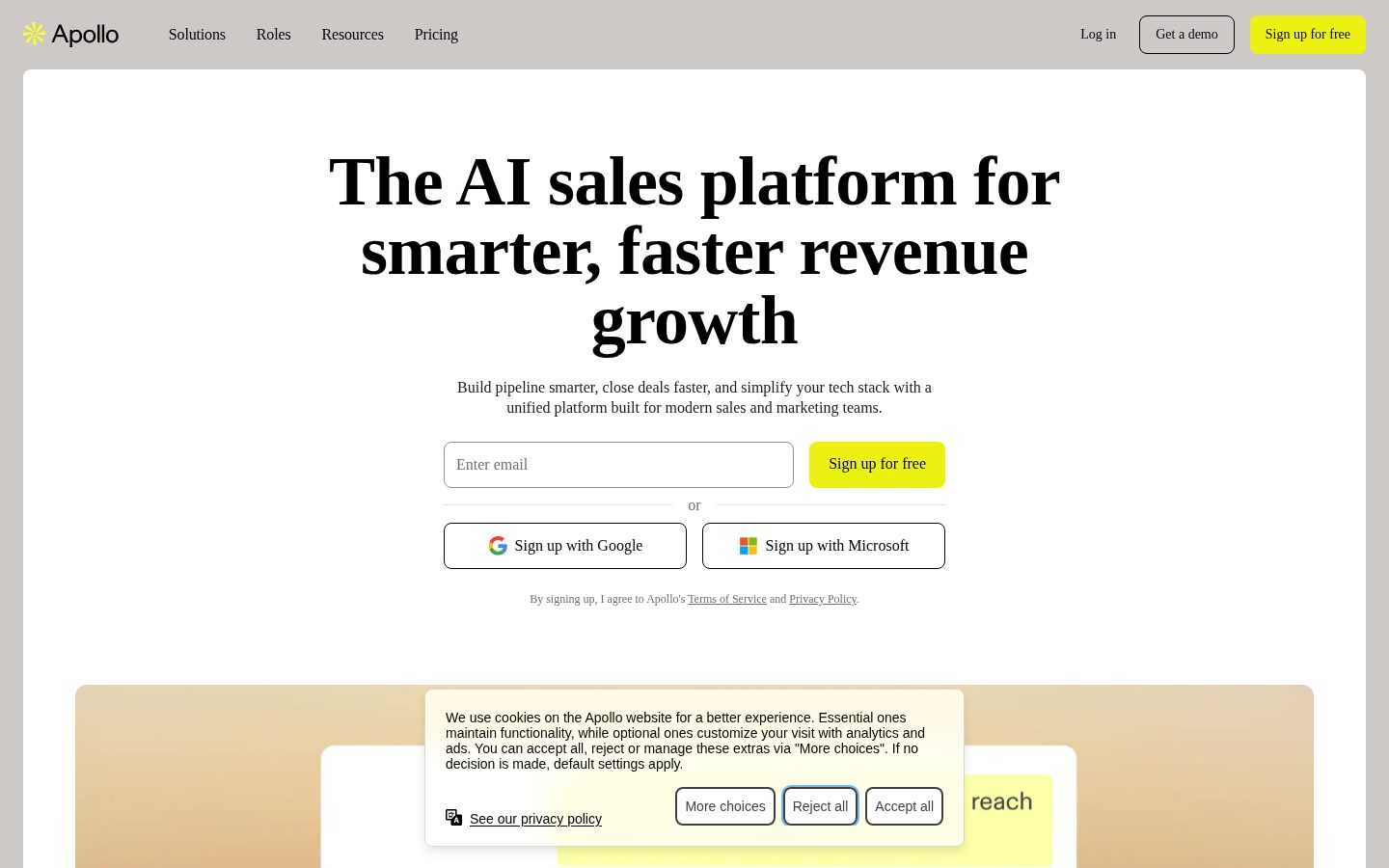
Apollo is a B2B sales intelligence and engagement platform for sales teams and go-to-market professionals.
AI Panel Score
6 AI reviews
Reviewed
AI Editor ApprovedApproved and published by our AI Editor-in-Chief after full panel analysis.In practice, users search Apollo's contact database using filters such as job title, industry, company size, location, and technology stack to identify target accounts and decision-makers. Once contacts are identified, they can be added to automated outreach sequences that combine emails, LinkedIn steps, and phone calls. A Chrome extension allows users to pull contact data directly from LinkedIn profiles and company websites without leaving the browser.
Apollo highlights several specific capabilities including contact data enrichment, which appends or updates existing CRM records with verified email addresses and phone numbers, and a go-to-market workflow builder that connects prospecting, outreach, and pipeline management in one place. The platform integrates with Salesforce, HubSpot, and other CRMs, and includes analytics for tracking sequence performance, open rates, and reply rates. Inbound lead routing and scoring features are also available for teams managing both inbound and outbound motions.
Apollo targets B2B sales representatives, sales development representatives (SDRs), revenue operations teams, and growth-stage startups. It operates on a freemium model with a permanently free tier that includes limited monthly credits for contact exports and emails. Paid plans start at a published monthly rate and scale based on credit volume and team size. Competitors in the category include ZoomInfo, Outreach, Salesloft, Lusha, and Seamless.AI.
Apollo is a web-based platform with a supporting Chrome browser extension. It offers API access for data enrichment use cases and native integrations with major CRMs, email providers including Gmail and Outlook, and LinkedIn for sequencing steps.

Generates outreach sequences across email, phone, and other channels with minimal setup.
AI transcribes calls, generates follow-up actions, and creates CRM tasks automatically.
Analyzes call recordings for coaching insights and performance tracking.
Real-time visibility into deal status with notifications for pipeline changes.
Automatically assigns inbound leads to available reps via calendar integration.
Creates rules to identify high-performing outreach patterns and automatically scale them.
Segments prospects by job title, seniority, company size, industry, and buyer intent signals.
Reveals which companies are browsing the website without submitting information.
Access to verified emails and phone numbers across 30M+ companies.
Built-in protections ensure messages reach inboxes rather than spam folders.
Syncs contact data, activity history, and campaigns with Salesforce, HubSpot, and other CRMs.
Auto-populates prospect data fields when leads submit forms on the site.
Free tier with limited credits and core sales engagement features. Lets individual users prospect a small contact list and run basic email sequences before committing to paid.
Per-user monthly pricing for individual reps and small teams. Adds full email sequencing, advanced filters, and dialer minutes — the entry tier for serious outbound work.
Mid-tier for sales teams running outbound campaigns at scale. Adds A/B testing, custom reporting, and integration with HubSpot, Salesforce, and Outreach.
Top published tier for full sales orgs. Includes call transcription, advanced security controls, and full integration with Salesforce, HubSpot, and SalesLoft.
230M contacts plus sequencing in one tool at $49 — hard to argue with that math.
“Apollo consolidates what used to cost three separate vendor contracts into one platform. For outbound-heavy teams under 200 people, it's the default choice right now.”
ZoomInfo charges enterprise prices for data alone. Apollo bundles 230M+ contacts, email sequencing, a dialer, and CRM sync starting at $49/seat. That's the whole pitch, and it's a strong one. The free tier — 10,000 email credits per year — means a rep can validate fit before finance ever sees a PO.
The tradeoff: Apollo wants to be your CRM too. Their own buyer FAQ says it outright. That's either liberating or a red flag depending on whether your RevOps team has already standardized on Salesforce. Don't let the consolidation story pull you into ripping out working infrastructure.
Two things I'd watch. One: data quality on mobile credits — 300/month on Professional is thin if your team dials heavily. Two: the AI multichannel campaign feature is real but relatively new; the changelog isn't public, so maturity is harder to verify than I'd like.
Peers at growth-stage B2B companies are already using this; it's table stakes for modern outbound, not a differentiator.
Well-known in the SDR community; won't raise eyebrows on a board slide, though it's not a Salesforce-tier safe choice for enterprise procurement.
Free tier and Chrome extension mean a rep can be prospecting on day one — no lengthy implementation cycle.
Combines prospecting, sequencing, and enrichment in one workflow — advances outbound capability, doesn't just cut costs on existing tools.
Apollo's been in market long enough, has a freemium flywheel, and competes directly with ZoomInfo — not a startup science experiment.
Growth-stage B2B teams running outbound who don't have a locked-in data provider or sequencing tool yet.
Your org is already deep in ZoomInfo contracts and Outreach workflows with RevOps processes built around them.
Apollo consolidates the outbound stack at $79/seat before most competitors finish loading their demo.
“230M contacts, sequencing, dialer, enrichment, and inbound routing in one platform at Professional-tier pricing that ZoomInfo charges separately for each piece. The consolidation play is real and the pricing pressure on the category is significant.”
At $79/seat on the Professional plan, Apollo is undercutting the traditional data-plus-engagement stack by a wide margin. ZoomInfo data alone runs multiples of that, and you'd still need Outreach or Salesloft on top for sequencing. The 300 mobile credits per month at mid-tier is where I'd stress-test the math for high-volume SDR teams — that ceiling gets hit fast in a phone-heavy motion.
The architecture tells me this was built by people who've run outbound teams. Advanced lead filtering with buyer intent signals, anonymous visitor identification feeding inbound routing, and AI-generated call summaries that create CRM tasks automatically — that's a full-funnel workflow, not a point solution with a sequencer tacked on. CRM sync with Salesforce and HubSpot means it fits alongside existing revenue ops infrastructure rather than demanding a rip-and-replace.
The 3-year risk is data quality decay and deliverability. Apollo's email deliverability guardrails are a documented feature, which suggests they've seen the problem — but any platform this size lives and dies on how aggressively they clean the 230M contact database. If data accuracy slips, the whole stack degrades simultaneously.
Apollo is the clearest price-performance threat to the ZoomInfo-plus-Outreach incumbent stack, and the freemium entry makes it the default evaluation starting point for growth-stage teams.
Buyer intent signals, inbound lead routing, and call coaching in one workflow maps directly to how modern revenue teams actually run outbound and inbound in parallel.
Native Salesforce, HubSpot, and Salesloft sync plus API access and Chrome extension gives ops teams real flexibility without custom engineering.
Consolidating data, sequencing, and dialer into Apollo creates efficiency gains but also single-vendor concentration risk if data quality or deliverability degrades at scale.
Multichannel sequencing, conversation intelligence, pipeline boards, and workflow automation at $79/seat represents genuine platform depth, not feature theater.
Growth-stage B2B teams running outbound SDR motions who want to consolidate their data, sequencing, and dialer spend under one contract.
Enterprise teams with existing ZoomInfo contracts and deeply customized Outreach or Salesloft workflow configurations won't recoup switching costs quickly.
$49 entry, 230M contacts, four tiers published — rare pricing honesty in this category.
“Apollo publishes four tiers with no sales call required. At $79/seat Professional, it bundles what ZoomInfo and Outreach charge separately.”
Four tiers, all priced publicly. Free → $49 → $79 → $119/month per seat. That's uncommon at this database scale. ZoomInfo won't show a number without a demo. Apollo does. Procurement won't fight this one.
50-seat Professional team: $79 × 50 × 12 = $47,400/year. Add 30% seat creep by year 3 — call it $62K. Still competes hard against ZoomInfo plus Outreach stacked separately, which routinely lands above $80K for similar headcount. The consolidation math works.
Tradeoff: mobile credit caps bite at scale. Professional allows 300 mobile credits per seat per month. Heavy phone-based SDR teams will hit that ceiling fast. Overage rates aren't published. That's the invoice risk — not the sticker. Export limits at 4,000/seat/month also constrain high-volume list pulls.
Self-serve monthly billing with no mandatory annual lock visible at entry tiers reduces procurement friction significantly versus ZoomInfo's contract model.
No public auto-renewal window or termination-for-convenience terms visible on the pricing page — standard category gap, but a real procurement concern.
Four tiers with specific dollar amounts and credit limits published without a sales call — rare in the data-enrichment category.
Sequence analytics, open rates, reply rates, and pipeline boards give measurable output signals; ROI is trackable, not hand-wavy.
Consolidates data provider, sequencer, and dialer into one bill, but unpublished overage rates on mobile credits create year-3 forecast risk.
Growth-stage B2B teams wanting a single platform for prospecting, sequencing, and dialing under $100/seat.
Your SDR team runs high call volume and needs predictable mobile-credit costs at scale.
230M contacts plus sequences in one tab — ZoomInfo can't touch this price
“Apollo stacks prospecting, sequencing, dialing, and enrichment at $49/month where ZoomInfo charges enterprise contracts. The daily workflow is genuinely consolidated, but mobile credit limits will frustrate reps who live on the phone.”
Apollo's core pitch holds up under scrutiny. Advanced Lead Filtering hits job title, seniority, company size, industry, and buyer intent signals — that's the full prospecting stack in one filter panel. The Chrome extension letting you pull contact data off LinkedIn without switching tabs is the kind of friction-removal that compounds across a 60-prospect day. The 230M contact database at $49/month Basic is a category-redefining price point versus ZoomInfo.
Day three is where the credit math bites. Basic gives you 100 mobile credits per month. If you're cold-calling seriously, that's gone in a week. Upgrading to Professional at $79 gets you 300 — still thin for a dialer-first rep. Unlimited email credits at every paid tier is genuinely useful; the phone ceiling is the real daily fight.
The multichannel sequence builder — email, LinkedIn steps, calls in one workflow — means reps aren't juggling Outreach or Salesloft separately. CRM sync with Salesforce and HubSpot means your activity logs actually show up. Pipeline boards and deal alerts are solid operational additions. Power users get A/B testing and custom reporting at Professional. This is a real daily-driver tool.
Consolidated workflow holds up past the demo, but mobile credit ceilings at Basic and Professional tiers create a recurring monthly squeeze for phone-heavy reps.
Docs exist and API access is confirmed, but no changelog is publicly visible — makes it harder to know when enrichment data or sequence logic has changed under you.
Unlimited email credits reduce one major daily friction, but the 100 mobile credits/month at Basic means reps hit a wall fast and have to manage credits consciously.
A/B testing, custom reporting, workflow automation scaling high-performing patterns, and call transcription at Organization tier give advanced reps genuine depth to grow into.
Chrome extension, CRM sync with Salesforce and HubSpot, and native LinkedIn sequencing steps match how SDRs actually work without forcing new tooling habits.
SDRs and small outbound teams who want prospecting, sequencing, and dialing consolidated under $80/month per seat.
Your motion is primarily cold calling — the mobile credit caps will force a credit management habit that breaks flow.
230 million contacts, one tab — Apollo is the outbound stack in a box
“Apollo packs prospecting, sequencing, dialing, and enrichment into a single platform starting at $49/month. It replaces what used to be three or four tools, which is either a relief or a commitment depending on how you look at it.”
The free tier alone — 10,000 email credits per year, Chrome extension, basic sequences — is genuinely useful for solo reps testing the waters. That's not a crippled demo. That's enough to run real outbound before you spend a dollar. The jump to $79/month Professional unlocks A/B testing and CRM sync with HubSpot and Salesforce, which is where most small teams will actually live. ZoomInfo charges multiples of that just for data access.
The feature list is dense. AI-generated multichannel sequences, call transcription, anonymous visitor identification, pipeline boards. That's a lot of surface area. Day three, you're probably still finding settings. The learning curve isn't punishing, but it's real — discoverable over weeks, not an afternoon.
The honest tradeoff: web-only with a Chrome extension. No mobile app worth mentioning. If you're between meetings and want to check a sequence reply on your phone, that's friction. For a platform calling itself a full go-to-market solution, mobile is an afterthought and everyone who travels for sales will feel it.
Email deliverability guardrails and real-time form enrichment suggest thoughtful daily-use details, though the sheer feature density can make navigation feel cluttered.
Advanced lead filtering, workflow automation, and conversation intelligence are all powerful but stacked — month three looks very different from day one, in a good way eventually.
Web-only platform — the Chrome extension helps on desktop but there's no real mobile product, which is a gap for field reps and anyone away from their laptop.
The free plan lowers the entry barrier meaningfully, but 230M+ contacts plus sequences plus dialer plus pipeline boards is a lot to orient yourself inside in the first session.
CRM sync with Salesforce and HubSpot and documented API access suggest a mature infrastructure, though no changelog is publicly visible to verify fix velocity.
SDRs and small outbound sales teams who want prospecting, sequencing, and dialing without stitching together four separate tools.
You're frequently selling on the go and need a real mobile experience to manage pipeline between meetings.
230M contacts, $49 entry, one real question: is the data actually clean?
“Apollo bundles what used to require ZoomInfo plus Outreach plus a dialer into one freemium stack. Pricing is honest. The 'replaces your CRM' claim is where I'd pump the brakes.”
Three tells on the pitch. One: 'smarter, faster revenue growth' is the kind of headline that could belong to any of the six competitors listed. Two: no changelog visible — I can't verify shipping cadence from public materials. Three: the buyer FAQ literally claims Apollo replaces your CRM. That's aggressive. Category norm is integration, not replacement. Lusha doesn't say this. ZoomInfo doesn't say this. It ages poorly when your ops team needs Salesforce.
The pricing structure is actually transparent. Free tier exists with real limits — 60 mobile credits, 120 exports. $49 Basic is a legitimate entry point for solo SDRs. $119 Organization includes call transcription and international dialer. No hidden enterprise-only wall on core features based on the pricing page.
The data quality question hangs over every contact database play. Seamless.AI got torched for accuracy. ZoomInfo gets complaints about stale records. Apollo's 230M+ contact claim is meaningless without hit-rate data — which isn't visible publicly. That's the real migration risk at 18 months.
Bundling database plus dialer plus sequencing at $49/month undercuts ZoomInfo's entry price substantially — that's a real gap, not a copycat move.
CRM sync with Salesforce and HubSpot means data isn't fully trapped, but if you've run sequences inside Apollo, rebuilding cadences elsewhere is manual work.
No public funding data visible and no changelog — can't confirm shipping cadence, though API access and docs suggest an active engineering org.
The CRM-replacement claim in the FAQ is overreach; category-norm language on the homepage won't help when prospects check competitors.
Freemium contact database plus sequencing is a proven survivor pattern — closer to what Outreach built than what Yesware attempted.
Growth-stage SDR teams who want one platform instead of three separate vendor contracts.
Your ops team is Salesforce-native and you need CRM as the system of record, not a replacement.
Common questions answered by our AI research team
Apollo replaces your CRM, meaning it can serve as a standalone alternative rather than integrating with an existing one.
Yes, Apollo offers a free plan. You can get started for free directly from the homepage.
Apollo replaces your data provider, outreach platform, dialer, enrichment, and CRM.