Clay logo

Clay Review

Visit

GTM data enrichment and workflow automation across 150+ data providers

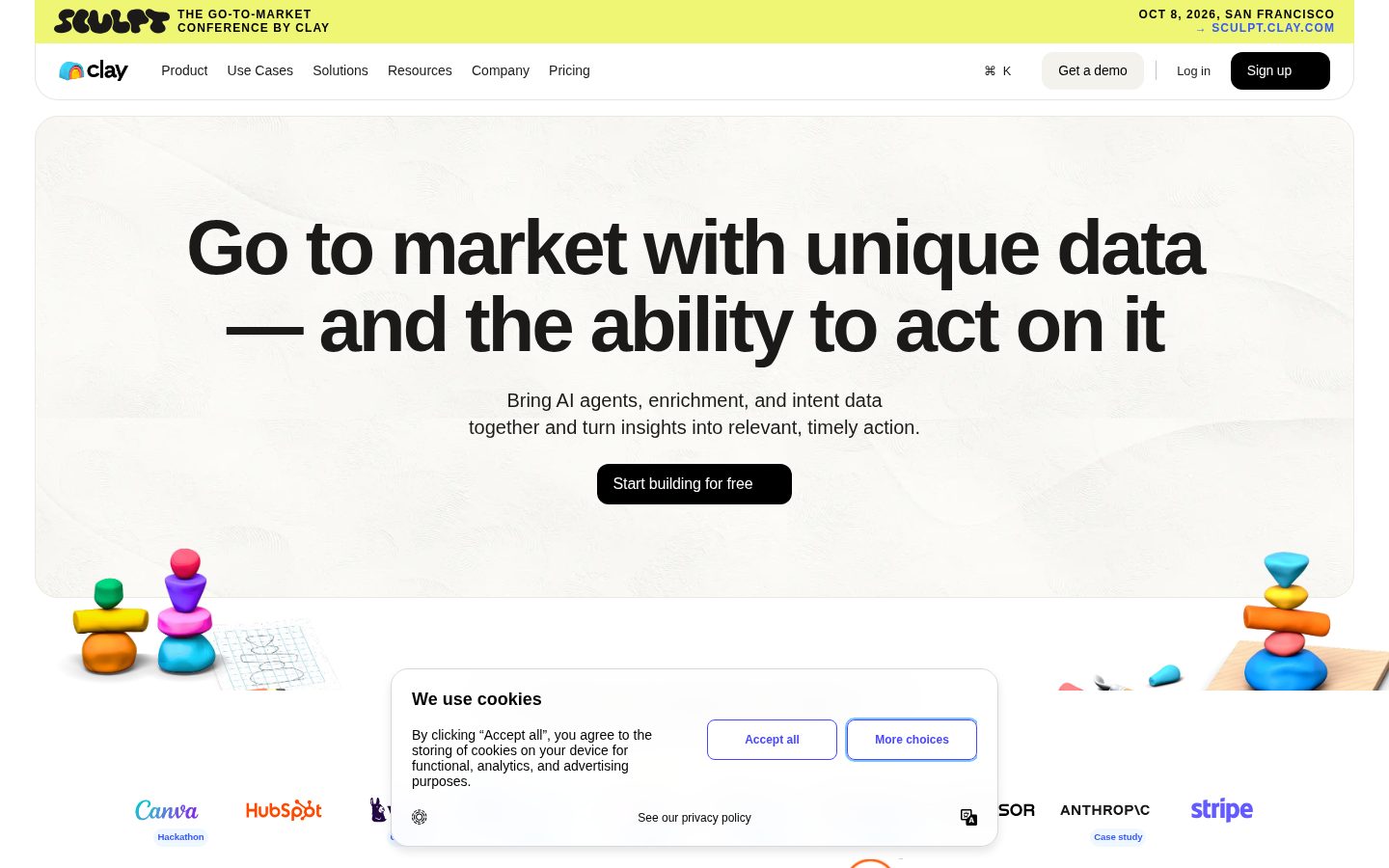
Clay is a go-to-market data enrichment and workflow automation platform for sales, marketing, and revenue operations teams.

Clay·Founded 2021·From $185/moFree PlanFree TrialAI Sales ToolsAI Data ToolsAI Workflow Automation

AI Panel Score

8.3/10

6 AI reviews

Reviewed

AI Editor Approved

About Clay

In practice, users build table-based workflows where each row represents a contact or account, and each column applies an enrichment step — pulling firmographics, finding verified emails or phone numbers, checking intent signals, or running an AI research prompt against public data. Workflows can be triggered by events such as job changes, website visits, or CRM record updates, and the output is pushed downstream to tools like Salesforce, Outreach, HubSpot, or a data warehouse.

Clay offers several distinguishing capabilities beyond standard data enrichment. Claygent is its built-in AI research agent that can navigate public databases, fill out gated forms, and surface custom data points not available through traditional APIs. Sculptor is a chat interface for generating GTM workflow ideas and building tables conversationally. Conditional logic lets users apply different enrichment providers or fallback rules depending on record characteristics, and AI formatting tools clean and standardize incoming data. Clay also supports Model Context Protocol (MCP) server connections, allowing Claygents to pull context from tools like Gong, Salesforce, or Google Docs.

Clay is used primarily by SDR teams, revenue operations, growth marketers, and GTM engineers at companies ranging from early-stage startups to large enterprises. Customers cited in testimonials include Anthropic, Rippling, and OpenAI. Pricing is subscription-based with a free tier available; paid plans are billed based on usage credits. Competitors in the data enrichment and sales intelligence space include Apollo.io, ZoomInfo, Lusha, and Clearbit, though Clay differentiates by aggregating multiple providers rather than operating a single proprietary database.

Clay is a web-based platform and requires no engineering resources for most workflow configurations. It connects to CRMs, email sequencers, ad platforms, data warehouses, and custom endpoints via HTTP API. Security certifications include SOC 2 Type II, GDPR compliance, CCPA support, ISO 27001, and ISO 42001.

Features

AI

  • AI Formatting

    Uses AI to transform any record into a required format, concatenating data, ensuring consistent formatting, and removing extraneous characters in seconds.

  • Claygent AI Research Agents

    Build and version multiple AI agents that search public databases, navigate gated forms, and find unique datapoints to fill enrichment coverage gaps.

  • Sculptor AI Workflow Builder

    Chat with Sculptor for GTM idea generation, analysis, and table building to go from idea to workflow without writing code.

Automation

  • AI Conditional Logic

    Conditionally runs workflow steps based on any logic—such as using different providers for different companies or building fallback enrichment chains—without engineering support.

  • Intent Signals Monitoring

    Automatically monitors buying signals from 3M+ companies and triggers instant action when prospects change jobs, visit your website, or mention your company online.

  • Native Email Sequencer

    Triggers outreach campaigns directly within Clay's native sequencer, alerting reps or updating the CRM based on enrichment and intent data.

Core

  • Dynamic Audience Building

    Combines signals, enrichment data, and CRM data to create high-intent buyer segments for targeted outreach.

Customization

  • Own API Key Support

    Allows users to bring their own API keys for data providers in addition to Clay's built-in 100+ premium data source subscriptions, without separate contracts or renewals.

Integration

  • 150+ Data Provider Enrichments

    Access premium data from 150+ third-party providers to identify new leads, score accounts and contacts, and personalize outreach in a single platform.

  • CRM and Destination Sync

    Pushes enriched data on a recurring basis to CRMs, data warehouses, email tools, website CMS, ad managers, and custom integrations via HTTP API.

  • MCP Server Integration for Claygents

    Connects Claygent AI agents to any MCP server—including Salesforce, Gong, and Google Docs—to enrich workflows with deeper business context.

Security

  • SOC 2 Type II & Compliance Certifications

    Certified under SOC 2 Type II, GDPR, CCPA, ISO 27001, and ISO 42001 to support enterprise-grade security and data compliance requirements.

Preview

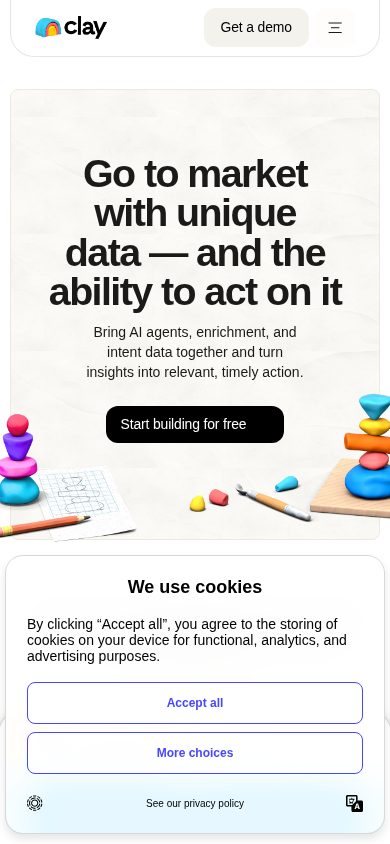
Clay desktop previewClay mobile preview

Pricing Plans

Free

Free

A low risk way to learn and experiment with Clay.

  • Unlimited seats and tables
  • Multi-provider waterfalls
  • Claygent enrichment
  • Clay Sequencer for email
  • Up to 200 rows per table
  • 100 Data Credits and 500 Actions/mo

Launch

$185/monthly

For individuals and small teams automating their first prospecting workflows.

  • Phone number enrichment
  • Job change and signal tracking
  • Email campaign integrations
  • Up to 50,000 rows per table
  • 2,500 Data Credits and 15,000 Actions/mo
Popular

Growth

$495/monthly

For teams scaling their GTM motion.

  • CRM auto-sync and enrichment
  • HTTP API integrations
  • Webhook automation
  • Web intent signal tracking
  • Audience pushes to ads platforms
  • Priority support
  • 6,000 Data Credits and 40,000 Actions/mo

Enterprise

Contact sales

For GTM teams running at scale, with enterprise-grade security, support, and infrastructure. Custom pricing with annual commitment.

  • Unlimited Audiences across sources
  • Unlimited row bulk enrichment
  • Clay API access
  • Data warehouse syncs
  • SSO and RBAC permissions management
  • 100,000+ Data Credits and 200,000+ Actions/mo
  • Dedicated Growth Strategist

AI Panel Reviews

The Decision Maker

The Decision Maker

Strategic bet, vendor viability, timing, adoption approval
8.6/10

Clay is what GTM teams reach for when Apollo and ZoomInfo stop being enough.

150+ data providers behind one credit-based interface is a real moat. The $495 Growth tier is where most scaling teams will live.

Anthropic and Rippling are on the customer list. That's not filler — those GTM teams are sophisticated buyers. Claygent handling gated forms and public database navigation is the kind of capability that replaced a vendor relationship at companies like these.

Two things separate Clay from Apollo or ZoomInfo. One: it aggregates providers instead of betting on a single proprietary database. Two: the waterfall logic — applying different enrichment chains based on record characteristics — is operationally significant, not just a demo trick. No-code setup gets revops moving without an engineering queue.

The tradeoff is the credit model. At $185/month you get 2,500 credits. Scale the operation and you're into $495 or custom Enterprise territory fast. Worth it if outbound is a core motion. Overkill if you're buying 500 contacts a quarter from a spreadsheet.

Competitive Positioning8.8

Apollo and ZoomInfo are single-database bets; Clay's 150+ provider aggregation model is structurally different and harder to replicate.

Reputation Risk8.5

SOC 2 Type II, ISO 27001, GDPR, and CCPA cover the board's compliance questions; customer logos do the reputational work.

Speed to Value8.0

No-code workflow builder with a free tier means a revops hire can ship a working enrichment table in days, not quarters.

Strategic Fit9.0

Multi-provider waterfalls, Claygent agents, and CRM auto-sync advance a modern outbound motion rather than just digitizing an existing one.

Vendor Viability8.5

Customers include Anthropic, Rippling, and OpenAI — that's a client list that implies real revenue, though no public funding data is available.

Pros

  • 150+ data providers under one subscription — no separate contracts
  • Claygent navigates gated forms and fills coverage gaps no single provider can
  • SOC 2 Type II, ISO 27001, GDPR certified — enterprise procurement won't stall
  • Free tier with Claygent access lets teams validate before committing

Cons

  • Credit consumption at scale pushes costs up fast past the $185 Launch tier
  • Depth of the platform has a learning curve even without code
  • MCP server integrations and webhook automation locked behind $495+ plans

Right for

GTM teams running structured outbound who've hit the ceiling on single-database enrichment tools.

Avoid if

You're buying contacts in small batches and don't have a revops owner to build and maintain the workflows.

The Domain Strategist

The Domain Strategist

Craft and strategy in the product's domain — adapts identity per category, same lens
8.6/10

Clay is the enrichment layer your outbound stack has been missing for three years.

150+ data providers in one subscription replaces a fragmented vendor mess of ZoomInfo, Clearbit, and Lusha contracts. Claygents and conditional waterfall logic make this a serious infrastructure bet, not a point tool.

The architecture here is smart: instead of competing with any single data provider, Clay aggregates them all and lets conditional fallback logic decide which source fires in which sequence. That's how a VP of Sales actually thinks about coverage — no single vendor wins every segment, every geography, every company size. The multi-provider waterfall structure, combined with SOC 2 Type II and ISO 27001 certifications, means this can survive the security review at a mid-market or enterprise account.

At $495/month for Growth, you're getting CRM auto-sync, web intent signals, and 40,000 actions per month — that's a fraction of what a ZoomInfo enterprise seat costs, and you're not locked into one proprietary database. The tradeoff is operational: someone on your RevOps or GTM engineering bench needs to own the workflow build. Claygents and Sculptor reduce the lift, but this isn't a plug-and-play SDR tool.

If we adopt this as our enrichment backbone, in three years we have a proprietary signal-to-sequence pipeline that compounds as we add more trigger logic. That's durable. The risk is credit consumption — at scale, 100,000+ credits sounds generous until you're running waterfalls across a 50,000-account TAM weekly.

Category Positioning8.8

Clay sits above point providers like Apollo.io and Lusha by aggregating the category rather than competing within it — a structurally stronger position.

Domain Fit8.5

Intent signals, job change triggers, CRM auto-sync, and native sequencing map directly to how a modern outbound motion is actually run.

Integration Surface9.0

Native connectors to Salesforce, HubSpot, Outreach, data warehouses, ad platforms, and MCP servers covers the full GTM stack without custom engineering.

Long-term Implications8.2

Proprietary enrichment workflows become a compounding asset, but credit-based pricing creates cost unpredictability as TAM and trigger volume scale.

Strategic Depth9.0

Conditional waterfall enrichment across 150+ providers plus Claygent AI agents represents genuine architectural depth, not feature accumulation.

Pros

  • 150+ data providers under one subscription eliminates multi-vendor contract management
  • Conditional waterfall logic solves coverage gaps no single database can fix
  • Intent signals plus job change triggers enable event-driven outbound without manual list pulls
  • Enterprise security stack — SOC 2 Type II, ISO 27001, ISO 42001 — clears procurement hurdles

Cons

  • Credit-based pricing gets unpredictable fast when running high-frequency waterfalls across large account lists
  • RevOps or GTM engineering ownership required — not a self-serve SDR tool out of the box
  • No public API listed on lower tiers; Clay API access is Enterprise-only per pricing page

Right for

RevOps-led sales orgs that run event-triggered outbound and need enrichment coverage across multiple segments and geographies.

Avoid if

Your team has no one to own workflow configuration — this tool rewards operators, not passive users.

The Finance Lead

The Finance Lead

Money, total cost of ownership, contracts, procurement math
7.8/10

Three visible tiers, credit-based billing, and a real TCO trap at scale.

Clay publishes four pricing tiers without a sales call — rare at this category complexity. Credit-based consumption means invoices won't match sticker at year 3.

Launch at $185/month, Growth at $495/month. Both visible on the pricing page without a demo. That's $2,220 and $5,940/year respectively. Enterprise goes dark — custom pricing, annual commitment required, SSO locked behind that wall. SOC 2 Type II and ISO 27001 check enterprise security boxes.

TCO math gets complicated fast. Growth at $495 × 12 = $5,940/year. Add seat creep — Clay says unlimited seats, so headcount isn't the variable. Credits are. 40,000 Actions/month sounds generous until Claygents run against 10,000 records weekly. No published overage rate on the pricing page. That's the real risk. Compare to Apollo.io's flat-rate model — predictable invoices, lower ceiling on data coverage.

Contract terms aren't published. Enterprise locks to annual. Month-to-month availability at Launch and Growth isn't confirmed in evidence. Own-API-key support is a legitimate cost offset — bring ZoomInfo credentials, skip a separate contract. But credit consumption across 150+ providers needs a usage audit at month 2, not month 12.

Billing & Procurement7.2

Unlimited seats removes per-seat negotiation friction; own-API-key support reduces third-party contract overhead, but credit model adds procurement complexity.

Contract Flexibility6.5

Enterprise requires annual commitment; month-to-month availability for Launch and Growth isn't confirmed in public materials.

Pricing Transparency7.5

Three paid tiers published without a sales call, but Enterprise is custom and no overage rates are disclosed.

ROI Clarity7.8

Multi-provider waterfall enrichment with CRM auto-sync creates measurable pipeline inputs; Claygent coverage gaps are quantifiable against Apollo.io single-source benchmarks.

Total Cost of Ownership6.8

Credit-based billing with no published overage rate makes year-3 TCO unmodellable without a usage audit.

Pros

  • Four tiers visible without a sales call — procurement won't fight this one
  • Unlimited seats at every tier; headcount growth doesn't reprice the contract
  • Own-API-key support offsets provider costs; no separate ZoomInfo or Clearbit contract required
  • SOC 2 Type II, ISO 27001, GDPR — enterprise security stack is real

Cons

  • No published overage rate for credits — invoice unpredictability at scale
  • Enterprise SSO and RBAC locked behind custom annual contract
  • Credit consumption across 150+ Claygent calls is hard to forecast without historical usage data
  • Contract flexibility terms aren't publicly disclosed

Right for

Revenue ops teams at 20-200 person companies who need multi-source enrichment without managing five vendor contracts.

Avoid if

Your finance team needs predictable monthly invoices — credit-based consumption without published overages will cause problems at budget review.

The Domain Practitioner

The Domain Practitioner

Daily hands-on reality in the product's domain — adapts identity per category, same lens
8.4/10

Clay is the tool your ops team builds sequences on while you're still prospecting in Apollo

Clay's multi-provider waterfall enrichment and Claygent AI agents solve the coverage gap problem that kills outbound quality. At $495/month for Growth, it's a team buy, not a rep buy.

The spreadsheet-like interface is either a gift or a trap depending on your ops maturity. Day three, a solo SDR without a RevOps partner is probably staring at empty columns wondering why the waterfall didn't fire. The 150+ provider logic and conditional fallback chains are powerful, but they require someone who thinks in workflow, not someone who thinks in quota. The free tier caps at 100 credits and 200 rows — enough to feel the power, not enough to prospect a real segment.

Workflow integration is where Clay earns its keep. CRM auto-sync, Outreach/HubSpot pushes, intent signal triggers on job changes — the pipes are all there at Growth tier. Claygent filling gated-form data that ZoomInfo simply doesn't have is a genuine differentiator, not a marketing claim. MCP server connections to Gong or Salesforce for enrichment context is a power-user move most teams won't touch for months.

The credit-based pricing is the daily friction point. Every enrichment column burns credits, and at 6,000/month on Growth, a badly designed waterfall table wipes your budget fast. Apollo runs a flat subscription. Clay rewards discipline and punishes experimentation.

Day-3 Reality7.2

Without a RevOps owner, solo reps hit credit confusion and waterfall misconfiguration fast — the Sculptor chat builder helps but doesn't fully close that gap.

Documentation Practitioner-Fit7.8

Docs exist and changelog is active — signals that practitioners are in the loop — but public evidence doesn't confirm workflow-level depth for SDR-specific use cases.

Friction Surface7.0

Credit-based metering on every enrichment column creates a daily mental tax that flat-rate competitors like Apollo don't impose.

Power-User Depth9.1

Conditional enrichment chains, own-API-key support, MCP server connections, and Claygent versioning give a GTM engineer a genuinely deep surface to build on.

Workflow Integration8.8

Native CRM sync, intent signal triggers, and sequencer integrations at the Growth tier fit directly into a modern outbound stack without duct tape.

Pros

  • 150+ providers in one subscription — no separate ZoomInfo and Lusha contracts
  • Claygent fills data gaps that no single proprietary database covers
  • Intent signal triggers on job changes and website visits fire actions automatically
  • SOC 2 Type II plus ISO 27001 clears enterprise security reviews cleanly

Cons

  • Credit-based metering punishes poorly designed tables — budget burns fast at 6,000 credits/month on Growth
  • Meaningful power requires a RevOps or GTM engineer owner, not a solo SDR
  • Free tier at 100 credits is a preview, not a real trial for prospecting at volume

Right for

RevOps-supported SDR teams at growth-stage companies who need multi-source enrichment and automated CRM sync without stitching together five vendor contracts.

Avoid if

You're a solo rep managing your own stack without ops support — the credit model and workflow complexity will slow you down more than Apollo would.

The Power User

The Power User

Daily human experience, onboarding, polish, learning curve, reliability
8.2/10

Clay makes ZoomInfo's single-database model look embarrassingly limited

150+ enrichment providers in one spreadsheet-like interface is genuinely powerful. At $185/month to start, it's priced for teams serious about outbound, not experimenters.

The core idea here is smart and it shows. Instead of betting everything on one proprietary database like Apollo or ZoomInfo, Clay waterfalls across 150+ providers, fills gaps with Claygent AI research agents, and pushes clean records downstream to your CRM without you writing a line of code. That's a real workflow, not a demo. The free tier caps at 100 data credits and 200 rows per table — enough to feel it out, not enough to run actual campaigns.

The spreadsheet-style interface is going to click immediately for ops-minded people and confuse everyone else. Sculptor helps — chatting your way into a workflow is a genuinely nice touch. But the learning curve is real. Month one you're figuring out credit logic. Month three you're either a power user or you've quietly stopped logging in.

Mobile is web-only, and this tool is clearly built to live on a big monitor with multiple columns open. That's fine. Nobody's enriching leads from their phone. The tradeoff is you're buying depth over simplicity, and that's a conscious product decision, not a gap.

Daily Polish7.8

The changelog shows active iteration and the AI formatting tools are thoughtfully designed, but a spreadsheet-heavy UI with 150+ providers in it carries unavoidable visual weight.

Learning Curve6.8

Power ceiling is high and Claygent plus Sculptor help, but understanding credits, waterfalls, and conditional logic together is a real month-one tax.

Mobile Parity4.5

Web-only platform — no mobile app listed, and a multi-column enrichment table isn't something you navigate on a phone.

Onboarding Experience7.2

Free tier and Sculptor's conversational workflow builder lower the entry barrier, but credit-based pricing logic adds cognitive overhead in the first 30 minutes.

Reliability Feel7.9

SOC 2 Type II, ISO 27001, and ISO 42001 certifications suggest mature infrastructure; conditional fallback enrichment chains also imply the team has thought hard about what happens when providers fail.

Pros

  • 150+ data providers in one subscription — no separate contracts, no juggling renewals
  • Claygent AI agents can surface custom data points that no single provider covers
  • No-code workflow automation with genuine conditional logic, not just simple triggers
  • Strong compliance stack: SOC 2 Type II, GDPR, ISO 27001, ISO 42001

Cons

  • Starts at $185/month — the free tier's 100 credits won't get serious work done
  • Steep learning curve around credit logic and waterfall configuration
  • Web-only, no mobile experience to speak of
  • Depth of the platform means smaller teams may be paying for power they won't use

Right for

Revenue ops and GTM engineers at growth-stage companies who've outgrown single-database tools and need serious multi-source enrichment automation.

Avoid if

You're a solo rep or early-stage founder who just needs a basic contact list — Apollo.io will do the job for less friction and lower cost.

The Skeptic

The Skeptic

Contrarian. Watch-outs, deal-breakers, broken promises, category patterns
8.1/10

150+ providers, one interface — this pitch actually has evidence behind it

Clay aggregates what Apollo.io and ZoomInfo sell separately, and the waterfall enrichment model is genuinely differentiated. Credits-based pricing at $185/month is real money, but the logic holds if you're burning on multiple data contracts.

Three tells I watch for in enrichment tools: single-database lock-in, no fallback logic, opaque provider count. Clay avoids all three. Conditional waterfall enrichment — use Provider A, fall back to Provider B — is the feature Apollo.io doesn't offer by design, because they want you inside their database. Claygent navigating gated forms is either genuinely novel or a compliance headache waiting to happen. Could go either way.

The exit story is mediocre. Data lives in Clay's tables. CRM sync exists, but if you leave, you're rebuilding enrichment logic from scratch. No portable workflow export that's obvious from docs. That's the real risk — not losing data, losing the orchestration.

Customers named: Anthropic, Rippling, OpenAI. SOC 2 Type II plus ISO 27001 and 42001. Changelog exists. This isn't vaporware. For GTM engineers running multi-source enrichment, it's a legitimate $495/month Growth tier conversation.

Competitive Differentiation8.5

Waterfall enrichment across 150+ providers with AI fallback logic is a structural gap vs. Apollo.io or Lusha, which operate single proprietary databases and can't offer the same coverage breadth.

Exit Portability5.9

CRM sync helps, but enrichment workflow logic — the conditional waterfalls and Claygent configurations — appears Clay-proprietary with no obvious export path.

Long-term Viability8.0

SOC 2 Type II, ISO 27001, ISO 42001, changelog present, enterprise tier with dedicated strategist — signals a real team shipping, not a prototype; no public funding data visible but enterprise motion suggests revenue.

Marketing Honesty7.8

'Go to market with unique data' is aspirational but the 150+ provider count and named feature set (Claygent, Sculptor, waterfall logic) are specific enough to be falsifiable — not pure fluff.

Track Record Match8.2

Clearbit survived until HubSpot acquired it; ZoomInfo went public; category has durable winners — Clay's multi-provider aggregation model mirrors what survived, not what failed.

Pros

  • Waterfall enrichment across 150+ providers fills coverage gaps no single vendor can match
  • No-code workflow building with Claygent and Sculptor is credible, not just marketing
  • Enterprise compliance stack (SOC 2, ISO 27001, GDPR, CCPA) supports serious deals
  • Bring-your-own-API-key option reduces lock-in on individual data contracts

Cons

  • Credits-based pricing at $185-$495/month gets expensive fast at scale — cost model needs stress-testing
  • Workflow logic is Clay-proprietary; migration would mean rebuilding orchestration, not just exporting CSVs
  • Claygent navigating gated forms raises compliance questions that aren't addressed in public docs
  • API access gated to Enterprise tier — Growth teams hit a wall without custom pricing

Right for

GTM engineers and RevOps teams running multi-source enrichment who are spending on three separate data contracts and need fallback logic.

Avoid if

You need predictable per-seat pricing and a clean exit path — credits-based billing and proprietary workflow logic make both difficult.

Buyer Questions

Common questions answered by our AI research team

Features

How many data providers does Clay include?

Clay includes 150+ data providers.

Security

Is Clay SOC 2 Type II certified?

Yes, Clay is SOC 2 Type II compliant. You can request the SOC 2 report via their Trust Center.

Integration

Can Clay push enriched data to my CRM automatically?

Yes, Clay pushes enriched data to your CRM, data warehouse, email tool, website CMS, ad manager, and more on a recurring basis.

Setup

Do I need to write code to build workflows in Clay?

No coding is required. Clay offers AI conditional logic and workflow automation with no engineering needed, plus an HTTP API capability to build custom integrations without code.

Pricing

Does one Clay subscription cover all 150+ data sources?

One Clay subscription gives you immediate access to 100+ premium data sources with no separate contracts, renewals, or implementation required. You can also bring your own API keys.

Also in AI Sales Tools