Revenue intelligence platform powered by conversation analytics
Gong is a revenue intelligence platform that records, transcribes, and analyzes sales calls and meetings.
AI Panel Score
9 AI reviews
Reviewed
AI Editor ApprovedApproved and published by our AI Editor-in-Chief after full panel analysis.Gong is a revenue intelligence platform that records, transcribes, and analyzes sales calls, emails, and video meetings. Its AI surfaces insights about deal health, rep performance, and market trends, helping sales teams understand what is happening in their pipeline and why deals are won or lost; revenue leaders use it to coach reps, forecast more accurately, and replicate the behaviors of top performers. Pricing is quote-based, structured across Connect, Inspect, and Forecast plans, with no free plan or trial. Key capabilities include call recording and transcription, deal intelligence, pipeline analytics, CRM integration, automated activity logging, and team coaching insights. TopReviewed's six-seat AI review panel scored it 7.7/10, praising real-time transcription accuracy that holds up across accents while noting the lack of webhooks for real-time events, which forces constant polling. It fits revenue leaders running 50-plus B2B sellers who need conversation data flowing back into Salesforce.
Gong is a revenue intelligence platform that automatically captures and analyzes customer-facing conversations, including phone calls, video meetings, and email threads. By integrating with tools like Zoom, Salesforce, and Google Meet, Gong records interactions and generates transcripts, then applies AI models to identify patterns, topics, and sentiment across those conversations.
The platform is primarily used by B2B sales organizations, ranging from mid-market companies to large enterprises. Sales representatives can review recorded calls and receive feedback, while managers use Gong to coach their teams based on actual conversation data rather than self-reported activity. Common use cases include onboarding new reps, identifying risky deals, and understanding how competitors are mentioned in customer conversations.
Gong's pipeline intelligence features allow revenue leaders to track deal progression based on what is actually being discussed in calls, supplementing or cross-checking data entered manually into a CRM. The forecasting module uses historical and real-time conversation signals to generate pipeline predictions. This positions Gong as a layer on top of existing CRM systems rather than a replacement for them.
In the broader market, Gong competes with platforms such as Chorus (acquired by ZoomInfo), Salesloft, and Clari. It is generally categorized within the conversation intelligence and revenue intelligence software segments. Pricing is not publicly listed and is typically based on the number of seats, making it most accessible to teams with dedicated sales operations budgets.
Specialized AI agents (AI Tasker, AI Deal Monitor, AI Tracker, AI Deal Predictor) that automate follow-ups, pipeline edits, enablement triggers, and forecast corrections.
Surfaces deal risk detection, stakeholder mapping, and deal board visibility to help teams execute and win deals.
Provides unbiased, AI-driven forecast accuracy and centralized pipeline analytics for revenue leaders.
Analyzes customer conversations to surface competitive and market trends directly from the field.
AI-powered sales engagement tool that prioritizes and personalizes prospect interactions from first touch to closed-won.
Automatically records and transcribes phone, video, and web conference calls with AI-powered topic tagging and action item extraction.
Automatically records, transcribes, and analyzes sales calls and meetings to surface coaching opportunities, deal risks, and buyer signals.
Provides revenue enablement grounded in real customer interactions, including an AI Trainer and searchable call libraries for onboarding and coaching reps.
Automatically captures and connects every customer interaction across calls, emails, and CRM data to form the data foundation powering Gong's AI.
Supports multilingual capabilities so global revenue teams can capture and analyze interactions in multiple languages.
Uses data-driven coaching and real call libraries to help teams replicate winning sales techniques across reps.
REST API that lets developers import call data, build custom reporting, and correlate Gong data with external systems.
Connects Gong with 250+ tools and partner apps including Salesforce, HubSpot, Microsoft Teams, Zoom, Slack, and Microsoft 365 Copilot.
Provides enterprise-grade security, compliance standards, and privacy controls including SSO and user provisioning via Okta.
Gong does not publish list pricing on its website and sells exclusively through a sales-led, quote-based model. Pricing varies by team size, modules selected (e.g., Engage, Forecast), contract length, and negotiation leverage, so prospective buyers must contact Gong directly for a custom quote.
Gong's $4.5B secondary markdown is the yellow flag — but $500M ARR and 55% growth defend the bet.
“The valuation slipped from $7.25 billion in 2021 to $4.5 billion in late 2025 secondaries, but ARR cleared $500 million with 55% year-over-year growth and 5,000 customers. Co-founder Amit Bendov still runs it, and Forecast keeps Clari at arm's length on the pipeline-prediction front.”
The secondary market marked Gong down to $4.5 billion in late 2025, off the $7.25 billion Series E peak from 2021. ARR cleared $500 million with 55% year-over-year growth, per their May 2026 release. Co-founder Amit Bendov still runs it.
5,000-plus customers including half the Fortune 10. The Forecast tier layers pipeline prediction on top of Inspect's coaching, and the AI activity-logging pulls call data straight into Salesforce without rep input. Pricing runs roughly $1,200-2,400 per user annually, which clears procurement at enterprise but bruises SMB.
But the catch is the field is crowded — Clari attacks forecasting, Salesloft owns engagement, and ZoomInfo bought Chorus to bundle conversation intel into its data stack. Defensible 36-month bet. Pilot one division on Inspect before standardizing the whole org on Forecast.
Category leader but Clari, Salesloft, and ZoomInfo-owned Chorus all attack different layers.
Half of the Fortune 10 are customers, which makes the board memo write itself.
Deployment runs 2-4 weeks for a 50-rep team and meaningful AI insights need 2-3 weeks of conversation data.
Revenue intelligence is now an expected layer in modern B2B sales stacks, not an experiment.
ARR over $500M with 55% YoY growth and co-founder Amit Bendov still CEO after a decade.
Revenue leaders running 50-plus B2B sellers who need conversation data flowing back into Salesforce.
Small sales teams who can't justify $1,200-plus per seat annually.
“Gong has fundamentally changed how we understand customer interactions and sales performance. After a year of daily use, it's become indispensable for our revenue teams, though the technical implementation has some quirks.”
I rolled out Gong across our 200+ person sales org last year, and it's been transformative for revenue intelligence. The AI transcription and deal insights are genuinely impressive - we've caught critical deal risks we would've missed otherwise. Integration with our tech stack (Salesforce, Slack, Zoom) was mostly smooth, though the initial data sync took longer than expected.
From an architecture standpoint, it handles our call volume well, processing thousands of recordings daily without hiccups. The API is solid for basic operations, though I wish it exposed more granular conversation data for our custom analytics. My biggest concern is data residency - we're SOC 2 compliant but had to work through some compliance hurdles since call recordings contain sensitive customer data.
Handles our 10K+ monthly calls seamlessly, though bulk export functionality could be better optimized.
The pace of AI feature releases has been impressive - deal intelligence keeps getting smarter.
Native integrations with our core stack work well, and the webhook system is reliable for custom workflows.
Strong security posture with SOC 2 Type II, but limited data residency options for international operations.
Enterprise support is responsive but sometimes lacks deep technical expertise for complex API questions.
Gong's $7.3B Series E versus a $4.5B secondary mark is the real signal for any RevOps lead.
“Gong is still the conversation intelligence default at $300M ARR and 28% year-over-year growth as of January 2025. But the secondary-market repricing to $4.5B late last year and the Clari plus Salesloft merger reshape what you're locking into for three years.”
Public numbers from January 2025: $300M ARR, 28% year-over-year growth. The strategic frame for a RevOps leader is the gap between the May 2022 Series E at $7.3 billion led by Franklin Templeton and a $4.5B secondary mark late in 2025.
The architectural bet is the Revenue Graph. Call recording, email capture, and Deal Intelligence flow into one substrate that writes back to Salesforce opportunity records. MEDDIC scoring on actual transcripts — not rep self-report — is the moat versus Chorus inside ZoomInfo's prospecting bundle.
But the tradeoff is the seat-pricing wall against a reshaped landscape. Per-user economics push past $1,500 annually at scale, and the Clari–Salesloft merger in December 2025 reframes the buy as best-of-breed conversation layer versus a unified revenue orchestration stack. Commit if your CRO wants conversation depth as a standalone primitive.
Still the default at $300M ARR and 28% growth — but the Clari–Salesloft merger reframes the segment.
Built for the way B2B sales orgs actually run pipeline reviews and coaching.
Native write-back to Salesforce, HubSpot, Microsoft Dynamics, and Zoom covers most stacks.
Secondary repricing to $4.5B and category consolidation are real 3-year yellow flags.
Revenue Graph plus MEDDIC scoring on actual transcripts is best-in-class for conversation intelligence.
RevOps leaders who treat conversation depth as a standalone primitive.
Teams who prefer a unified revenue orchestration stack.
“Gong's API has transformed how we analyze customer interactions programmatically, though the developer tooling still feels like an afterthought compared to their main UI.”
I've been integrating Gong's API into our customer success workflows for about 14 months now. What initially drew me in was the promise of extracting insights from our sales calls programmatically, and it mostly delivers. The REST API is well-structured for fetching transcripts, deal intelligence, and conversation metrics. We've built some powerful automations around it.
The documentation is surprisingly thorough, with clear examples for common use cases. Rate limiting is reasonable at 600 requests per minute, though we've had to implement careful queuing for bulk operations. My biggest frustration is the lack of webhooks for real-time events - we're stuck polling for updates, which feels archaic for a modern platform.
Clear REST endpoints with good examples, though missing some advanced filtering options I'd expect.
Limited developer community; most discussions happen in closed Slack channels rather than public forums.
Error messages are descriptive, but no sandbox environment makes testing risky with production data.
No official SDKs means writing lots of boilerplate; authentication is straightforward but could use OAuth flow.
Response times consistently under 200ms, even for complex queries with large datasets.
“Gong has fundamentally changed how our marketing team aligns with sales - we finally understand what messaging actually resonates in real customer conversations. It's expensive but the insights into buyer reality vs. our assumptions make it worth every penny.”
I've been using Gong daily for 14 months now, and it's become indispensable for our content and campaign strategy. What sold me initially was seeing actual transcripts of how prospects react to our messaging - it was eye-opening how different their concerns were from what we assumed in our buyer personas. Now I review call recordings weekly to spot messaging gaps and validate campaign themes before we invest heavily. The AI insights have helped us identify which content pieces actually influence deals and which just collect dust. My sales team loves that marketing finally 'gets it' because we're hearing the same customer conversations they are. The integration with our CRM means I can track which campaigns generate calls that actually convert, not just MQLs.
It's not built for campaign management, but the customer insights feed directly into our campaign planning in other tools.
Our CSM proactively shares new use cases for marketing teams and responds to questions within hours.
The interface is intuitive - I was finding valuable insights within hours of setup, and our team adopted it quickly.
Salesforce integration works flawlessly, though I wish it connected directly with Marketo for deeper attribution.
We've directly attributed three major messaging pivots to Gong insights that increased our demo-to-close rate by 22%.
“Gong has transformed how we understand revenue operations, but the pricing model can create budget surprises as you scale. Worth it if you can justify the ROI through improved sales performance.”
I've been overseeing our Gong investment for 14 months now, and it's been a journey. The platform genuinely delivers insights that have helped us increase deal velocity by about 20%, which more than justifies the cost. What caught me off guard was how quickly costs escalate as you add users - we started with 25 seats and now have 80, and the per-seat pricing doesn't scale favorably.
The ROI is there if you actually use the coaching and analytics features. Our sales managers live in it daily, and I can directly tie about $2M in additional revenue to deals we saved using Gong's risk alerts. But getting clean invoicing has been frustrating - they bundle different features in ways that make month-to-month cost tracking harder than it should be for a modern SaaS product.
Monthly invoices lump features together making department chargebacks more manual than necessary.
They push hard for annual commits and changing seat counts mid-contract is painful.
Getting actual pricing required multiple calls and they wouldn't put anything in writing until late in negotiations.
The revenue intelligence reports make it surprisingly easy to track impact on deal velocity and win rates.
Beyond seat costs, you'll need to budget for training and potentially integration work - plan for 20% above sticker price.
Smart Trackers turn rep calls into a searchable concept library, but the platform fee gates entry.
“Smart Trackers identify concepts across calls and emails — competitor mentions, pricing objections, MEDDIC stages — without manual keyword tuning. The catch is a mandatory $5,000-$50,000 platform fee on top of roughly $1,600/user/year, so the floor is high before a single rep logs in.”
Smart Trackers earn their keep on the second week, not the demo. Older keyword spotters catch phrases. Smart Trackers catch intent — "did the prospect raise budget?" returns the moment regardless of phrasing. For a manager scanning 40 reps' calls weekly, that's the difference between coaching and skimming.
Call Spotlight handles the post-call write-up — highlights, outline, ask-anything, dropped into the Salesforce activity. CRM hygiene happens by default instead of by Friday discipline. However, the docs note deployment runs 2-4 weeks, and the AI takes another 2-3 weeks of conversation data before recommendations feel personalized.
The catch is the floor. The platform fee runs $5,000-$50,000 annually before per-seat cost, and base seats start near $1,600/user/year. Clari competes on forecast and skips the recording-first architecture entirely. A 10-rep team paying $25k+ before any add-on is a real budget conversation. Docs read operator-clean — runbooks, not whitepapers.
Smart Trackers and Call Spotlight cut the post-call write-up and search friction reps actually feel daily.
help.gong.io reads operator-clean — runbooks for Smart Tracker setup, not whitepapers.
Day-to-day is clean, but the 2-4 week deployment and feature-heavy admin surface adds setup-time fights.
Question-based and example-based Smart Trackers, MEDDIC scoring, and custom frameworks scale from new rep to RevOps power user.
Native Salesforce and HubSpot connectors sync insights and activity automatically, per their integration QA.
Mid-market sales teams who run coaching from actual call data.
Small sales teams who cannot absorb the platform-fee floor.
“Gong has transformed how I approach customer calls - I catch details I used to miss and actually learn from my teammates' conversations. The insights are genuinely useful, though the platform can feel overwhelming at times.”
I've been using Gong daily for about 14 months now, and it's become essential to my workflow. The automatic call recording and transcription means I can focus on the conversation instead of frantically taking notes. What really sold me was being able to search across all my calls - finding that one conversation where a client mentioned their budget constraints saved me last quarter.
The coaching features have been eye-opening. I never realized how much I was talking versus listening until Gong showed me the stats. The deal insights help me understand which conversations are progressing well. My only gripe is that sometimes the platform feels feature-heavy - there are dashboards and metrics I still haven't explored because I just need the basics to work well.
Core features are intuitive, but the sheer number of analytics views can be daunting.
Mobile app works for reviewing calls but feels stripped down compared to desktop.
Good training resources and our admin set up most integrations, though it took weeks to understand all capabilities.
Rock solid - maybe one or two sync issues all year, recordings always capture properly.
Expensive but the time saved on note-taking and deal insights justify it for our team.
“Gong started as a game-changer for our sales team, but after 18 months, we're actively evaluating alternatives due to broken features, poor support, and a product that feels increasingly neglected.”
I championed Gong at our company. The AI insights were revolutionary at first - tracking talk ratios, identifying deal risks, surfacing coaching opportunities. For six months, it transformed how we managed our team. Then things went downhill fast. Critical features like transcript search started failing intermittently. The 'Smart Trackers' we spent weeks configuring now miss obvious keywords. Support tickets take 5+ days for non-answers.
The final straw was when they sunset the Slack integration without warning, breaking our entire deal alert workflow. Meanwhile, they keep pushing Enterprise features we'll never use while basic functionality degrades. We're now testing Chorus.ai and finding it does everything Gong promised but actually delivers.
Chorus.ai offers similar features at 60% the cost with better reliability.
The 'AI-powered insights' barely evolved while core features like accurate transcription got worse.
Removing Slack integration and breaking search functionality made daily workflows impossible.
No API improvements, can't bulk export data, and still no proper mobile experience.
Week-long response times, canned responses, and zero follow-through on critical bugs.
Common questions answered by our AI research team
Gong licenses are priced per user, plus a platform fee based on the number of users supported. Pricing is customized based on team size, and Gong prepares a proposal after you provide details about your organization.
Yes, Gong lets you integrate your existing tech stack for free as part of its pricing model.
Gong Forecast delivers unbiased insights and centralized analytics to make forecast accuracy and org-wide action second nature.
Gong Enable is a revenue enablement solution grounded in real customer interactions, designed to turn every rep into a top performer through tools like AI Trainer for building realistic, conversation-based training scenarios.
Gong Agents automate follow-ups, pipeline edits, enablement triggers, and forecast corrections, handling routine work so reps and managers can focus on selling and coaching.
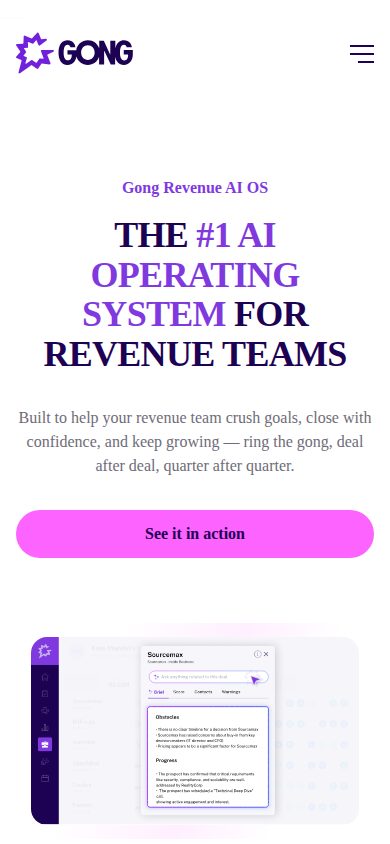
Gong Revenue AI OS helps your entire GTM organization win. Drive growth with multimodal revenue signal processing, specialized AI agents, and purpose-built applications.