AuditBoard Review
VisitConnected risk management for audit, compliance, and ESG teams
AuditBoard is a cloud-based platform for managing internal audit, risk, compliance, and ESG programs.
AI Panel Score
6.2/10
6 AI reviews
Reviewed
Connected risk management for audit, compliance, and ESG teams
AuditBoard is a cloud-based platform for managing internal audit, risk, compliance, and ESG programs.
AI Panel Score
6 AI reviews
Reviewed
AuditBoard is a cloud-based platform for managing internal audit, risk, compliance, and ESG programs at enterprise scale. Audit, compliance, and risk teams use it to centralize internal audit workflows, SOX compliance, risk assessment, and ESG reporting in one connected system, replacing spreadsheet-based processes. Pricing is quote-based, with no free plan or trial. Key capabilities include continuous control monitoring, AI-powered risk analysis and risk signal analysis, a unified data core with embedded analytics, automated assurance workflows, stakeholder engagement automation, and an AI governance framework that treats AI risk as a native compliance object. TopReviewed's six-seat AI review panel scored it 6.2/10, praising penetration of more than half the Fortune 500 and unlimited stakeholder licenses while noting an active mid-sales-cycle rebrand to Optro raises contract and support continuity questions. It best fits publicly traded companies replacing spreadsheet-based SOX testing with a unified governance program.
AuditBoard is a cloud-based connected risk platform that helps organizations manage internal audit, enterprise risk, compliance, and environmental, social, and governance (ESG) programs. It brings together multiple risk and assurance functions into a unified system, replacing fragmented spreadsheets and disconnected tools with structured workflows and centralized data.
The platform is primarily built for mid-sized to large enterprises, including publicly traded companies with SOX compliance obligations, regulated industries, and organizations with mature internal audit functions. Its user base typically includes Chief Audit Executives, risk managers, compliance officers, and their teams.
Core capabilities include audit project and engagement management, SOX control testing and documentation, enterprise risk assessment, issue tracking and remediation, vendor risk management, and ESG data collection and reporting. The platform supports cross-functional collaboration by connecting audit findings to risk registers and compliance controls in a shared environment.
AuditBoard competes in the Governance, Risk, and Compliance (GRC) software market alongside products such as Workiva, ServiceNow GRC, and MetricStream. It differentiates itself with a focus on usability and a purpose-built interface for audit and risk professionals, rather than a broader IT or enterprise platform approach.
The product is delivered entirely as a SaaS web application and is priced on an enterprise contract basis. Pricing is not publicly listed and is typically determined through direct sales engagement based on organization size and modules selected.
Uses domain-trained AI to analyze risk signals, test controls, and respond to incidents within a secure and governed framework.
Continuously analyzes risk signals across the enterprise to proactively surface emerging risks and control failures.
Delivers embedded analytics that provide continuous visibility into enterprise risk and turn risk insights into coordinated action across the business.
Automates assurance workflows to replace manual processes and enable teams to operate risk programs at scale.
Continuously monitors controls and automates assurance workflows to maintain oversight without manual intervention.
Streamlines and automates stakeholder engagement to improve efficiency across compliance and risk functions.
Analyzes evidence, surfaces control failures, identifies emerging risks, and recommends actions within governance frameworks designed for enterprise security, auditability, and oversight.
Connects risks, controls, evidence, and frameworks into a single operational model that breaks down silos across audit, cyber risk, compliance, and AI governance.
Provides a centralized data foundation with integrations spanning the entire compliance and risk ecosystem to connect all GRC functions.
Includes built-in AI governance capabilities within the platform designed for enterprise-grade auditability, security, and human oversight.
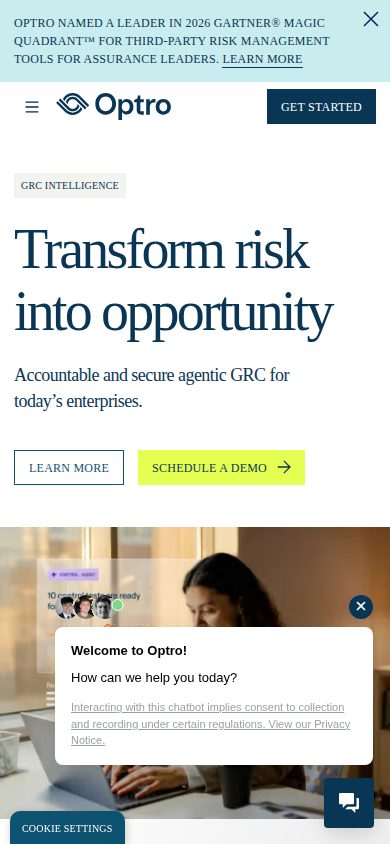
Flexible GRC pricing plans aligned to business needs, designed to scale with your program over time.

Fortune 500 penetration is real, but the rebrand to Optro creates near-term noise.
“AuditBoard — now apparently Optro — claims 50% Fortune 500 penetration, which is a serious number. The mid-rebrand timing introduces vendor identity risk right when you'd be signing a multi-year enterprise contract.”
The meta description says 'formerly AuditBoard' and the product is now Optro. That's a live rebrand. No changelog, no public pricing, no support email visible — and you're being asked to sign an enterprise-tier contract with a company mid-identity-shift. That's a flag worth naming before anything else.
The penetration claim is real signal though. Over 50% of the Fortune 500 puts this alongside Workiva and well ahead of MetricStream in install base credibility. The Unified Risk Foundation — connecting risks, controls, evidence, and frameworks in a single model — is exactly what SOX-obligated enterprises need. Spreadsheet replacement at scale is a defensible ROI story to the board.
The tradeoff: AI features like Risk Signal Analysis and Continuous Control Monitoring sound strong, but the docs gap is real. No public technical documentation means I can't verify how the 'domain-trained AI' actually works or where the human oversight boundaries are. That matters when auditors are signing off on AI-surfaced findings.
No free trial. Contact-only pricing. Implementation is white-glove, which means slow. For a mid-market team, this is likely over-engineered. For a public company with a CAE and a mature audit function, it fits. Pilot the scoped SOX module first — don't buy the full platform until you see one audit cycle close.
Ahead of MetricStream on usability positioning, but Workiva remains the default board-room-safe GRC choice for SOX-heavy public companies.
The peer install base is defensible to a board, but explaining why you signed with a vendor mid-rebrand will require a clean answer.
White-glove implementation and no free trial suggest a long ramp; category norm for enterprise GRC is 6-12 months before a full audit cycle closes on the new system.
Unified Risk Foundation directly addresses the spreadsheet-fragmentation problem that most enterprise compliance teams have, advancing program maturity rather than just cutting cost.
Fortune 500 penetration above 50% suggests real staying power, but an active rebrand to Optro with no public funding data introduces short-term uncertainty.
A public company with a mature internal audit team and an active SOX compliance obligation that needs to move off spreadsheets.
You need to ship a working compliance workflow inside 90 days.

Fortune 500 GRC pedigree, now rebranding mid-flight as Optro.
“AuditBoard — now going to market as Optro — is a mature enterprise GRC platform with genuine SOX and audit workflow depth. The rebrand introduces real questions about roadmap continuity that any Head of Compliance needs to pressure-test before signing.”
The platform's core architecture is built around what they call a Unified Risk Foundation — connecting risks, controls, evidence, and frameworks into a single operational model. For a compliance function that's still reconciling SOX control matrices in spreadsheets, that's the right structural bet. The AI Governance Framework feature is notable because it positions the platform to handle AI risk oversight as a first-class object, not a tagged-on module. That's forward-looking in a way that ServiceNow GRC and MetricStream haven't fully committed to yet.
The AI-Powered Risk Analysis and Continuous Control Monitoring capabilities suggest someone with real audit operations experience designed the workflow logic. Continuous control monitoring done right means fewer point-in-time assessments and more defensible audit trails. The question the evidence can't answer is how the AI's domain training was scoped — whether it understands regulatory frameworks like SOC 2 or ISO 27001 at the control level, or is pattern-matching on generic risk language.
The rebrand to Optro is the single biggest concern I'd bring to any renewal conversation. The meta title on their site now reads 'Optro | AI-Powered GRC Software,' and the changelog is dark — no public evidence of what's changing or staying. Trusted by over 50% of the Fortune 500 is the claim, but enterprise compliance programs don't survive vendor identity pivots gracefully. If the implementation team, support model, and control library survive the transition intact, the platform holds its value. If the rebrand signals a product-line consolidation, three-year commitments get complicated.
Pricing is contact-only with no public floor. That means your negotiating leverage lives entirely in deal timing and competitive pressure from Workiva. No free trial means you're evaluating through demos and reference calls — workable for enterprise procurement, but plan for a 90-day evaluation cycle minimum.
Trusted by over 50% of the Fortune 500 and built-in AI governance puts it ahead of MetricStream's positioning, though Workiva's financial reporting integration remains a sharper SOX story for some teams.
SOX control testing, issue tracking, vendor risk, and ESG data collection map directly to how enterprise compliance functions are actually structured — not retrofitted from an IT platform.
Unified Data Core claims integrations spanning the compliance ecosystem, but no public API docs or integration catalog means coverage is unverifiable before a sales call.
The mid-flight rebrand to Optro with no public changelog creates real continuity risk for compliance programs on multi-year contracts.
Unified Risk Foundation and AI Governance Framework show genuine architectural thinking, but the technical mechanism connecting risks, controls, and evidence isn't publicly documented.
A publicly traded company replacing spreadsheet-based SOX testing and ready to unify audit, risk, and ESG into one governance program.
Your compliance stack is already deeply integrated with Workiva for financial reporting and you can't absorb a dual-platform migration risk.

Fortune 500 penetration is real; pricing is a black box.
“No published pricing, no free trial, no public contract terms. You're negotiating blind against a vendor that claims 50%+ Fortune 500 penetration.”
Zero pricing on the page. That's the first number — and the only one AuditBoard (now rebranded Optro) wants you to know is missing. Enterprise GRC on a contact-sales model means procurement starts with no leverage. The '50% of the Fortune 500' claim signals premium positioning. Category norm for platforms like ServiceNow GRC or Workiva: six-figure annual contracts, multi-year terms, deep professional services line items.
The feature set covers audit, SOX controls, ESG, and vendor risk — all inside one Unified Risk Foundation. Unlimited stakeholder licenses are listed under the 'Optro Free' tier, which looks promising until you realize the pricing page itself is absent. 'No hidden fees or surprise overages' is a marketing promise. No public contract language backs it.
The real TCO risk: implementation services, module expansion costs, and migration complexity. Year 1 might be tolerable. Year 3, with seat growth, added modules, and an auto-renewal clause you didn't read, is where the invoice surprises happen. No changelog, no API docs, no support email in the evidence — that's a procurement friction signal. Comparable platforms like Workiva publish enough to model a TCO. Optro doesn't.
No support email, no API docs, no public invoicing model — procurement onboarding will require significant vendor engagement before a PO clears.
No public auto-renewal terms, no termination-for-convenience language visible; category norm for enterprise GRC is 2-3 year locked terms.
No pricing page exists; the scraped meta confirms contact-sales only with zero published tiers or ranges.
Continuous Control Monitoring and embedded analytics could support measurable audit cycle reduction, but no published benchmarks or ROI calculators are in evidence.
White-glove implementation is listed as included, but module-based pricing and no public overage rates make 3-year TCO unmodelable without a sales call.
Large enterprises with SOX obligations that have budget, procurement infrastructure, and time for a full sales cycle.
You need to model TCO before board approval or lack the procurement staff to negotiate opaque enterprise contracts.

Fortune 500 GRC backbone, but the AI layer needs an audit trail you can actually show regulators
“Optro (formerly AuditBoard) has real SOX and enterprise risk DNA, and the rebrand toward AI-powered GRC is coherent. The missing changelog and no public API docs are the kind of gaps that surface during vendor due diligence reviews.”
The platform's core proposition — Unified Risk Foundation connecting controls, evidence, risks, and frameworks — is exactly the architecture a compliance team needs to stop maintaining seventeen spreadsheets before a SOX audit cycle. Continuous Control Monitoring is the feature I'd pressure-test first. The docs indicate it 'automates assurance workflows without manual intervention,' but the specific evidence linkage mechanism isn't detailed publicly. That ambiguity matters when your external auditors want to walk the data lineage.
The AI Governance Framework is listed as a built-in capability, which is increasingly relevant given SEC and EU AI Act exposure. But no changelog is publicly available. When a vendor touches AI risk signals and control testing, I need to know what changed in the last 90 days — not because I'm paranoid, but because my audit committee will ask. Workiva publishes release notes. That's the comparison that stings.
Pricing is enterprise-contract only, no trial, no free tier for meaningful evaluation. Onboarding a GRC platform without a sandbox period means your implementation team is learning on live data. White-glove implementation is listed, but for a compliance officer inheriting a mature program, that's slower than self-directed ramp.
Trusted by over 50% of the Fortune 500 per the meta description — that's a real signal of enterprise fit. The Stakeholder Engagement Automation feature will reduce the quarterly evidence-collection chase. The power-user depth question is unanswered without public API docs or a developer portal.
Automated assurance workflows reduce manual chase cycles, but no sandbox trial means real onboarding happens on production data, which is a compliance team's nightmare.
The Unified Risk Foundation explanation in buyer Q&A openly admits the technical mechanism 'is not detailed in the content' — that's a documentation gap, not a feature gap.
No public changelog and absent API docs create recurring friction during board reporting cycles when you need to explain what the platform changed and when.
Embedded Analytics and AI-Powered Risk Analysis suggest depth, but with no API documentation publicly visible, advanced integration workflows are opaque before contract signing.
Unified Risk Foundation architecture maps directly to how audit, risk, and compliance functions actually interlock; cross-functional control linkage is a genuine workflow fit.
Enterprise compliance officers running SOX programs who need a single system of record to replace spreadsheet-based control testing and risk tracking.
Your team needs to self-direct onboarding quickly or requires transparent API documentation before committing to a GRC platform integration.

Built for the audit team, not the person who has to use it daily
“AuditBoard — now rebranding as Optro — is a serious enterprise GRC platform trusted by over 50% of the Fortune 500. But serious and enjoyable to use every day are two very different things.”
Let's start with the rebranding situation. The website says Optro, the product brief says AuditBoard. That's not a minor detail — that's a company mid-pivot, and mid-pivot is when polish slips. No changelog visible, no pricing page, no public docs. The meta description is doing a lot of heavy lifting where a real onboarding experience should be.
The feature set is genuinely strong on paper. Continuous Control Monitoring, AI-Powered Risk Analysis, automated stakeholder engagement — these are things that compliance teams actually need and that spreadsheet-based workflows genuinely can't handle at scale. If you're managing SOX controls across a large org, centralizing that in one place instead of emailing Excel files around is a real win. Workiva does similar things, but AuditBoard's pitch has always been that the interface was built for auditors, not IT admins. That positioning still matters.
Here's what makes me cautious for the daily user, though. Web-only, contact-for-pricing, no free trial. That combination means you're committing before you've felt it. Day three, after the implementation team leaves, is when you find out if the micro-copy is helpful or just there. The 'unlimited stakeholder licenses' in the new Optro pricing is genuinely interesting — that's the kind of thing that removes friction across a whole org.
The learning curve on GRC platforms is always steep. Category norm is six to twelve weeks before teams stop fighting the tool. Without visible onboarding materials or a trial, there's no way to judge whether this one earns its keep faster than MetricStream or slower.
No changelog and a mid-rebrand to Optro suggests the team's attention is split — that's when the small daily details get deprioritized.
The Unified Risk Foundation connects audit, cyber risk, compliance, and AI governance in one model, which is powerful but historically steep to configure and internalize.
Listed as web-only with no mobile platform mention — for a tool managing live risk signals and incident response, that's a meaningful gap.
No free trial, no public docs, and a contact-sales-only entry point means onboarding is gated behind a sales cycle, not a product experience.
Fortune 500 adoption at the scale the meta description claims implies the core platform holds up under enterprise load, even if surface signals are thin.
Large enterprises with a dedicated internal audit or compliance function that's ready to replace spreadsheet chaos with a structured, long-term GRC program.
You need to evaluate the tool before committing, move fast, or have a team that works primarily on mobile.

AuditBoard quietly became Optro — that's the first thing to explain
“The website scrape says 'Optro (formerly AuditBoard)' but the product brief still says AuditBoard. Mid-rebrand, no changelog, no pricing page, no API docs. Category has survivors — Workiva is one. Not sure yet if this is one.”
Three tells from the evidence before I go deeper. One: the meta description says 'Optro (formerly AuditBoard)' but zero explanation of why or when. Rebrands mid-contract are a yellow flag. Two: no changelog visible. In GRC software, shipping cadence matters — SOX requirements move, SEC climate rules move, frameworks shift. Three: 'trusted by over 50% of the Fortune 500' is exactly the kind of superlative that ages poorly if you can't verify the count.
The product itself isn't a bad pitch. Unified risk foundation connecting audit, controls, and ESG into one model makes structural sense. That's roughly what Workiva built and why Workiva survived. The AI-Powered Risk Analysis feature sounds reasonable for the category, but the buyer Q&A admits they can't explain the technical mechanism. That's a real gap — enterprise procurement teams will ask exactly that question.
Exit portability is the real problem. No API docs visible, no data export story, contact-only pricing, and now a rebrand in progress. If direction shifts again in 18 months, what do you migrate? Spreadsheets you already left. The free Optro tier listed in pricing contradicts the 'no free plan' flag — someone's data is stale, and I don't know whose.
Usability focus vs. ServiceNow GRC's complexity is a real differentiator, but the AI governance framework feature language is identical to every other GRC platform repositioning right now.
No API docs visible, no public data export documentation, and contact-only pricing means vendor lock-in has no clearly described ceiling.
No public funding data visible, no changelog cadence, active rebrand in progress — could go either way, but the signals aren't clean for a 3-year enterprise commitment.
Mid-rebrand with no explanation, unverifiable Fortune 500 claim, and a pricing page that contradicts the 'no free plan' data point.
The GRC consolidation play matches Workiva's successful pattern, but rebrands during growth phases have killed category peers like Rsam before they scaled.
Large enterprises already running structured internal audit programs who need SOX and ESG workflows in one system and have budget for an opaque enterprise contract.
You need clear data portability guarantees or an API-first integration story before signing a multi-year deal.
Common questions answered by our AI research team
The content states that the unified risk foundation breaks down silos across audit, cyber risk, compliance, and AI governance by connecting risks, controls, evidence, and frameworks into a single operational model, giving teams and leaders continuous visibility into enterprise risk. However, the specific technical mechanism of how these elements are connected is not detailed in the content.
AuditBoard (now Optro) is a Cerritos, California-based GRC platform used by large enterprises for audit, risk, and compliance workflows.