Azure OpenAI Service logo

Azure OpenAI Service Review

Visit

Microsoft's managed cloud service for OpenAI's GPT and AI models

Azure OpenAI Service is Microsoft's cloud platform providing enterprise access to OpenAI's AI models like GPT-4.

Microsoft·Founded 1975·From $1/moFree TrialLLM PlatformsAI APIsAI CloudAI DevOps

AI Panel Score

8.1/10

6 AI reviews

Reviewed

AI Editor Approved

About Azure OpenAI Service

Azure OpenAI Service is Microsoft's managed cloud offering that provides enterprise access to OpenAI's models, including the latest GPT-5-series models (such as GPT-5.5), o-series reasoning models for complex multi-step problems, earlier GPT-4-class models, and image-generation models. The service integrates these models into Microsoft's Azure ecosystem with enterprise-grade security, privacy, and compliance capabilities.

The platform is designed for businesses and developers who need to integrate advanced AI capabilities into their applications while maintaining enterprise security standards. It offers features like private networking, data residency controls, content filtering, and abuse monitoring. Users can fine-tune models on their own data and deploy custom AI solutions at scale.

Azure OpenAI Service targets enterprise customers, software developers, and organizations that require AI capabilities with strict security and compliance requirements. It competes with other cloud AI services like Google Cloud's Vertex AI and Amazon's Bedrock, but distinguishes itself through its integration with Microsoft's broader ecosystem and its partnership with OpenAI.

The service operates on a pay-per-use pricing model based on token consumption, with different rates for different models and capabilities, alongside provisioned-throughput options for predictable enterprise workloads. Azure customers can access most models directly, with additional review required for certain higher-risk capabilities such as modified content filters.

Features

AI

  • Chat Completions API

    Enables interaction with GPT-based chat models using system messages, few-shot learning, and configurable best practices for conversational AI.

  • Codex Code Generation

    Uses Codex models to perform code generation, code editing, and code understanding tasks.

  • DALL-E Image Generation

    Generates images from text prompts using DALL-E models deployed through Azure OpenAI Service.

  • Reasoning Models (o1, o3)

    Offers access to advanced reasoning models such as o1 and o3 for solving complex, multi-step problems.

  • Responses API

    Provides access to the latest Azure OpenAI features including tool use and structured outputs via a dedicated Responses API endpoint.

  • Text Embeddings

    Generates text embeddings from input content to support semantic search, similarity comparisons, and retrieval workflows.

Automation

  • Function Calling

    Allows chat models to define and invoke external functions, enabling tool use and agentic workflows within applications.

Core

  • Model Deployment Options

    Supports multiple deployment types including Standard, Global Standard, Provisioned, and Serverless for flexible capacity management.

  • Prompt Engineering Support

    Provides documented prompt engineering techniques and best practices for optimizing model interactions with Azure OpenAI.

  • Structured Outputs

    Returns reliable JSON responses from models that conform to a user-defined schema, ensuring predictable output formats.

Customization

  • Fine-Tuning

    Allows users to fine-tune foundation models with their own training data to adapt model behavior for specific use cases.

Integration

  • Use Your Own Data (RAG)

    Grounds OpenAI models with custom enterprise data using retrieval-augmented generation to produce contextually accurate responses.

Preview

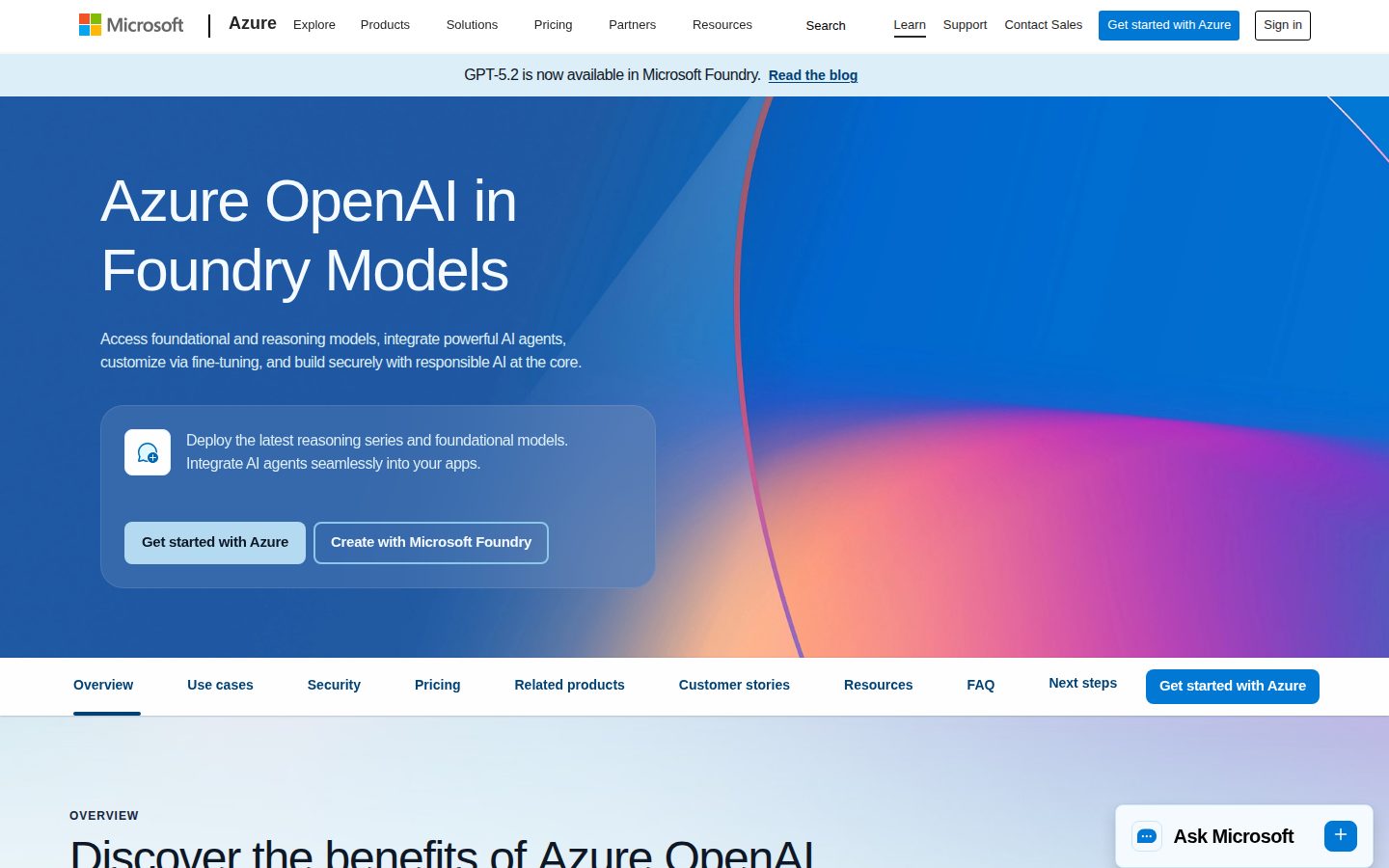
Azure OpenAI Service desktop previewAzure OpenAI Service mobile preview

Pricing Plans

Pay-as-you-go (GPT-5)

$1/usage

Per million tokens — GPT-5: $1.25 input / $10 output. GPT-5-nano: $0.05/$0.40. Global Standard deployment.

  • $1.25/$10 per M tokens (GPT-5)
  • $0.05/$0.40 (GPT-5-nano)
  • No commitment
  • Global Standard deployment
  • Regional zones may vary

Pay-as-you-go (GPT-4.1)

$2/usage

GPT-4.1: $2 input / $8 output per million tokens.

  • $2/$8 per M tokens
  • Wider availability
  • Mature model
  • Production-grade

Pay-as-you-go (GPT-5.4 Pro)

$30/usage

GPT-5.4 Pro: $30 input / $180 output per million tokens. Premium tier for the newest reasoning model.

  • $30/$180 per M tokens
  • Newest reasoning model
  • Premium tier
  • Heaviest workloads

Pay-as-you-go (o4-mini)

$1/usage

o4-mini: $1.10 input / $4.40 output per million tokens.

  • $1.10/$4.40 per M tokens
  • Cost-optimized reasoning
  • Smaller context
  • Faster latency
Popular

Provisioned Throughput Units

$2,448/monthly

PTUs allocate dedicated throughput with predictable costs. Up to ~70% per-token savings on sustained workloads. Monthly and annual reservations.

  • Starting ~$2,448/month
  • Predictable cost
  • ~70% savings on sustained load
  • Monthly + annual reservations
  • Dedicated capacity

Enterprise

Contact sales

Custom enterprise agreements with EA bundling, additional regions, compliance add-ons.

  • EA pricing bundles
  • Additional regions
  • Compliance add-ons
  • Custom volume commitments
  • Dedicated support

AI Panel Reviews

The Decision Maker

The Decision Maker

Strategic bet, vendor viability, timing, adoption approval
8.6/10

Microsoft's $13B OpenAI stake makes Azure OpenAI the safest GenAI bet a board will sign off on.

Microsoft committed roughly $13B to OpenAI and made Azure OpenAI Service generally available in January 2023, which is most of the procurement case already done. The catch is portability — the Responses API and PTU model lock you to Azure for the foreseeable future.

This is the GenAI line item nobody on the board will challenge. Microsoft committed $13B to OpenAI across multiple rounds and shipped Azure OpenAI Service to general availability in January 2023. Procurement already has the MSA and the compliance team already cleared the data-residency story.

Pricing is honest enough — GPT-5 at $1.25/$10 per million tokens on Global Standard, o4-mini at $1.10/$4.40 for cost-optimized reasoning. Provisioned Throughput Units start near $2,448/month and the docs claim roughly 70% per-token savings on sustained workloads. That's predictable line-item math for finance.

But the tradeoff is portability. The Responses API and PTU model don't move cleanly to AWS Bedrock or Vertex AI, and model approval gates still slow some workloads. Pilot one production workflow on Global Standard for a quarter before sizing the PTU reservation.

Competitive Positioning8.5

Frontier OpenAI models on Azure terms beat Bedrock and Vertex AI for most enterprise buyers.

Reputation Risk9.0

Microsoft is the default safe pick — boards rarely question this line item.

Speed to Value8.0

Existing Azure MSA and compliance shortcut procurement, but model access approval still adds days.

Strategic Fit8.0

Strong fit if you already run Azure; weaker if your stack is AWS or GCP native.

Vendor Viability9.5

Microsoft is public, profitable, and has $13B committed to OpenAI — survival case is as strong as it gets.

Pros

  • Microsoft's $13B OpenAI stake gives this the strongest vendor-survival case in the GenAI category.
  • Provisioned Throughput Units deliver roughly 70% per-token savings on sustained workloads with predictable monthly cost.
  • Enterprise compliance, data residency, and private networking are already covered by the Azure MSA.
  • Frontier models including GPT-5 and o4-mini ship on Azure with the same API surface as OpenAI.

Cons

  • Model access still requires application and approval, which slows time-to-pilot for new teams.
  • Responses API and PTU reservations lock workloads to Azure with limited portability to Bedrock or Vertex AI.
  • Foundry Models naming and capacity tiers add procurement complexity for first-time buyers.

Right for

Enterprises who already run on Azure.

Avoid if

Teams who need vendor-neutral inference.

The Domain Strategist

The Domain Strategist

Craft and strategy in the product's domain — adapts identity per category, same lens
8.5/10

Azure OpenAI Service is the enterprise path to GPT-5, with VNet isolation Bedrock and Vertex AI still chase.

Azure OpenAI Service delivers GPT-5, o4-mini, and the rest of OpenAI's frontier through Microsoft's enterprise control plane — Entra ID, private VNet, Data Zones, and SOC/ISO/HIPAA/GDPR coverage across 28 regions. For a CTO picking the LLM substrate through 2029, the call is whether OpenAI exclusivity beats AWS Bedrock's multi-vendor lineup or Google Vertex AI's Gemini-native stack.

Most enterprise AI buys die in the security review, not the demo. Azure OpenAI Service clears that gate — Microsoft Entra ID, private VNet ingress, and Data Zones for EU and US residency are wired in from day zero. For a CTO defending the LLM substrate through 2029, that's the actual moat against AWS Bedrock and Google Vertex AI.

GPT-5 sits at $1.25 input and $10 output per million tokens on Global Standard, with Provisioned Throughput Units from ~$2,448 monthly for predictable load. SOC, ISO, HIPAA, and GDPR coverage spans 28 regions. Function Calling and Structured Outputs ship at the API surface, not as a wrapper.

But the catch is upstream dependency. You're betting on Microsoft's OpenAI partnership holding shape — if Anthropic or Google's frontier pulls ahead, Bedrock's multi-vendor lineup looks less negotiated. Fine for a Microsoft-stack CTO; riskier if your roadmap needs Claude or Gemini natively.

Category Positioning8.6

Clear duopoly with AWS Bedrock at the top of enterprise-LLM-on-cloud; Vertex AI trails in regulated-industry footprint.

Domain Fit8.7

Entra ID, private VNet, Data Zones, and SOC/ISO/HIPAA/GDPR match how Fortune 500 CTOs actually procure LLM infrastructure.

Integration Surface8.8

Native to Key Vault, Monitor, AAD, Foundry, and the rest of Azure — one billing line, one identity layer, one network perimeter.

Long-term Implications7.8

OpenAI exclusivity is the moat today and the lock-in by 2029 — model-vendor optionality lives on Bedrock, not here.

Strategic Depth8.5

Direct, exclusive access to OpenAI's frontier (GPT-5, o-series) inside an enterprise control plane — best-in-class for the Microsoft-stack buyer.

Pros

  • Data Zones for EU and US deliver regional residency without giving up access to the latest OpenAI models.
  • Provisioned Throughput Units from ~$2,448 monthly give predictable cost and dedicated capacity on sustained load.
  • SOC, ISO, HIPAA, and GDPR coverage clears Fortune 500 security review out of the box across 28 regions.
  • GPT-5, o4-mini, DALL-E, and embeddings unified under one Azure API surface, one identity layer, one billing line.

Cons

  • OpenAI exclusivity means no native Claude or Gemini on the same control plane — Bedrock wins on model-vendor optionality.
  • GPT-5.4 Pro at $30 input and $180 output per million tokens compounds fast on heavy reasoning workloads.
  • PTU floor near $2,448 monthly prices smaller teams out of dedicated capacity and into pay-as-you-go variance.

Right for

CTOs who need OpenAI's frontier models inside Microsoft's enterprise compliance perimeter.

Avoid if

Teams who want Claude or Gemini on the same control plane.

The Finance Lead

The Finance Lead

Money, total cost of ownership, contracts, procurement math
8.0/10

Microsoft EA bundling is the moat — but PTU quotas and regional zones still bite procurement.

Azure OpenAI rolls into existing Microsoft EA commitments — no new MSA, no new vendor onboarding. Token pricing runs $1.10 to $30 per million across the model lineup, with PTUs starting near $2,448 monthly for sustained workloads.

Microsoft Enterprise Agreement is the real pricing story. Azure OpenAI rolls into existing Microsoft EA commitments — no new vendor onboarding, no new MSA, no procurement queue. That's the moat versus AWS Bedrock and Google Vertex AI.

Tokens are the unit. o4-mini runs $1.10 input and $4.40 output per million. GPT-5 at $1.25/$10. GPT-5.4 Pro at $30/$180 — the premium tier punishes heavy reasoning. A 200M-token month on o4-mini lands near $1,100. Provisioned Throughput Units start near $2,448 monthly and trim per-token cost up to 70% on sustained load.

The catch is capacity. Global Standard deployment works, but PTU quotas require approval and regional availability varies. Microsoft's $1B OpenAI investment in July 2019 bought the distribution, but procurement still chases regional zone bills.

Billing & Procurement8.5

EA bundling removes new vendor onboarding — Microsoft shops skip the procurement queue entirely.

Contract Flexibility7.5

Pay-as-you-go has no commit, but EA terms are annual with standard Microsoft renewal language.

Pricing Transparency7.5

Token rates published per model, but PTU minimums and EA bundling pricing require sales contact.

ROI Clarity8.0

Token meter is observable per call; PTU ROI is clear once load is sustained.

Total Cost of Ownership7.8

PTUs cut per-token cost up to 70% on sustained load, but regional zone bills add variance.

Pros

  • EA bundling removes new vendor onboarding for Microsoft shops.
  • PTUs trim per-token cost up to 70% on sustained workloads.
  • Wide model lineup from o4-mini at $1.10 to GPT-5.4 Pro at $30 input.
  • Enterprise security, data residency, and content filtering included.

Cons

  • PTU minimum near $2,448 monthly locks out smaller teams.
  • Regional zone availability varies — capacity is not uniform.
  • GPT-5.4 Pro output at $180 per million punishes heavy reasoning workloads.

Right for

Enterprises who already run Microsoft EA contracts.

Avoid if

Solo builders who want a single OpenAI invoice.

The Domain Practitioner

The Domain Practitioner

Daily hands-on reality in the product's domain — adapts identity per category, same lens
8.0/10

Azure OpenAI Service ships OpenAI's models inside a VNet, but region availability and quota approvals stall day one.

Engineers get GPT-5 and o4-mini behind private endpoints, Entra ID auth, and content filters that the OpenAI direct API doesn't expose. But quota lives per region per model, so the model you want is rarely available where your other Azure resources already run.

Deploying isn't "pick a model" — it's pick a model, in a specific region, on a specific capacity type. Standard, Global Standard, and Provisioned Throughput Units (PTUs) are separate SKUs. GPT-5 might be Global Standard in East US 2 but Standard-only in Sweden Central. Region-pinning the rest of your Azure stack to match is the first day-one task.

Function Calling and Structured Outputs mirror the OpenAI direct API spec, so porting code is mostly a base-URL swap and an Entra ID token instead of an API key. Pricing tracks OpenAI: GPT-5 at $1.25/$10 per million tokens, o4-mini at $1.10/$4.40. PTUs start around $2,448/month for sustained workloads — Bedrock's Provisioned Throughput is shaped similarly.

The catch is the moving-target portal. Azure OpenAI Studio is sliding into Microsoft Foundry, and "On Your Data" — the built-in RAG path — is deprecated in favor of Foundry IQ. Runbooks written six months ago point at URLs that redirect.

Day-3 Reality7.4

Region-by-model quota juggling and approval gates are the recurring friction once the demo POC is past.

Documentation Practitioner-Fit8.2

Microsoft Learn ships curl examples, language-tabbed SDK snippets for Python, .NET, Java, and JavaScript, and explicit deployment-type tables.

Friction Surface7.0

Capacity types, region availability, and the Azure OpenAI Studio to Microsoft Foundry portal shift add weekly small fights.

Power-User Depth8.5

PTUs, fine-tuning, content filter customization, and Function Calling give power users deep levers without leaving the portal.

Workflow Integration8.5

Entra ID auth, VNet support, and the Azure SDK family slot into existing Microsoft-shop infrastructure without bolt-on work.

Pros

  • Function Calling and Structured Outputs mirror the OpenAI direct API spec, so porting code is mostly a base-URL swap.
  • Entra ID auth and private endpoints fit enterprise security postures without custom proxy work.
  • Provisioned Throughput Units give predictable monthly cost for sustained workloads, with roughly 70% savings versus pay-as-you-go at full utilization.
  • Microsoft Learn docs read engineer-fluent — curl examples, SDK snippets for Python, .NET, Java, and JavaScript.

Cons

  • Model availability varies by region and deployment type, and quota requests routinely take days for the newest models.
  • The "On Your Data" built-in RAG feature is deprecated in favor of Foundry IQ, breaking runbooks that targeted the older path.
  • The portal is shifting from Azure OpenAI Studio to Microsoft Foundry mid-stream, so URLs and screenshots in older guides drift quickly.

Right for

Engineers in Microsoft shops who need OpenAI models behind a VNet.

Avoid if

Solo developers who want the fastest path from signup to first API call.

The Power User

The Power User

Daily human experience, onboarding, polish, learning curve, reliability
7.6/10

Azure OpenAI is OpenAI's models with Microsoft's enterprise scaffolding — and Microsoft's docs.

GPT-5 lands at $1.25 input and $10 output per million tokens through Global Standard, with Provisioned Throughput Units starting around $2,448 a month for sustained load. The platform tax buys EA billing, Azure AI Search integration, and compliance — at the cost of regional chess and Microsoft documentation.

The approval gate is the first thing you meet. Azure OpenAI isn't a sign-up-and-swipe-a-card API — Microsoft vets enterprise applicants before the keys land. That filter does real work. Also means you're not standing this up on a Saturday.

Once you're in, GPT-5 lands at $1.25 per million input tokens and $10 output through Global Standard deployment. Provisioned Throughput Units start around $2,448 a month if you want predictable cost on sustained load. Use Your Own Data wires retrieval to Azure AI Search — that integration is what justifies the platform tax over calling OpenAI directly. AWS Bedrock pitches model variety, Google Vertex AI pitches data-cloud gravity. Azure's pitch is your existing EA.

But region availability is a chess game. GPT-5 isn't everywhere, and the docs are Microsoft docs — a slog. Generally available since January 2023, and it still feels like an enterprise product first, a developer product second.

Daily Polish7.5

The Azure portal is competent but Microsoft documentation reorganizes itself frequently and reads dense.

Learning Curve7.0

Region availability, deployment types, and PTU math compound the Azure complexity over months.

Mobile Parity7.5

Dev infrastructure where mobile parity is not a use case — scored neutral.

Onboarding Experience6.5

Enterprise approval gate before keys land — not the 60-second signup category norm.

Reliability Feel8.5

Azure underneath means real SLAs, private networking, and content filtering as managed primitives.

Pros

  • GPT-5 pricing on Global Standard matches OpenAI direct rates at $1.25 input and $10 output per million tokens.
  • Provisioned Throughput Units give predictable monthly cost on sustained workloads from around $2,448 a month.
  • Use Your Own Data wires retrieval-augmented generation to Azure AI Search without you stitching the integration.
  • Enterprise compliance, private networking, and data residency are built in, not add-ons.

Cons

  • The approval gate before access means you cannot stand this up on a weekend.
  • Region availability for newest models is patchwork and you have to plan around it.
  • Microsoft documentation is dense, reorganizes often, and slows the first month down.

Right for

Enterprises who already live in Azure.

Avoid if

Solo developers who want to swipe a card.

The Skeptic

The Skeptic

Contrarian. Watch-outs, deal-breakers, broken promises, category patterns
7.8/10

Same models as OpenAI direct, wrapped in Azure compliance — the partnership is the moat and the risk.

Microsoft put $1B into OpenAI in 2019 and hit GA on Azure OpenAI in January 2023, with Provisioned Throughput Units starting near $2,448/month and up to 70% savings on sustained load. The catch is AWS Bedrock and Google Vertex AI now offer the same enterprise wrapper around competing models, and the Microsoft-OpenAI commercial alignment has visibly strained.

Same models as OpenAI direct. Enterprise wrapper on top. The question is whether buyers are paying for Azure's compliance story or hedging against a partnership that's gotten visibly strained.

Microsoft put $1B into OpenAI in 2019 and the service hit GA in January 2023. Pricing tracks OpenAI's: GPT-5 at $1.25/$10 per million tokens, o4-mini at $1.10/$4.40. Provisioned Throughput Units start near $2,448/month with up to 70% savings on sustained load — real money for predictable workloads.

But the partnership is the moat and the risk. AWS Bedrock offers Anthropic, Cohere, and Meta behind the same compliance posture; Vertex AI has Gemini natively. If commercial alignment slips, differentiation thins. Exit is decent — the SDK mirrors OpenAI's, so reverting is mostly endpoint swaps. Worth it for Microsoft shops, hedged on the alliance.

Competitive Differentiation7.0

Bedrock and Vertex AI now match the compliance posture with multi-vendor model menus — the wrapper is the only edge.

Exit Portability8.0

OpenAI-compatible SDK means reverting to OpenAI direct or Bedrock is mostly endpoint swaps, not rewrites.

Long-term Viability7.5

Microsoft is durable, but the OpenAI commercial relationship is the dependency, and it has visibly strained.

Marketing Honesty7.8

Pricing page lists GPT-5 at $1.25/$10 per million tokens and PTU floors openly — no superlative hedging.

Track Record Match8.2

Microsoft shipped GA in January 2023 and has kept model parity with OpenAI direct across three years.

Pros

  • OpenAI-compatible SDK keeps the exit lane clean — endpoint swap, not rewrite.
  • Pay-as-you-go GPT-5 at $1.25/$10 per million tokens tracks OpenAI direct pricing closely.
  • Provisioned Throughput Units deliver up to 70% savings on sustained workloads with predictable monthly cost.
  • Enterprise compliance, data residency, and private networking are first-class — not afterthoughts.

Cons

  • The whole moat is the Microsoft-OpenAI partnership, and that relationship has visibly strained.
  • AWS Bedrock and Google Vertex AI now offer the same compliance posture with multi-vendor model choice.
  • PTU minimums near $2,448/month price out smaller teams testing production workloads.

Right for

Microsoft enterprise shops who need OpenAI models behind Azure compliance.

Avoid if

Teams who want vendor diversity beyond a single model family.

Buyer Questions

Common questions answered by our AI research team

Pricing

What is the pricing model for Azure OpenAI in Foundry Models — is it consumption-based (pay-per-use) or are there commitment-based options like Azure reservations?

The content mentions that Azure offers a consumption-based pricing model where you pay only for the resources you use, as well as commitment-based options such as Azure reservations and Azure savings plan for compute. However, the content does not provide specific pricing details for Azure OpenAI in Foundry Models itself.

Integration

Can Azure OpenAI Service be integrated with Azure AI Search to enable enterprise-scale search capabilities within AI-powered applications?

The content lists both Azure OpenAI in Foundry Models and Azure AI Search as separate Azure products, with Azure AI Search described as 'Enterprise-scale search for app development.' However, the content does not explicitly describe a direct integration between Azure OpenAI Service and Azure AI Search.

Features

Does Azure OpenAI Service support multi-agent application workflows through the Foundry Agent Service, and what models are available for those use cases?

The content references Foundry Agent Service as a service to 'Build, deploy, and manage multi-agent applications' and Foundry Models as a 'Rich and diverse collection of models designed to meet every enterprise AI need,' but it does not explicitly describe which specific models are available for multi-agent workflows or confirm a direct link between Azure OpenAI Service and Foundry Agent Service.

Setup

Is there a free trial available to test Azure OpenAI Service before committing to a paid consumption-based plan?

The content states that Azure offers a free trial option, noting you can 'Get started with a free trial or a consumption-based pricing model.' However, it does not specifically confirm that Azure OpenAI Service itself is included in or eligible for the free trial.

Product Information

  • Company

    Microsoft
  • Founded

    1975
  • Pricing

    From $1/mo
  • Free Trial

    Available

Platforms

web

About Microsoft

Microsoft is a Redmond, Washington-based technology company that develops and sells software, cloud services, hardware, and AI products including Windows, Microsoft 365, and Azure.

Resources

Documentation
API
Blog
Changelog

Also in LLM Platforms