MLflow logo

MLflow Review

Visit

Open source platform for tracking, evaluating, and deploying AI models and agents

MLflow is an open source AI engineering platform for managing the full lifecycle of machine learning models and LLM-based agents.

AI Panel Score

8.5/10

6 AI reviews

Reviewed

About MLflow

In practice, users instrument their code—either automatically through framework integrations or manually via SDK calls—to capture traces, parameters, metrics, and artifacts. For ML workflows, runs are logged to a tracking server where experiments can be compared side-by-side, models packaged in a unified format, and promoted through a registry with versioning and approval stages. For LLM and agent workflows, every step of agent execution is recorded with inputs, outputs, latency, and token costs, then surfaced in a UI for debugging and evaluation.

Distinctive capabilities highlighted by the project include: LLM-as-a-judge evaluation with predefined scorers for safety, correctness, relevance, and RAG-specific metrics (groundedness, context sufficiency); a Prompt Registry for versioning and automatically optimizing prompt templates; an AI Gateway that provides a unified authentication layer, rate limiting, and fallback routing across providers such as OpenAI, Anthropic, AWS Bedrock, and Google Gemini; and distributed tracing with OpenTelemetry compatibility. Autologging support covers scikit-learn, XGBoost, PyTorch, TensorFlow, Keras, HuggingFace Transformers, and Spark ML, among others.

MLflow targets data scientists, ML engineers, and AI application developers across team sizes. The software is 100% open source under the Apache 2.0 license, meaning the core platform is free to self-host with no paid tiers on the open source project itself; managed hosting is available through Databricks. Comparable tools in the experiment tracking and MLOps category include Weights & Biases, Neptune, Comet ML, and DVC; in the LLM observability category, alternatives include LangSmith, Arize Phoenix, and Helicone.

MLflow runs on any major cloud provider (AWS, Azure, GCP, Databricks) or on-premises infrastructure. Native SDKs are available for Python, TypeScript/JavaScript, Java, and R. The self-hosted server supports basic HTTP authentication, SSO, and multi-tenant workspaces. Deployment targets for models include local REST endpoints and Kubernetes clusters.

Features

AI

  • LLM & Agent Tracing

    Records every step of agent and LLM execution—including inputs, outputs, latency, and costs—with automatic instrumentation for frameworks like LangChain, OpenAI, and Anthropic, plus support for distributed and manual tracing.

  • LLM Evaluation with Judges

    Assesses agent and LLM output quality using pre-built LLM-as-a-judge scorers for safety, correctness, relevance, and RAG-specific metrics like groundedness and context sufficiency, with support for custom scorers.

Analytics

  • AI Issue Discovery

    Automatically discovers quality issues in AI applications by analyzing traces and evaluation results.

  • Token Usage & Cost Tracking

    Tracks token consumption and associated costs across LLM providers within the tracing system.

Automation

  • Hyperparameter Tuning

    Optimizes ML models using state-of-the-art hyperparameter optimization techniques integrated with the experiment tracking system.

Collaboration

  • Human Feedback Collection

    Collects domain expert and end-user feedback on AI outputs to measure and improve AI application quality.

Core

  • AI Gateway

    Provides a single control plane for LLM provider access with unified authentication, rate limiting, and fallback routing across providers like OpenAI, Anthropic, and AWS Bedrock.

  • Experiment Tracking

    Tracks, compares, and reproduces ML experiments by logging parameters, metrics, and artifacts, with autologging support for popular ML frameworks.

  • Model Packaging & Serving

    Packages models from any framework into a unified format and deploys them for real-time or batch inference locally, via REST API, or on Kubernetes.

  • Model Registry

    Manages ML model versions and lifecycle stages with approval workflows and deployment management.

  • Prompt Registry

    Creates, versions, and manages prompt templates with comparison, evaluation, and automatic optimization capabilities.

Security

  • Multi-tenant Workspaces & SSO

    Supports multi-tenant team workspaces with configurable HTTP authentication and single sign-on (SSO) for self-hosted MLflow instances.

Preview

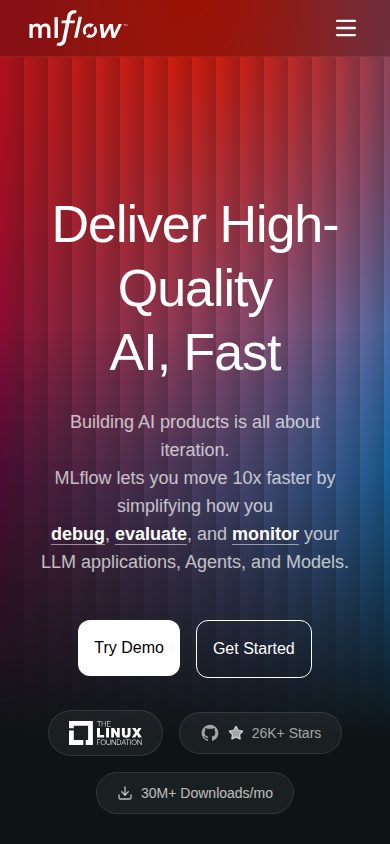
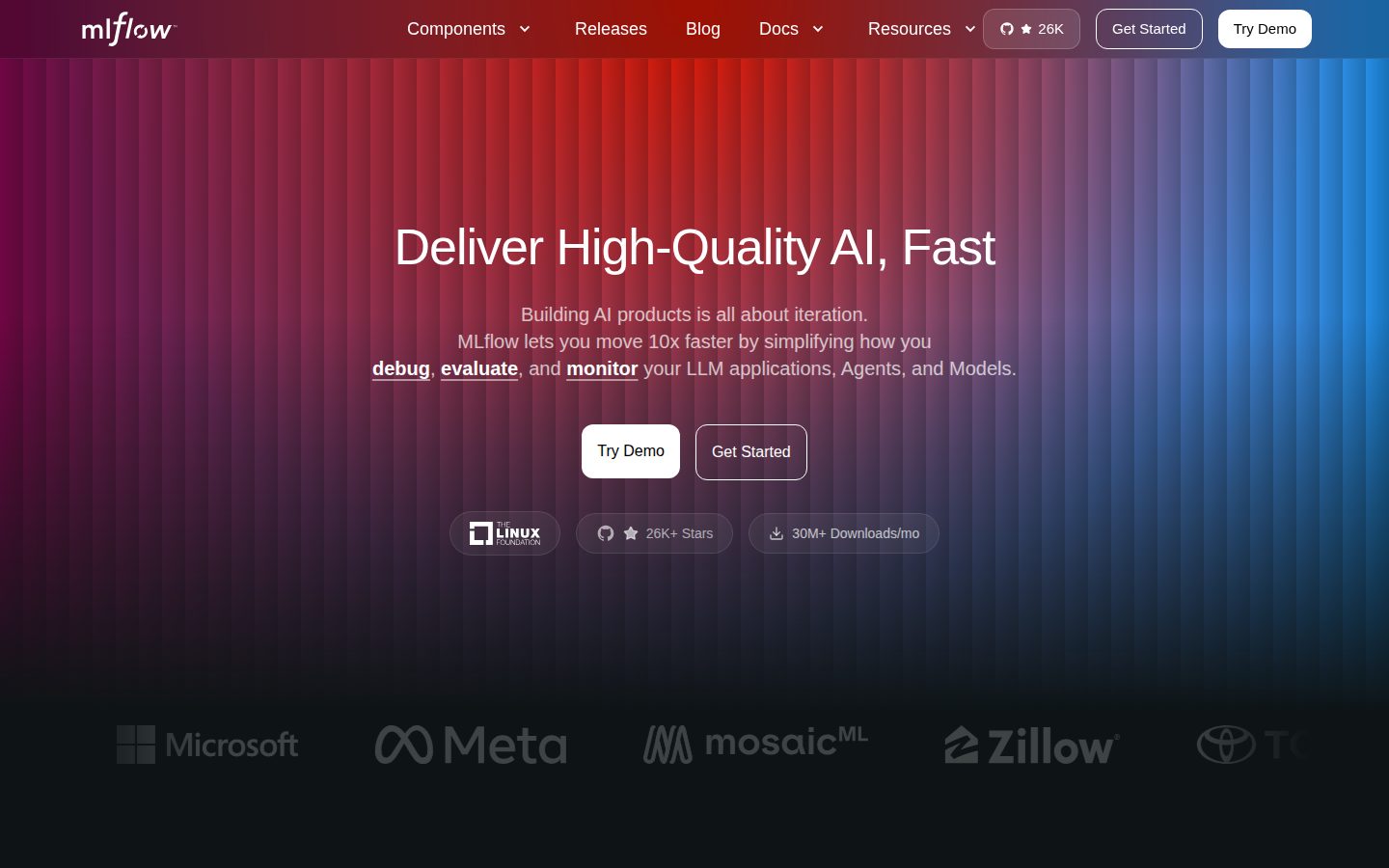
MLflow desktop previewMLflow mobile preview

Pricing Plans

Popular

Open Source (Self-Hosted)

Free

Free, open-source MLflow for individuals, researchers, and teams who self-host their own tracking server and infrastructure. No license fees ever.

  • Experiment tracking (parameters, metrics, artifacts)
  • MLflow Model Registry
  • MLflow Projects for reproducible runs
  • Model deployment and serving
  • LLM/GenAI tracing and evaluation
  • Supports Python, TypeScript/JS, Java, and R SDKs
  • Integrates with TensorFlow, PyTorch, Scikit-learn, LangChain, LlamaIndex
  • Apache 2.0 license – no vendor lock-in
  • Self-managed infrastructure (compute and storage costs apply separately)

Managed MLflow on Databricks

Contact sales

Fully managed MLflow hosted within the Databricks Data Intelligence Platform. Pricing is consumption-based (Databricks Units / DBUs) tied to your compute usage and cloud provider (AWS, Azure, GCP) — there is no standalone list price for MLflow itself. A free trial is available via the Databricks Free Trial. Contact Databricks for a quote.

  • Fully managed tracking server – no infrastructure to maintain
  • Built on Unity Catalog for enterprise governance and access control
  • Experiment tracking, model registry, and model serving in one platform
  • GenAI/LLM observability, prompt management, and AI Gateway
  • Real-time monitoring with trace explorer and automated alerts
  • Integration with Databricks AI/BI and SQL for performance analysis
  • Supports AWS, Azure, and Google Cloud
  • Enterprise-grade reliability, security, and scalability
  • Consumption-based pricing in DBUs (billed per second); cloud VM costs billed separately

AI Panel Reviews

The Decision Maker

The Decision Maker

Strategic bet, vendor viability, timing, adoption approval
8.8/10

Apache 2.0, Databricks-backed, and covering the full ML lifecycle for free.

MLflow is the default open source choice for teams running both classical ML and LLM workloads. Databricks backing means it won't disappear, and $0 to start removes the budget conversation entirely.

Apache 2.0 license. Databricks behind it. 100+ framework integrations including LangChain, OpenAI, and Anthropic. That's a rare combination of zero cost and institutional staying power. Weights & Biases charges per seat; MLflow charges nothing until you want Databricks-managed infrastructure.

Two things stand out. One: the LLM-as-a-judge evaluation with built-in scorers for groundedness and context sufficiency is genuinely useful, not demo-ware. Two: the AI Gateway gives you unified auth and rate limiting across OpenAI, Bedrock, and Gemini from one control plane — that's real operational leverage.

The tradeoff is infrastructure ownership. Self-hosted means your team runs the tracking server. Small teams without DevOps support will hit friction fast. Managed Databricks solves it, but now you're on consumption-based DBU pricing with no published list price.

Competitive Positioning8.2

LangSmith owns some LLM observability mindshare, but MLflow's combined ML and LLM coverage is a genuine differentiator.

Reputation Risk9.0

Adopting MLflow is a neutral-to-positive signal — peers and the board recognize it as the open source standard.

Speed to Value8.5

Their own docs claim 2-minute setup; autologging for scikit-learn and PyTorch means engineers ship value before lunch.

Strategic Fit8.5

Covers classical ML experiment tracking and LLM agent observability in one platform, advancing teams running both workloads.

Vendor Viability9.2

Databricks-backed, Apache 2.0, and the dominant open source MLOps project — it'll outlast most paid competitors.

Pros

  • Permanently free under Apache 2.0 — no licensing negotiation ever
  • Prompt Registry with versioning and auto-optimization is production-ready, not experimental
  • AI Gateway unifies auth and rate limiting across OpenAI, Bedrock, and Gemini
  • Databricks backing provides institutional staying power no startup competitor can match

Cons

  • Self-hosted means your team owns the infrastructure — real cost for small shops without DevOps
  • Managed Databricks pricing is consumption-based with no public list price, making budget forecasting hard
  • LangSmith has deeper agent debugging UX for pure LLM teams

Right for

ML teams running both classical models and LLM agents who want zero licensing cost and Databricks upgrade optionality.

Avoid if

Your team has no DevOps capacity and needs a fully managed platform with predictable per-seat pricing.

The Domain Strategist

The Domain Strategist

Craft and strategy in the product's domain — adapts identity per category, same lens
8.8/10

The default MLOps backbone for teams who want zero vendor leverage over their stack.

MLflow owns the experiment tracking category for a reason — Apache 2.0, self-hostable, and broad enough to cover both classical ML and LLM workflows without a subscription gate. The managed Databricks path adds enterprise governance when you need it, but the core is yours free and portable.

Autologging across scikit-learn, PyTorch, XGBoost, HuggingFace Transformers, and Spark ML is table-stakes coverage done right. The Model Registry with versioning and approval stages gives ML engineers an actual promotion workflow, not just a file system with good intentions. LLM-as-a-judge evaluation with predefined scorers for groundedness and context sufficiency puts it ahead of most classical MLOps tools that retrofitted GenAI features as an afterthought.

The AI Gateway — unified auth, rate limiting, and fallback routing across OpenAI, Anthropic, Bedrock, and Gemini — is the sleeper feature here. That's real infrastructure, not a demo integration. If you adopt this, in 3 years your model governance, prompt versioning, and provider routing all live in one audit trail.

The honest constraint: self-hosting means your infra team owns the tracking server, storage, and auth configuration. Weights & Biases removes that operational burden with a managed-first model. If your team lacks MLOps infra bandwidth, the Databricks path is consumption-billed and abstracts that away — but now you're inside the Databricks cost structure.

Category Positioning8.7

Sits uniquely across both classical MLOps and LLM observability, competing with Weights & Biases on the former and LangSmith on the latter — few tools span both credibly.

Domain Fit9.2

Experiment tracking, hyperparameter tuning, model registry with approval stages, and distributed tracing maps precisely to how senior ML practitioners actually structure their workflow.

Integration Surface8.8

100+ framework integrations including LangChain, LlamaIndex, OpenAI, and Spark ML, plus OpenTelemetry compatibility, cover essentially every stack a modern data science team runs.

Long-term Implications8.5

Apache 2.0 with no paid tier on core means zero license leverage over you in year 3; the only lock-in risk is if you go deep on Databricks-managed Unity Catalog governance.

Strategic Depth9.0

LLM-as-a-judge scorers for RAG-specific metrics plus Prompt Registry with automatic optimization shows genuine craft depth, not checkbox GenAI coverage.

Pros

  • Apache 2.0 license with no paid tier on core — genuine zero lock-in
  • Autologging covers every major ML framework out of the box
  • AI Gateway centralizes provider auth and rate limiting across OpenAI, Anthropic, Bedrock, and Gemini
  • LLM evaluation with groundedness and context sufficiency scorers built-in, not bolted on

Cons

  • Self-hosted tracking server means your team owns infra, auth config, and availability — Weights & Biases removes this burden entirely
  • No standalone pricing page for Databricks-managed tier; consumption-based DBU billing makes cost forecasting non-trivial
  • UI depth for experiment comparison lags behind Weights & Biases on polish

Right for

Teams who need full-lifecycle ML and LLM governance without ceding control of their infrastructure or budget to a SaaS vendor.

Avoid if

Your data science team has no MLOps infra support and needs a managed, turn-key platform with predictable per-seat pricing.

The Finance Lead

The Finance Lead

Money, total cost of ownership, contracts, procurement math
8.2/10

$0 license forever — but Databricks DBU costs are the real invoice to model

MLflow is Apache 2.0, self-hosted, no per-seat fees. The managed Databricks path has no published list price — that's the number procurement needs and won't find on the pricing page.

$0 license cost. Apache 2.0, no tiers, no SSO tax. Self-hosted infrastructure costs apply — compute and storage on AWS, Azure, or GCP are real line items, but they're yours to control. For a 50-person ML team self-hosting on modest cloud compute, rough TCO lands $15K–$30K over 3 years in infra, not licenses. Weights & Biases Business runs $50/seat — 50 users × $50 × 12 × 3 = $90K. The math favors MLflow if your team can own the ops burden.

Managed MLflow on Databricks flips the model. Consumption-based DBU pricing, no published rate, cloud VM costs billed separately. That's two unpredictable line items. Finance teams can't pre-approve what they can't model. Databricks free trial exists, but no standalone list price — quote required.

Contract flexibility is strong on the open source path: no auto-renewal, no termination clauses, no vendor. The tradeoff is ops overhead and no SLA. Self-sufficient ML teams win here. Teams wanting zero infra management should get a Databricks quote before committing.

Billing & Procurement8.5

Self-hosted requires zero procurement process; Databricks path requires a vendor quote and DBU consumption forecasting before finance will sign.

Contract Flexibility9.5

Apache 2.0 open source — no contract, no auto-renewal, no termination clauses, no vendor lock-in by design.

Pricing Transparency7.5

Self-hosted pricing is perfectly transparent at $0; managed Databricks path has no published DBU rate, requiring a sales call.

ROI Clarity8.0

Experiment tracking, token cost tracking, and LLM-as-a-judge evaluation produce measurable outputs; ROI is traceable against compute spend and model quality metrics.

Total Cost of Ownership8.0

Self-hosted TCO is controllable and predictable; Databricks DBU model adds unpredictable cloud compute stacking that's hard to model at year 3.

Pros

  • $0 license, Apache 2.0 — no per-seat fees ever
  • SSO included in self-hosted — no add-on charge, rare in this category
  • Token cost tracking built into tracing — actual spend visibility across providers
  • No auto-renewal risk on the open source path

Cons

  • Databricks managed pricing is opaque — no list price, DBU rates require a quote
  • Self-hosted ops burden is real — compute, storage, and maintenance fall on your team
  • No published overage rates or usage caps for the managed tier

Right for

ML and AI teams with infra capability who want full cost control and zero license spend.

Avoid if

Your team can't own server ops and needs a predictable flat-rate SaaS invoice.

The Domain Practitioner

The Domain Practitioner

Daily hands-on reality in the product's domain — adapts identity per category, same lens
8.5/10

MLflow is the default experiment tracker for a reason — self-hosting is the real cost

Free under Apache 2.0, deep autologging across scikit-learn, XGBoost, PyTorch, and HuggingFace, and now a credible LLM observability layer. The self-hosted operational burden is the honest tradeoff.

Autologging is where MLflow earns its install base. Two lines of code and your runs are tracked — parameters, metrics, artifacts, framework-specific metadata. That's not marketing copy, the docs show it for 8+ frameworks. Compared to Weights & Biases, there's no SaaS account required, no data leaving your VPC. For teams with data residency constraints, that matters immediately.

The new LLM surface is real, not bolted-on theater. The AI Gateway gives you a single auth layer across OpenAI, Anthropic, Bedrock, and Gemini with rate limiting and fallback routing. The Prompt Registry versions and evaluates templates. LLM-as-a-judge scorers for groundedness and context sufficiency are pre-built. LangSmith does some of this more cleanly for pure LLM workflows, but MLflow covers classical ML + LLM in one install.

The friction lives in infrastructure. You're running your own tracking server, managing storage, handling SSO config, and keeping the service up. On day three that's a background tax on every ML engineer who isn't also an ops person.

Day-3 Reality7.5

Autologging removes the per-experiment instrumentation tax, but someone on the team owns the tracking server and that ownership compounds daily.

Documentation Practitioner-Fit8.0

The changelog ships and docs cover CLI setup, SDK calls, and deployment targets with concrete code — written for engineers, not a marketing audience.

Friction Surface7.0

The ML tracking UX is mature and low-friction; the LLM tracing and Prompt Registry are newer and docs show more manual instrumentation steps than the classical ML path.

Power-User Depth8.5

Custom LLM-as-a-judge scorers, distributed OpenTelemetry-compatible tracing, Kubernetes deployment targets, and multi-tenant SSO workspaces give power users real surface area to work with.

Workflow Integration9.0

SDK-level autologging for scikit-learn, PyTorch, TensorFlow, HuggingFace, LangChain, and 100+ frameworks means it fits into existing training loops without restructuring code.

Pros

  • Apache 2.0 — zero license cost, no vendor lock-in, no data egress to a third-party SaaS
  • Autologging across 8+ major frameworks means minimal instrumentation overhead in existing training code
  • AI Gateway unifies auth, rate limiting, and fallback routing across OpenAI, Anthropic, Bedrock, and Gemini
  • LLM-as-a-judge evaluation with pre-built RAG scorers (groundedness, context sufficiency) ships out of the box

Cons

  • Self-hosting means you own the tracking server, storage, and uptime — that's real ops overhead for ML-focused teams
  • LLM tracing and Prompt Registry features are newer; expect rougher edges than the battle-tested experiment tracking core
  • Managed hosting requires Databricks, introducing DBU-based consumption pricing with no standalone list price
  • No native paid tier between free self-host and full Databricks platform — the middle is missing

Right for

ML engineering teams who want full data control, broad framework coverage, and are willing to operate their own infrastructure.

Avoid if

You want a fully managed LLM observability tool with zero ops overhead and don't need classical ML experiment tracking.

The Power User

The Power User

Daily human experience, onboarding, polish, learning curve, reliability
8.2/10

Free, serious MLOps backbone — but you're running your own infrastructure

MLflow is the open source default for ML experiment tracking and now a real contender for LLM observability. Zero licensing cost, real setup in 2 minutes, but the ops burden lands on you.

Apache 2.0, self-hosted, no paid tiers on the core product. That's the whole pitch and it lands hard when you compare it to Weights & Biases charging per seat or LangSmith gating features behind a plan. The Prompt Registry, AI Gateway with fallback routing across OpenAI, Anthropic, and Bedrock, plus LLM-as-a-judge scoring — that's a real feature set, not a checkbox list.

The daily experience is developer-native, which means the UI is functional but nobody agonized over empty states. Autologging for scikit-learn, PyTorch, LangChain and 100+ others means instrumentation is mostly painless. Still, this isn't a polished SaaS product. You feel the difference.

The honest tradeoff: $0 in licensing, but compute and storage costs are yours, and so is every ops headache. Databricks managed hosting exists if that gets heavy. Not for teams who want someone else to babysit the server.

Daily Polish6.5

The UI surfaces traces and experiment comparisons competently, but the open source project shows its seams — this was built for engineers, not for people who care about micro-copy.

Learning Curve7.8

Autologging flattens the first hour dramatically, but mastering the AI Gateway, Prompt Registry, and LLM evaluation scorers together takes real time.

Mobile Parity4.0

No mobile story exists here — this is a data scientist's workbench running on web, Linux, Mac, Windows, and mobile is simply not the use case.

Onboarding Experience8.5

The docs indicate a 2-minute setup path — one command, two lines of code — which is genuinely rare for an MLOps tool with this feature depth.

Reliability Feel7.5

Self-hosted reliability depends on your infra, but the tracking server and REST API architecture are battle-tested; Databricks managed option handles this for teams who want it.

Pros

  • Genuinely free forever under Apache 2.0 — no licensing games
  • LLM-as-a-judge evaluation with RAG-specific metrics like groundedness is production-grade
  • 100+ framework integrations including LangChain, PyTorch, and HuggingFace mean autologging actually works
  • Polyglot SDKs — Python, TypeScript, Java, R — so it's not Python-only

Cons

  • Self-hosting means you own the ops burden — compute and storage costs add up
  • UI polish is functional, not delightful — empty states feel like an afterthought
  • Mobile is essentially nonexistent for a tool that lives in browsers
  • Managed hosting means Databricks pricing, which is consumption-based DBUs with no simple list price

Right for

ML engineers and data scientists who want serious experiment tracking and LLM observability without a SaaS licensing bill.

Avoid if

Your team has no one to run infrastructure and needs a polished, managed product on day one.

The Skeptic

The Skeptic

Contrarian. Watch-outs, deal-breakers, broken promises, category patterns
8.2/10

Apache 2.0, 100+ integrations, Databricks backstop — this one's got legs

MLflow is the incumbent open source MLOps standard. Self-host free forever, or pay Databricks for managed. Most competitors in this space either got acquired or went quiet.

Three tells that made me pay attention. One: Apache 2.0 license — no bait-and-switch pricing tier lurking. Two: Databricks is the commercial backstop, not a seed-stage startup with 18 months of runway. Three: the changelog exists. That last one eliminates more tools than you'd expect.

The differentiation is real. LangSmith owns LangChain workflows. Weights & Biases owns experiment tracking mindshare. MLflow is the only one covering both classical ML — scikit-learn autologging, Model Registry with approval stages — and the LLM layer with an AI Gateway that spans OpenAI, Anthropic, and AWS Bedrock. That breadth is the moat, maybe. Could also be the trap.

Tradeoff worth naming: self-hosted means you own the infrastructure costs and ops burden. The managed Databricks path has no list price — it's DBU consumption plus cloud VM costs. That's a blank check if you're not watching usage.

Competitive Differentiation7.5

The AI Gateway plus classical ML tracking in one platform is a real gap vs. LangSmith (LLM-only) or W&B (ML-only), but the UI polish delta vs. Weights & Biases is visible.

Exit Portability9.0

Apache 2.0, self-hostable, multi-SDK — Python, TypeScript, Java, R — and open artifact formats mean migration pain is low if Databricks ever changes direction.

Long-term Viability9.0

Databricks is a multi-billion dollar company with Unity Catalog already integrated — MLflow isn't going anywhere, and the changelog shows active shipping.

Marketing Honesty8.5

'Largest open source AI engineering platform' is the kind of claim that invites argument, but the 100+ integrations and Apache 2.0 terms are verifiable and the docs are present — no obvious vaporware.

Track Record Match9.0

MLflow has been the default experiment tracker for years — Comet ML and Neptune are still alive but smaller; MLflow's Databricks parentage gives it a category-survivor profile most alternatives lack.

Pros

  • Apache 2.0 forever — no license ambush down the road
  • Databricks as commercial backer removes the 'startup going dark' risk
  • Covers both classical ML autologging and LLM tracing in a single platform
  • 2-minute setup claim is plausible — one command, two lines of code

Cons

  • Managed Databricks pricing is DBU consumption-based with no list price — budget visibility is poor
  • Self-hosted means you own infra ops, which isn't free in eng time
  • UI finish lags Weights & Biases on experiment comparison workflows

Right for

ML or AI teams who want a free, portable, framework-agnostic platform and don't want to pick separate tools for LLM observability vs. classical experiment tracking.

Avoid if

You need a fully managed SaaS with predictable per-seat pricing and no infrastructure responsibility.

Buyer Questions

Common questions answered by our AI research team

Pricing

Is MLflow free to use?

MLflow is 100% open source under the Apache 2.0 license — forever free, no strings attached.

Setup

How quickly can I set up MLflow?

Setup takes about 2 minutes: run one command to start the server (~30 sec), add 2 lines of code to enable logging (~30 sec), then run your code (~1 min).

Integration

Does MLflow work with LangChain and OpenAI?

Yes, MLflow integrates natively with LangChain and OpenAI, and works with 100+ AI frameworks out of the box.

Features

Can MLflow deploy agents to production?

Yes, the MLflow Agent Server deploys agents to production with a single command, providing FastAPI-based hosting with automatic request validation, streaming support, and built-in tracing.

Features

Does MLflow support languages other than Python?

Yes, MLflow supports Python, TypeScript/JavaScript, Java, and R.

Product Information

  • Company

    MLflow
  • Founded

    2018
  • Pricing

    Free
  • Free Plan

    Available

Platforms

weblinuxmacwindows

About MLflow

MLflow is an open-source platform for managing the machine learning lifecycle, including experiment tracking, model registry, and deployment, originally developed at Databricks.

Resources

Documentation
Blog
Changelog

Also in Machine Learning Platforms