Dayforce logo

Dayforce Review

Visit

Cloud HCM platform with real-time payroll, scheduling, and workforce management

Dayforce is a cloud-based human capital management (HCM) platform for mid-sized to large enterprises managing HR, payroll, and workforce operations.

AI Panel Score

7.9/10

6 AI reviews

Reviewed

About Dayforce

In day-to-day use, HR administrators and managers work within a single application to handle employee records, run payroll, build schedules, manage time and attendance, administer benefits, and track performance. Employees access pay stubs, request time off, swap shifts, and complete onboarding tasks through a self-service portal or the iOS and Android mobile app. When a manager approves a shift change or an employee clocks in, payroll and labor cost calculations update immediately without waiting for a nightly batch run.

The platform includes several capabilities the vendor specifically highlights as differentiators. Dayforce Wallet gives employees on-demand access to earned wages before payday. The workforce management module includes AI-powered scheduling with demand forecasting, geofenced mobile time capture, and real-time labor cost tracking — features aimed at organizations with hourly or shift-based workforces. The AI Assistant, embedded across the platform, handles natural language queries about HR policies, drafts job postings, assists with performance reviews, and routes unresolved questions to HR service tickets. AI Agents operate in payroll for anomaly detection and in workforce planning for demand forecasting. The talent suite covers applicant tracking with job posting to 25,000+ career sites, a learning management system with AI-generated learning paths, and succession planning with 360-degree feedback.

Dayforce targets organizations with 100 to 4,000+ employees and is particularly well-suited for retail, hospitality, manufacturing, and healthcare — industries with complex scheduling and hourly workforce needs. Pricing follows a per-employee-per-month model with modular packaging; specific rates are not publicly listed and require a sales consultation. Implementation typically takes three to six months for mid-sized deployments. Direct competitors include Workday, ADP, UKG Pro, and Oracle HCM Cloud.

The platform is cloud-native SaaS hosted on infrastructure certified to SOC 1, SOC 2 Type II, and ISO 27001 standards, with GDPR and CCPA compliance. It offers an open API and pre-built integrations with Microsoft Outlook, Microsoft Teams, Slack, and QuickBooks. The mobile application is available for iOS and Android and carries a 4.7-star rating. Platform updates are continuous rather than versioned releases.

Features

AI

  • AI Workspace

    A collaborative strategic planning environment with an infinite canvas that supports what-if scenario modeling, workforce capacity planning, and multi-modal interaction including voice, text, and clicks.

  • AI-Powered Scheduling & Workforce Management

    Uses AI-driven demand forecasting to generate employee schedules, track real-time labor costs, and enable shift swapping and self-scheduling for hourly and shift-based workforces.

  • Dayforce AI Assistant

    A conversational AI assistant embedded across the platform that answers HR policy questions, generates job postings, assists with performance reviews, automates time-off requests, and escalates issues to HR service tickets.

Analytics

  • People Analytics & Advanced Reporting

    Provides 300+ pre-built report templates, a drag-and-drop custom report builder, predictive analytics for flight risk and overtime forecasting, industry benchmarking, and real-time data visualization dashboards.

Core

  • Benefits Administration

    Automates open enrollment, manages life events, handles COBRA administration, and provides benefits shopping and comparison tools with carrier integrations.

  • Continuous Payroll Calculation Engine

    Processes payroll changes in real time rather than batches, so updates to hours, pay rates, or deductions instantly reflect across all modules including taxes, benefits, and reporting.

  • Dayforce Wallet

    Provides employees on-demand access to earned pay before the standard payday, integrated directly within the payroll module.

  • Global Payroll

    Delivers payroll processing across 200+ countries and territories with multi-currency support, tax compliance automation, and garnishment management.

  • Learning Management System with AI Skills Tagging

    Delivers a full LMS with personalized learning paths, AI-assisted course creation, AI-powered skills gap analysis, and a Career Explorer tool for internal mobility.

  • Talent Acquisition & Applicant Tracking

    Offers AI-powered recruiting with job posting distribution to 25,000+ career sites, resume parsing, candidate screening, interview scheduling, and onboarding automation.

Integration

  • Open API & Pre-Built Integrations

    Offers an open API for third-party connections along with pre-built integrations to Microsoft Outlook, Teams, QuickBooks, and Slack to extend platform functionality.

Mobile

  • Mobile App with GPS Time Capture

    A full-featured iOS and Android app enabling employees to view pay stubs, schedules, and time off, while supporting mobile time capture with GPS and geofencing and allowing managers to approve requests on the go.

Preview

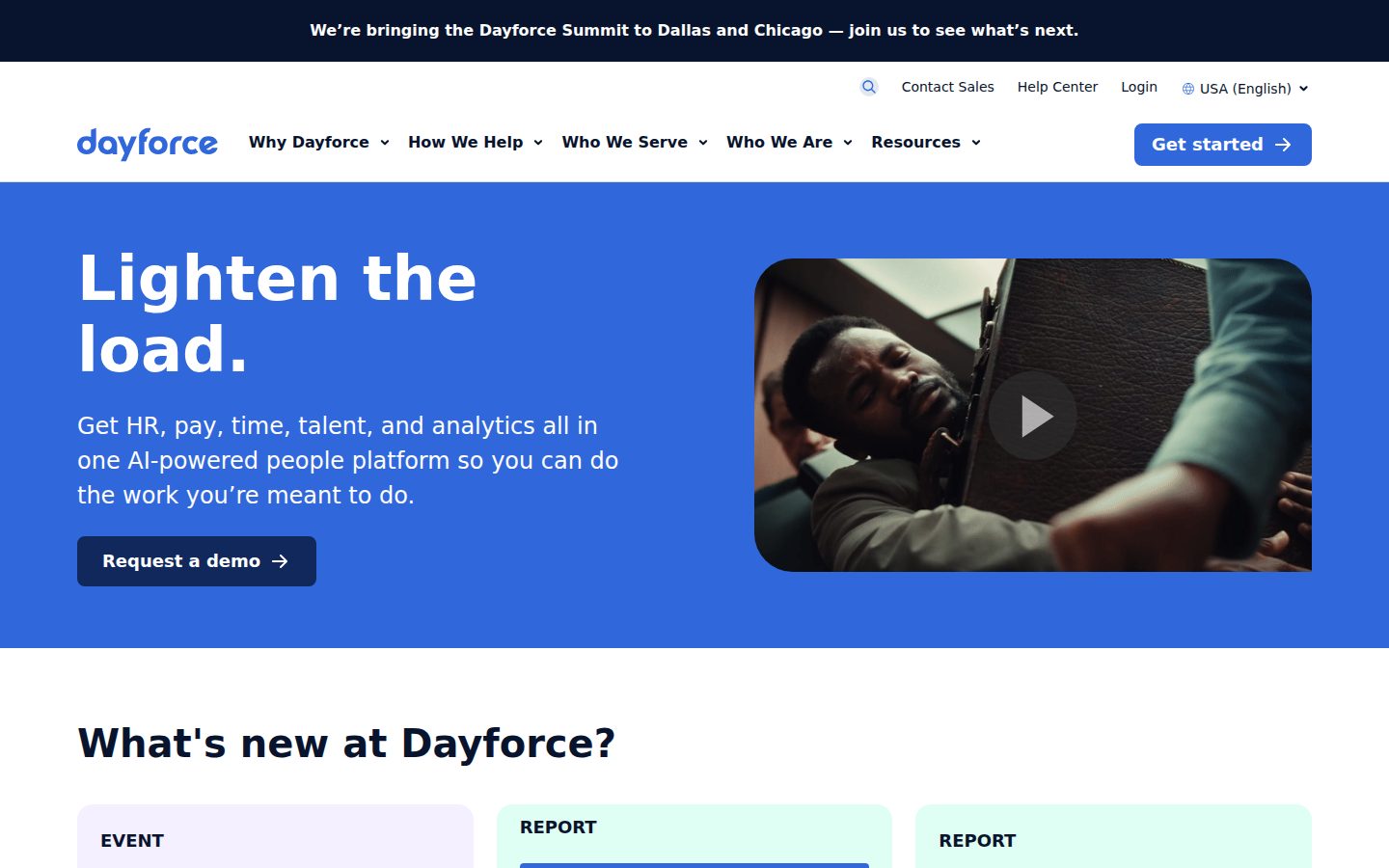
Dayforce desktop previewDayforce mobile preview

Pricing Plans

Standard (Core HCM & Payroll)

Contact sales

Ideal for small to mid-sized businesses with approximately 350–1,000 employees. Focuses on essential HR and payroll functionality. Pricing is quote-based; contact Dayforce sales. Third-party buyer reports indicate a typical range of ~$20–$28 PEPM when HCM and payroll are bundled.

  • Core HR & employee record management
  • Real-time payroll processing & tax compliance
  • Benefits administration
  • Time & attendance tracking
  • Employee self-service portal
  • Reporting & dashboards
  • Dayforce Wallet (earned wage access)
Popular

Select (Workforce Suite)

Contact sales

Designed for mid-sized enterprises with approximately 1,000–5,000 employees. Adds workforce management and talent acquisition modules on top of Core HCM. Pricing is quote-based; contact Dayforce sales. Third-party buyer reports indicate a typical range of ~$28–$34 PEPM.

  • Everything in Standard
  • Workforce management (scheduling, labor forecasting, absence management)
  • Onboarding & recruiting / ATS
  • Performance management
  • Advanced analytics & workforce reporting
  • Mobile clock-in/out with geofencing
  • AI-optimized scheduling

Signature (Enterprise Full Suite)

Contact sales

Targeted at large enterprises with 5,000+ employees and complex, multi-jurisdictional HR needs. Includes the full module set. Pricing is quote-based; contact Dayforce sales. Third-party buyer reports indicate a typical range of ~$35–$45 PEPM, with average annual contract values around $92,000+ for mid-market deals.

  • Everything in Select
  • Compensation planning & succession management
  • Learning management system (LMS)
  • Employee engagement tools
  • Global payroll (160+ countries, multi-currency)
  • AI Workspace with predictive staffing & compliance insights
  • Strategic workforce planning & scenario modeling
  • Advanced talent intelligence & career pathing
  • People analytics with 300+ pre-built reports

AI Panel Reviews

The Decision Maker

The Decision Maker

Strategic bet, vendor viability, timing, adoption approval
8.2/10

Proven enterprise HCM with real-time payroll that Workday can't match at this price.

Dayforce is a mature, full-suite HCM used by 6,000+ organizations across 200+ countries. The continuous payroll engine is the real differentiator — everything else is competitive table stakes.

Gartner Magic Quadrant, five consecutive years. Six thousand customers. That's not a startup bet — that's a category incumbent with staying power. Third-party pricing data puts the mid-market bundle at $28–$34 PEPM, which is defensible against Workday and Oracle HCM at equivalent scope.

The continuous payroll calculation engine is what I'd lead with in any board conversation. Batch payroll is a liability most companies don't realize they have. Dayforce Wallet and AI-powered scheduling add real operational leverage for retail, healthcare, or manufacturing workforces — the buyers this platform is actually built for.

The tradeoff: three to six months to implement, no free trial, and pricing that requires a sales call. You won't know your number until you're halfway through a vendor relationship. Pilot with a defined scope, get the contract math in writing before you commit modules.

Competitive Positioning8.0

Real-time payroll processing is a genuine edge over ADP and UKG Pro, which still run batch; $28–$34 PEPM undercuts Workday at comparable scope.

Reputation Risk9.0

Nobody gets fired for buying a Gartner-recognized platform with SOC 2 Type II and ISO 27001 certifications; the board will nod.

Speed to Value6.5

Three to six month implementation window for mid-sized deployments means payback is slow — no free trial to de-risk the decision upfront.

Strategic Fit8.0

The continuous payroll engine and AI Workspace with scenario modeling advance operations — this isn't just cost reduction on existing processes.

Vendor Viability9.0

Five consecutive Gartner Magic Quadrant appearances and 6,000+ customers across 200+ countries signals a durable, well-resourced operator.

Pros

  • Continuous payroll engine eliminates batch processing risk — live updates across all modules instantly
  • Dayforce Wallet and AI-powered scheduling built for hourly workforces, not retrofitted
  • 300+ pre-built analytics reports plus a drag-and-drop builder — no BI tool required
  • Global payroll in 200+ countries with multi-currency and tax compliance automation

Cons

  • No pricing transparency — $28–$45 PEPM range comes from third-party sources, not Dayforce directly
  • Three to six month implementation with no free trial means significant sunk cost before you know if it works
  • Full suite depth may be overkill for companies under 350 employees
  • No public changelog or API docs visible — harder to assess integration velocity

Right for

Mid-to-large enterprises in retail, healthcare, or manufacturing with complex scheduling and a need for real-time payroll across multiple jurisdictions.

Avoid if

You need a fast deployment or want to trial before committing — this platform requires both time and a sales relationship before you see a number.

The Domain Strategist

The Domain Strategist

Craft and strategy in the product's domain — adapts identity per category, same lens
8.4/10

The HCM suite that actually connects payroll, scheduling, and talent in one real-time engine.

Dayforce is a serious enterprise HCM platform built around a continuous calculation engine — not a patchwork of acquisitions. For people teams running complex workforces across multiple locations, this is the operational backbone worth betting on.

The single-database architecture is the story here. When a manager approves overtime at 2pm, payroll, labor costs, and compliance all update instantly — no nightly batch, no reconciliation sprint. That's not a demo feature; that's a different operational model. At $28–$34 PEPM on the Select tier, mid-market people teams get scheduling, ATS, performance, and AI-optimized forecasting in one system.

The AI layer is substantive, not cosmetic. 300+ pre-built report templates, flight risk prediction, and an AI Assistant that escalates unresolved HR queries to service tickets — that's workflow integration, not a chatbot wrapper. Dayforce Wallet adds a retention angle that Workday and UKG Pro can't match as natively.

The tradeoff is implementation weight. Three to six months for a mid-sized deployment means real change management cost before any value lands. And no public pricing page means every renewal conversation starts on their terms, not yours.

Category Positioning8.6

Five consecutive Gartner Magic Quadrant appearances and 6,000+ customers put Dayforce firmly in the Workday and ADP conversation, with a credible edge in hourly workforce complexity.

Domain Fit8.5

Retail, hospitality, and healthcare use cases are explicitly designed in — geofenced time capture, shift swapping, and on-demand staffing via Flex Work match how these workforces actually operate.

Integration Surface7.6

Pre-built connectors to Teams, Outlook, Slack, and QuickBooks cover most mid-market stacks, though no public API docs limit pre-sales due diligence.

Long-term Implications7.8

Single-database consolidation creates operational leverage over time, but opaque pricing and a 3–6 month implementation window create switching costs that grow with headcount.

Strategic Depth8.8

Continuous payroll calculation engine plus AI Workspace with scenario modeling signals platform-grade architecture, not feature accumulation.

Pros

  • Real-time payroll engine eliminates batch reconciliation cycles
  • AI scheduling with demand forecasting purpose-built for shift-based industries
  • Dayforce Wallet gives people teams a retention lever competitors don't match natively
  • 300+ analytics templates with predictive flight risk and overtime forecasting

Cons

  • No public pricing — every negotiation and renewal is opaque by design
  • 3–6 month implementation is real organizational lift before ROI
  • No free trial or self-serve evaluation path for pre-sales diligence
  • AI Workspace depth (scenario modeling, infinite canvas) is Signature-tier only

Right for

Mid-to-large people teams in retail, manufacturing, or healthcare running hourly workforces who need payroll, scheduling, and compliance in one system.

Avoid if

You're under 350 employees or need a fast, self-serve onboarding path before committing to a multi-month implementation.

The Finance Lead

The Finance Lead

Money, total cost of ownership, contracts, procurement math
7.2/10

$28–$34 PEPM buys a full HCM suite, but the invoice is unknowable until contract.

Dayforce is a feature-complete HCM for 1,000–5,000-employee orgs with complex scheduling needs. No public pricing, no free trial, no short exit.

Third-party buyer reports put Select tier at $28–$34 PEPM. At 1,000 employees, that's $336K–$408K annually before implementation, training, or integrations. Three-year TCO with 15% headcount growth lands at roughly $1.1M–$1.4M all-in. That's not unreasonable for the feature set — continuous payroll calculation, 25,000+ job site distribution, AI-powered scheduling, Dayforce Wallet — but buyers should model it explicitly before the first sales call.

The Signature tier averages $92K+ ACV at mid-market. Add three-to-six months of implementation. No published overage rates. No free trial. Compared to Workday, the PEPM is likely lower, but Workday's ecosystem is deeper. ADP is cheaper at the low end. Dayforce earns its price for hourly-workforce-heavy industries — retail, healthcare, manufacturing — where the scheduling AI and geofenced time capture justify the delta.

Contract risk is real. No termination-for-convenience terms are public. Annual contracts are standard in this category; assume auto-renewal windows of 60–90 days. Procurement timelines run long given the sales-only motion. No self-serve, no trial, no sandbox.

Billing & Procurement5.5

Sales-only motion, no free trial, and a 3–6 month implementation window create high procurement friction compared to lighter HCM competitors.

Contract Flexibility5.0

No public termination-for-convenience clause, no self-serve cancellation, and category-standard auto-renewal windows likely apply — standard enterprise hostage terms.

Pricing Transparency3.5

No published rates on the pricing page; third-party $20–$45 PEPM ranges exist but Dayforce itself discloses nothing without a sales call.

ROI Clarity7.0

Real-time payroll, 300+ pre-built reports, and AI anomaly detection in payroll give measurable labor-cost and compliance savings, especially for shift-based workforces.

Total Cost of Ownership6.0

PEPM benchmarks exist via third parties, but implementation (3–6 months), training, and undisclosed overage rates make year-3 modeling speculative.

Pros

  • Continuous payroll calculation engine eliminates batch-run risk — unique at this tier
  • Third-party PEPM benchmarks exist: $20–$45 depending on tier and headcount
  • 300+ pre-built analytics reports reduces BI build cost post-go-live
  • Global payroll across 200+ countries at one contract — consolidation value is real

Cons

  • Zero pricing transparency — every number requires a sales engagement
  • 3–6 month implementation adds six figures to year-one TCO before first paycheck runs
  • No free trial or sandbox — can't validate fit before committing
  • No public auto-renewal or cancellation terms — assume unfavorable until proven otherwise

Right for

Mid-to-large enterprises in retail, healthcare, or manufacturing with 1,000+ employees and complex hourly scheduling needs.

Avoid if

Your team is under 500 employees or needs pricing clarity before engaging a sales rep.

The Domain Practitioner

The Domain Practitioner

Daily hands-on reality in the product's domain — adapts identity per category, same lens
7.8/10

Enterprise-grade HCM that earns its place, but recruiting lives in the shadow of payroll

Dayforce is a serious platform for complex workforces — retail, healthcare, manufacturing — where scheduling, compliance, and payroll are the daily grind. Recruiting and talent acquisition are real features, not afterthoughts, but they're not the reason you buy this.

The ATS posts to 25,000+ career sites, does resume parsing, and handles interview scheduling. That's table stakes, but table stakes done properly. The AI Assistant drafting job postings is genuinely useful — not because it's magic, but because writing the same warehouse associate JD for the fifteenth time is soul-draining. Based on the feature list, candidate pipeline visibility and recruiter workflow feel like they sit one click too deep inside an HR admin tool built around payroll cycles, not hiring velocity.

At ~$28–$34 PEPM for the Select tier, you're paying for the full workforce suite. Compared to a standalone ATS like Greenhouse or Lever, Dayforce costs more but delivers payroll, scheduling, and compliance alongside recruiting. That's the real tradeoff: you get deep integration but you sacrifice the recruiter-first UX that purpose-built tools nail.

Workday competes here with a similarly HR-centric ATS. Dayforce's edge is the continuous payroll engine and Flex Work for on-demand staffing — genuinely differentiated for high-volume hourly roles. For a recruiter filling corporate knowledge-worker positions, the scheduling depth is overhead. For retail or healthcare talent teams, it's exactly the right tool.

Day-3 Reality7.2

Single-database architecture means no re-keying data between modules, but docs indicate a 3–6 month implementation before that coherence pays off.

Documentation Practitioner-Fit6.5

No docs link surfaced in the evidence and no changelog is public — suggests documentation is gated behind the sales relationship, not open for daily reference.

Friction Surface6.8

No changelog is public and no free trial exists, so recruiters can't self-evaluate before committing to a full sales cycle and implementation.

Power-User Depth8.2

300+ pre-built report templates, predictive flight-risk analytics, and AI Workspace scenario modeling give experienced HR and TA leaders real depth to grow into.

Workflow Integration7.8

Pre-built integrations with Outlook, Teams, and Slack cover the recruiter's daily communication stack without forcing new habits.

Pros

  • ATS distributes to 25,000+ career sites with AI-assisted job posting drafts
  • Single database means candidate-to-employee data transfers without re-entry
  • Dayforce Flex Work handles on-demand worker sourcing for shift-gap coverage
  • Mobile app at 4.7 stars supports manager approvals and candidate actions on the go

Cons

  • No free trial — recruiting teams can't pressure-test the ATS workflow before buying
  • Pricing requires a sales call; third-party reports suggest $28–$45 PEPM, not cheap for TA-only use cases
  • Recruiter-centric UX is secondary to HR admin and payroll workflows
  • Implementation runs 3–6 months, so hiring doesn't accelerate until well after signing

Right for

Mid-to-large employers in retail, healthcare, or manufacturing who need recruiting tightly coupled with scheduling and payroll on one platform.

Avoid if

You're a talent acquisition team that just needs a fast, recruiter-first ATS and doesn't own payroll or workforce management.

The Power User

The Power User

Daily human experience, onboarding, polish, learning curve, reliability
8.1/10

The payroll engine is real — but budget 4 months before you see it run

Dayforce is a serious HCM platform with a genuinely differentiated continuous payroll calculation engine and strong workforce management depth. Onboarding is slow and pricing is opaque, but the product delivers for complex hourly workforces.

The thing that actually makes Dayforce interesting isn't the AI Assistant or the 25,000+ job board integrations — it's the continuous payroll engine. Changes to hours or deductions update in real time across every module, no batch runs, no end-of-cycle sprint. For retail, healthcare, or manufacturing with thousands of hourly workers, that's not a nice-to-have. That's the whole game. Workday and UKG Pro both batch. This doesn't.

The mobile app carries a 4.7-star rating and supports GPS time capture with geofencing, manager approvals, and self-service — that's actual mobile parity, not a read-only stub. The 300+ pre-built analytics reports and Dayforce Wallet earned wage access fill out a package that hits most enterprise HR checklist items in one product.

The tradeoffs are real though. No public pricing, no free trial, implementation runs three to six months minimum. Third-party data suggests ~$20–$28 PEPM for the base tier, scaling to $35–$45 PEPM for the full Signature suite. That's a significant budget conversation before you've seen it live. Not a tool you pilot over lunch.

Daily Polish7.8

Single-database design eliminates module-switching friction, but no changelog visibility makes it hard to know what's changing under you week to week.

Learning Curve6.8

300+ report templates and AI-assisted workflows help at month three, but the breadth of modules — payroll, LMS, ATS, scheduling — means the first 30 days require real investment.

Mobile Parity8.5

iOS and Android apps support geofenced time capture, manager approvals, shift swapping, and pay stubs — 4.7-star rating backs up the feature list.

Onboarding Experience6.5

Three-to-six month implementation for mid-sized deployments means day one is a project kickoff, not a welcome screen — no free trial compounds this.

Reliability Feel8.2

SOC 2 Type II and ISO 27001 certifications, continuous releases rather than versioned updates, and a single-database architecture suggest a team that sweats uptime.

Pros

  • Continuous payroll engine updates in real time — no batch processing, no end-of-cycle crunch
  • Genuine mobile parity with GPS geofencing, manager approvals, and 4.7-star app rating
  • Dayforce Wallet earned wage access built natively into payroll, not a third-party add-on
  • 6,000+ customers across 200+ countries with five consecutive Gartner Magic Quadrant appearances

Cons

  • No public pricing, no free trial — you're deep in a sales cycle before you see a number
  • Three-to-six month implementation is the floor, not the ceiling, for mid-market deployments
  • Signature tier at $35–$45 PEPM with ~$92K+ average contract value puts this out of range for lean HR teams
  • No public changelog means it's hard to track what the platform is shipping week to week

Right for

Mid-to-large enterprises in retail, healthcare, or manufacturing with complex hourly scheduling needs and budget for a multi-month implementation.

Avoid if

You need to be up and running in weeks, or you're under 350 employees without dedicated HR ops capacity.

The Skeptic

The Skeptic

Contrarian. Watch-outs, deal-breakers, broken promises, category patterns
7.8/10

5 Gartner Magic Quadrant appearances and a real differentiator — but exit costs are brutal

Dayforce has legitimate differentiation in its continuous payroll engine and earned wage access. The no-public-pricing, 3-6 month implementation, and opaque contract structure are the classic tells of a platform that's hard to leave.

Three observations before anything else. One: 'Lighten the load' as an H1 is deliberately vague — the kind of headline that doesn't age badly but also doesn't commit to anything. Two: no changelog, no API docs page, no pricing page — all gated behind sales. Three: the $20–$45 PEPM range from third-party reports is useful context, but Dayforce itself won't say it.

The continuous calculation engine is real and specific. Workday and ADP still batch-process payroll in many configurations. If you're running 1,000+ shift workers where a clock-in instantly touches labor cost, overtime, and tax — that's not marketing copy, that's architecture. Dayforce Wallet and geofenced mobile clock-in are coherent additions, not checkbox features.

The exit story worries me. Single-database HCM with 6-month implementations and $92K+ ACVs means you're not migrating casually. If direction shifts, the switching cost is real. That's not a flaw — it's the business model. Know it going in.

Competitive Differentiation7.8

Continuous payroll calculation and Dayforce Wallet are genuinely distinct vs. Workday and UKG Pro; the 25,000+ job site distribution in the ATS adds weight.

Exit Portability4.5

Single-database architecture, 3-6 month implementation timelines, and $92K+ ACVs mean migration is expensive and painful — open API helps at the margins, not at the core.

Long-term Viability8.2

200+ country payroll support, continuous release cadence, and enterprise contract base suggest a stable 3-5 year bet — no public funding alarm signals visible.

Marketing Honesty6.5

No pricing page, no changelog, 'simplicity at scale' headline — the marketing is aspirational and the evidence page has minimal public commitments.

Track Record Match8.5

Five consecutive Gartner Magic Quadrant appearances and 6,000+ customers matches the pattern of durable HCM vendors, not the ones that quietly shut down.

Pros

  • Continuous payroll engine is real architecture, not a marketing claim — changes reflect instantly across tax, benefits, and reporting
  • Dayforce Wallet earned-wage access is embedded, not a third-party bolt-on
  • Five consecutive Gartner MQ appearances indicates sustained enterprise validation
  • 300+ pre-built report templates and predictive flight-risk analytics in the Signature tier

Cons

  • No public pricing — $20-$45 PEPM comes from third-party data, not the vendor
  • 3-6 month implementation means you're committed before you're live
  • No changelog visible; shipping cadence can't be independently verified
  • Exit is painful — single-database design that's an asset during use becomes a liability when leaving

Right for

Mid-to-large enterprises in retail, healthcare, or manufacturing with hourly workforces who need payroll and scheduling to talk to each other in real time.

Avoid if

You're under 350 employees or need a quick deployment — the implementation timeline and contract structure weren't built for you.

Buyer Questions

Common questions answered by our AI research team

Features

Does Dayforce process payroll in real time?

Yes. Dayforce uses a continuous calculation engine, meaning changes to hours, pay rates, or deductions reflect instantly across all modules rather than processing in batches — eliminating the traditional payroll sprint at the end of each cycle.

Features

How many countries does Dayforce support for payroll?

Dayforce supports payroll in more than 200 countries.

Features

Can employees access earned wages before payday?

Yes. Dayforce Wallet gives employees on-demand access to their earned wages before payday, without payroll or funding complications.

Features

Does Dayforce use AI for workforce scheduling?

Yes. Dayforce uses AI to identify week-over-week trends and optimize scheduling hour by hour, helping businesses find labor efficiencies more accurately than manual forecasting.

Integration

Can Dayforce fill staffing gaps with on-demand workers?

Yes. Dayforce Flex Work connects businesses with qualified on-demand workers to fill labor and skill gaps and meet flexible staffing needs.

Product Information

  • Company

    Dayforce
  • Founded

    1992
  • Pricing

    Contact for pricing

Platforms

webiosandroid

About Dayforce

Dayforce is a cloud-based human capital management platform offering payroll, HR, benefits, talent management, and workforce management in a single application.

Resources

Blog

Also in AI HR & Recruiting