Mercor logo

Mercor Review

Visit

Expert talent and human data for frontier AI labs and enterprises

Mercor is a talent marketplace and human-data platform for AI labs training and evaluating frontier models.

AI Panel Score

8.0/10

6 AI reviews

Reviewed

AI Editor Approved

What is Mercor?

Mercor is a talent marketplace and human-data platform that supplies vetted domain experts to AI labs and enterprises for model training, evaluation, and agent development. Professionals such as physicians, lawyers, consultants, and software engineers create a profile, complete an adaptive AI interview, and receive remote contract offers paying $60 to $250 per hour with weekly payouts. Buyer pricing is quote-based; labs and enterprises contact sales for custom data projects, dataset licensing, or agent services. Core capabilities include the APEX benchmark family, which scores frontier models on professional tasks in banking, consulting, law, medicine, and software engineering; off-the-shelf licensed datasets covering 50,000-plus tasks; enterprise agent diagnostics, deployment, and benchmarking; and a data-monetization pipeline that masks over 60 types of sensitive identifiers across 34-plus integrations. It best fits AI labs needing RLHF and evaluation data at scale and experts seeking flexible remote AI work. Alternatives include Scale AI, Surge AI, Turing, and Toloka.

About Mercor

Mercor runs a two-sided marketplace connecting AI labs with the domain experts they need to train and evaluate models. Professionals create a profile, complete an adaptive AI interview that adjusts its questions to their field, and receive offers through the work portal in three steps. Contract roles span medicine, law, consulting, software engineering, and dozens of other domains, typically paying $60 to $250 per hour with an average contracted rate of $79 per hour and weekly payouts; interview responses are never sold or used to train customer models.

The platform's benchmarking arm publishes APEX, the AI Productivity Index, a family of evaluations that scores frontier models on real professional work: APEX v1 covers investment banking, management consulting, big law, and primary care tasks; APEX-Agents tests long-horizon, cross-application agent work; and APEX-SWE, built with Cognition, measures software engineering performance. Buyers can also license off-the-shelf, peer-reviewed datasets, including 2,620 APEX Agents tasks across eight professional domains, the 1,200-task ACE consumer index, and 3,558 BrowseComp web-browsing tasks, with sample tasks delivered the same day.

Mercor serves frontier AI labs sourcing RLHF and evaluation data, enterprises deploying agents, and professionals seeking flexible remote AI work. All buyer engagements are quote-based through the sales team; there is no self-serve pricing. In the human-data and evaluation category it competes with Scale AI, Surge AI, Turing, Toloka, and Invisible Technologies.

For enterprises, Mercor offers four services: Agent Diagnostics to find high-value automation opportunities, Agent Deployment to build and integrate expert-informed agents into company workflows, Agent Benchmarking for independent performance testing, and Data Monetization, which anonymizes workflow data using deterministic pattern matching and generative AI to mask more than 60 types of PII, PHI, and BII across 34-plus integrations before licensing it to AI labs. The platform runs in the browser, and APEX datasets and evaluation code are published on Hugging Face and GitHub.

Features

Analytics

  • APEX Benchmarks

    The AI Productivity Index, a benchmark family that scores frontier models on economically valuable tasks across investment banking, management consulting, big law, and primary care medicine.

  • APEX-Agents

    Leaderboard measuring whether frontier AI agents can execute long-horizon, cross-application tasks across professional services jobs.

  • APEX-SWE

    Software engineering benchmark built with Cognition that evaluates models on real-world work, from bug fixes to feature development.

  • Mercor Agent Benchmarking

    Independent, repeatable performance testing of enterprise agents run against Mercor's expert talent network.

Assessment

  • AI Interview

    Adaptive AI-led interview that adjusts its questions to a candidate's field to evaluate expertise at scale before matching them to roles; responses are never sold or used to train customer models.

Automation

  • Mercor Agent Deployment

    Builds agents infused with human expertise and integrates them into company workflows with deployment guardrails and observability.

  • Mercor Agent Diagnostics

    Analyzes enterprise workflows and organizational knowledge to identify high-value agent deployment opportunities.

Data

  • Mercor Data Monetization

    Lets enterprises license anonymized operational data to AI labs, with compensation based on data volume and depth, paid by wire transfer within 2-4 weeks.

  • Off-the-Shelf Datasets

    Pre-built, peer-reviewed licensable datasets, including 2,620 APEX Agents tasks across eight domains, the 1,200-task ACE consumer index, and 3,558 BrowseComp web-browsing tasks, with sample tasks delivered same day.

Marketplace

  • Work Portal

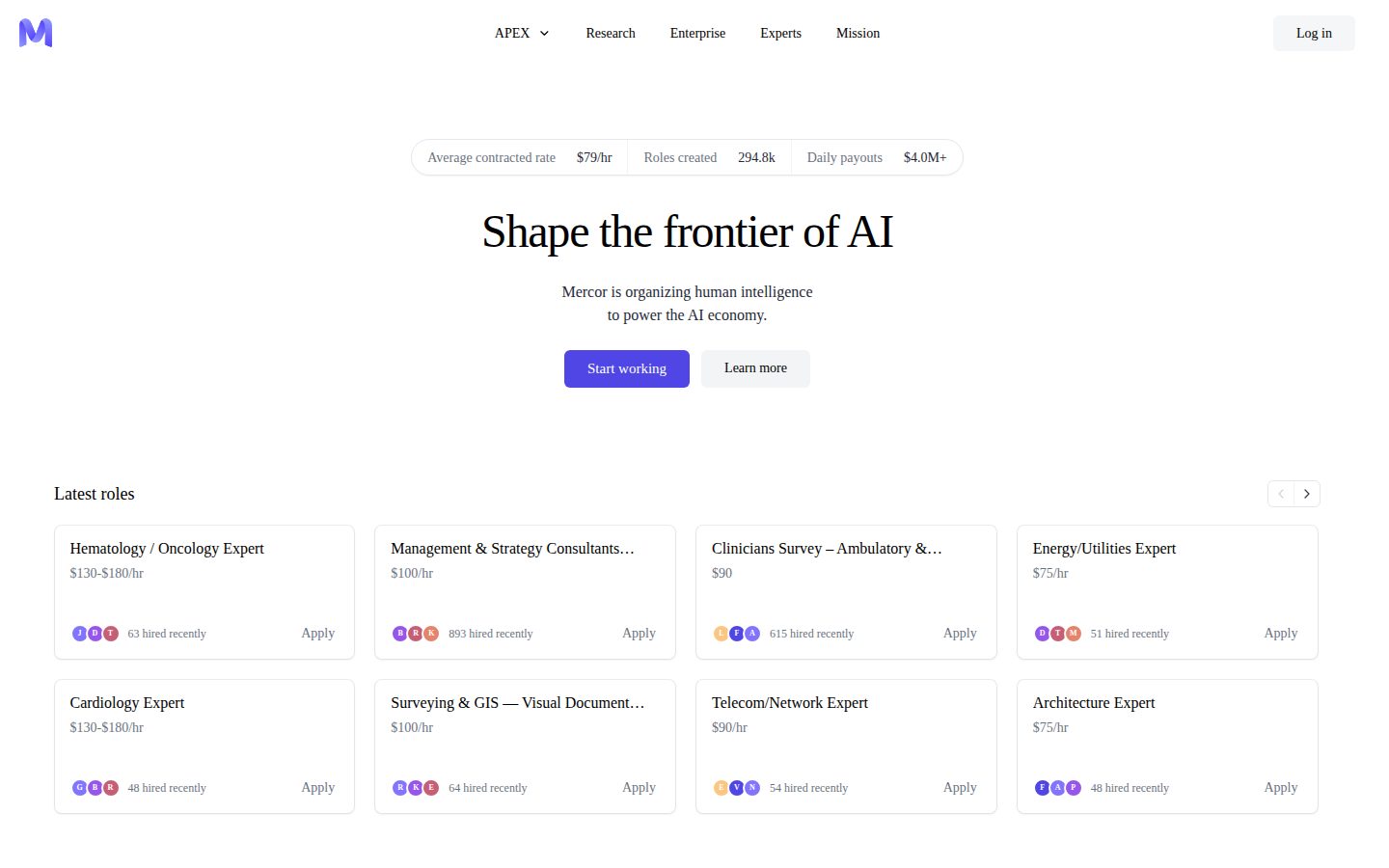
    Browse and apply to remote AI contract roles, from hematology and oncology experts at $130-$180/hr to machine learning engineers at $70-$250/hr, and receive offers in three steps.

Payments

  • Weekly Payouts

    Contractors are paid weekly for completed work, with more than $4M in daily payouts across the expert network.

Security

  • PII Anonymization Pipeline

    Combines deterministic pattern matching and generative AI to irreversibly mask PII, PHI, and BII, detecting and neutralizing more than 60 types of sensitive identifiers across 34+ integrations.

Preview

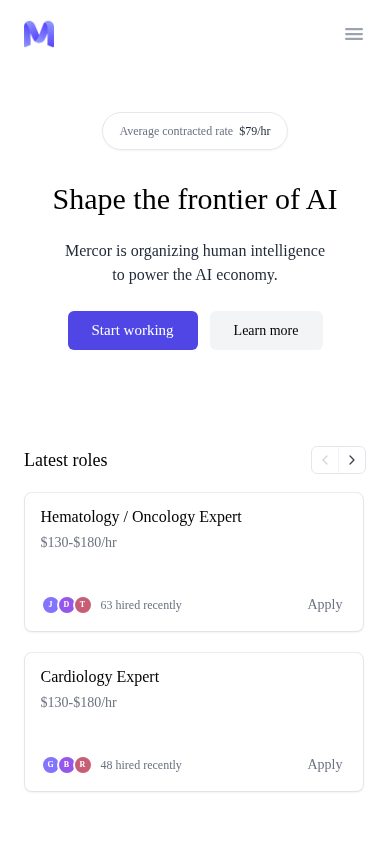
Mercor desktop previewMercor mobile preview

Pricing Plans

Contact Sales

Contact sales

Pricing requires contacting the vendor.

  • Custom human-data projects for RLHF, evaluations, and agent training
  • Off-the-shelf dataset licensing with same-day sample tasks
  • Enterprise agent diagnostics, deployment, and benchmarking
  • Data monetization partnerships paid by data volume and depth
  • Access to a network of 1M+ vetted domain experts

AI Panel Reviews

The Decision Maker

The Decision Maker

Strategic bet, vendor viability, timing, adoption approval
8.4/10

Mercor is the rare two-year-old vendor you can defend to the board.

Mercor matches vetted domain experts to frontier labs for model training and evaluation, and it publishes the APEX benchmark family. It's profitable, valued at $10 billion, and positioned as the neutral vendor the labs now want.

Six of the Magnificent Seven already buy from Mercor. That answers my reference-check question before I've placed a call. A $350 million Series C at a $10 billion valuation in October 2025 answers the runway question.

APEX is the strategic tell. Publishing how frontier models score on real banking and law work makes Mercor the referee, and referees get invited to every game. Scale AI's Meta entanglement pushed neutral-vendor demand straight to them.

The catch: revenue reportedly concentrates in a handful of labs, and contractor wage cuts drew press in late 2025. Still, they turned a profit in the first half of 2025 while quintupling their valuation. Pilot a scoped evaluation project now, and negotiate terms while they're still land-grabbing.

Competitive Positioning8.5

Neutral standing after Scale AI's Meta deal plus the APEX referee role is a strong hand.

Reputation Risk7.6

Reported late-2025 contractor wage cuts and lab revenue concentration are the visible flags.

Speed to Value8.2

Same-day dataset samples and an existing 1M+ expert network shorten the first engagement.

Strategic Fit8.3

Expert data and evaluation are the exact inputs frontier AI programs are short on.

Vendor Viability8.6

A $350M Series C at a $10B valuation plus a reported H1 2025 profit is unusual durability for a 2023 founding.

Pros

  • Profitable while growing run rate from $100M to $500M inside six months of 2025.
  • A $350M Series C at a $10B valuation removes runway risk for years.
  • APEX benchmarks make Mercor the visible referee for frontier-model productivity.
  • Neutral positioning after Scale AI's Meta deal wins lab trust.

Cons

  • Revenue reportedly concentrated in a handful of frontier labs.
  • Late-2025 contractor wage-cut reports carry reputation risk.
  • No self-serve motion; every engagement runs through sales.

Right for

AI teams who need vetted domain experts for large evaluation programs.

Avoid if

Small teams who need self-serve pricing without a sales cycle.

The Domain Strategist

The Domain Strategist

Craft and strategy in the product's domain — adapts identity per category, same lens
8.3/10

The strongest supply-side bet for teams that need thousands of calibrated expert evaluators.

Mercor treats expert evaluation as a recruiting-and-calibration problem and solves it with adaptive screening across a million-expert network. For long-horizon evaluation programs, the supply pipeline matters more than any single dataset, and this one is the deepest visible.

Expert supply, not task design, is the bottleneck in frontier evaluation programs now. Mercor's AI Interview screens candidates adaptively by field, which is the only credible way to keep a network of one million experts current. If the screening holds calibration, the refresh problem gets solved at the source.

Coverage runs from hematology specialists at $130 to $180 an hour through consulting, law, and software engineering, with weekly payouts keeping the pool warm. APEX-Agents — 2,620 peer-reviewed tasks across eight professional domains — proves they can turn that pool into durable evaluation assets, not just staffing.

However, quote-based buying means every new evaluation workstream routes through their sales team, and Surge AI competes for the same lab budgets with deeper RLHF roots. If you're standing up a three-year evaluator program, this is the strongest supply-side foundation visible in the category.

Category Positioning8.4

Publishing APEX-Agents and open datasets makes it the visible standard-setter against Surge AI and Turing.

Domain Fit8.6

Purpose-built for sourcing calibrated expert evaluators, which is precisely the scarce input.

Integration Surface7.8

34+ integrations on the data-partnership side; buyer-side work runs through quote-based services.

Long-term Implications7.9

The expert network holds value across cycles, but lab budget concentration shapes the roadmap.

Strategic Depth8.4

The AI Interview plus the APEX benchmarking arm compound into a supply moat, not a staffing agency.

Pros

  • The adaptive AI Interview keeps a million-expert network screened without armies of recruiters.
  • Domain coverage spans medicine, law, consulting, and software with posted rates.
  • APEX-Agents' 2,620 peer-reviewed tasks prove the pool converts into durable evaluation assets.

Cons

  • Quote-based engagement adds procurement latency to every new workstream.
  • Surge AI and Turing compete for the same concentrated lab budgets.
  • Evaluator quality consistency at million-expert scale isn't publicly evidenced.

Right for

Data operations leaders who run expert evaluation programs at scale.

Avoid if

Teams who only need occasional crowdsourced annotation.

The Finance Lead

The Finance Lead

Money, total cost of ownership, contracts, procurement math
7.7/10

Expert labor runs $60 to $250 an hour; everything above the rate is a negotiation.

All buyer engagements are quote-based with no published platform pricing. Posted expert rates and same-day dataset samples give partial cost visibility, but the total bill is a sales conversation.

The visible number is labor: $60 to $250 an hour, averaging $79 contracted. Everything above that rate is negotiated. No rate card, no published take rate, no tiers.

Off-the-shelf improves the math. Licensing the 1,200-task ACE index or 3,558 BrowseComp tasks beats commissioning custom work, and sample tasks arrive same day. Data Monetization runs the other direction — it pays enterprises by wire within 2 to 4 weeks, turning workflow exhaust into a revenue line.

Turing sells through the same quote-based motion, so no penalty for the category norm. The catch is year-three cost can't be modeled without a negotiation, and a vendor that grew from $100 million to $500 million run rate inside six months has pricing power. Budget a buffer.

Billing & Procurement7.8

Weekly contractor payouts and 2-4 week wire settlements show functioning money operations.

Contract Flexibility7.4

Quote-based, sales-led engagements with no visible self-serve or standard terms.

Pricing Transparency6.8

Expert hourly rates are posted; platform pricing and take rate are not.

ROI Clarity8.0

APEX scoring and same-day samples make deliverable value unusually measurable for this category.

Total Cost of Ownership7.6

Off-the-shelf datasets and posted labor rates anchor cost, but custom work is unbounded upward.

Pros

  • Posted expert rates of $60 to $250 an hour give real cost anchors.
  • Off-the-shelf datasets with same-day samples undercut custom commissions.
  • Data Monetization can turn workflow exhaust into a revenue line.
  • A profitable vendor is less likely to reprice mid-contract.

Cons

  • No published platform pricing or take rate.
  • Quote-only motion slows procurement and blocks cost modeling.
  • Rapid growth hands the vendor leverage at renewal.

Right for

Procurement teams who can budget for negotiated enterprise data contracts.

Avoid if

Buyers who require published pricing before a sales call.

The Domain Practitioner

The Domain Practitioner

Daily hands-on reality in the product's domain — adapts identity per category, same lens
8.1/10

Adaptive screening plus weekly payouts fix the two worst jobs in expert sourcing.

The AI Interview compresses specialist screening from weeks of calls into ranked candidates per field. Weekly payouts and posted rate bands keep a large expert pool from churning.

Screening a thousand specialist applicants normally eats a week of calls. The AI Interview runs that screen adaptively per field and hands you ranked candidates, which is the difference between sourcing ten evaluators and sourcing five hundred.

Offer flow is three steps, which keeps specialists from ghosting mid-funnel. Weekly payouts — more than $4 million moving daily across the network — remove the reconciliation mess that burns out expert pools on Scale's Outlier. Posted rate bands, like machine-learning engineers at $70 to $250 an hour, are rare candor in this category.

The friction sits at the edges, however. New project types route through Mercor's services team rather than self-serve tooling, and public documentation on rubric calibration is thin. For sourcing and paying specialists at volume, it still beats stitching a job board to a spreadsheet.

Day-3 Reality8.2

Adaptive AI Interview screening plus a three-step offer flow removes the worst manual sourcing work.

Documentation Practitioner-Fit7.8

APEX methodology is published openly, but buyer-facing rubric-calibration docs are thin.

Friction Surface7.7

New project types route through the services team instead of self-serve tooling.

Power-User Depth8.3

Rate bands, domain coverage, and a 1M+ expert network reward sourcing at serious volume.

Workflow Integration8.0

Weekly payouts at $4M-a-day scale fold payout operations into the platform.

Pros

  • AI Interview screening turns a week of calls into ranked candidates.
  • Weekly payouts at $4M-a-day scale eliminate reconciliation work.
  • Posted rate bands per role make offer conversations honest.
  • Three-step offer flow keeps specialist funnels from leaking.

Cons

  • Buyer-side workflows depend on Mercor's services team, not self-serve tooling.
  • Public documentation on rubric calibration and QA process is thin.
  • Wage-band changes like the late-2025 cuts can destabilize a curated pool.

Right for

Talent operations leads who source specialist contractors at volume.

Avoid if

Teams who want hands-on control of every screening interview.

The Power User

The Power User

Daily human experience, onboarding, polish, learning curve, reliability
8.0/10

A talent platform that pays weekly and answers in three steps earns real goodwill.

The contractor experience is unusually respectful, with three-step offers, posted rates, and weekly pay. The AI-led screening is efficient but leaves you without a human when it matters.

Three steps from profile to offer is the whole pitch, and it's a good one. Most talent platforms make you re-enter your resume four times and then go quiet for a month. The Work Portal at least respects the clock.

Getting paid weekly instead of net-60 is the detail that tells you someone there has actually freelanced. The average contracted rate is $79 an hour, with posted ranges up to $250, so nobody's reverse-engineering their worth from a black box.

Everything runs in the browser, no native app, so checking offers from your phone is a mobile-web experience. The catch with an AI-led interview: if it misreads your specialty, there's no human on the line to appeal to. Still, next to Upwork's bid-and-pray churn, this feels like a staffing agency that answers its email.

Daily Polish8.0

Posted rates and a clean three-step offer flow beat category norms for respect.

Learning Curve8.0

The marketplace mechanics are familiar to anyone who has freelanced before.

Mobile Parity7.5

Browser-only platform; neutral score since the work itself is desktop-shaped.

Onboarding Experience8.4

Profile, adaptive interview, offer — three steps with no resume re-entry loop.

Reliability Feel7.8

Over $4M in daily payouts landing weekly suggests the money side just works.

Pros

  • Weekly pay instead of the freelance-standard net-30 or worse.
  • Offers come to you with no bidding wars.
  • Posted rates up to $250 an hour take the guessing out.

Cons

  • No native mobile app; browser only.
  • The AI interview has no human fallback if it misjudges you.
  • Contract work means income can stop between projects.

Right for

Professionals who want flexible remote AI work with fast pay.

Avoid if

Candidates who want a human recruiter through the hiring process.

The Skeptic

The Skeptic

Contrarian. Watch-outs, deal-breakers, broken promises, category patterns
7.4/10

Fast, profitable, and dependent on a handful of labs staying hungry for expert data.

The growth and profitability look real in all visible reporting. So does the customer concentration, and the November 2025 wage cuts show how fast the economics can shift.

Two-year-old companies don't normally hit a $500 million run rate. When one does, I ask who's paying. The answer is a handful of frontier labs, with revenue reportedly concentrated among a few of them.

Credit where due. APEX-SWE, the software benchmark built with Cognition, publishes openly on Hugging Face, contractor rates average a stated $79 an hour, and they report an actual first-half 2025 profit. That's more disclosure than Toloka manages.

But watch three things. Forbes reported contractor wage cuts of roughly a third in November 2025, and curated expert pools remember that. Datasets port cleanly on exit; custom pipelines don't. And if lab data budgets tighten, concentrated revenue tightens with them. Solid company, fragile altitude.

Competitive Differentiation7.8

Post-Meta neutrality and the APEX referee position genuinely separate it from Scale AI.

Exit Portability7.0

Licensed datasets survive an exit; custom pipelines and network access don't.

Long-term Viability7.2

Profitable and well-capitalized, but the revenue base is a handful of lab budgets.

Marketing Honesty7.3

'Organizing human intelligence' is grand, but rates and benchmark methodology are published openly.

Track Record Match7.6

The $500M run rate, H1 2025 profit, and lab customers are corroborated by independent reporting.

Pros

  • Benchmark methodology is published openly on Hugging Face.
  • Reported profitability is rare in this cohort.
  • Contractor rates are stated plainly instead of hidden.

Cons

  • Revenue concentrated in a few frontier-lab budgets.
  • November 2025 wage cuts dented expert-pool trust.
  • Only two-plus years of operating history.
  • Custom pipelines don't port if you leave.

Right for

Labs who need expert data now from a well-capitalized vendor.

Avoid if

Buyers who want a vendor with a decade of history.

Buyer Questions

Common questions answered by our AI research team

Pricing

How much does Mercor pay experts per hour?

Listed contract roles pay $60 to $250 per hour, with an average contracted rate of $79 per hour. Rates depend on expertise, project complexity, and demand, and contractors are paid weekly, with over $4M in daily payouts across the network.

Features

What is the Mercor APEX benchmark?

APEX is Mercor's AI Productivity Index, a benchmark family scoring frontier models on real professional work. APEX v1 covers banking, consulting, law, and medicine; APEX-Agents tests long-horizon agent tasks; APEX-SWE, built with Cognition, measures software engineering.

Setup

How do I get hired through Mercor?

Create a profile, complete an adaptive AI interview that tailors questions to your field, and receive offers through the work portal. Roles are fully remote contracts lasting weeks to months, and Mercor says you can get your first offer in three steps.

Security

Does Mercor anonymize licensed enterprise data?

Yes. Its pipeline combines deterministic pattern matching with generative AI to irreversibly mask PII, PHI, and BII, detecting and neutralizing more than 60 types of sensitive identifiers before workflow data reaches AI labs.

Integration

What integrations do Mercor data partnerships support?

Mercor supports 34+ integrations spanning messaging, documents, email and calendar, CRM and sales tools, code repositories, and finance and HR systems, capturing signals like meeting transcripts, document edits, and task completions.

Also in AI HR & Recruiting