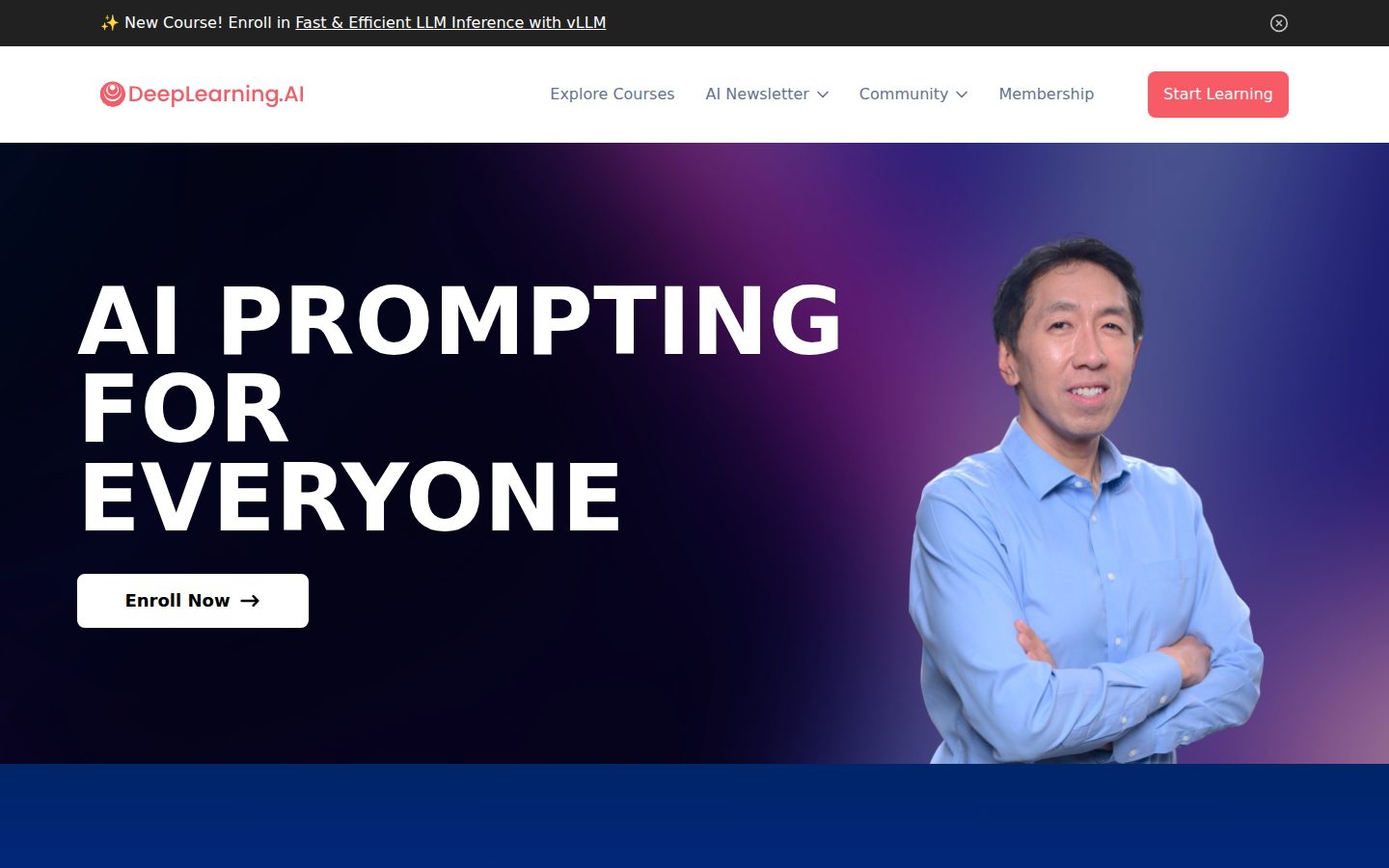
AI and machine learning courses from Andrew Ng and industry leaders
DeepLearning.AI is an online learning platform for AI and machine learning education.
AI Panel Score
6 AI reviews
Reviewed
AI Editor ApprovedApproved and published by our AI Editor-in-Chief after full panel analysis.Learners access DeepLearning.AI primarily through a course catalog organized into individual courses and multi-course specializations. The workflow involves enrolling in a course, progressing through video lectures and hands-on assignments, and completing assessments to earn certificates. Courses are hosted in collaboration with partners and range from foundational machine learning concepts to applied topics like natural language processing and agentic AI workflows.
Beyond the course catalog, the platform distributes free downloadable resources including Andrew Ng's career guide for AI practitioners and the book Machine Learning Yearning, which covers how to structure and tune ML projects. The Batch, a weekly newsletter, provides summaries of current AI research, policy developments, and industry news. These resources are available without enrollment in a paid course.
DeepLearning.AI targets a broad audience from beginners seeking foundational AI literacy to working engineers building production AI systems. Many courses are available for free to audit through Coursera, with paid certificates available via Coursera's subscription model. Competitors in the online AI education space include fast.ai, Udacity's AI nanodegrees, and Google's machine learning crash courses.
Courses are delivered entirely through web browsers, with Coursera serving as the primary distribution platform for structured specializations. No dedicated desktop or mobile application is required, though Coursera's iOS and Android apps provide access to course content on mobile devices.
In-browser programming environments (including Jupyter notebooks) where learners build and train real AI models, agentic systems, and production applications as part of each course.
Dedicated courses teaching learners how to apply fine-tuning and reinforcement learning techniques to shape model behavior, improve reasoning, and make LLMs safer and more reliable.
A personal dashboard that shows all enrolled short courses and tracks individual learner progress within each course, accessible from the top-right corner on desktop.
A dedicated DeepLearning.AI Forum where learners can ask questions, get peer and instructor support, and share ideas across all courses and specializations.
A paid subscription ($25/mo annually or $30/mo monthly) that unlocks full access to 150+ programs, professional certificates, quizzes, assignments, and new skills added weekly.
A video player with adjustable playback speed, selectable video quality for low-bandwidth users, English/Spanish captions, and a Picture-in-Picture (PiP) mode for multitasking.
Multi-course, in-depth programs (10+ hours) such as the Deep Learning Specialization and Machine Learning Specialization that culminate in a shareable certificate upon completion.
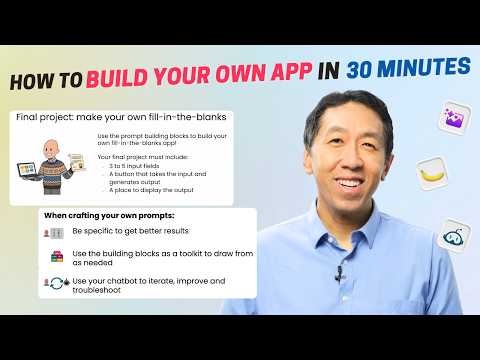
Bite-sized, topic-specific AI courses covering areas such as prompt engineering, RAG, agents, fine-tuning, and LLMOps that learners can complete in one to two hours.
Curated sequences of courses organized by skill level and role (e.g., beginner, AI practitioner, product manager) so learners can follow a progressive path from foundational basics to advanced application.
Course content spans 40+ AI tool providers and frameworks—including LangChain, LlamaIndex, Hugging Face, AWS, Snowflake, MongoDB, and PyTorch—teaching platform-agnostic, production-ready skills.
Courses are taught by instructors from leading AI organizations including OpenAI, Anthropic, Google, Meta, LangChain, CrewAI, and Replit, in addition to Andrew Ng and DeepLearning.AI faculty.
A regularly published AI news and insights newsletter from Andrew Ng covering the latest research, industry trends, and events, delivered to subscribers.
For anyone who wants to explore DeepLearning.AI short courses and audit course content without graded assignments or certificates.
For individual learners who want full access to all courses, graded assignments, and certificates on DeepLearning.AI's platform.
Same full Pro access as the monthly plan but billed annually ($300/year), offering the best per-month value for committed learners.
For groups of 10 to 150 people. Includes tools for managing member access and permissions. Pricing requires contacting DeepLearning.AI via their help center.
Andrew Ng built the category; $300/year makes this a no-brainer for any AI-serious team.
“DeepLearning.AI is the default choice for structured AI upskilling. Seven million learners and partners like OpenAI, Anthropic, and Google don't happen by accident.”
Founded in 2017 by Andrew Ng, this isn't a startup bet. The Coursera distribution, 7 million learners, and partner roster spanning OpenAI to Hugging Face signal a platform that's built to last. No funding drama to track here.
At $300/year for Pro, you're getting 150+ programs, in-browser Jupyter labs, LLM fine-tuning curriculum, and certificates. Fast.ai is free but unstructured. Udacity's nanodegrees cost 10x this. The pricing doesn't trap you either — audit mode is genuinely free.
The tradeoff: this is individual upskilling, not org-wide capability building. Team plans cap at 150 people and require a sales call. If you're trying to move 500 engineers, you'll need more than a learning catalog.
Fast.ai and Google's ML crash courses are free but shallow; DeepLearning.AI's partner-led depth at $25/mo is the clear value leader.
OpenAI, Anthropic, and Google as named course partners; no board member will question this choice.
One-to-two hour short courses on prompt engineering and LLMOps can pay back in days, not quarters.
Short courses on LangChain, RAG, and agentic AI workflows directly advance teams building production AI systems today.
Founded 2017, 7 million learners, Coursera-backed distribution, and Andrew Ng's personal brand as a durable moat.
Any team that needs applied AI skills fast and won't pay Udacity prices.
You need enterprise LMS integration or a cohort-based learning structure for large engineering orgs.
Andrew Ng's platform is the default L&D bet for AI upskilling at serious depth.
“DeepLearning.AI offers curriculum breadth that's genuinely hard to match — 40+ framework integrations, partner instruction from Anthropic, OpenAI, and Google, and structured paths from beginner to LLMOps practitioner. At $300/year per seat annually, the cost-per-learning-hour is difficult to argue against.”
150+ programs covering everything from foundational ML to agentic workflow design, with in-browser Jupyter environments baked into the core learning loop. That's not a content library — that's a curriculum architecture. The short-course format (1–2 hours) paired with deep specializations gives L&D leaders real scheduling flexibility across mixed-skill cohorts. The partner instructor roster — Anthropic, Meta, LangChain, CrewAI — means the applied content doesn't lag the industry by 18 months the way most edtech does.
The gap shows up at the organizational layer. The Team plan caps at 150 learners and requires contacting support for pricing — no self-serve, no LMS integration evidence in the docs, no cohort-level analytics beyond individual progress tracking. For enterprise L&D with an LMS already in place, that's friction.
If you're building an AI upskilling program against fast.ai or Udacity nanodegrees, DeepLearning.AI wins on curriculum depth and credential weight. The constraint is that you're building on Coursera's infrastructure, which means the learner data and completion workflows live in someone else's system.
7 million learners and Andrew Ng's credential gravity make this the default brand in AI education — fast.ai has community depth, Udacity has nanodegree structure, but neither matches DeepLearning.AI's industry-partner instruction roster.
Short courses and specializations match self-directed practitioner learning, but the Team plan's 10–150 cap and lack of visible LMS hooks limit fit for structured enterprise L&D programs.
No API, no changelog, no documented LMS integration — the platform is self-contained, which is fine for individual learners but constraining for L&D ops teams running SCORM or xAPI workflows.
Weekly course additions and 40+ framework integrations suggest the catalog stays current, but Coursera dependency means learner data and completion records sit outside your stack.
LLM fine-tuning, reinforcement learning, and agentic AI curriculum from actual practitioners at OpenAI and Anthropic — ceiling is genuinely high.
L&D teams building AI upskilling programs for technical and semi-technical staff who need production-ready skills fast.
Your org runs a centralized LMS and needs SCORM-compliant completions or learner data portability.
$300/year buys 150+ AI courses — cleanest per-seat math in the category
“DeepLearning.AI Pro at $25/month annual is $300/year, full stop. Team pricing requires a sales call, but individual math is unusually transparent.”
$300/year annual. $360/year monthly. Delta is $60 — trivial for a committed learner. 100+ short courses free without a credit card. That free tier is real, not bait. Competitor Udacity nanodegrees run $1,500–$2,000 per program. Coursera's audit model adds procurement flexibility most L&D teams ignore.
Team tier is the gap. 10–150 seats, no published rate, contact sales. Budget $400–$600/seat/year as a category baseline until invoice confirms. 50 seats × $500 × 3 years = $75K rough scenario. Could land lower. Could land higher. No published overage structure — standard for team tiers, still a risk.
ROI is measurable if you tie completions to role requirements. The My Learning Progress Tracker and shareable certificates give HR a paper trail. Andrew Ng's brand cuts internal approval friction. Tradeoff: self-paced means low completion rates without manager accountability baked in.
Stripe payments, clean individual billing; Team onboarding requires help center contact, adding friction.
Monthly cancel anytime; annual terms and Team contract clauses aren't publicly documented.
Individual tiers — Free, $30/mo, $300/yr — all published without a sales call; Team pricing is opaque.
My Learning Progress Tracker and shareable certificates create measurable completion artifacts; completion rates are self-driven.
Individual 3-year TCO is $900 annual plan; Team TCO requires quote, no published per-seat rate.
Individual engineers or L&D teams buying AI upskilling at predictable sub-$500/seat cost.
Your org needs a published Team per-seat rate before engaging procurement.
Andrew Ng's 7-million-learner machine is the default pick for structured AI training
“DeepLearning.AI delivers structured, production-relevant AI curriculum at $25/month annually — hard to beat for individual learners or small teams. The short-course format and Jupyter-in-browser labs keep cohorts engaged without heavy LMS overhead.”
The course architecture is the real differentiator. Short courses at 1–2 hours sit alongside full specializations like the Deep Learning Specialization, so you can slot a lunch-and-learn without rebuilding a whole training calendar. In-browser Jupyter notebooks mean no environment setup emails before class. That alone saves 30 minutes of onboarding friction per cohort session.
Day-3 reality: learners who audit for free hit a wall fast — no graded assignments, no certificates. That free tier works for exploration but won't carry a structured upskilling program. The $25/month annual Pro tier is genuinely reasonable for individuals, but the Team plan requires contacting sales for any group of 10–150, which slows procurement. fast.ai still edges it for self-directed researchers who want academic depth over career framing.
The 40+ framework integrations — LangChain, Hugging Face, AWS, Anthropic — mean you're teaching tools your learners will actually open on Monday. That's the daily relevance test most corporate training libraries fail.
Short courses and modular paths hold up after the novelty fades, but the audit-tier ceiling means free learners stall without converting to Pro.
Free resources like Machine Learning Yearning and structured learning paths by role signal content built by practitioners, not marketing.
Progress tracker and PiP video player reduce daily annoyances, but Team plan pricing opacity creates procurement drag for training managers.
LLM fine-tuning, RLHF, and agentic AI curriculum with industry instructors from OpenAI and Anthropic gives advanced learners real depth to grow into.
In-browser Jupyter labs remove environment friction, but Coursera dependency for specializations adds a second-platform context switch.
Training managers upskilling engineering or product teams on applied AI and LLM workflows at under $30 per seat.
You need a managed LMS with completion reporting, SCORM exports, or corporate SSO out of the box.
Andrew Ng built the category — 7 million learners later, it shows
“DeepLearning.AI is the default choice for serious AI education, from beginner to production engineer. $25/month annually for 150+ programs is genuinely hard to argue with.”
Founded in 2017, this is the platform that made machine learning education feel like something a working person could actually do. The course architecture is smart — short courses (1–2 hours) for skill spikes, specializations for depth, structured paths by role. The multi-provider curriculum covering LangChain, Hugging Face, Anthropic, and 40+ others means you're not learning toy skills. That's real.
The tradeoff is the Coursera dependency. The platform doesn't fully own the learner experience — graded assignments and certificates live inside Coursera's shell, and the seams show. Two systems, two designs, occasionally two moods. fast.ai gives you a more opinionated learning philosophy. Google's ML crash courses are faster for narrow topics. But neither has Andrew Ng and none has this breadth.
Mobile via the Coursera app is functional, not inspired. The progress tracker is a personal dashboard, not a coach. Day three feels fine. Month three, you're either done or deep in a specialization — and that second path is where this product earns its keep.
The multi-format video player with PiP and adjustable playback is thoughtful; the Coursera handoff creates visible design inconsistency across the experience.
Short courses handle first-hour; specializations handle month three; role-based learning paths make the jump between them discoverable without hand-holding.
Coursera's iOS and Android apps provide real access, but the in-browser Jupyter notebook labs don't translate to mobile, so hands-on work stays desktop-only.
Free audit access to 100+ short courses with no signup friction is a low-barrier entry; structured learning paths by role remove the 'where do I start' paralysis.
Coursera's hosting is mature infrastructure, but the split platform model means reliability perception is partly out of DeepLearning.AI's hands.
Engineers and career-changers who want structured, production-relevant AI skills with credible certificates.
You want a fully self-contained mobile learning experience or prefer fast.ai's code-first, no-certificate philosophy.
7 million learners, Andrew Ng's name, $25/mo — hard to fake this track record
“Founded 2017, clear pricing, 40+ framework integrations, free audit tier that actually works. The Coursera dependency is the thing I'd watch.”
Three green flags upfront. One: 7 million learners is a number that doesn't hide. Two: $300/year is honest pricing for 150+ programs — fast.ai is free but threadbare on structure; Udacity nanodegrees ran $1,500+ and quietly imploded. Three: partner-led instruction from OpenAI, Anthropic, Google isn't marketing fluff — it keeps the curriculum current in a category where 18-month-old content is already outdated.
The tradeoff nobody mentions: DeepLearning.AI is largely a content brand sitting on Coursera's infrastructure. If Coursera's direction shifts — pricing, access, cert policies — learners feel it. No API, no changelog visible, no dedicated app beyond Coursera's. That's platform risk dressed as a product.
Still. The free short courses, Jupyter-based labs, and weekly updates are real. Exit is clean — skills are yours, certs are shareable. Andrew Ng built Coursera once before. Maybe he knows what he's doing here.
40+ framework integrations including LangChain, Hugging Face, and Anthropic put this ahead of Google's ML Crash Course and fast.ai on applied GenAI depth.
Skills and certs transfer cleanly; content is yours once completed, but course access stops if you cancel Pro at $25/mo.
No public funding data visible, but weekly new course additions and 7M learner scale suggest operational stability — the Coursera dependency is the one structural risk.
'AI is the new electricity' is a Ng signature line — aspirational but consistent with his public record, not invented for a landing page.
Founded 2017, 7 million learners, Andrew Ng previously built and scaled Coursera — this matches patterns of durable edu platforms, not flash-in-pan bootcamps.
Working engineers or career-switchers who want applied GenAI and ML skills with real lab work at honest pricing.
You need employer-recognized accreditation or want infrastructure fully independent of Coursera's platform decisions.
Common questions answered by our AI research team
Over 7 million people are learning on DeepLearning.AI.
Courses are created by Andrew Ng and collaborating AI organizations.
Yes, The Batch is a free weekly AI newsletter delivering news and insights to over 7 million learners.
Yes, free resources include 'How to Build Your Career in AI,' 'Machine Learning Yearning,' and 'A Complete Guide to Natural Language Processing.'
Courses cover machine learning, deep learning, and applied AI, with a focus on building foundational skills and real-world applications.
Company
DeepLearning.AIFounded
2017Pricing
From $25/moFree Plan
Available


DeepLearning.AI is an education technology company based in Palo Alto that offers online courses, specializations, and professional certificates in artificial intelligence and machine learning.