NVIDIA Deep Learning Institute logo

NVIDIA Deep Learning Institute Review

Visit

Hands-on AI and deep learning training from NVIDIA engineers

NVIDIA Deep Learning Institute is an online and in-person technical training platform for developers, data scientists, and engineers learning AI, deep learning, and accelerated computing.

AI Panel Score

8.2/10

6 AI reviews

Reviewed

AI Editor Approved

About NVIDIA Deep Learning Institute

Learners access DLI content through a web browser, working through structured courses that combine instructional material with Jupyter Notebook-based lab exercises hosted on cloud GPU instances. Each lab provides a preconfigured environment so participants can run real model training and inference tasks without installing software locally. Courses can be taken individually at a self-directed pace or as part of instructor-led workshops hosted at events, universities, and enterprise sites.

DLI offers certification exams that validate competency in specific domains such as deep learning fundamentals, computer vision, NLP, and accelerated data science. Workshop formats include public events tied to conferences like GTC, on-site enterprise training, and university program partnerships. Course content is updated to reflect current NVIDIA frameworks and libraries including TensorRT, TAO Toolkit, RAPIDS, and Triton Inference Server.

The platform targets software developers, data scientists, researchers, and IT professionals who want applied skills in GPU-accelerated AI workloads. Some introductory courses are available at no cost, while full course access and certification exams are priced individually or bundled. Comparable training platforms in the AI space include Coursera, fast.ai, and DeepLearning.AI, though DLI is specifically scoped to NVIDIA hardware and software ecosystems.

All lab environments run on NVIDIA GPU-accelerated cloud infrastructure, meaning hands-on exercises reflect real-world GPU workloads. The platform supports browser-based access with no client installation required, and enterprise or academic organizations can arrange group licensing or on-site instructor-led delivery.

Features

AI

  • Generative AI & LLM Tracks

    Dedicated learning paths covering large language models, prompt engineering, retrieval-augmented generation, fine-tuning with NeMo, and LLM deployment on NVIDIA Triton.

Collaboration

  • Educator Program

    University faculty can apply for free DLI Teaching Kits and receive complimentary instructor and student access for their courses, with curriculum aligned to NVIDIA technologies.

Core

  • Cloud GPU Lab Environments

    Each course lab provisions a fully configured cloud GPU instance with CUDA, drivers, frameworks, and datasets pre-loaded — no local NVIDIA hardware required to complete training.

  • Enterprise Training Plans

    Custom training programs for corporate teams: bulk seats, curated learning paths by role, manager dashboards for progress tracking, and on-site delivery options.

  • Free Introductory Courses

    A subset of introductory courses (e.g. Getting Started with Deep Learning, Building a Brain in 10 Minutes) is offered free to lower the on-ramp for new learners.

  • Instructor-Led Workshops

    Full-day technical workshops led by NVIDIA-certified instructors, delivered live online or on-site at customer organizations, with hands-on labs throughout.

  • Jupyter Notebook-Based Curriculum

    Hands-on lab exercises run inside Jupyter notebooks, blending narrative instruction with runnable code cells students execute against real GPU compute.

  • Multi-Framework Coverage

    Courses span PyTorch, TensorFlow, CUDA C/C++, NVIDIA RAPIDS, TensorRT, Triton, NeMo, and Omniverse — chosen by topic rather than locked to one framework.

  • NVIDIA Certification Programs

    Industry-recognized certifications across deep learning, accelerated computing, generative AI, and data science. Exam-based, with downloadable certificates upon passing.

  • Self-Paced Online Courses

    Library of self-paced courses covering deep learning, computer vision, NLP, accelerated computing, data science, robotics, and graphics — accessed entirely through a web browser.

Preview

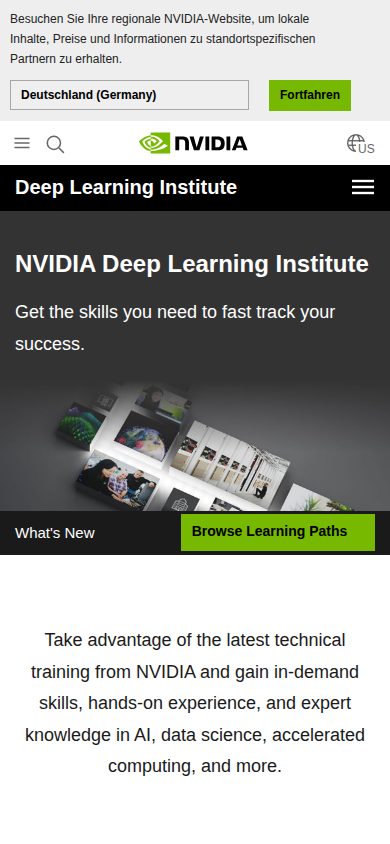
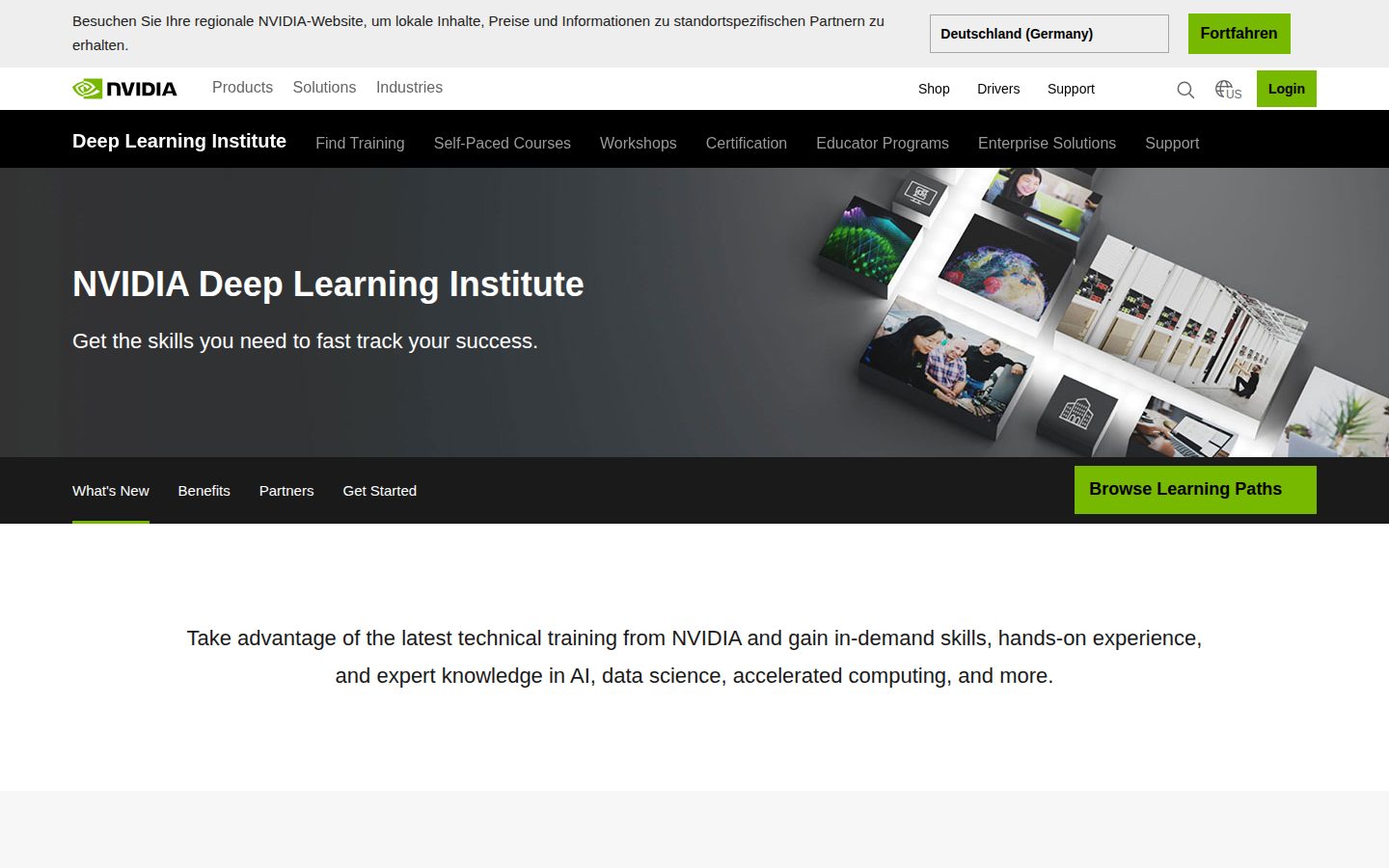
NVIDIA Deep Learning Institute desktop previewNVIDIA Deep Learning Institute mobile preview

Pricing Plans

Free Self-Paced Courses

Free

For individual developers, students, and administrators who want to build foundational AI and accelerated computing skills at no cost. Includes many permanently free courses and promotional free access.

  • Self-paced online courses accessible anytime
  • Cloud-based GPU-accelerated lab environment
  • Covers AI, deep learning, data science, accelerated computing, robotics, and graphics
  • Certificate of competency on select free courses
  • 1–2 hour topic modules and up to ~8-hour end-to-end project courses
  • Free access via NVIDIA Developer Program membership (includes one free DLI course)
Popular

Paid Self-Paced Courses

$30/one-time

For individual learners and professionals seeking in-depth, hands-on self-paced training with GPU lab access and a certificate of competency. Price starts at $30 and goes up to ~$90 per course depending on length and topic.

  • Self-paced online access to premium course content
  • Cloud GPU-accelerated lab environment included
  • Courses range from ~1–2 hours (topic modules) to ~6–8 hours (full courses)
  • NVIDIA DLI certificate of competency upon completion
  • Content designed by NVIDIA and industry experts
  • Topics: deep learning, generative AI, data science, accelerated computing, HPC, robotics

Public Instructor-Led Workshop (Per Seat)

$500/one-time

For individual professionals who want live, instructor-led training. Priced per seat starting at $500. Discounts available when purchasing 5 or more seats.

  • Live instruction by NVIDIA-certified DLI instructors
  • Hands-on GPU lab exercises in a cloud environment
  • Full-day (8-hour) sessions on topics like deep learning, AI, accelerated computing
  • NVIDIA DLI certificate of competency upon completion
  • Volume discounts on purchase of 5+ seats
  • Available remotely (virtual) or at NVIDIA events such as GTC

Private Workshop

Contact sales

For organizations and enterprises looking to upskill entire teams with a customized, private instructor-led workshop. Starts at $10,000. Exact pricing depends on team size, course topic, GPU type, and duration. Contact NVIDIA sales for a quote.

  • Private, dedicated instructor-led training for your organization
  • Customizable curriculum tailored to organizational needs
  • Hands-on GPU lab environment for all participants
  • DLI certificates of competency for participants
  • Covers AI, deep learning, data science, accelerated computing, HPC, and more
  • Pricing varies by number of students, topic, course length, and GPU type

AI Panel Reviews

The Decision Maker

The Decision Maker

Strategic bet, vendor viability, timing, adoption approval
8.2/10

NVIDIA's own training platform: credible, GPU-native, and priced for real commitment.

DLI is the only AI training platform where the labs run on the same hardware your models will actually use. Self-paced courses start at $30, instructor-led workshops at $500 — the pricing works for both individuals and enterprise teams.

Vendor viability is a non-issue. This is NVIDIA. The Educator Program, enterprise plans, and GTC-tied workshops show institutional depth, not a startup hoping to break even. The changelog confirms active updates to TensorRT, Triton, and NeMo content.

The real strength is the Cloud GPU Lab environment — no local hardware, no environment setup, real GPU-accelerated training tasks running in a browser. Coursera and DeepLearning.AI can't match that. The tradeoff: DLI is scoped entirely to the NVIDIA stack. If your team needs framework-agnostic depth, this won't cover it.

For teams already betting on NVIDIA infrastructure, this accelerates that bet. $500 per seat for a full-day instructor-led workshop is defensible spend. Enterprise private workshops start at $10,000 — get headcount right before committing.

Competitive Positioning8.5

Unique GPU-native lab environment puts it ahead of Coursera and DeepLearning.AI for applied CUDA and inference workloads.

Reputation Risk9.5

No board will question an NVIDIA-sourced training program — it's a brand that signals seriousness, not risk.

Speed to Value7.5

Free intro courses and $30 self-paced options mean fast individual onboarding, but team-wide ROI depends on how quickly skills transfer to active projects.

Strategic Fit8.0

Strong fit for teams deploying on NVIDIA infrastructure; narrower value if your stack is cloud-agnostic or framework-diverse.

Vendor Viability9.8

It's NVIDIA — no runway question, active content updates across TensorRT and Triton confirm ongoing investment.

Pros

  • Cloud GPU lab environments — real hardware, no local setup, every course
  • Covers GenAI, LLMs, NeMo, Triton, RAPIDS — current NVIDIA stack, not legacy content
  • Pricing ladder works: $0 intro, $30-90 self-paced, $500 live workshop, $10K private
  • NVIDIA-issued certifications carry board-room weight

Cons

  • Entirely NVIDIA-ecosystem scoped — not useful for teams on AMD, cloud TPUs, or framework-first learning
  • Private workshop pricing starts at $10,000 with no public rate card — budget planning requires a sales call
  • No API or LMS integration evidence — enterprise rollout tracking may be manual

Right for

Engineering teams standardizing on NVIDIA GPU infrastructure who need applied, certifiable AI skills fast.

Avoid if

Your team needs framework-agnostic training or you're not committed to the NVIDIA stack.

The Domain Strategist

The Domain Strategist

Craft and strategy in the product's domain — adapts identity per category, same lens
8.2/10

Best GPU-native training platform on the market, but it's an ecosystem bet.

DLI is the only place where hands-on CUDA and TensorRT training comes directly from the engineers who built those frameworks. The $30 entry point and free introductory tier make it accessible, but the entire catalog assumes you're building on NVIDIA infrastructure.

Cloud GPU lab provisioning is the architectural decision that separates DLI from Coursera or DeepLearning.AI. Learners aren't simulating GPU workloads — they're running real model training on preconfigured instances with CUDA, TensorRT, and Triton pre-loaded. For any L&D program trying to close the gap between classroom and production, that's a meaningful design choice.

The curriculum architecture is genuinely broad: PyTorch, TensorFlow, RAPIDS, NeMo, Triton, CUDA C/C++ — chosen by topic, not locked to one framework. Generative AI and LLM tracks now include RAG, fine-tuning with NeMo, and Triton deployment, which tells me the content team is tracking production workflows, not lagging them. The Educator Program and enterprise dashboard with progress tracking show institutional design thinking, not just individual learner tooling.

The constraint is real: if your organization runs on AMD or Google TPUs, this catalog has almost nothing for you. Private workshops start at $10,000, which is right-sized for enterprises but prices out mid-market L&D budgets fast. Adopt DLI as your technical AI curriculum and you're implicitly endorsing the NVIDIA stack — that's fine if it's already your infrastructure, a problem if it isn't.

Category Positioning8.8

No competitor at $30-per-course offers GPU-native lab environments with framework-level depth; fast.ai and DeepLearning.AI are broader but shallower on infrastructure skills.

Domain Fit8.5

Enterprise training plans with manager dashboards, curated role-based paths, and on-site delivery match how corporate L&D programs actually operate at scale.

Integration Surface7.8

Browser-based access and enterprise group licensing integrate cleanly into most LMS workflows, but there's no public API and no LRS/xAPI export evidence in the docs.

Long-term Implications7.5

If you build your technical AI curriculum on DLI, in three years your team's skills are optimized for NVIDIA tooling — powerful if that's your stack, limiting if it shifts.

Strategic Depth9.0

Jupyter notebook labs running against live GPU instances, multi-framework coverage across TensorRT and NeMo, and exam-based certification show library-grade instructional design — not demo depth.

Pros

  • Cloud GPU lab environments remove hardware prerequisites entirely — zero friction for distributed teams
  • Multi-framework curriculum (PyTorch, TensorRT, RAPIDS, NeMo) reflects actual production AI stacks
  • Free introductory tier plus $30 paid courses create a viable individual learner pathway
  • Certification programs provide credentialing infrastructure for competency-based learning programs

Cons

  • Entire catalog assumes NVIDIA hardware — limited value for AMD or cloud-agnostic environments
  • Private workshops start at $10,000, which strains mid-market L&D budgets
  • No LRS or xAPI integration evidence, complicating enterprise learning record management
  • Content depth on non-GPU topics (MLOps, data governance) is thin compared to broader platforms

Right for

Enterprise L&D teams upskilling developers and data scientists who are building on NVIDIA GPU infrastructure.

Avoid if

Your organization runs multi-cloud or non-NVIDIA hardware and needs hardware-agnostic AI curriculum.

The Finance Lead

The Finance Lead

Money, total cost of ownership, contracts, procurement math
8.1/10

$30 per course, GPU cloud included — rare pricing honesty in AI training

Self-paced courses start at $30, workshops at $500/seat. No subscription trap, no SSO tax, no seat inflation risk.

Pricing structure is unusually legible. $30–$90 per self-paced course, $500/seat for instructor-led workshops, free tier via NVIDIA Developer Program membership. Three tiers visible without a sales call. Procurement won't fight this one.

50-person team upskilling scenario: 50 seats × $500 = $25K for one workshop cycle. Add 2 self-paced courses per person at $60 average = $6K. Year 1 all-in: ~$31K. Year 3 depends entirely on how many workshops repeat — no auto-renewal risk because it's transactional, not subscription. Private workshops start at $10K but require a quote, which is the one opaque number.

Compared to Coursera for Business or DeepLearning.AI, DLI is narrower — NVIDIA stack only. That's the real tradeoff. PyTorch, TensorRT, Triton, NeMo coverage is deep, but if your team runs non-NVIDIA infrastructure, the curriculum specificity works against you.

Billing & Procurement8.0

Individual courses are credit-card transactional; enterprise requires sales engagement, which adds procurement friction for teams under $10K threshold.

Contract Flexibility9.0

Per-transaction purchases with no auto-renewal clauses cited; private workshops require vendor engagement but no term lock evident from public materials.

Pricing Transparency8.5

$0, $30–$90, $500/seat, and $10K+ private workshop all published — only private workshop pricing requires a sales contact.

ROI Clarity7.5

NVIDIA certifications are industry-recognized and exam-based, giving measurable competency signals, but business impact per dollar is self-reported by the buyer.

Total Cost of Ownership8.2

Transactional model eliminates subscription creep; 50-seat workshop year lands around $25K–$31K all-in with no hidden overage mechanism.

Pros

  • $30 floor on paid courses — low individual commitment
  • No local GPU hardware required; cloud environments included in price
  • Free tier via Developer Program membership removes zero-budget barrier
  • Certifications are exam-based, not completion-based — defensible on a resume

Cons

  • Private workshop pricing starts at $10K with quote required — no self-serve above $500/seat
  • NVIDIA-stack-only curriculum; limited value for non-NVIDIA infrastructure teams
  • No subscription bundle option visible — frequent learners pay per course repeatedly

Right for

Teams running NVIDIA GPU workloads who need credentialed, hands-on upskilling without subscription overhead.

Avoid if

Your infrastructure is cloud-agnostic or AMD-based and you need framework-neutral AI training.

The Domain Practitioner

The Domain Practitioner

Daily hands-on reality in the product's domain — adapts identity per category, same lens
8.2/10

NVIDIA's GPU labs remove the biggest blocker in AI training: hardware setup

DLI delivers hands-on GPU-accelerated training without requiring learners to own a single NVIDIA card. The content depth and certification credibility are real, but the platform is tightly scoped to the NVIDIA stack.

The cloud GPU lab environments are the story here. Every course provisions a live CUDA-ready instance in a browser. That removes the first 90 minutes of every AI workshop I've ever run — the 'my drivers aren't installed' segment. Jupyter-based labs mean learners aren't context-switching between a video and a terminal; the instruction and the execution are in the same pane. That's good instructional design, not just a convenience feature.

Pricing tiers work for most audiences. Free introductory courses lower the on-ramp. Self-paced paid courses start at $30. Instructor-led seats at $500 are reasonable for professional development budgets, and private workshops starting at $10,000 cover enterprise team deployments. The Educator Program — free Teaching Kits and student access for university faculty — is a genuine differentiator versus DeepLearning.AI's university approach.

The constraint is obvious: this is NVIDIA hardware and software curriculum, full stop. TensorRT, NeMo, RAPIDS, Triton — the whole catalog assumes you're building on the NVIDIA stack. If your learners are deploying on non-NVIDIA infrastructure, the certification credibility doesn't transfer cleanly. That's not a flaw, but it's the tradeoff every training manager needs to name explicitly before enrolling a team.

Day-3 Reality8.0

Browser-based GPU labs with no local install means learners can re-enter a course mid-week without a setup ritual — daily re-engagement friction is genuinely low.

Documentation Practitioner-Fit8.0

Changelog is public and content is updated to current NVIDIA frameworks like TAO Toolkit and Triton, suggesting docs are maintained by engineers, not just marketers.

Friction Surface8.5

Preconfigured cloud environments eliminate driver, CUDA, and framework versioning fights — the category's most common friction surface — entirely.

Power-User Depth7.8

Multi-framework coverage across PyTorch, CUDA C/C++, TensorRT, and NeMo gives advanced learners real depth, though course discoverability across tracks isn't evidenced as structured.

Workflow Integration7.5

Jupyter notebooks fit developer workflows naturally, but the platform is self-contained and doesn't push into LMS integrations or Slack/Teams notifications for enterprise cohort tracking.

Pros

  • Cloud GPU labs provision instantly — no local hardware, no driver setup, no lost lab time
  • Free introductory courses and Educator Program reduce on-ramp friction for both individuals and university cohorts
  • Certification spans deep learning, generative AI, and accelerated computing — credible given the source
  • Multi-framework coverage: PyTorch, TensorFlow, CUDA, RAPIDS, Triton, NeMo in one catalog

Cons

  • Entire catalog assumes NVIDIA infrastructure — certifications carry less weight in cloud-agnostic or AMD environments
  • No evidence of LMS integration or SCORM export for enterprises that already run Workday Learning or Cornerstone
  • Private workshop pricing starts at $10,000 with contact-for-quote, which stalls budget approval for mid-size teams

Right for

Developers and data scientists building production AI on NVIDIA GPU infrastructure who need hands-on, certifiable training without local hardware.

Avoid if

Your team deploys on non-NVIDIA cloud infrastructure and needs vendor-neutral AI curriculum that transfers across environments.

The Power User

The Power User

Daily human experience, onboarding, polish, learning curve, reliability
8.1/10

NVIDIA's GPU training platform is the real thing — if you're living in their ecosystem

Hands-on GPU labs in a browser, no local hardware required, starting at $30. Best-in-class for NVIDIA-stack skills, but don't come here for framework-agnostic fundamentals.

The cloud GPU lab setup is the thing that makes DLI different. You're running real model training in a Jupyter notebook against an actual GPU instance — no driver installs, no local setup, no 'works on my machine' nonsense. For someone who's been through the DeepLearning.AI onboarding flow, this hits different. The gap between reading about backprop and actually watching a training run tick through epochs is enormous, and DLI closes it without making you own a $3,000 workstation.

Free introductory courses lower the ramp, and $30–$90 for a self-paced course with a real GPU environment is fair pricing for what you get. The $500/seat public workshops feel steep until you remember you're getting NVIDIA-certified instruction plus cloud compute included.

The honest tradeoff: this is NVIDIA's world. TensorRT, Triton, NeMo, RAPIDS — everything points back to their stack. That's fine if GPU-accelerated production workloads are your destination. If you want portable, framework-neutral AI fundamentals, fast.ai still owns that lane.

Daily Polish7.5

Jupyter-based labs are a known, functional interface — not flashy, but they work without friction and the preloaded environments mean you're coding within minutes.

Learning Curve8.0

Multi-framework coverage across PyTorch, CUDA C/C++, TensorRT, and generative AI tracks means there's a real progression path from intro modules to certification, not just a flat course list.

Mobile Parity4.5

Jupyter notebooks inside a browser on mobile is a rough experience — this is a sit-at-a-desk product, full stop.

Onboarding Experience8.2

Free courses like 'Getting Started with Deep Learning' and no local setup requirement make the first session feel genuinely welcoming rather than punishing.

Reliability Feel7.8

Cloud-provisioned GPU instances have an inherent spin-up delay, but a preconfigured environment beats local setup failures for reliability over time.

Pros

  • Real GPU compute included in every lab — no local hardware needed
  • Pricing starts at $0 with meaningful free courses, paid courses top out around $90
  • Certification carries actual name recognition in NVIDIA-stack hiring contexts
  • Generative AI and LLM tracks covering NeMo, RAG, and Triton are current and specific

Cons

  • Entirely NVIDIA-ecosystem focused — not a neutral AI education platform
  • Mobile experience is basically unworkable for hands-on labs
  • Private enterprise workshops start at $10,000, which is a steep jump from self-paced
  • No free trial for paid courses — you're buying before you preview the full content

Right for

Developers and data scientists who need production-grade GPU skills and are already working in or moving toward the NVIDIA stack.

Avoid if

You want framework-agnostic AI fundamentals or need to learn on a phone or tablet.

The Skeptic

The Skeptic

Contrarian. Watch-outs, deal-breakers, broken promises, category patterns
8.1/10

NVIDIA's name is the moat. The content mostly earns it.

DLI is a hardware-vendor training program that actually delivers on the pitch. Cloud GPU labs at $30/course removes the usual barrier. The NVIDIA ecosystem lock-in is real — that's the tradeoff, not a flaw.

Three tells I watch for in vendor training programs: generic content rebranded as proprietary, no real credentials, and labs that are demos not workloads. DLI clears all three. Jupyter notebooks running against live GPU instances, TensorRT and Triton coverage, certifications that aren't just PDFs — the changelog shows ongoing updates. That's not nothing.

The lock-in story is honest. This is NVIDIA-stack training. If your team runs PyTorch on AWS instances without touching CUDA deeply, DeepLearning.AI or fast.ai serve you better at lower cost. The $500/seat public workshop is steep for a one-day session. Private workshops starting at $10,000 assume enterprise budget.

Long-term viability concern is basically zero — NVIDIA is the infrastructure layer of the AI moment. Educator program with free Teaching Kits is a smart pipeline move. Maybe the catalog depth lags Coursera's breadth, but that's a scope choice, not a weakness.

Competitive Differentiation8.0

No competitor offers GPU-accelerated lab environments tied directly to NVIDIA's own frameworks like Triton and NeMo at $30/course entry.

Exit Portability6.2

Certificates are NVIDIA-branded and skills are NVIDIA-stack specific — PyTorch knowledge transfers, but RAPIDS and TensorRT proficiency doesn't map cleanly to non-NVIDIA environments.

Long-term Viability9.2

NVIDIA's market position and the changelog cadence make this one of the safest vendor training bets in the category right now.

Marketing Honesty8.5

Tagline says 'hands-on from NVIDIA engineers' — the cloud GPU lab feature and Jupyter notebook curriculum back that up concretely.

Track Record Match8.8

Vendor-led certification programs that survive: AWS Training, Google Cloud Skills Boost, Microsoft Learn. DLI fits that pattern, not the startup-graveyard pattern.

Pros

  • Cloud GPU labs — no local hardware needed, real workloads at $30 entry
  • Covers current NVIDIA stack: TensorRT, Triton, NeMo, RAPIDS — not legacy content
  • Free Educator Program lowers institutional adoption friction
  • Generative AI and LLM tracks reflect actual 2024 demand

Cons

  • $500/seat public workshop is steep relative to Coursera or fast.ai alternatives
  • Skills are NVIDIA-ecosystem specific — limited portability to non-GPU or cloud-native stacks
  • No API, no pricing page visible — discovery friction for enterprise buyers
  • Catalog breadth trails Coursera; depth outside NVIDIA tooling is thin

Right for

Developers and data scientists going deep on GPU-accelerated workloads who need NVIDIA-stack credentials.

Avoid if

Your team runs cloud-agnostic ML pipelines and doesn't need CUDA or NVIDIA-specific framework expertise.

Buyer Questions

Common questions answered by our AI research team

Setup

Do DLI courses require local GPU hardware?

No local GPU hardware is required. DLI courses use preconfigured GPU-accelerated cloud environments for hands-on labs, so learners can participate without any local hardware setup.

Features

What AI topics do DLI courses cover?

DLI courses cover deep learning, computer vision, natural language processing, and CUDA programming.

Features

Are instructor-led workshops available through DLI?

Yes, instructor-led workshops are available alongside self-paced online courses.

Features

Does DLI offer certification programs?

Yes, DLI offers certification programs in addition to its courses and workshops.

Setup

Do DLI labs run in preconfigured cloud environments?

Yes, DLI labs run in preconfigured GPU-accelerated cloud environments, eliminating the need for local hardware setup.

Also in AI Education & Training