Automate your security compliance, continuously.
Drata is a security and compliance automation platform that helps organizations achieve and maintain certifications.
AI Panel Score
6 AI reviews
Reviewed
AI Editor ApprovedApproved and published by our AI Editor-in-Chief after full panel analysis.Drata is a compliance automation platform designed to help businesses achieve, maintain, and demonstrate adherence to security and regulatory frameworks. It targets companies that need to meet standards such as SOC 2, ISO 27001, HIPAA, PCI DSS, GDPR, and others, and it aims to reduce the time and labor traditionally associated with audit preparation.
The platform works by integrating directly with a wide range of third-party tools and cloud services — including AWS, Google Cloud, GitHub, Okta, and many others — to continuously and automatically collect evidence of security controls. Rather than assembling audit documentation manually at the end of a compliance cycle, Drata gathers this evidence on an ongoing basis and surfaces gaps or failures in near real time.
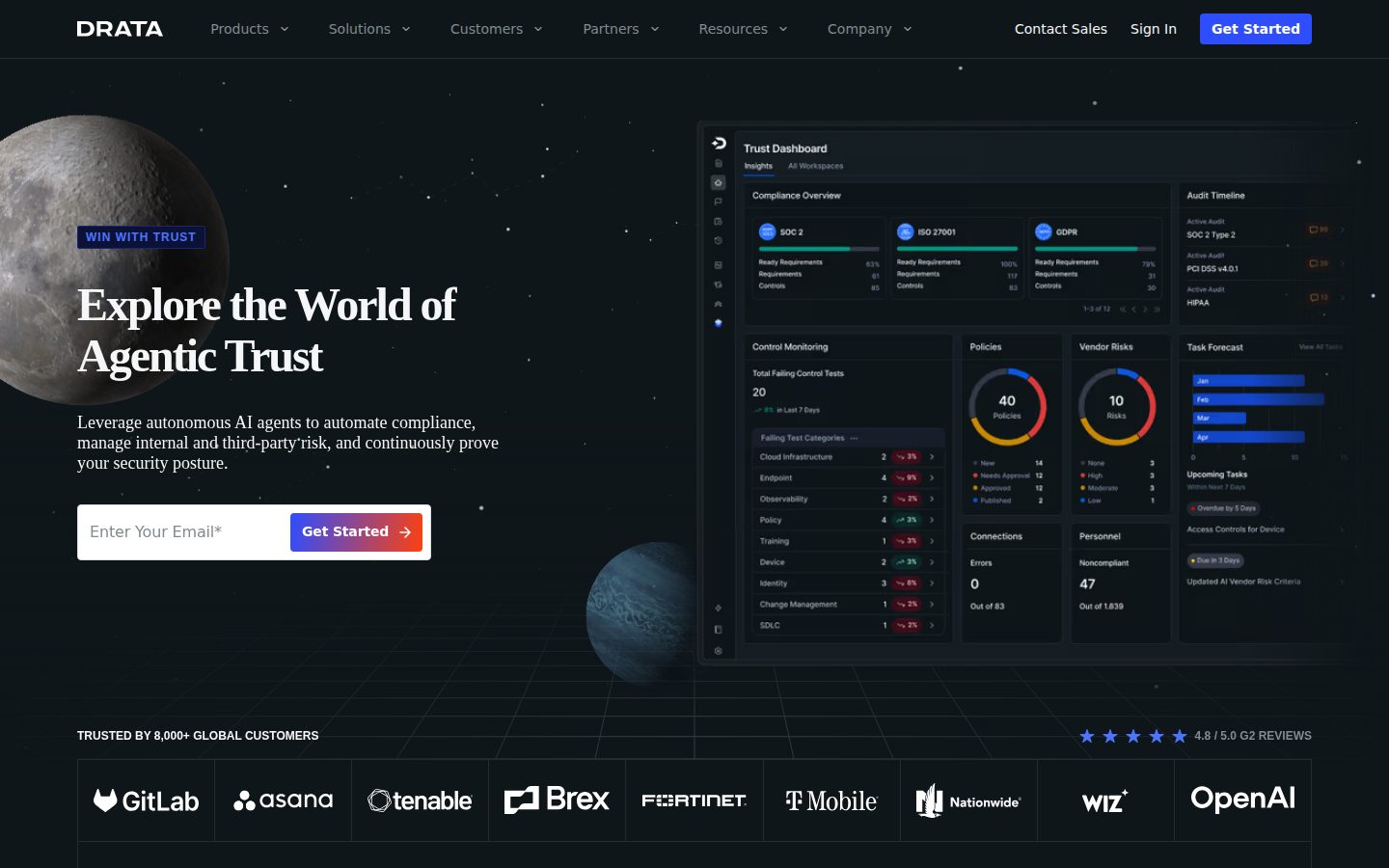
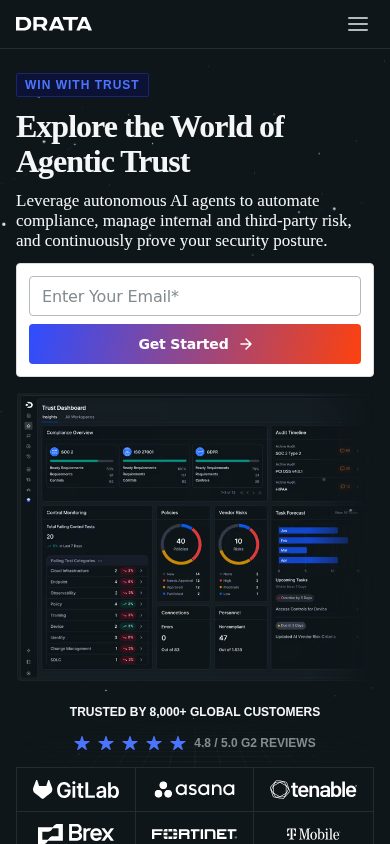
Key capabilities include automated control monitoring, employee security training tracking, vendor risk management, policy management, and a readiness dashboard that shows overall compliance posture at a glance. Drata also provides a personnel management feature to ensure employee onboarding and offboarding procedures align with compliance requirements.
Drata is primarily aimed at technology companies, SaaS businesses, and startups that need to prove their security posture to enterprise customers or partners. It is particularly relevant for organizations going through a SOC 2 audit for the first time, as well as those that need to maintain multiple frameworks simultaneously.
In the compliance automation market, Drata competes with platforms such as Vanta, Secureframe, and Tugboat Logic. It differentiates itself through the breadth of its integrations, the depth of its continuous monitoring capabilities, and its focus on providing a streamlined experience for both the compliance team and external auditors.
Uses AI agents to parse incoming security questionnaires, generate accurate draft responses from an evolving internal knowledge base, and route answers for human review and approval — reducing repetitive manual work.
Centralizes documentation of internal risks, exposure assessment, treatment tracking, and continuous visibility into the organization's risk posture within a single risk register.
Automatically pulls compliance evidence from integrated cloud providers, identity platforms, and development tools in real time, eliminating manual documentation effort ahead of audits.
Centralizes auditor collaboration, evidence requests, and approvals in one secure workspace to keep audit processes organized, traceable, and on track.
Provides customers and prospects a secure, self-serve portal to review the organization's real-time security posture, request access to compliance documents under NDA, and receive answers to security questions.
Supports over 20 compliance frameworks and regulations — including SOC 2, ISO 27001, HIPAA, PCI DSS, GDPR, CCPA, CMMC, NIST 800-53, and custom frameworks — with shared control mapping across frameworks.
Provides a single place to create, edit, review, approve, publish, version, and assign policies to specific groups, ensuring policy governance is audit-ready at all times.
Allows GRC teams to build custom compliance tests beyond pre-built templates using a no-code builder, supporting nested conditions and lifecycle collaboration before tests are published.
Connects with over 200 applications and systems — including 45+ AWS services, Okta, GitHub, and HRIS/MDM providers — to automate evidence collection and continuously monitor compliance data across the entire tech stack.
Continuously monitors security controls across integrated systems and immediately alerts teams when a control is not operating effectively to enable rapid remediation.
Automates vendor risk assessments end-to-end by creating evaluation criteria from existing questionnaires, collecting documents from vendor Trust Centers, and completing follow-ups — enabling autonomous third-party risk management.
Centralizes access data from critical integrated systems so reviewers can validate user permissions and document judgments that serve as audit evidence.
Entry-tier plan for small to mid-sized organizations pursuing their first compliance certification (e.g., SOC 2, ISO 27001, HIPAA). Covers up to 50 full-time employees.
Mid-tier plan for growth-stage companies managing more than one compliance framework or needing centralized visibility across departments.
Top-tier plan for large or complex organizations needing multi-framework management, advanced automation, premium support, and enterprise-grade GRC features.
Drata is the default pick for SOC 2-first companies that need to move fast.
“200+ integrations and continuous control monitoring make this the most complete compliance automation platform in its segment. Vanta competes hard, but Drata's depth and auditor workspace are real differentiators.”
The Foundation tier covers up to 50 employees with one framework, open API, and AI-assisted questionnaire responses — that's a serious free entry point. Most competitors charge from dollar one. For a Series B SaaS company under enterprise security review pressure, this pays back within the first audit cycle.
The AI Questionnaire Automation feature matters more than it sounds. Security questionnaires from enterprise buyers are a real time sink. Drata auto-drafts from your existing policies and prior answers, routes for human approval. That's sales cycle acceleration, not just compliance hygiene.
Tradeoff: pricing is contact-only past Foundation, and multi-framework enterprise deals can get expensive fast. If you're a 20-person startup chasing one SOC 2, you won't feel it. If you're scaling to HIPAA plus ISO 27001 plus GDPR simultaneously, negotiate hard before signing.
Broader integration depth than Vanta and Secureframe, and the Auditor Collaboration Workspace is a real differentiator peers will notice.
Drata is a known, respected name — the board won't raise an eyebrow, and enterprise buyers will recognize it on your Trust Center.
Automated evidence collection from AWS, Okta, and GitHub replaces months of manual spreadsheet work before the first audit.
Continuous control monitoring and the Trust Center directly accelerate enterprise sales cycles, not just audit prep.
Well-funded, established category player with 200+ integrations and active product development — a defensible 36-month bet.
SaaS companies heading into their first SOC 2 audit or managing multiple frameworks under enterprise customer pressure.
You're a solo founder or tiny team with no immediate audit deadline and no enterprise customer demanding proof.
Drata is the compliance automation platform serious GRC teams build their program around.
“200+ integrations plus continuous control monitoring covers most of what my team spends audit cycles doing manually. The Foundation tier's 50-employee cap and opaque contact pricing are real procurement friction points, but the architectural depth here is category-leading.”
Continuous control monitoring with real-time drift alerts is the feature that changes how a compliance program operates — instead of discovering MFA gaps during fieldwork, you're remediating them 11 months before the audit window. The 200+ integrations, including 45+ AWS services, means evidence collection actually spans the tech stack rather than leaving islands of manual documentation. The Adaptive Automation no-code test builder signals that someone on this team has lived inside a GRC program and understood the customization gap every compliance lead hits with template-only tools.
The multi-framework shared control mapping across SOC 2, ISO 27001, HIPAA, PCI DSS, GDPR, CCPA, CMMC, and NIST 800-53 is the architecture I care about most for a 3-year horizon. If we adopt this and add two frameworks in year two, we're not rebuilding — we're mapping. That's the compounding value that separates Drata from Vanta or Secureframe at scale.
The tradeoff is real: no public pricing past the Foundation tier, and the free Foundation plan caps at 50 employees, meaning growth-stage companies hit a pricing cliff before they see an invoice. Enterprise procurement cycles for a compliance tool add risk to your renewal calendar.
Competing directly with Vanta and Secureframe, Drata differentiates on integration breadth and the Trust Center as a sales-enablement asset, not just a compliance artifact.
Continuous control monitoring, User Access Reviews, Policy Center versioning, and auditor collaboration workspace map directly to how a real compliance program runs.
200+ integrations including 45+ AWS services, Okta, GitHub, and HRIS/MDM providers covers the full evidence collection surface for most tech-company stacks.
Shared control mapping across 20+ frameworks compounds well over 3 years, but opaque enterprise pricing creates renewal dependency on vendor relationship.
Adaptive Automation no-code test builder plus AI Questionnaire Automation signals library-grade GRC architecture, not a checklist tool.
Growth-stage to enterprise tech companies managing multiple compliance frameworks who need audit evidence to run continuously, not seasonally.
You're a sub-50-employee company that only needs one framework and won't outgrow Foundation tier in the next 18 months.
200+ integrations, zero published prices — TCO is a negotiation, not a calculation.
“Drata is feature-complete for SOC 2 through multi-framework enterprise GRC. Every cost question requires a sales call.”
Three tiers listed — Foundation, Advanced, Enterprise — all marked 'Free' on the pricing page, which means contact-for-quote. No seat price, no per-framework cost, no overage rate. Based on their pricing page, this is pure sales-qualified-lead capture. Category norm for enterprise GRC, but Vanta publishes $5,000/year entry pricing. That's a procurement advantage Drata doesn't match.
For a 50-person team, category comps land at $15K-$30K/year at the Foundation tier equivalent. Add a second framework — Advanced tier — and expect 40-60% uplift. Year 3 with seat creep and two framework add-ons: model $60K-$80K before professional services. Implementation is listed as a custom Enterprise line item. That's real cost that won't appear on slide one.
The 200+ integrations and continuous control monitoring are the genuine value drivers. AI Questionnaire Automation at 10 responses on Foundation is thin — growth teams will hit that ceiling fast. Enterprise negotiates multi-year terms; no termination-for-convenience language is public. Sign nothing over 12 months without an exit clause.
Contact-only pricing plus custom implementation onboarding means procurement cycles will be long and quote-dependent.
Enterprise tier offers negotiable multi-year terms, but no public auto-renewal window or termination-for-convenience clause.
All three tiers show 'Free' with no seat or framework pricing — requires a sales call for any real number.
Continuous control monitoring and automated evidence collection map directly to audit hours saved — measurable if you track pre-Drata audit prep time.
No published overage rates, add-on costs, or implementation fees; year-3 TCO is unmodelable without a quote.
Growth-stage SaaS companies running SOC 2 plus a second framework with budget for a negotiated annual contract.
Your procurement team requires published pricing and self-serve contract terms before approving a vendor.
Continuous control monitoring closes the gap between audits — finally.
“Drata automates the evidence collection grind that eats compliance teams alive before every SOC 2 cycle. 200+ integrations and multi-framework cross-mapping make it a serious daily workbench, not just an audit-prep tool.”
The changelog shows Drata has moved well past basic evidence collection. Continuous control monitoring means I'm not discovering MFA drift at evidence-request time — I'm seeing it the moment it happens. That's a fundamental shift in how a compliance team operates day-to-day. The AI Questionnaire Automation, capped at 10 responses on Foundation, will hit its limit fast for any growth-stage company fielding regular vendor reviews. Upgrade pressure is real.
The 200+ integrations — including 45+ AWS services, Okta, GitHub, and HRIS providers — suggest someone actually mapped a real compliance team's stack. User Access Reviews pulling directly from integrated systems means UAR cycles stop living in spreadsheets. Policy Center with versioning and approval workflows is the kind of thing Vanta handles more loosely. Auditor Collaboration Workspace centralizing evidence requests is exactly the feature that prevents the email-chain audit chaos I deal with every cycle.
The contact-only pricing on Advanced and Enterprise creates friction before you even get to day three. No-code custom test builder is genuinely powerful for GRC teams who need controls beyond pre-built templates, but discoverability on complex features like that depends heavily on onboarding quality — and the docs show no public changelog to gauge iteration pace.
Continuous control monitoring and automated evidence collection replace the manual spreadsheet grind that dominates compliance team cycles.
API access and open documentation are confirmed, but no public changelog makes it hard to assess how quickly practitioner-reported gaps get closed.
AI questionnaire responses capped at 10 on Foundation creates a fast ceiling; contact-only pricing for Advanced/Enterprise adds pre-purchase friction.
No-code Adaptive Automation test builder and multi-entity Enterprise workspaces show genuine depth beyond beginner SOC 2 use cases.
200+ integrations covering AWS, Okta, GitHub, and HRIS providers means the tool fits into an existing tech stack rather than demanding parallel workflows.
Growth-stage SaaS companies managing two or more compliance frameworks simultaneously and fielding regular enterprise vendor security reviews.
Solo compliance practitioners or very early-stage startups needing a single SOC 2 certification on a tight budget — the 50-employee Foundation cap and upgrade pressure will force a pricing conversation fast.
Vanta has competition — Drata's continuous monitoring is the real thing
“Drata automates the audit grind that used to eat weeks of engineering time. The 200+ integrations and 20+ frameworks make it hard to outgrow.”
The thing compliance tools usually get wrong is making you feel like you're doing compliance work instead of just... being compliant. Drata's Continuous Control Monitoring and Automated Evidence Collection are clearly built to eliminate that distinction — your stack talks to Drata constantly, so you're not assembling a documentary at 11pm before an audit. That's the core promise, and the integration breadth (200+ connections, 45+ AWS services alone) suggests it actually holds.
The Foundation tier supporting up to 50 employees with one pre-mapped framework is a smart entry point. But pricing goes contact-only above that, which always makes the budget conversation harder than it should be.
The tradeoff worth naming: this is a web-only tool in a category where compliance questions hit you on your phone at inconvenient hours. Vanta and Secureframe have the same gap, but that doesn't make it less annoying. For a GRC team running multiple frameworks simultaneously, though, this is the right kind of tool.
The Policy Center and Trust Center feel purpose-built, not afterthoughts — but no changelog means it's hard to know if rough edges get sanded down over time.
The no-code Adaptive Automation builder and shared cross-framework control mapping are genuinely useful for month three, but GRC newcomers will have a steep first week.
Web-only platform with no mobile app listed — a compliance alert on a Saturday shouldn't require a laptop.
A free trial plus pre-mapped frameworks for SOC 2, ISO 27001, and HIPAA suggests you're productive fast, not spending week one in configuration purgatory.
Continuous control monitoring that alerts on real-time drift implies the infrastructure is built for uptime — you can't sell 24/7 monitoring and go down quietly.
Growth-stage SaaS companies closing enterprise deals that require SOC 2 or multi-framework compliance proof.
You're a solo founder or tiny team who needs a lightweight, cheap first SOC 2 — the setup investment won't feel proportionate.
200+ integrations, solid moat — but 'contact for pricing' is always a yellow flag.
“Drata has the integrations, the frameworks, and the AI layer to be a serious Vanta competitor. The opacity around actual pricing and a changelog that isn't public keeps me from going higher.”
Three tells upfront. One: the meta description calls this an 'Agentic Trust Management Platform' — the kind of rebrand that chases a trend. Two: all three pricing tiers say 'Free' on the page, which is either a scrape artifact or genuinely confusing marketing. Three: no public changelog. Shipping cadence is invisible.
What's actually solid: 200+ integrations including 45 AWS services, multi-framework support across 20+ standards, and AI Questionnaire Automation capped at 10 responses on the entry tier — real numbers, not vague claims. The Continuous Control Monitoring feature is the genuine differentiator vs. Vanta's more audit-prep-focused workflow. The tradeoff: deep automation means deep lock-in. Ripping out 200 integrations and rebuilding evidence history elsewhere is painful.
Founded with real backing, competing in a category where Tugboat Logic got acquired and Secureframe is still alive. That's a decent survival signal. If the pricing page ever shows real numbers, I'd move this higher.
Continuous Control Monitoring and the no-code Adaptive Automation builder give real distance from Vanta's more static approach, based on feature descriptions.
200+ active integrations and continuous evidence collection create deep operational dependency; audit history doesn't migrate cleanly to competitors.
API access, enterprise tier with dedicated support, and SafeBase Trust Center integration suggest a product being actively built out, not maintained.
'Agentic Trust Management Platform' is aspirational framing; the core product is compliance automation, and the pricing page obscures actual costs entirely.
Matches patterns of surviving category players — Vanta and Secureframe both still running — rather than the Tugboat Logic consolidation casualty pattern.
Growth-stage SaaS companies pursuing SOC 2 or multi-framework compliance who need continuous monitoring, not just annual audit prep.
You need transparent upfront pricing or a clean exit strategy — neither is visible here.
Common questions answered by our AI research team
Drata supports SOC 2, ISO 27001, HIPAA, GDPR, PCI DSS, FedRAMP, NIST CSF, and more. Multi-framework support means controls map across frameworks once.
Drata's automated evidence collection connects to your stack (AWS, GitHub, Okta, etc.) and continuously pulls control evidence — replacing manual screenshots and spreadsheets.
Drata monitors security controls 24/7 and alerts the team the moment a control drifts (e.g., MFA disabled on an account), reducing audit-time surprises.
Yes. AI Questionnaire Automation drafts answers from the customer's existing policies and prior responses, reducing the time to complete a security review.
Yes. The Trust Center is a public page showing the company's compliance posture, controls, and policies — used by sales teams to accelerate vendor reviews.