Everlaw logo

Everlaw Review

Visit

Cloud-based ediscovery software for litigation and investigations

Everlaw is a cloud-based ediscovery platform for law firms, corporate legal teams, and government agencies managing litigation and investigations.

AI Panel Score

7.8/10

6 AI reviews

Reviewed

About Everlaw

In practice, users upload collected documents into Everlaw's cloud environment, where the platform processes and indexes them for review. Attorneys and legal professionals can then search, tag, code, and annotate documents, build timelines, and collaborate with team members in a shared workspace. The review workflow is designed to move from raw data ingestion through document coding to final production without requiring separate tools at each stage.

Everlaw highlights several specific capabilities on its platform, including predictive coding (technology-assisted review) to prioritize relevant documents, a feature called Coding Suggestions that uses generative AI to assist reviewers, story builder tools for organizing facts into case narratives, and advanced search across document metadata and content. The platform is built on cloud infrastructure, which Everlaw positions as enabling real-time collaboration and eliminating the need for on-premises hardware or software installations.

Everlaw serves law firms of various sizes, corporate legal and compliance departments, and government agencies including federal bodies. The company operates an 'Everlaw for Good' program aimed at providing access to legal teams working on public interest matters. Pricing is not publicly listed on the website and is provided on a contact basis; prospective customers are directed to request a demo. Competitors in the ediscovery space include Relativity, Disco, Exterro, and Nuix.

Everlaw is a web-based application requiring no client-side installation. It supports integrations relevant to common legal workflows and has a presence in both the US and UK markets, with UK-specific subject matter expertise noted on the platform.

Features

AI

  • Concept Search & Clustering

    Groups conceptually related documents so reviewers can find materials by meaning rather than only exact keywords; useful when the right terms aren't known in advance.

  • Predictive Coding

    Train a model on a small set of reviewer-coded documents and have it rank or auto-categorize the rest of the population by relevance, hot-doc likelihood, or issue tag.

  • Translation

    Automated machine translation across dozens of languages for foreign-language documents within the review interface.

Analytics

  • Case Analytics

    Visualizations of document volume by custodian, communication patterns, hot-doc concentration, and reviewer throughput for matter management.

Core

  • AWS-Native Cloud Architecture

    Built on AWS with elastic compute and storage so ingest and review scale with matter size without on-prem infrastructure.

  • Document Review at Scale

    Single-pane review of millions of documents across emails, attachments, chat messages, and audio/video — built to handle large litigation matters without slowing down at high volumes.

  • Email Threading

    Reconstructs email conversations across custodians into single threads so reviewers see the full back-and-forth and don't recode duplicate messages.

  • Production & Bates Labeling

    Tools for producing documents to opposing counsel: Bates numbering, redactions, native and TIFF productions, privilege logs, and load files.

  • Search & Tagging Engine

    Boolean search with proximity, wildcards, family-aware filters, and reusable saved searches; supports tagging, coding panels, and bulk assignment.

  • StoryBuilder

    Case-building workspace where reviewers assemble depositions, exhibits, and timelines into a narrative that maps to the legal theory of the matter.

Preview

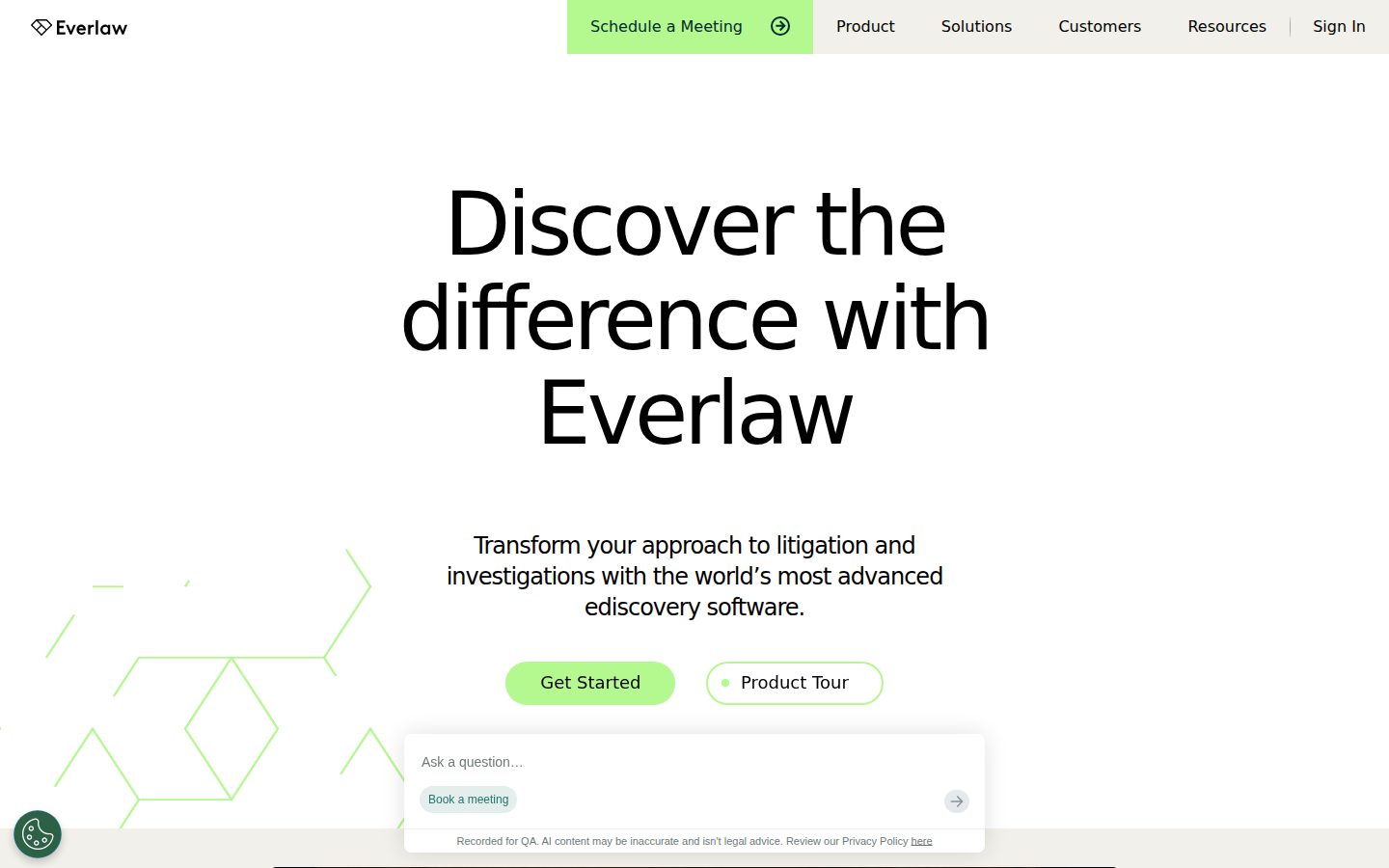
Everlaw desktop previewEverlaw mobile preview

Pricing Plans

Platform Subscription (Per GB)

Contact sales

Flexible case or annual platform subscription for legal teams. Pricing is based on the amount of data managed and usage, with no limits on users or uploads. Contact Everlaw for a quote.

  • Unlimited user licenses and uploads
  • Core eDiscovery features included in per GB rate (processing, imaging, analytics, predictive coding)
  • Generative AI single-document actions included at no extra cost (Q&A, summaries, topic analysis, coding suggestions)
  • Batch AI actions (summaries, topic analysis, custom extractions, coding suggestions) require credits
  • Storybuilder for case building, deposition prep, and fact/narrative development
  • Cloud connectors (Microsoft, Google, Slack, Zoom) and native support for Slack, Teams, iMessage, WhatsApp

AI Panel Reviews

The Decision Maker

The Decision Maker

Strategic bet, vendor viability, timing, adoption approval
8.2/10

Everlaw cuts review volume 74% — mature platform, opaque pricing, real competition from Relativity.

Established ediscovery platform with genuine AI depth, not feature vaporware. The per-GB model and contact-only pricing mean you won't know your true cost until you're deep in a demo cycle.

That 74% reduction in documents promoted to active review isn't marketing fluff — it's what Early Case Assessment plus predictive coding actually delivers when the model's trained right. Coding Suggestions handles first-pass review with rationale attached, which matters for attorney sign-off. Deep Dive has held up at 10 million documents. That's a real number.

The tradeoff: Relativity still owns BigLaw and large government matters on name recognition alone. Everlaw competes on UX and cloud architecture — AWS-native, no on-prem, unlimited user licenses baked into the per-GB rate. For mid-market firms and corporate legal teams, that's a compelling stack. For an Am Law 50 shop already standardized on Relativity, the switching cost is the conversation.

No public pricing, no free trial, no changelog visible. You're flying somewhat blind on cost until the sales cycle starts. Pilot a single matter, watch the per-GB math, then decide.

Competitive Positioning7.8

Strong differentiation vs. Relativity on UX and unlimited-user pricing, though Relativity's market lock-in at large firms is real friction to overcome.

Reputation Risk8.0

Everlaw for Good program and government agency adoption signals credibility; peers won't raise eyebrows at this choice.

Speed to Value7.5

Cloud-native onboarding removes hardware delays, but contact-only pricing and no trial mean time-to-contract is slower than it should be.

Strategic Fit8.5

Advances legal ops meaningfully — ECA, StoryBuilder, and Coding Suggestions move teams from cost center to active case advantage, not just document storage.

Vendor Viability8.0

Established enough to serve federal agencies and operate in both US and UK markets — low short-term failure risk, though no public funding data available.

Pros

  • 74% document reduction via ECA is a defensible ROI number for board conversations
  • Unlimited user licenses in the per-GB rate removes the seat-count negotiation
  • Deep Dive handles 10M+ document sets without separate tooling
  • Generative AI single-document actions included at no extra cost in base tier

Cons

  • No public pricing — cost visibility requires a full sales cycle
  • No free trial makes it hard to validate fit before committing
  • Batch AI actions require separate credits, adding cost complexity at scale
  • Relativity's network effect in BigLaw makes cross-matter collaboration harder if counterparties are on different platforms

Right for

Mid-market law firms and corporate legal teams running multi-matter loads who want cloud-native ediscovery without per-seat licensing headaches.

Avoid if

Your matters routinely involve opposing counsel or co-counsel standardized on Relativity, where platform interoperability friction adds real cost.

The Domain Strategist

The Domain Strategist

Craft and strategy in the product's domain — adapts identity per category, same lens
8.2/10

Everlaw is the ediscovery platform corporate legal teams should be benchmarking against Relativity right now.

Cloud-native architecture, per-GB pricing with unlimited users, and a 74% ECA document reduction claim make this a serious alternative to incumbent platforms. The AI layer — Coding Suggestions, Deep Dive, concept clustering — is built into the review workflow, not appended to it.

The per-GB subscription with unlimited user licenses is the right commercial structure for corporate legal teams managing variable litigation volume. No per-seat tax on associates, contract reviewers, or outside counsel added to a matter is a meaningful operational advantage. That pricing architecture tells me someone understood how litigation teams actually staff.

The feature set maps to how I'd expect a mature ediscovery workflow to run: ECA to cull, predictive coding to prioritize, Coding Suggestions for first-pass automation, StoryBuilder to move from review into case theory. That's a complete arc from ingestion to production without stitching together separate tools. Deep Dive handling 10 million-document corpora with direct citations is the claim I'd pressure-test in any proof of concept.

The tradeoff: no public pricing, no free trial, no changelog visible from public materials. For procurement and IT security review, that opacity adds evaluation time. If you're replacing Relativity mid-matter, the migration and validation burden is real — plan for it.

Category Positioning8.0

Positioned as a credible challenger to Relativity with a more modern cloud stack and a cleaner AI-native architecture than Disco or Exterro at this feature depth.

Domain Fit8.8

Per-GB unlimited-user pricing, Bates production, privilege log tooling, and StoryBuilder reflect how litigation teams actually structure review matters.

Integration Surface7.5

Native connectors for Microsoft, Google, Slack, Teams, iMessage, and WhatsApp cover the custodian data sources that matter most; API availability isn't confirmed in public docs.

Long-term Implications7.8

AWS-native architecture avoids on-prem lock-in, but data residency obligations and matter portability at offboarding need contractual scrutiny before commitment.

Strategic Depth8.5

Concept clustering, predictive coding, and Deep Dive corpus analysis represent genuine TAR sophistication, not checkbox AI.

Pros

  • Unlimited user licenses on per-GB pricing removes seat-cost friction for variable litigation staffing
  • 74% document reduction at ECA stage is a defensible time-and-cost argument for legal ops
  • Coding Suggestions with explicit rationales supports defensibility arguments for TAR methodology
  • Full workflow arc from ingest through production in a single platform

Cons

  • No public pricing makes budget forecasting and procurement approval slower
  • No API documentation visible publicly limits custom workflow or SIEM integration assessment
  • No free trial means proof-of-concept requires vendor engagement before technical validation
  • Batch AI actions require credits beyond the base subscription — cost at scale is opaque

Right for

Corporate legal departments and Am Law 200 firms running high-volume litigation who want to move off Relativity without sacrificing TAR defensibility.

Avoid if

You need transparent, self-service pricing or a sandboxed trial before executive sign-off.

The Finance Lead

The Finance Lead

Money, total cost of ownership, contracts, procurement math
6.2/10

No published price, per-GB model, unlimited seats — math requires a sales call.

Pricing is contact-only. Per-GB billing sounds clean until your matter size doubles mid-case.

No pricing page in any useful sense. 'Contact for a quote' on a per-GB model means procurement can't benchmark without a demo. Compare Relativity — also opaque — but at least the ecosystem has enough public broker pricing to triangulate. Everlaw gives you nothing to anchor on.

The unlimited-user-license structure is genuinely buyer-friendly. No SSO tax, no per-seat creep. A team of 50 reviewers doesn't move the invoice. What moves it: data volume. The 74% ECA reduction claim matters here — if it holds, it compresses billable GB materially. Batch AI actions require credits, though. No published credit rate. That's the unpredictable line item.

Year-3 TCO is unknowable without a signed contract. Matter-based billing means costs spike with litigation cycles, not headcount. Auto-renewal terms and overage rates aren't public. Procurement will fight this one. Budget holders need a hard data-volume estimate before any negotiation.

Billing & Procurement4.0

Per-GB model with add-on credits and no published overage rate means invoices won't match budgets without tight scoping.

Contract Flexibility4.5

No public auto-renewal window, term length, or termination-for-convenience clause — standard ediscovery opacity.

Pricing Transparency2.5

No public rates, no tier table, no per-GB baseline — contact-only with zero public anchors.

ROI Clarity7.0

74% document reduction via ECA and Coding Suggestions performance claims give procurement a measurable lever.

Total Cost of Ownership5.0

Unlimited seats help, but unpublished credit rates for batch AI actions make 3-year modeling speculative.

Pros

  • Unlimited user licenses — no per-seat billing surprise
  • 74% ECA reduction claim gives measurable review cost offset
  • Generative AI single-document actions included at no extra cost
  • Handles 10M+ document sets per their Deep Dive evidence

Cons

  • Zero public pricing — every deal starts blind
  • Batch AI credits unpublished — the unpredictable line item
  • No changelog or API docs visible — integration cost unknown
  • Contract terms opaque; procurement friction is high

Right for

Large law firms or corporate legal teams with dedicated procurement resources and predictable matter volume.

Avoid if

You need a signed budget number before the demo.

The Domain Practitioner

The Domain Practitioner

Daily hands-on reality in the product's domain — adapts identity per category, same lens
8.2/10

Everlaw's ediscovery workflow holds up past the demo — pricing opacity is the real friction

Everlaw handles the full document review lifecycle in a single platform, from ingest through production, without stitching together separate tools. The 74% ECA reduction claim and 10-million-document scale are the numbers that matter for paralegal triage work.

Email Threading reconstructing full custodian conversations is the kind of feature that saves hours per week — not recoding duplicate messages across a 2-million-document set is a genuine quality-of-life win. Predictive Coding plus Coding Suggestions handling first-pass review with rationale output means reviewers can focus on the close calls, not the obvious irrelevants. The per-GB pricing model with unlimited user licenses removes the per-seat negotiation headache that burns time before every new matter.

The workflow coverage is real: ingest, search, tagging, production, Bates labeling, privilege logs, and StoryBuilder for deposition prep all live in one pane. That's a meaningful advantage over workflows that bounce between Relativity for review and separate tools for case narrative. Concept Search reducing reliance on exact keywords matters when you're chasing a custodian who never typed the word 'invoice' once.

The friction is pricing opacity — no public numbers, contact-only, no free trial. Starting a new matter under deadline with an unpriced tool is a real problem. Batch AI actions requiring credits also introduces a cost variable that's hard to budget mid-matter. Docs appear marketing-forward based on the site; whether there's practitioner-depth training material is unclear from available evidence.

Day-3 Reality8.1

Single-platform ingestion-to-production workflow with email threading and bulk tagging suggests low daily tool-switching friction after initial setup.

Documentation Practitioner-Fit6.8

No public changelog visible and the site reads marketing-first; buyer Q&A answers suggest some practitioner depth but docs quality is unverified from available evidence.

Friction Surface7.4

Batch AI credit model introduces unpredictable mid-matter cost friction; pricing opacity makes matter budgeting harder than it should be.

Power-User Depth8.3

Predictive coding, concept clustering, Deep Dive corpus analysis, and Boolean proximity search with family-aware filters indicate real depth beyond basic tagging.

Workflow Integration8.5

Cloud connectors for Microsoft, Google, Slack, Zoom, and native support for Teams and iMessage cover the custodian data sources paralegals actually fight with.

Pros

  • Email Threading eliminates duplicate recoding across custodian sets
  • 74% ECA document reduction is a defensible time-saving claim
  • Unlimited user licenses in the per-GB model removes per-seat friction
  • Single platform covers ingest through Bates-labeled production

Cons

  • No public pricing, no free trial — hard to budget before a matter starts
  • Batch AI actions require credits, adding a variable cost mid-review
  • No changelog visible, making it hard to track what changed between matters
  • Docs appear marketing-heavy; practitioner-depth unclear without a trial

Right for

Litigation teams running multi-custodian matters at scale who need one platform from collection through production.

Avoid if

Solo practitioners or small firms needing transparent per-matter pricing before committing to a demo conversation.

The Power User

The Power User

Daily human experience, onboarding, polish, learning curve, reliability
8.2/10

Serious ediscovery muscle — if you can survive the onboarding

Everlaw is built for legal teams who live inside massive document reviews, and it shows. The depth is real, but this isn't a tool you pick up in an afternoon.

The feature list here isn't padding. Predictive coding, Coding Suggestions with AI rationales, Deep Dive across 10-million-plus document sets, StoryBuilder for case narratives — that's a full litigation workflow without tab-switching to Relativity or DISCO. The 74% reduction in documents promoted to active review through Early Case Assessment is the kind of number that makes a partner actually care. Per-GB pricing with unlimited user licenses is smart for big teams that don't want per-seat surprises mid-matter.

The tradeoff is honest: this is professional-grade infrastructure. No free trial, no public pricing, contact-for-a-demo. That's not laziness — that's a product that knows its buyer. But it means the first ten minutes aren't yours to discover alone. Someone has to show you around, which slows adoption for smaller teams or first-timers without a champion.

Mobile parity is basically a non-starter here, and for a web-only platform serving working attorneys, that's worth knowing upfront. Review work happens at a desk. The polish feels deliberate for power users, less so for anyone arriving without ediscovery context.

Daily Polish7.8

Email threading, family-aware search filters, and StoryBuilder suggest a team that has actually watched reviewers work — small details done with intention.

Learning Curve6.8

Deep Dive, predictive coding, and Coding Suggestions are genuinely powerful but require ediscovery fluency to get value from quickly.

Mobile Parity4.0

Web-only platform with no documented mobile experience — fine for desk review, but worth knowing before you commit.

Onboarding Experience6.5

No free trial and a mandatory demo gate means onboarding is entirely mediated — not a pick-up-and-go experience for new users.

Reliability Feel8.5

AWS-native elastic infrastructure and proven handling of 10M+ document sets signals a platform built to not crack under pressure.

Pros

  • Unlimited user licenses on per-GB pricing — no seat-count anxiety on big matters
  • Coding Suggestions delivers AI rationales tied to your actual coding sheet
  • Deep Dive handles 10M+ document sets with cited, targeted insights
  • StoryBuilder keeps case narrative work inside the same platform as review

Cons

  • No free trial and zero public pricing — you're committing to a sales process upfront
  • Web-only with no real mobile story
  • Batch AI actions require credits on top of subscription — cost can surprise
  • Steep enough that someone without ediscovery experience will be lost for weeks

Right for

Law firms and corporate legal teams running high-volume litigation who need a single platform from ingestion to production.

Avoid if

You're a solo practitioner or small team hoping to self-onboard without a dedicated ediscovery practice.

The Skeptic

The Skeptic

Contrarian. Watch-outs, deal-breakers, broken promises, category patterns
7.8/10

Three real differentiators, one big unknown: pricing opacity is a deal-qualifier

Everlaw is a legitimate Relativity alternative with cloud-native architecture and a credible AI feature set. No public pricing and no changelog makes long-term commitment a trust exercise.

The 74% document reduction claim from Early Case Assessment is specific enough to take seriously. Coding Suggestions with rationale outputs, Deep Dive across 10M+ document sets, StoryBuilder — these are named, scoped features, not vaporware bullets. 'World's most advanced' in the meta description is the kind of superlative that ages poorly, but the feature list underneath it mostly holds up.

The competitive picture is real. Relativity still owns BigLaw. Disco carved out mid-market. Everlaw's per-GB pricing with unlimited users is a structural wedge — matters with large teams but moderate data volumes get a better deal here. That's an honest differentiator, not a marketing fiction.

Two flags. No changelog visible, so shipping cadence is opaque. No API listed in evidence — in a category where Relativity and Nuix both expose integrations, that's a gap worth verifying before signing. Exit portability is messy by category default: Bates-stamped productions exist, but case work product in StoryBuilder doesn't travel clean.

Competitive Differentiation7.8

Unlimited users on per-GB pricing is a real structural advantage over Relativity's per-seat model for team-heavy matters with moderate data.

Exit Portability5.5

Standard production outputs (Bates, TIFF, load files) help, but StoryBuilder narratives and case-build work product are proprietary and won't migrate cleanly.

Long-term Viability7.0

US and UK market presence and an 'Everlaw for Good' program suggest institutional depth, but no public funding data and no changelog make cadence hard to verify.

Marketing Honesty7.2

'World's most advanced' is unverifiable, but specific claims like 74% ECA reduction and 10M-doc reliability are concrete enough to respect.

Track Record Match8.0

Cloud-native ediscovery with per-GB pricing matches the pattern of Disco's successful mid-market run — not the Nuix on-prem model that's struggled.

Pros

  • Per-GB pricing with unlimited users undercuts Relativity on team-heavy, moderate-data matters
  • Deep Dive handles 10M+ document sets — that's a real enterprise threshold, not a marketing number
  • Coding Suggestions with rationale output is more auditable than black-box TAR tools
  • Cloud connectors for Slack, Teams, iMessage, WhatsApp covers modern custodian data natively

Cons

  • No public pricing — every deal is a negotiation, which disadvantages smaller buyers
  • No changelog visible; shipping cadence is blind faith based on available evidence
  • API availability unconfirmed in evidence — Relativity and Nuix both expose this
  • StoryBuilder lock-in: case narratives don't have a clean export story

Right for

Mid-market law firms and corporate legal teams running team-heavy matters who want off Relativity's per-seat model.

Avoid if

You need confirmed API access for custom integrations or predictable list pricing before legal procurement will approve it.

Buyer Questions

Common questions answered by our AI research team

Features

Can Everlaw handle document sets over 10 million files?

Yes, Deep Dive has proven reliability across sets of 10 million documents and more.

Features

How does Coding Suggestions automate first-pass review?

Coding Suggestions instantly categorizes documents and provides clear rationales based on your specific coding sheet, delivering AI automation with performance on par or exceeding eyes-on review.

Features

What is Deep Dive used for in ediscovery?

Deep Dive analyzes entire document corpora to surface specific insights with direct citations, helping legal teams pinpoint key facts across millions of documents without manual searching.

Features

Does Everlaw support internal investigations like cyber breaches?

Yes, Everlaw supports internal investigations including cyber breaches, whistleblower actions, subpoenas, and audits using its powerful discovery technology.

Features

How much does early case assessment reduce documents for review?

Everlaw users slash documents promoted to active review by 74% with Early Case Assessment (ECA).

Also in AI Legal