Thomson Reuters Westlaw AI-Assisted Research logo

Thomson Reuters Westlaw AI-Assisted Research Review

Visit

AI-powered legal research backed by the most trusted law database

Westlaw is a legal research platform offering AI-assisted search across case law, statutes, and legal analysis.

Thomson Reuters·Founded 2008·Contact for pricingFree TrialAI LegalAI Agents & AssistantsAI Search & Knowledge

AI Panel Score

8.1/10

6 AI reviews

Reviewed

AI Editor Approved

About Thomson Reuters Westlaw AI-Assisted Research

Thomson Reuters Westlaw is one of the most established legal research platforms in the United States, providing access to a comprehensive database of case law, statutes, regulations, court rules, law review articles, and other legal materials. The platform is used primarily by practicing attorneys, law firms, corporate legal departments, government agencies, and law schools.

Westlaw incorporates AI-assisted research features designed to reduce the time required to locate relevant legal authority. These tools include natural language search capabilities, AI-generated passage highlights, and the ability to identify related cases and citing references. The platform also includes KeyCite, a citation verification tool that indicates whether a case remains good law and shows subsequent case history.

The product is positioned within the broader legal research software market alongside competitors such as LexisNexis. Westlaw differentiates itself through the depth and breadth of its proprietary content, its editorial enhancements such as headnotes and the Key Number System, and its ongoing integration of generative AI features under the Thomson Reuters AI strategy.

Access to Westlaw is typically sold through subscription agreements, with pricing structured around the size of the firm or organization, the scope of content needed, and the number of users. Law schools and academic institutions often receive access through institutional licensing arrangements. Individual pricing for solo practitioners or small firms is available but generally considered premium-priced relative to newer legal research entrants in the market.

Features

AI

  • AI-Assisted Research

    Powered by AI to help users find legal answers faster, built on 150 years of legal expertise and trusted Westlaw content.

  • Westlaw Advantage

    Combines agentic AI with comprehensive, verified Westlaw content to move users from research to strategy faster.

Core

  • Federal and State Jurisdiction Coverage

    Spans an extensive legal database covering federal and state jurisdictions across the United States for comprehensive legal research.

  • Natural Language Legal Search

    Allows legal professionals to search case law, statutes, regulations, and secondary sources using AI-interpreted queries.

  • Practical Law Content

    Provides AI-powered guides, templates, and checklists authored by more than 650 attorney-editors to support confident legal work.

  • Westlaw Edge

    Expedites complex legal research with AI tools that deliver precise, verified answers and strategic insights.

  • Westlaw Precision

    A version of Westlaw offering precise, verified answers and strategic insights for complex legal research.

Integration

  • CoCounsel Legal Integration

    Integrates Westlaw research, analysis, and drafting into one seamless AI-powered experience grounded in trusted Westlaw and Practical Law content.

  • Legal Research API Access

    Offers a developer portal with comprehensive APIs and an API catalogue enabling seamless integration with Thomson Reuters legal platforms.

Support

  • On-Demand Legal Training

    Provides a Legal Learning Hub with flexible, on-demand training modules designed to improve product knowledge and maximize software value.

Preview

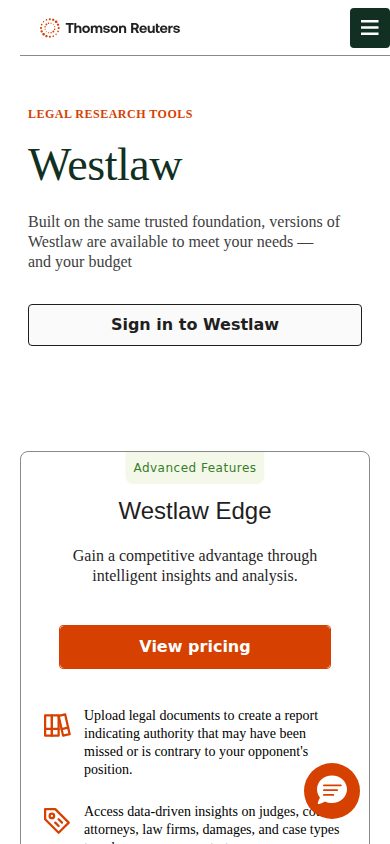
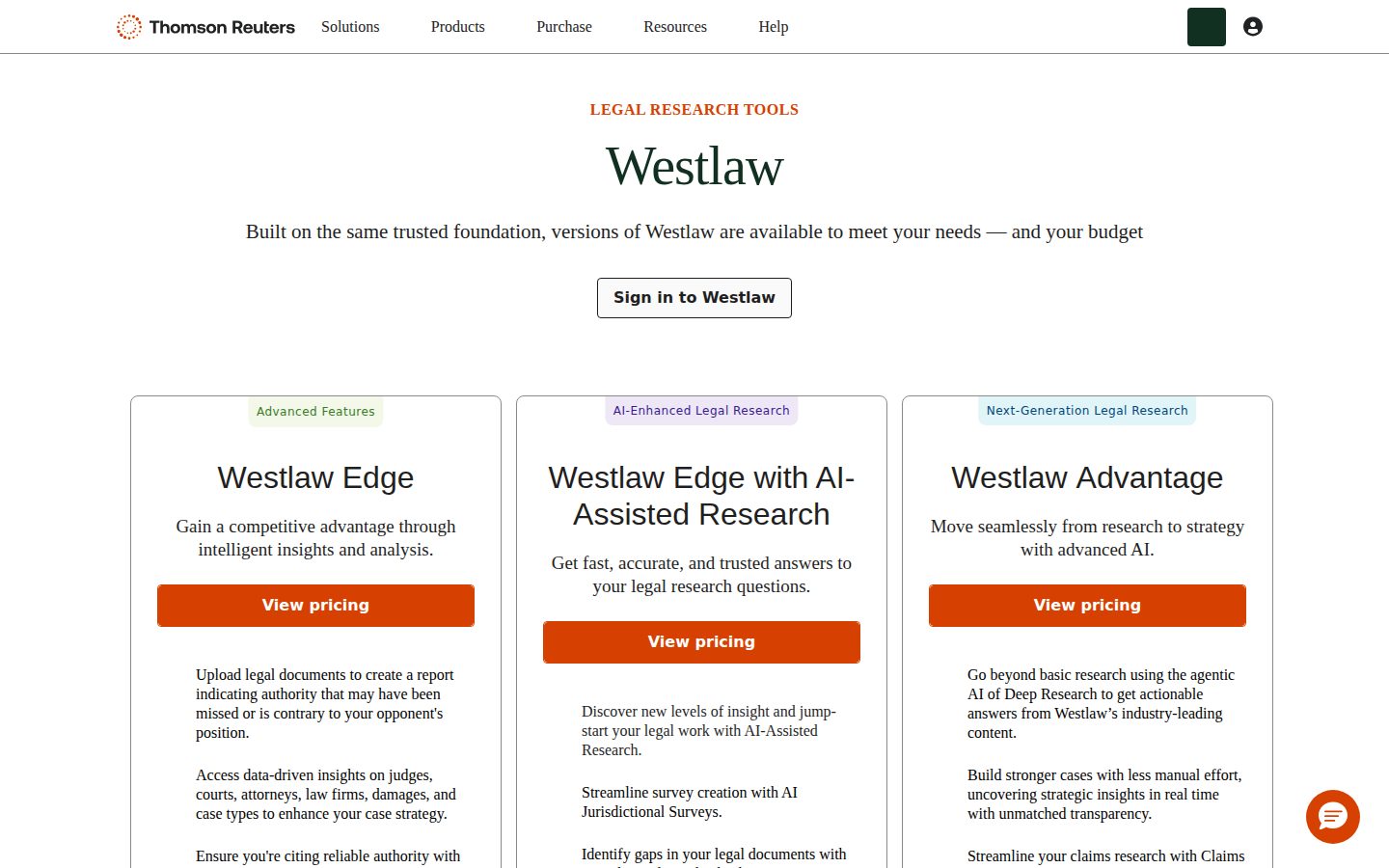
Thomson Reuters Westlaw AI-Assisted Research desktop previewThomson Reuters Westlaw AI-Assisted Research mobile preview

Pricing Plans

Westlaw Edge

Contact sales

For legal professionals seeking competitive advantage through intelligent insights and analysis.

  • Upload legal documents to create authority reports
  • Data-driven insights on judges, courts, attorneys, and law firms
  • KeyCite Overruling Risk for citing reliable authority
  • Instantly compare two versions of a statute or regulation

Westlaw Edge with AI-Assisted Research

Contact sales

For legal professionals who want fast, accurate, and trusted AI-powered answers to legal research questions.

  • AI-Assisted Research for fast and accurate answers
  • AI Jurisdictional Surveys for streamlined survey creation
  • AI-enhanced Quick Check to identify gaps in legal documents
  • WestSearch Plus to get to the heart of legal matters faster

Westlaw Advantage

Contact sales

For legal professionals who need advanced agentic AI to move seamlessly from research to strategy.

  • Deep Research agentic AI for actionable answers
  • Claims Explorer for finding the strongest legal claims
  • Litigation Document Analyzer for deeper insights and counterarguments
  • Includes all features of Westlaw Edge with AI-Assisted Research

AI Panel Reviews

The Decision Maker

The Decision Maker

Strategic bet, vendor viability, timing, adoption approval
8.5/10

150 years of legal data plus agentic AI — the default choice for serious firms.

Westlaw isn't a bet, it's the incumbent. The new Westlaw Advantage tier adds agentic AI that actually moves work forward, not just search.

Thomson Reuters has been in this market longer than most law firms have existed. KeyCite alone — their citation verification tool — is irreplaceable for malpractice-conscious attorneys. LexisNexis competes hard, but Westlaw's Key Number System and 650-attorney Practical Law editorial team are genuine moats. No public funding risk here; this is a $6B+ division of a publicly traded company.

The tradeoff is price and flexibility. Contact-only pricing signals enterprise contracts, and solo practitioners consistently call it premium-expensive relative to newer entrants. Two 7-day trials per year is thin for a firm doing serious due diligence. CoCounsel integration is promising, but agentic AI claims deserve a pilot before you standardize.

Three questions matter. Will they exist in three years? Absolutely. Does Westlaw Advantage advance you or just automate existing research? Early evidence says both. Can you defend it to the board? Easily — this is the safe, defensible choice.

Competitive Positioning8.0

Peers are already on Westlaw or LexisNexis — Westlaw Advantage's agentic AI layer is currently ahead of LexisNexis's equivalent offering.

Reputation Risk9.5

Adopting Westlaw is the professionally expected move — no board will question it.

Speed to Value7.5

Access in one business day is fast, but contact-only pricing and contract negotiation slow real deployment.

Strategic Fit8.0

Westlaw Advantage's Deep Research and Claims Explorer push toward strategy, not just faster search.

Vendor Viability9.5

Thomson Reuters is publicly traded with 150+ years in legal publishing — zero runway risk.

Pros

  • KeyCite citation verification is a malpractice shield competitors can't replicate
  • 650 attorney-editors behind Practical Law content — not a scraped database
  • Westlaw Advantage's agentic AI moves from research to courtroom strategy
  • API access enables firm-wide workflow integration

Cons

  • Contact-only pricing means no fast procurement — budget cycles will grind
  • Only two 7-day trials per year makes real team evaluation difficult
  • Premium cost is real friction for small firms relative to newer entrants
  • Agentic AI features in Westlaw Advantage are still early — claims need validation in a pilot

Right for

Mid-size to large law firms and corporate legal departments where research accuracy and malpractice exposure justify premium pricing.

Avoid if

You're a solo practitioner or small firm with a tight budget — cheaper alternatives exist that cover 80% of the use case.

The Domain Strategist

The Domain Strategist

Craft and strategy in the product's domain — adapts identity per category, same lens
8.5/10

Westlaw remains the gold standard for legal authority, now with credible AI layered on top.

150 years of editorial infrastructure behind the content layer. CoCounsel integration and Deep Research agentic AI signal Thomson Reuters is serious about generative AI, not just rebranding search.

KeyCite alone justifies the subscription for any firm doing appellate or complex litigation work — citation verification with Overruling Risk flags is the kind of malpractice-prevention infrastructure you don't rebuild yourself. The 650+ attorney-editors behind Practical Law content means the secondary source layer has real editorial accountability, not scraped web content. That's a meaningful distinction when your associates are drafting transactional documents at speed.

The Westlaw Advantage tier adds agentic AI with Claims Explorer and Litigation Document Analyzer — features that move research from retrieval into something closer to early-stage legal strategy. Against LexisNexis, that's a genuine differentiator right now. The tradeoff is cost opacity: pricing is contact-only, multi-year discounts exist but aren't published, and solo practitioners consistently flag this as premium-priced relative to newer entrants.

If we adopt Westlaw Advantage, in three years we're deeply integrated through the Legal Research API and CoCounsel — productive, but locked into Thomson Reuters' AI roadmap. That's acceptable given their content moat, but procurement should negotiate hard on API access rights and data portability before signing.

Category Positioning9.0

Clear category co-leader alongside LexisNexis, with Westlaw Advantage's agentic AI features currently ahead of publicly documented LexisNexis equivalents.

Domain Fit8.8

KeyCite, jurisdiction-spanning coverage, and Practical Law templates map directly to how practicing attorneys and corporate legal departments actually work through matters.

Integration Surface8.0

Developer portal with published API catalogue and CoCounsel integration covering research, analysis, and drafting is a strong surface for enterprise legal ops stacks.

Long-term Implications7.5

API access and CoCounsel integration create real workflow lock-in; Thomson Reuters' AI roadmap becomes your AI roadmap, which is a strategic dependency worth pricing in.

Strategic Depth9.0

150 years of editorial infrastructure plus headnotes, Key Number System, and now agentic AI — this is library-grade depth that competitors can't replicate quickly.

Pros

  • KeyCite with Overruling Risk is genuine malpractice-prevention infrastructure
  • 650+ attorney-editors behind Practical Law content means editorial accountability, not algorithmic assembly
  • Agentic AI in Westlaw Advantage — Claims Explorer and Deep Research — moves the tool from retrieval toward early legal strategy
  • API catalogue enables integration with existing enterprise legal tech stack

Cons

  • Pricing is contact-only with no published rate card — budget certainty requires a negotiation cycle
  • Deep API and CoCounsel integration creates meaningful lock-in to Thomson Reuters' AI roadmap
  • Premium cost structure is prohibitive for solo practitioners and small firms relative to newer entrants

Right for

Mid-to-large law firms and corporate legal departments that need bulletproof citation integrity and are ready to build AI-assisted workflows on a mature content foundation.

Avoid if

Your department needs transparent, predictable per-seat pricing before taking a contract to finance for approval.

The Finance Lead

The Finance Lead

Money, total cost of ownership, contracts, procurement math
6.8/10

150 years of legal data, zero published prices — classic enterprise hostage math.

Westlaw's content depth is unmatched. The pricing model weaponizes that depth against buyers.

No published seat price. Three tiers visible — Edge, Edge with AI, Advantage — all labeled 'Free' on the pricing page, which means 'free trial,' not free product. Real pricing requires a sales call. That's a procurement friction score, not a feature. Compare LexisNexis: same opacity, same enterprise posture. Neither trusts buyers with numbers.

KeyCite, the Key Number System, and 650 attorney-editors behind Practical Law content are real moats. CoCounsel integration adds agentic AI on top of verified data — that's a defensible stack. But 'contact us' pricing at this category premium means year-3 TCO is genuinely unknowable without an invoice. Multi-year terms are confirmed available; discounts are not quantified anywhere public.

Two 7-day trials per year. One business day for credential access. Auto-renewal terms and termination clauses are not public. Solo practitioners get hit hardest — category norm is premium pricing for small seat counts, and Westlaw's reputation suggests no exception here.

Billing & Procurement4.0

One business day for access is clean, but contact-only pricing adds a full sales cycle before any procurement can begin.

Contract Flexibility5.0

Multi-year terms confirmed, but auto-renewal windows and termination clauses aren't publicly documented.

Pricing Transparency2.5

All three tiers show 'Free' with no actual dollar figures — pricing requires a direct sales engagement.

ROI Clarity7.0

KeyCite and AI-Assisted Research have clear time-savings narratives; attorney billing rates make research-hour math concrete.

Total Cost of Ownership4.5

Multi-year discounts exist per the docs but are unquantified; year-3 TCO is unmodelable without a contract in hand.

Pros

  • 650 attorney-editors behind Practical Law content — defensible editorial moat
  • KeyCite citation verification is a hard procurement justification for litigation teams
  • Two 7-day trials per year gives procurement some evaluation runway
  • API access supports integration into existing legal workflows

Cons

  • Zero published pricing — every TCO model starts with a guess
  • Auto-renewal and termination terms are not public
  • Solo and small-firm buyers absorb premium pricing without volume leverage
  • No published overage rates for content scope expansion mid-term

Right for

Mid-to-large law firms and corporate legal departments that can absorb enterprise contract friction and need verified, deep-jurisdiction coverage.

Avoid if

You need transparent pricing before executive sign-off or you're a solo practitioner without negotiating leverage.

The Domain Practitioner

The Domain Practitioner

Daily hands-on reality in the product's domain — adapts identity per category, same lens
8.5/10

Westlaw AI Knows Legal Research — Daily Workflow Proves It

Built on 150 years of legal content, Westlaw's AI layer isn't a feature bolted on late — it's woven into citation checking, document analysis, and jurisdiction surveys. For paralegals living in case law and statutory research daily, this is the default choice, not a consideration.

KeyCite alone justifies the subscription for most paralegal workflows. Verifying that a case is still good law before an attorney signs off on a brief — that's a daily task, and Westlaw's KeyCite Overruling Risk flag does it without a separate verification pass. The Quick Check feature scanning documents for citation gaps is the kind of thing that saves a paralegal at 4:45 PM.

The tiered structure — Edge, Edge with AI-Assisted Research, Advantage — means the agentic AI features like Claims Explorer and Litigation Document Analyzer sit behind the top Advantage tier. Contact-only pricing makes budget conversations with firm management harder than they should be. LexisNexis has the same opaque pricing problem, so this is a category norm, not a Westlaw-specific failure.

The two 7-day trials per year give enough runway to pressure-test the AI search against a real docket. On-demand training through the Legal Learning Hub helps, but docs suggest it's product-knowledge focused, not workflow-focused. Power users who learn the Key Number System unlock real depth. Most don't, which is a recurring gap.

Day-3 Reality8.5

KeyCite and natural language search handle the repetitive daily verification and lookup tasks that define paralegal work without requiring mode-switching.

Documentation Practitioner-Fit7.0

Legal Learning Hub exists and offers on-demand modules, but the docs appear product-knowledge oriented rather than task-flow oriented for paralegals.

Friction Surface7.5

Contact-only pricing and tier ambiguity create friction before you even log in; inside the tool, the three-tier feature split means hunting for what's included.

Power-User Depth8.8

The Key Number System and 650-attorney-editor Practical Law content library represent genuine depth that rewards users who invest in learning the system.

Workflow Integration8.2

CoCounsel integration combines research, analysis, and drafting in one session — reduces the copy-paste loop between research and document prep.

Pros

  • KeyCite Overruling Risk flag catches bad citations before they leave the office
  • Practical Law's 650 attorney-editor content library covers templates and checklists paralegals actually draft from
  • AI Jurisdictional Surveys collapse multi-state research that used to take hours
  • Two 7-day trials per year let you test against real matters before committing

Cons

  • Contact-only pricing makes firm budget conversations slow and opaque
  • Advanced agentic features like Claims Explorer require the top Advantage tier — no public price
  • Legal Learning Hub skews toward product training, not paralegal-specific workflows
  • Three-tier structure makes it unclear which AI features any given subscription actually includes

Right for

Paralegals at mid-size to large firms doing daily case law research, citation verification, and multi-jurisdiction statutory work.

Avoid if

Solo or small-firm support staff whose workload doesn't justify premium subscription pricing when cheaper alternatives cover basic research needs.

The Power User

The Power User

Daily human experience, onboarding, polish, learning curve, reliability
8.2/10

150 years of legal credibility, now with AI that actually earns its place

Westlaw is the default for a reason — depth, KeyCite, and now agentic AI that goes beyond search. The cost will make solo practitioners wince, but for firms where research errors are unacceptable, it's hard to argue with.

KeyCite alone has saved attorneys from citing overruled cases for decades. Now Westlaw Advantage layers agentic AI on top of that same verified content — Deep Research, Claims Explorer, a Litigation Document Analyzer — and the pitch makes sense. This isn't AI stapled onto a legacy tool. The content foundation is genuinely different from what LexisNexis or any newer entrant can replicate overnight.

The 7-day trial (two per year, per their site) is enough to feel the difference between natural language search that actually understands legal context versus one that just keyword-matches. Practical Law's 650 attorney-editors producing templates and checklists is a real signal that someone thought about daily workflow, not just search results.

The tradeoff is obvious: pricing is contact-only, which means small firms and solo practitioners are probably going to sticker-shock themselves out of the room. Newer competitors are eating that segment. Mobile exists on iOS and Android, but based on category norms, complex research workflows on a phone remain aspirational. Day three you'll be at your desk.

Daily Polish8.0

Editorial features like headnotes, the Key Number System, and AI passage highlights show a team that has thought hard about what attorneys actually need mid-research.

Learning Curve7.5

Natural language search lowers the floor, but the Key Number System and full Advantage feature set reward the attorneys who put in the hours with the Legal Learning Hub.

Mobile Parity6.5

iOS and Android exist, but agentic AI workflows like Deep Research and Litigation Document Analyzer are almost certainly desktop-first experiences by design.

Onboarding Experience7.0

Access in 1 business day is clean, but a platform this deep — Westlaw Edge, Precision, Advantage, plus APIs — takes real time to navigate without the Legal Learning Hub.

Reliability Feel8.5

150 years of institutional investment and enterprise legal contracts don't leave room for flaky infrastructure; KeyCite's citation verification depends on it being right every time.

Pros

  • KeyCite citation verification is category-defining and genuinely reduces professional risk
  • 650 attorney-editors behind Practical Law content means templates and checklists actually reflect how law is practiced
  • Westlaw Advantage's agentic AI — Claims Explorer, Deep Research — goes meaningfully beyond search
  • Federal and state jurisdiction coverage in one place, no patchwork

Cons

  • Contact-only pricing is a wall for small firms and solo practitioners
  • Platform depth is an asset until day three, when you realize how much there is to learn
  • Two 7-day trials per year is thin if you're evaluating for a full firm rollout
  • Mobile experience almost certainly doesn't match desktop for complex research tasks

Right for

Mid-size to large law firms and corporate legal departments where research accuracy is non-negotiable and budget matches the stakes.

Avoid if

You're a solo practitioner or small firm watching every dollar, because newer entrants will give you 80% of the utility at a fraction of the price.

The Skeptic

The Skeptic

Contrarian. Watch-outs, deal-breakers, broken promises, category patterns
7.8/10

150 years of legal data plus agentic AI — the incumbent plays offense

Westlaw isn't a startup story. It's a 150-year content moat with AI layered on top. Premium-priced, hard to leave, and genuinely hard to replicate.

Three tells upfront. One: pricing is contact-only despite a 'pricing page' listed — the kind of opacity that signals enterprise lock-in by design. Two: the 7-day trial eligibility caps at twice per year, which is oddly specific gatekeeping. Three: 'Westlaw Advantage' is branded as free on the plans page, which almost certainly means free to evaluate, not free to keep. Expect a call.

That said — the differentiation here is real. The Key Number System, KeyCite, and 650+ attorney-editors on Practical Law aren't features LexisNexis can replicate overnight. CoCounsel integration signals genuine agentic AI investment, not a chatbot wrapper. The API catalogue suggests they're building for embedded workflows, not just portal visits.

Exit story is the honest red flag. Proprietary headnotes, Key Numbers, and editorial layers don't export. If you build workflows around Westlaw-specific citation structure, leaving hurts. That's the tradeoff: depth costs portability.

Competitive Differentiation8.5

650 attorney-editors, KeyCite Overruling Risk, and 150 years of curated content are not features a 3-year-old AI startup can match.

Exit Portability4.5

Proprietary Key Number System and editorial headnotes create deep workflow lock-in that doesn't migrate to LexisNexis or Fastcase cleanly.

Long-term Viability9.2

Thomson Reuters is a publicly traded company with CoCounsel already shipping and an API catalogue live — no viability concerns here.

Marketing Honesty6.5

Plans listed as 'Free' but clearly trials; no actual pricing published — classic enterprise opacity.

Track Record Match9.0

Westlaw has survived every wave — CD-ROMs, early internet, LegalZoom, Ross Intelligence — and is still the default cite in federal briefs.

Pros

  • KeyCite citation verification is category-standard for a reason — no equivalent at newer entrants
  • CoCounsel agentic AI integration shows active AI investment, not just keyword stuffing
  • 650+ attorney-editors on Practical Law is a real content moat
  • API access available — suggests genuine integration strategy beyond the portal

Cons

  • Contact-only pricing means budget conversations happen before you know if it fits
  • Proprietary editorial layers make exit painful — you don't own that structure
  • Premium pricing puts it out of reach for solo practitioners without institutional access
  • No public changelog — hard to verify shipping cadence from outside

Right for

Mid-size to large law firms or legal departments that need verified, citation-safe research and can absorb enterprise pricing.

Avoid if

You're a solo practitioner or small firm where Fastcase or Casetext at a fraction of the cost covers 80% of your actual research needs.

Buyer Questions

Common questions answered by our AI research team

Pricing

Does the free 7-day trial for Westlaw Edge Premium include access to the AI-Assisted Research tools, and how many trials am I eligible for per year?

The content confirms a free 7-day trial is available for Westlaw Edge Premium, and users are eligible for two 7-day trials per year. However, the content does not specify whether the trial explicitly includes access to AI-Assisted Research tools.

Setup

How long does it take to get access credentials after signing up for a Westlaw plan, and what does the onboarding process look like?

After signing up, online access will be available in 1 business day, and access credentials will be sent after sign-up. The content does not describe any further details about the onboarding process beyond this.

Pricing

Can multi-year subscriptions be purchased for Westlaw Edge with AI-Assisted Research, and how much can firms save compared to standard pricing?

The content states that multi-year (longer) terms are available and that signing on for longer terms allows customers to save money. However, the content does not specify exact discount amounts or percentages for multi-year subscriptions.

Product Information

  • Founded

    2008
  • Pricing

    Contact for pricing
  • Free Trial

    Available

Platforms

webiosandroid

About Thomson Reuters

Thomson Reuters is a Toronto-based information and technology company providing Westlaw, Practical Law, Checkpoint, and AI-powered tools for legal, tax, and news professionals.

Resources

Documentation
API
Blog

Also in AI Legal