AI legal assistant built for law firms and legal teams
Harvey AI is an AI platform designed for legal professionals to assist with research, drafting, and analysis.
AI Panel Score
6 AI reviews
Reviewed
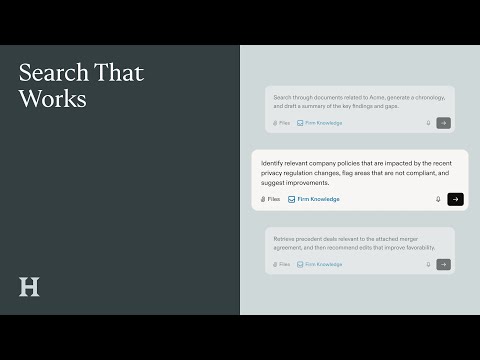
Harvey AI is an artificial intelligence platform purpose-built for legal professionals, including law firms, corporate legal departments, and professional services organizations. It applies large language models, trained and fine-tuned on legal data, to help attorneys handle time-intensive tasks more efficiently.
The platform supports a range of legal workflows including contract analysis, legal research, memo drafting, regulatory compliance review, and due diligence. Users can interact with the system through a conversational interface, ask questions about documents, and receive structured outputs grounded in source material.
Harvey is designed for enterprise use and is deployed with security and confidentiality controls intended to meet the standards expected in legal practice. The company has established partnerships with major law firms and legal networks, positioning it as an enterprise-grade solution rather than a consumer tool.
In the broader legal tech market, Harvey competes with tools like CoCounsel (Thomson Reuters) and Lexis+ AI, differentiating itself through its focus on foundation model development tailored to legal use cases and its relationships with Am Law 100 firms. It is backed by venture capital and has raised significant funding to expand its model capabilities and client base.
Access to Harvey is typically granted through enterprise agreements, and pricing is not publicly listed. The platform is primarily web-based and does not appear to offer a publicly available free trial or free tier.

Automated review and analysis of contracts to identify key terms, clauses, and potential issues.
AI-powered legal research tool that helps legal professionals find and analyze relevant legal information and precedents.
Automates and orchestrates multi-step legal workflows to reduce manual effort across complex legal tasks.
Streamlines the due diligence process by automating document review and information extraction for legal teams.
Manages legal deal workflows and documentation to support transactional legal work.
Stores and organizes legal documents within the platform for easy access and retrieval.
Supports legal teams in preparing and processing fund formation documents and related legal work.
Records user activity and system events to provide a traceable history of actions taken within the platform.
Controls how data is stored, retained, and deleted throughout its lifecycle to meet compliance requirements.
Restricts platform access to approved IP addresses to prevent unauthorized network-level access.
Supports SAML-based Single Sign-On for secure and centralized user authentication across enterprise teams.
Harvey meets SOC2 Type II, ISO 27001, GDPR, and CCPA standards to satisfy enterprise security and regulatory requirements.
Harvey AI is a sales-led product with no public pricing listed. The pricing page returned a 404 error. Prospective customers must request a demo to learn about pricing.
An $11 billion legal AI bet that the board will approve, if procurement can stomach opaque pricing.
“Harvey raised $200 million in March 2026 at an $11 billion valuation, co-led by GIC and Sequoia. The catch is contact-only pricing with no list to model against.”
Harvey crossed $1 billion in total funding with a March 2026 round at an $11 billion valuation. Vendor survival is not the board's question here.
The real call is whether Harvey advances your legal function or just speeds up work you already outsource. Vault handles secure bulk document analysis, and Workflow Agents run multi-step tasks like due diligence and fund formation without an attorney babysitting each step. CoCounsel from Thomson Reuters has the distribution edge, but Harvey's draw is foundation models tuned on legal data and signed Am Law 100 firms.
However, pricing is fully sales-led and the pricing page returns a 404, so you cannot model cost before a demo. SOC2 Type II and ISO 27001 cover the reputation risk. Pilot it with one practice group for 90 days, confirm the per-seat math, then standardize.
Peers already use it, and legal-tuned foundation models differentiate it from CoCounsel and Lexis+ AI.
SOC2 Type II, ISO 27001, and signed Am Law 100 firms make this a defensible board choice.
Web-based with no free trial, so payback only starts after an enterprise agreement closes.
Vault and Workflow Agents automate core billable tasks rather than just trimming cost.
Over $1 billion raised and an $11 billion March 2026 valuation co-led by GIC and Sequoia.
Law firms and in-house legal teams who automate research and due diligence at scale.
Solo practitioners or small firms who need transparent published pricing.
Harvey is the legal-AI category leader, but its enterprise-only shape is a deliberate procurement filter.
“Harvey is a foundation-model legal platform with genuine Am Law adoption and serious compliance depth. The craft ceiling is high, but the contact-sales model means you buy a partnership, not a tool.”
A general counsel scoping a legal-AI layer through 2029 should weigh who builds the model. Harvey, founded in 2022 by ex-litigator Winston Weinberg and ex-DeepMind researcher Gabriel Pereyra, fine-tunes its own models on legal data rather than wrapping a generic LLM. That foundation-model commitment is the strategic differentiator.
The architecture reads enterprise-first. Vault handles secure document storage and bulk analysis, Workflow Agents orchestrate multi-step matters like due diligence and fund formation, and SAML SSO plus IP allow-listing meet the access controls a firm review demands.
The catch is procurement. There is no free trial and no public pricing — the pricing page returns a 404 — so every adoption runs through an enterprise agreement. Against CoCounsel and Lexis+ AI, Harvey trades self-serve evaluation for deeper model work, and the March 2026 round valuing it at $11 billion funds that bet.
Am Law adoption and an $11 billion valuation place Harvey as the category leader.
Workflow Agents map to real matter types like due diligence and fund formation.
SAML SSO, IP allow-listing, and audit logs fit firm security stacks cleanly.
Enterprise-agreement adoption deepens reliance on one vendor with no public exit pricing.
Fine-tuning its own legal foundation models is deeper craft than wrapping a generic LLM.
General counsels who want a vendor building legal-specific foundation models.
Solo practitioners who need self-serve pricing and an instant trial.
No public price, a 25-seat floor, and contracts that land near a million dollars a year.
“Harvey publishes nothing — the pricing page returns a 404. Every quote is custom, and the entry point is enterprise-scale by design.”
Harvey is sales-led. No tiers, no list price, no free trial. Market reports put per-seat cost at roughly $1,200 to $2,000 a month, with a 25-seat minimum on annual terms. Run the math on a 50-attorney firm: 50 x $1,500 x 12 is near $900K a year before discounts.
That number buys real product. Vault handles secure bulk document analysis, and Workflow Agents automate multi-step tasks like due diligence and fund formation. The vendor is funded — a March 2026 round valued Harvey at $11 billion, and ARR reportedly hit $190M. But custom-model training and dedicated success teams bill on top of seat cost, so the quote is a floor.
ROI is measurable if you track billable hours saved. CoCounsel from Thomson Reuters competes here. Procurement should expect a long negotiation and audit the overage terms.
Enterprise invoicing with SAML SSO and SOC2 Type II eases vendor onboarding for large legal teams.
Annual terms with a 25-seat minimum leave little room for small pilots but standard negotiation for large firms.
The pricing page returns a 404 and every quote is custom, so buyers start fully blind.
Billable hours saved on due diligence and contract review give a legible, auditable value story.
A 50-attorney deployment lands near $900K a year before custom training and success-team add-ons.
Am Law 100 firms who can absorb six-figure annual legal AI contracts.
Solo lawyers or small firms who need transparent per-seat pricing.
Harvey AI grounds drafting and due diligence in source documents, but enterprise-only access locks out solo practitioners.
“Vault and Workflow Agents pull legal AI into the contract-review and diligence work that fills an associate's week. But there is no public pricing, no trial, and no way in without a firm-level enterprise agreement.”
An associate judges legal AI on the third afternoon of a diligence review, not the partner demo. Harvey's Vault holds the data room — bulk-upload a deal's contracts and query the whole set, with answers citing the source clause instead of a confident paragraph you then re-verify. That grounding is the difference between a usable first pass and another thing to check.
Workflow Agents are the daily win. Pre-built or custom, they chain the repetitive steps of a contract analysis or fund-formation pass so you stop re-prompting each matter. Knowledge research spans legal, regulatory, and tax sources in one query. CoCounsel from Thomson Reuters covers similar ground, but Harvey's agents feel built around how transactional work actually moves.
The catch is getting in. There is no public pricing — the pricing page returns a 404 — no free trial, and access runs through firm-wide enterprise agreements. A solo practitioner can't scope a pilot. Founded in 2022, this is built for Am Law firms, and the buying path makes that explicit.
Source-cited answers in Vault hold up past the demo because every output points back to a clause you can verify.
The platform ships a blog but no public docs or changelog, so workflow guidance stays behind the enterprise wall.
Conversational interface and ecosystem integrations reduce tab-switching, though enterprise access gating adds onboarding friction.
Custom Workflow Agents and cross-domain Knowledge research give experienced legal teams real depth beyond a basic Q&A assistant.
Workflow Agents chain repetitive diligence and contract steps so the tool fits transactional work instead of demanding new habits.
Law firm associates and in-house legal teams who do high-volume contract and diligence work.
Solo practitioners or small firms who need to trial a tool before committing.
Harvey feels built by people who know legal work, but you cannot test-drive it
“The legal workflows and the Vault document store look genuinely thought through. The catch is no free trial, no public pricing, and a 404 where the pricing page should be.”
You learn a lot about a tool from how it lets you in the door. With Harvey, you do not get in without a sales call. No free tier, no trial, and the pricing page returns a 404 — so the first ten minutes are a demo form, not the product.
What is behind that wall looks solid. Vault handles secure document storage and bulk analysis, and Workflow Agents give you pre-built or custom flows for contract review instead of a blank chat box. There is a real Harvey Mobile app too, which most enterprise tools skip. Founded in 2022, it now serves over 1,000 customers, so the empty-state guesswork is gone.
CoCounsel from Thomson Reuters is the obvious comparison, and it lives inside an existing research stack. Harvey is the standalone bet. However, you cannot judge month-three feel from a scripted demo, and that should worry a careful buyer.
Workflow Agents and Vault suggest a team that designed for real legal tasks, not a generic chat box.
Pre-built and custom Workflow Agents give structure, though enterprise depth takes time to learn.
A real Harvey Mobile app exists, which most enterprise legal tools skip entirely.
No free tier, no trial, and a 404 pricing page make the first ten minutes a sales form.
SOC2 Type II, ISO 27001, audit logs, and IP allow-listing point to enterprise-grade solidity.
Law firms who want a purpose-built legal AI with mobile access
Solo practitioners who need to trial a tool before committing
A $11B valuation and OpenAI as seed investor, but the hype is running ahead of the track record.
“Harvey sits on real funding and Am Law 100 logos, founded only in 2022. The catch is no public pricing, no free trial, and a roadmap moving fast toward agents.”
Start with the money. Founded 2022, OpenAI as seed investor, and a $200M round in March 2026 at an $11B valuation co-led by GIC and Sequoia. That removes the graveyard worry most three-year-old vendors carry.
The product itself looks grounded. Contract Analysis, Fund Formation, and Deal Management are named workflows, not vapor, and the security posture is real — SOC2 Type II, ISO 27001, SAML SSO, IP Allow-Listing. CoCounsel from Thomson Reuters and Lexis+ AI both have decades of legal data behind them; Harvey leans on foundation-model tuning instead. But a $190M ARR number climbing this fast is the kind of growth that invites a hard repricing later.
What worries me is the opacity. Contact-only sales, a 404 pricing page, no trial. You cannot test before signing. Exit portability is the yellow flag — documents export, but workflows do not.
Foundation-model tuning sets it apart from data-heavy rivals CoCounsel and Lexis+ AI, a real if unproven gap.
Document Storage allows export, but multi-step Complex Workflows would not port cleanly off the platform.
A $11B valuation in March 2026 and roughly $190M ARR signal a well-funded three-year bet.
Homepage says "secure platform" with no detail, though the feature list does name real SOC2 Type II and ISO 27001 controls.
Founded 2022 with Am Law 100 logos and OpenAI backing, but three years is short for a category that has churned vendors.
Large law firms who can absorb enterprise contracts.
Solo practitioners who need transparent pricing and a free trial.
Common questions answered by our AI research team
Harvey supports Legal Research, Deal Management, Due Diligence, Fund Formation, Contract Analysis, Complex Workflows, and Document Storage, as listed on the platform's homepage.
Harvey is designed for both law firms and in-house legal teams. The homepage states that 'Today's top law firms and in-house legal teams trust Harvey,' and customer testimonials include both law firms (e.g., Reed Smith, Burges Salmon) and in-house legal departments (e.g., Deutsche Telekom AG, Syngenta Group).
The homepage describes Harvey as 'a secure platform,' but no further specific details about security certifications, encryption standards, or data handling practices are provided in the available content.
Yes, the Harvey homepage includes a 'Request a Demo' option for prospective customers.


Harvey is a San Francisco-based AI platform built for legal and professional services firms, offering tools for legal research, contract analysis, and document drafting.