Secure collaboration and compliance platform for regulated industries
Exostar is a compliance and collaboration platform for aerospace, defense, life sciences, and healthcare organizations.
AI Panel Score
6 AI reviews
Reviewed
AI Editor ApprovedApproved and published by our AI Editor-in-Chief after full panel analysis.Exostar is a compliance and collaboration platform for aerospace, defense, life sciences, and healthcare organizations operating in highly regulated environments. It connects more than 200,000 vetted organizations through a purpose-built network spanning CMMC compliance, supply chain collaboration, supplier management, clinical trial access, and DEA-compliant electronic prescribing for controlled substances. Pricing is quote-based, with no free plan or trial. Key capabilities include the Managed Access Gateway for identity federation and single sign-on across partner ecosystems, delegated administration, organization hierarchy management, role-based access control, partner onboarding, CMMC and NIST 800-171 compliance tools, order-to-cash supply chain automation, and procurement tooling for regulated-industry RFx events and auctions. Its Access: One product handles identity and access governance, and a dedicated life sciences identity solution serves clinical environments. The platform fits defense contractors, suppliers, and life sciences organizations that must prove compliance while collaborating across large partner networks.
In practice, organizations use Exostar to manage the full lifecycle of regulated business relationships — onboarding and verifying suppliers, sharing sensitive documents under compliance controls, managing sourcing and contracts, and coordinating order-to-cash workflows. Users interact through a web-based platform that enforces identity proofing and multifactor authentication, ensuring that access to sensitive systems meets regulatory requirements.
Exostar's platform includes specific modules for CMMC Level 2 readiness (protecting Controlled Unclassified Information for defense contractors), clinical trials management (enabling faster site activation with compliant system access), and Electronic Prescriptions for Controlled Substances (EPCS) using DEA-compliant identity verification). The network model means participants can collaborate with other vetted members without rebuilding trust or compliance checks for each relationship.
Exostar primarily serves large enterprises and mid-sized suppliers in the Defense Industrial Base, pharmaceutical companies, and healthcare organizations. More than half the Defense Industrial Base and over 25 pharmaceutical companies are cited as transacting through the platform. Pricing is not publicly listed and appears to be contract-based; prospective customers should contact Exostar directly. Competitors in adjacent spaces include Coupa (supply chain), Veeva (life sciences collaboration), and CyberArk or Okta (identity and access management for regulated environments).
The platform is web-based and built around a federated identity and access management architecture. It supports enterprise-grade security controls aligned with NIST SP 800-171 and CMMC frameworks, making it suitable for environments handling CUI and other regulated data categories.

Streamlines CMMC and NIST SP 800-171 self-assessments, calculates SPRS scores, and generates SSPs and POA&Ms to support compliance reporting.
Enables organizations to delegate user and access administration tasks across the partner network rather than managing every account centrally.
Speeds up onboarding of new partners using pre-verified credentials, training options, and global identity validation services for secure external collaboration.
Automates customer communication and aligns demand with production to streamline order-to-cash processes and enable proactive issue resolution.
Allows external partners to authenticate once through MAG and gain access to approved tools and systems, improving user experience and reducing IT burden.
An integrated IAM platform that brings together access management and identity governance use cases in a single place for users, line managers, and administrators.
Streamlines RFx processes and auctions for regulated industries, helping procurement teams source faster while staying compliant and engaging suppliers effectively.
Lets administrators implement flexible organization hierarchies that associate users with line managers, delegates, and approvers across departments, locations, or third-party suppliers.
Simplifies application access and accelerates clinical study start-up through seamless authentication within a trusted life sciences community.
Centralizes identity federation across partner organizations so users can be securely recognized and authenticated across the Exostar Network.
A federated identity management gateway that extends secure access to internal systems for external partners without manual credential provisioning.
Provides granular, role-based access controls combined with high-assurance authentication to secure partner access to sensitive systems.
Exostar is a sales-led, enterprise-grade platform serving highly regulated industries such as aerospace & defense, life sciences, healthcare, and financial services. No public list prices are published. Pricing is subscription-based and determined by the number of users, modules selected, and level of access required. Additional costs may apply for implementation, integration, and premium support. Prospective customers must contact Exostar directly for a custom quote.
Exostar owns the DIB compliance network — but you're buying access, not agility.
“200,000 vetted organizations and half the Defense Industrial Base already run through it. That's not a feature comparison, that's a network you either need or don't.”
More than half the Defense Industrial Base transacts through Exostar. Over 25 pharma companies too. That's not a startup pitch — that's infrastructure, and infrastructure doesn't get ripped out easily.
Two things stand out. CMMC Level 2 tooling that covers all 110 NIST SP 800-171 controls, and DEA-compliant EPCS for controlled substances — narrow use cases, but ones where Coupa and Veeva don't play. No public pricing, sales-led, quote-based. That's normal for this category but it means procurement will take months, not days.
This isn't a tool you pilot with five engineers. It's a network you join because your primes or your regulators require it. Reputation risk is near zero — using it signals you take CMMC seriously. The real question is whether you need the network or just the compliance checkbox.
Peers in defense and pharma are already on the network; staying off it can be a competitive disadvantage in bidding.
Adopting a platform tied to CMMC and FedRAMP-equivalent architecture reads as prudent, not risky, to any board.
Access One cuts provisioning to minutes per their claims, but sales-led contracting and no free trial slow the front end.
Advances compliance posture directly for CMMC/EPCS use cases, but overkill if you just need generic supplier onboarding.
No public funding data, but 200,000+ organizations and DIB-majority penetration suggests entrenched, durable revenue.
Defense contractors or pharma companies that need CMMC Level 2 readiness and already work with DIB primes or clinical networks.
Skip it if you just need general supply chain software and have no regulatory mandate forcing your hand.
Exostar buys you a pre-built trust network for CUI and controlled substances, not just software.
“This is infrastructure for regulated relationships, not a point tool. The 200,000-organization network is the actual product; the modules are how you draw on it.”
For CMMC Level 2 and NIST SP 800-171, I don't want a dashboard — I want evidence I can hand an assessor. The Certification Assistant generating SSPs, POA&Ms, and SPRS scores against all 110 controls is the right artifact, and the network effect of more than half the Defense Industrial Base already being onboarded removes a real chunk of third-party risk re-verification.
The federated identity architecture (MAG, Access One, RBAC) matches how audits actually get scoped — by relationship, not by seat. That's a materially different posture than bolting IAM onto a generic collaboration tool like Coupa.
My hesitation: quote-based pricing with no public tiers means procurement and compliance sign-off happen in the dark for months, and switching away from a federated network this embedded is a multi-year unwind, not a contract non-renewal.
Sits ahead of general IAM players like Okta and CyberArk for regulated-industry specificity, without published pricing to benchmark against Veeva.
Federated identity model mirrors how DIB and life sciences actually scope third-party trust relationships.
Managed Microsoft 365 on Azure GCC High and SSO via MAG plug directly into existing DIB and life sciences stacks.
200,000-org network creates strong lock-in; unwinding a federated identity dependency later is costly.
Certification Assistant covering all 110 NIST SP 800-171 controls plus SPRS scoring is audit-grade, not checkbox compliance.
Defense contractors, pharma, and healthcare organizations that need pre-vetted partner trust and CMMC or DEA compliance built into daily collaboration.
Avoid if you need transparent per-seat pricing or a lightweight tool outside the aerospace, defense, life sciences, or healthcare compliance perimeter.
Zero public pricing. Three CMMC tiers exist, but you'll never see the number.
“No pricing page, no free trial, no published tier costs. Procurement will need a full sales cycle before anyone signs.”
No sticker price anywhere. CMMC Ready Suite has three tiers by company size — none priced publicly. Pricing depends on users, modules, and access level. That's three variables procurement can't model without a call.
Compare to Coupa or Okta, both quote-based too — category norm for regulated-industry platforms. But Exostar adds implementation and integration costs on top, per their own pricing notes. At 200,000+ vetted organizations and half the Defense Industrial Base already on-network, switching costs run high once you're in. Year 3 TCO likely dwarfs year 1 once modules like EPCS and Managed M365 get bolted in as add-ons.
No auto-renewal terms disclosed. No termination language published. ROI is real but narrow — provisioning time cut from days to minutes is measurable. Compliance risk avoidance is not. Budget for a long sales cycle and a longer contract review.
Sales-led onboarding fits enterprise procurement norms but adds cycle time and friction.
No published renewal or cancellation terms; enterprise contract likely negotiated case-by-case.
No list prices; three CMMC tiers exist but are named, not priced.
Provisioning time (days to minutes) is measurable; compliance risk reduction is not.
Implementation, integration, and premium support flagged as extra costs on top of subscription.
Defense contractors or life sciences firms already needing CMMC or DEA-compliant identity verification at scale.
You need to compare list prices before picking up the phone.
The SSP writes itself, but every workflow runs through a sales rep first.
“Exostar maps cleanly onto DIB and life sciences compliance obligations — CMMC, DEA EPCS, NIST SP 800-171 — but the buying and daily-use experience is opaque until you're contractually in. This is infrastructure you inherit from a prime contractor, not something you evaluate freely.”
As the person who owns the POA&M and the SPRS score, I care that Certification Assistant maps to all 110 NIST SP 800-171 controls and generates SSPs automatically. That's a real audit-cycle time saver over spreadsheet-tracking evidence myself. Access One's provisioning claim — days to minutes via HR/directory integration — matters when a supplier onboarding delay is blocking a contract milestone.
Day-3 reality is murkier. No public pricing page, no docs, no changelog listed in the evidence — for a platform governing CUI access and DEA identity proofing, I want to see control documentation before I'm mid-contract. Compare that to how Okta or CyberArk publish integration guides upfront.
The network effect — 200,000+ vetted orgs, half the DIB already onboarded — is the real moat; you're not rebuilding trust per relationship. But sales-led, quote-only pricing across modules (MAG, SAM, EPCS, CMMC Ready Suite) means procurement friction before you ever touch the RBAC console.
Automated SSP/POA&M generation and SPRS scoring reduce manual audit prep, but no public docs mean unknowns persist post-signature.
No public docs, API reference, or changelog listed — buyer questions are answered by sales copy, not practitioner-authored guides.
Quote-based pricing across many modules (MAG, SAM, EPCS, CMMC Ready Suite) adds procurement overhead before any hands-on evaluation.
Delegated administration, organization hierarchy management, and RBAC suggest genuine depth for large, multi-tier supplier networks.
Federated SSO via MAG and Microsoft 365/Azure GCC High integration fit existing DIB tooling rather than forcing new habits.
Defense Industrial Base contractors and life sciences firms who already need CMMC Level 2 or clinical trial access controls and can commit to a sales-led enterprise contract.
Avoid if you need transparent self-serve pricing or want to evaluate the platform hands-on before involving procurement.
The network is the whole pitch, and the everyday experience is anyone's guess.
“Exostar connects 200,000+ vetted organizations and covers real compliance headaches like CMMC Level 2 and DEA e-prescribing. But there's zero public evidence of what using it day-to-day actually feels like.”
No pricing page, no docs, no changelog. For a platform that touches CMMC, NIST 800-171, and DEA-compliant prescribing, that's not shocking — this is a sales-led enterprise tool, not a self-serve app you poke around in on a Tuesday afternoon. But it means I can't tell you if the SSO login through their Managed Access Gateway feels smooth or if it's the kind of thing that eats twenty minutes every Monday.
What I can tell you: Access One claims it cuts partner provisioning from days to minutes, which if true is a real 3pm-on-a-Friday kind of win. Delegated administration and pre-verified onboarding suggest someone thought about the pain of managing hundreds of third-party accounts.
Compared to Okta or CyberArk on identity, Exostar bundles compliance-specific tooling those platforms don't touch. Trade-off: you're locked into a vendor relationship with no visible price tag and no trial. That's homework before you even see the product.
No screenshots, no product UI evidence — features are described functionally, not shown in use.
Organization hierarchy and RBAC suggest depth that takes time, though Access One's low-code workflow tools aim to shorten that.
Platform listed as web-only with no mobile mention anywhere in the evidence.
Sales-led, contact-only, no free trial; identity proofing and MFA setup for a defense contractor is not a ten-minute start.
FedRAMP-equivalent architecture and audit logging cited, which speaks to backend rigor even without user-facing loading/error evidence.
Defense contractors or pharma companies needing CMMC and supplier compliance in one contract.
You want to see pricing or try the product before talking to sales.
200,000 vetted organizations. Zero public price. Classic enterprise moat.
“Exostar looks like an incumbent, not a startup — that's the point. But no pricing page and no docs means you're trusting the sales deck.”
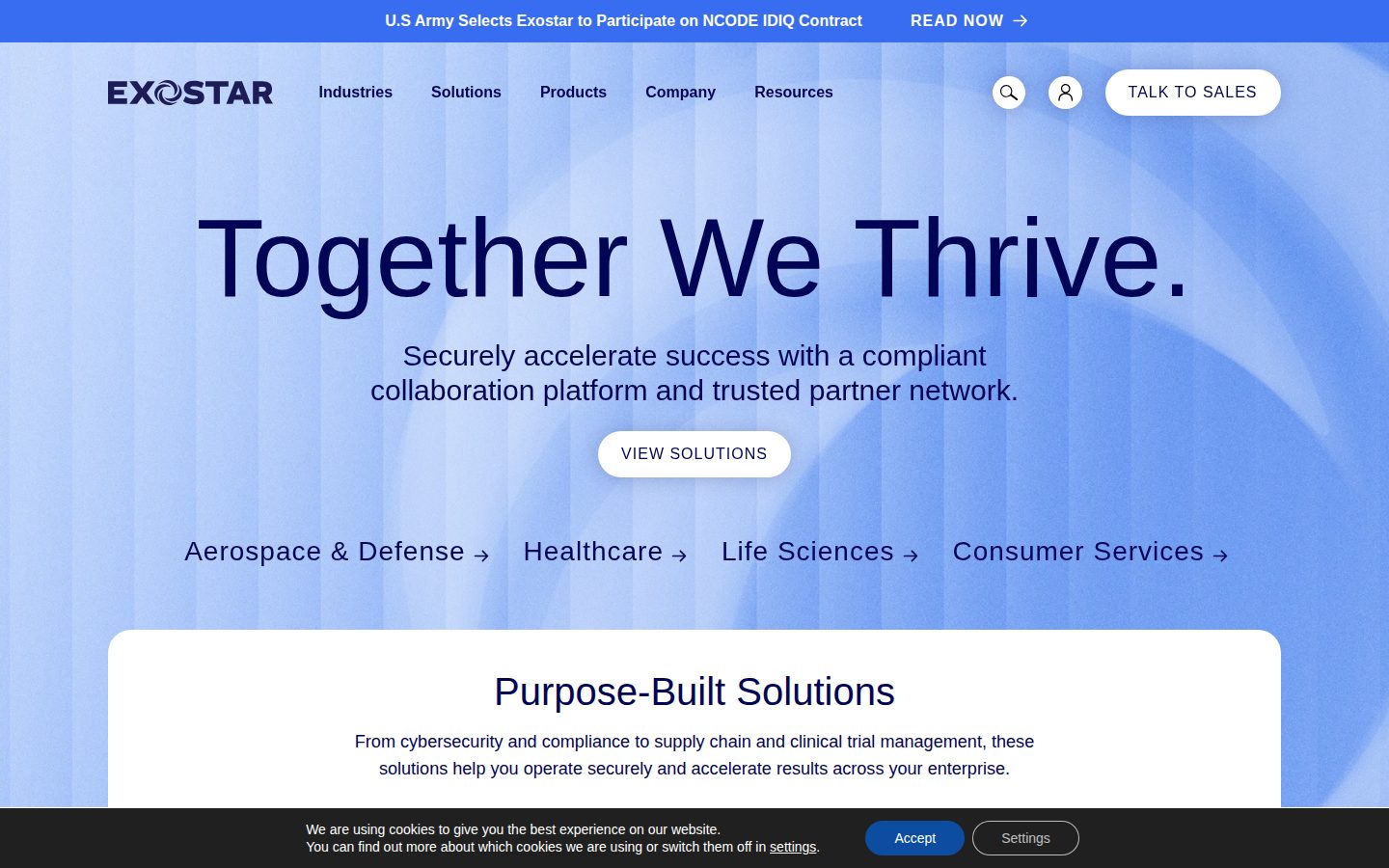
'Together We Thrive' is the H1. That's brand-copy filler, not product info. No pricing page, no docs, no API listed. For a platform touching CUI and DEA-controlled substances, that opacity is category-normal — Veeva and CyberArk do the same contact-sales dance. Doesn't make it comfortable.
The track record is real, though. Half the Defense Industrial Base and 25+ pharma companies transacting through it isn't a marketing number you fake easily. CMMC Level 2 tooling covering all 110 NIST 800-171 controls is specific, not aspirational.
Exit is the real cost here. Once your supplier network, SSO, and identity federation run through Exostar's Managed Access Gateway, unwinding means re-onboarding every partner elsewhere. That's not a bug to them — it's the business model. Fine if you're locked in for a decade. Worth pausing on if you're not sure yet.
Coupa and Veeva cover pieces; nobody named combines CMMC, EPCS, and clinical trial access in one network.
Federated identity and network-effect onboarding via MAG make migration off Exostar costly, by design.
No funding data public, but DIB and pharma dependency at this scale implies durable contracts, not a startup runway bet.
Vague H1 copy, but the compliance claims (SPRS scoring, 110 NIST controls) are specific and checkable.
200,000+ organizations and over half the DIB transacting through it — hard to fake at that scale.
Defense contractors or pharma companies who need CMMC and DEA-compliant access already built by someone else.
Avoid if you need transparent pricing or a fast, reversible pilot before committing.
Common questions answered by our AI research team
Exostar pricing is quote-based through sales, with no public list prices. The CMMC Ready Suite is offered in three standardized tiers aligned to company size, complexity, and software environment.
Exostar delivers secure supply chain collaboration for aerospace and defense, healthcare, and life sciences. Solutions include SupplyLine, Supplier Management, and Managed Access Gateway (MAG) for supplier onboarding and compliance verification.
Yes. Exostar Managed on Microsoft 365 provides a secure Microsoft Teams environment for CMMC compliance and secure collaboration. The network connects 200,000+ vetted organizations, including more than half the Defense Industrial Base.
Exostar's Access One cuts third-party provisioning time from days to minutes with automated provisioning via HR and directory integration. Low-code, drag-and-drop tools let teams customize workflows and access policies.
Yes. The CMMC Ready Suite is a fully managed solution addressing all 110 NIST SP 800-171 controls, while Certification Assistant calculates SPRS scores and generates SSPs and POA&Ms. Exostar cites FedRAMP-equivalent security architecture.
Exostar operates a cloud-based collaboration and identity management platform for the aerospace, defense, healthcare, and life sciences industries, based in Herndon, Virginia.