Forethought logo

Forethought Review

Visit

AI customer service agents for support ticket deflection and resolution

Forethought is an AI-powered customer service automation platform for CX and support teams.

AI Panel Score

7.2/10

6 AI reviews

Reviewed

About Forethought

In practice, support teams deploy Forethought's agents across their existing helpdesk and communication channels. Customers interacting via chat or email are handled by the Solve Agent, which attempts to resolve issues end-to-end without human involvement. When escalation is needed, the Triage Agent classifies and routes the ticket to the right human agent. Human agents working live cases receive contextual suggestions and information from the Assist Agent, functioning as an AI copilot during conversations.

The platform includes four named agent components: Solve (omnichannel customer-facing resolution), Triage (intelligent ticket classification and routing), Assist (AI copilot for live human agents), and Discover (knowledge gap detection that identifies where documentation or answers are missing). These components can be deployed independently or together. Channel coverage includes email, chat, voice, Slack, and in-app mobile support.

Forethought targets CX teams, support operations, IT/security teams, and content managers across industries including ecommerce, fintech, healthcare, SaaS, education, and mobile apps. Pricing is not publicly listed; prospective customers are directed to request a demo. Competitors in the AI customer service automation category include Intercom, Zendesk AI, Freshdesk Freddy, and Salesforce Agentforce.

Forethought supports integration with existing helpdesk and CRM systems, though specific named integrations are listed on a dedicated integrations page. The platform includes documented security and compliance policies, a Data Processing Addendum, and a subprocessors list, indicating readiness for enterprise procurement reviews.
Features

AI

  • AI Voice Agent

    Handles customer support interactions over phone using AI to resolve issues or route callers without requiring a live human agent.

  • Assist Agent

    An agentic AI copilot that provides human support agents with relevant information and response suggestions during live customer interactions.

  • Solve Agent

    An omnichannel AI agent that autonomously resolves customer issues across email, chat, voice, and Slack without requiring human intervention.

Analytics

  • Discover Agent

    Surfaces knowledge gaps in real time by identifying topics customers ask about that lack sufficient existing documentation or answers.

  • Knowledge Base Gap Detection

    Analyzes customer interactions to identify missing or inadequate content in the knowledge base, enabling content teams to fill coverage gaps.

Automation

  • Triage Agent

    Intelligently classifies and routes incoming support tickets to the appropriate agents based on issue type and context.

Collaboration

  • Slack AI Support

    Integrates Forethought's AI agents into Slack so internal teams can receive and resolve support requests directly within their workspace.

Core

  • Omnichannel Support

    Delivers AI-powered customer support across email, chat, voice, and Slack from a single platform.

Integration

  • Integrations

    Connects Forethought's AI agents with existing customer support systems and tools to enhance operational workflows.

Mobile

  • In-App Chat Support

    Enables customers to receive real-time help directly within a mobile application without switching to email or an external help center.

Security

  • Security & Compliance

    Provides data safety measures and industry-standard compliance controls governing how customer data is processed and stored on the platform.

Preview

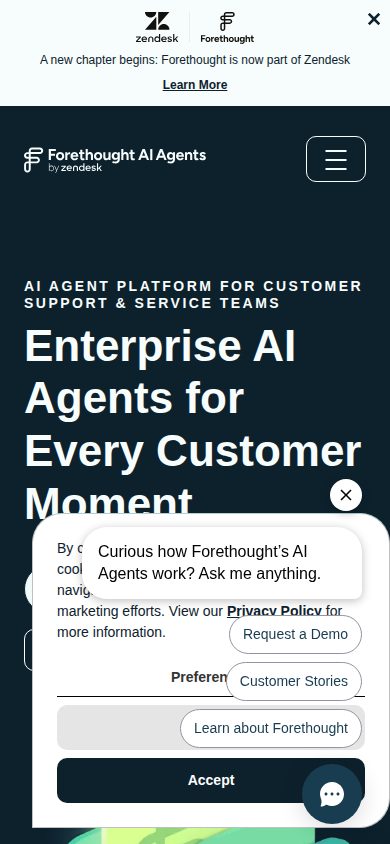
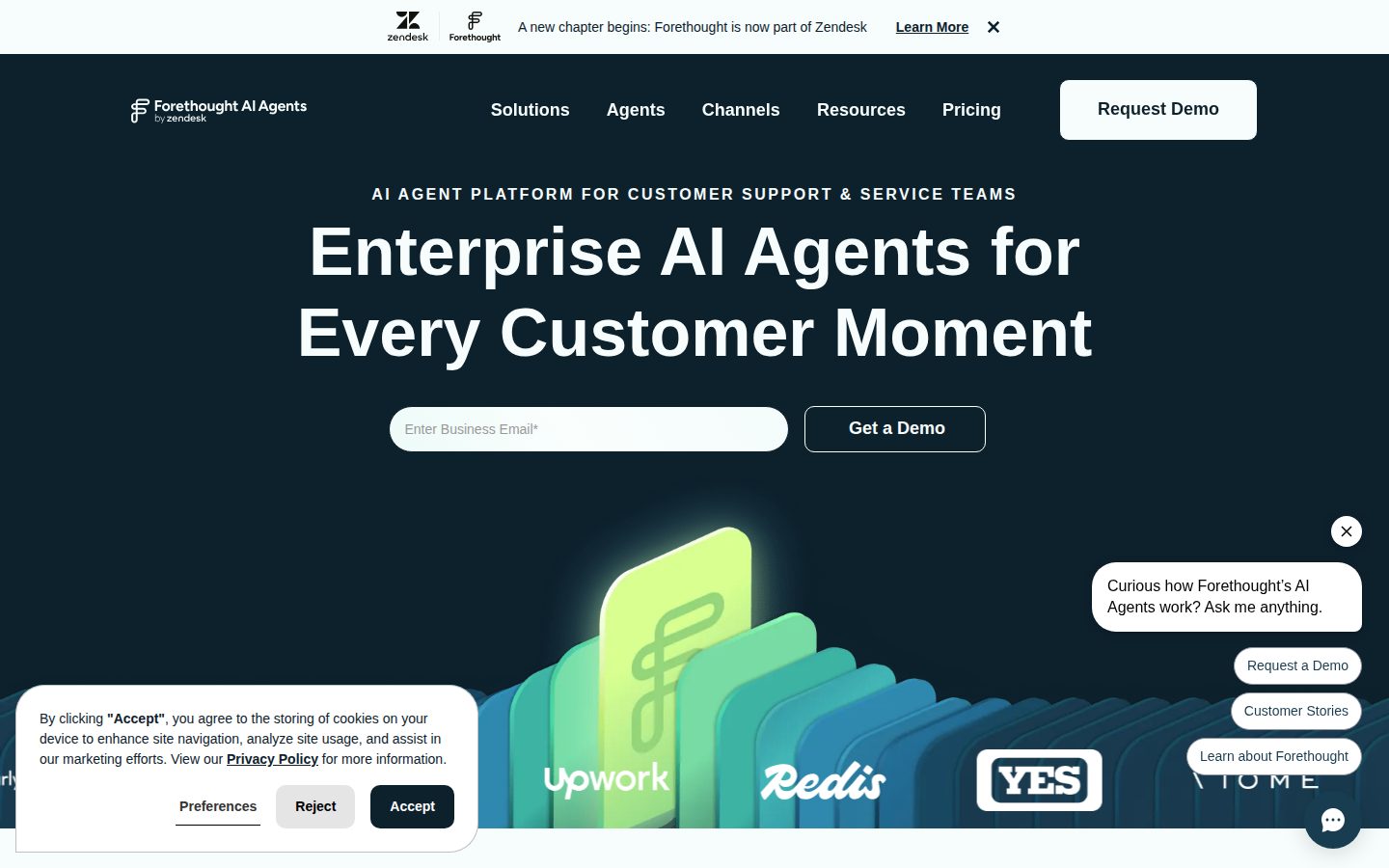
Forethought desktop previewForethought mobile preview

Pricing Plans

Contact Sales

Contact sales

Forethought does not publicly list pricing tiers or prices. All plans require contacting sales or requesting a demo for custom pricing.

  • AI Agent for omnichannel customer support (Solve)
  • Smarter ticket classification (Triage)
  • Knowledge gap detection (Discover)
  • Agentic AI copilot for human agents (Assist)
  • Enterprise integrations and security & compliance

AI Panel Reviews

The Decision Maker

The Decision Maker

Strategic bet, vendor viability, timing, adoption approval
7.2/10

Solid multi-agent architecture, now absorbed into Zendesk — evaluate accordingly.

Forethought built a genuinely differentiated four-agent platform covering resolve, triage, assist, and knowledge gap detection. Zendesk acquired them in March 2026, which changes the vendor calculus entirely.

The acquisition is the headline. Forethought was an independent AI-native support platform — now it's a Zendesk product line. That's not automatically bad, but your 36-month vendor risk conversation is now a Zendesk conversation, not a Forethought one. Two-day deployment claim and the Discover Agent's knowledge gap detection are genuinely useful differentiators versus Intercom or Freshdesk Freddy.

The four-agent architecture — Solve, Triage, Assist, Discover — is well-designed. Modular deployment means you're not forced to buy the whole stack. No public pricing is a real friction point; every deal goes through a demo cycle, which slows procurement and signals enterprise-only appetite.

Tradeoff worth naming: if you're already a Zendesk shop, this may land as a native upsell with real integration value. If you're on a competing helpdesk, the integration story gets murkier fast. That context determines whether this is a smart move or an expensive detour.

Competitive Positioning6.5

Differentiated pre-acquisition; post-acquisition, Zendesk AI is effectively the same bet with more integration risk for non-Zendesk shops.

Reputation Risk8.0

Zendesk backing makes this boardroom-safe; the AI-native origin story still reads as forward-leaning.

Speed to Value7.5

Two-day setup claim with ticket-history training is credible for a focused deflection use case if helpdesk integration is clean.

Strategic Fit7.0

Solve and Triage Agents automate resolution and routing, which advances CX capacity without just headcount reduction.

Vendor Viability7.5

Acquired by Zendesk in March 2026 — existential risk is low, but roadmap control now sits inside a larger org.

Pros

  • Four specialized agents deployable independently — buy what you actually need
  • Discover Agent's knowledge gap detection is a real operational differentiator
  • Omnichannel coverage including voice and Slack in one platform
  • Zendesk ownership removes startup runway risk

Cons

  • No public pricing — every deal requires a demo, which slows fast-moving procurement
  • Post-acquisition roadmap is now Zendesk's call, not a focused founding team's
  • Non-Zendesk helpdesk customers face unknown integration complexity

Right for

CX teams already on Zendesk who want native AI deflection without stitching together a separate vendor.

Avoid if

You're running a non-Zendesk helpdesk and want a vendor whose roadmap isn't subject to a larger platform's priorities.

The Domain Strategist

The Domain Strategist

Craft and strategy in the product's domain — adapts identity per category, same lens
8.1/10

Four specialized agents, one platform — Forethought is a serious enterprise CS bet now inside Zendesk.

Forethought's multi-agent architecture — Solve, Triage, Assist, Discover — covers the full support workflow from deflection to knowledge gap remediation. The March 2026 Zendesk acquisition changes the strategic calculus significantly.

The four-agent model is the right architectural instinct. Solve handles autonomous resolution, Triage owns routing logic, Assist runs the agent copilot layer, and Discover closes the feedback loop on knowledge gaps. That's a complete deflection-to-coaching workflow in one platform, which puts it ahead of point solutions like Freshdesk Freddy that bolt AI onto existing ticket flows without the same operational depth.

The Zendesk acquisition is the dominant fact in any 2026 evaluation. If you're already on Zendesk, Forethought's roadmap just got a native integration path and a larger engineering team behind it. If you're on Salesforce Agentforce or Intercom, you're now evaluating a competitor's subsidiary — that's a real procurement and roadmap-dependency concern worth surfacing in your business case.

No public pricing and no free trial means every deal runs through a sales cycle, which slows time-to-value for teams under budget pressure. Two-day setup claim is credible for Zendesk-native deployments post-acquisition, but verify channel scope — voice and Slack readiness vary by helpdesk config.

Category Positioning8.0

Sits above Freshdesk Freddy in architectural depth and competes directly with Zendesk AI and Intercom — now operating as Zendesk's AI agent layer, which is a durable position.

Domain Fit8.2

Omnichannel coverage across email, chat, voice, Slack, and in-app mobile matches how enterprise support orgs actually distribute interaction volume.

Integration Surface7.5

Integrations page exists but named connectors aren't enumerated in public evidence; Zendesk-native fit is now strong, third-party helpdesk fit needs verification.

Long-term Implications7.8

Zendesk acquisition means deep native integration ahead, but also roadmap dependency — teams not on Zendesk should model a potential platform migration.

Strategic Depth8.5

Four specialized named agents covering deflection, routing, live assist, and knowledge gap detection signals genuine CX workflow thinking, not feature-list AI.

Pros

  • Multi-agent architecture (Solve, Triage, Assist, Discover) covers the full support lifecycle without requiring separate vendors
  • Discover Agent's knowledge gap detection gives CS ops a proactive content improvement loop, not just reactive deflection
  • Zendesk acquisition (March 2026) creates a strong native integration path for the largest helpdesk install base
  • Two-day setup claim suggests lightweight onboarding overhead relative to enterprise AI tooling

Cons

  • No public pricing and no free trial forces every evaluation through a full sales cycle
  • Zendesk subsidiary status creates a real conflict for teams running Salesforce Agentforce or Intercom as their primary CRM or support platform
  • Named third-party integrations aren't publicly documented, making pre-sales stack compatibility checks harder
  • No changelog or API docs publicly visible, limiting technical due diligence before demo

Right for

Enterprise support teams on Zendesk who need a multi-channel AI deflection and agent assist layer with a fast deployment path.

Avoid if

Your support stack runs on Salesforce Service Cloud or Intercom and you're not planning a helpdesk migration in the next 18 months.

The Finance Lead

The Finance Lead

Money, total cost of ownership, contracts, procurement math
5.8/10

No public pricing, no free trial, now absorbed into Zendesk — budget blind going in.

Forethought lists zero pricing on its page. Acquired by Zendesk in March 2026, which reshapes the procurement math entirely.

No price. No tier. No per-seat, no per-resolution, no range. The pricing page exists; numbers don't. That's not modesty — that's a sales-gated contract, and procurement will eat 6-8 weeks just getting a quote. No free trial means no pilot data before commitment. Category norm for this tier is $2-5 per automated resolution or $30K-$80K annual contracts. Zendesk AI and Intercom both publish at least entry-level numbers.

The Zendesk acquisition in March 2026 is the dominant variable now. Existing Forethought contracts may roll into Zendesk commercial terms. New buyers negotiating directly with Zendesk inherit their renewal and bundling structure — typically 60-day auto-renewal windows and limited termination-for-convenience clauses. Year 3 TCO is genuinely unmodelable without a contract in hand.

Four named agents — Solve, Triage, Assist, Discover — suggest modular deployment, but modular often means modular pricing. The 2-day setup claim is notable. Still, zero public overage rate on resolution volume is the real procurement risk.

Billing & Procurement3.0

No trial, no self-serve, no published invoicing model — maximum procurement friction before dollar one is committed.

Contract Flexibility4.0

No public contract terms; Zendesk's standard commercial structure likely applies post-acquisition, typically unfavorable for mid-market buyers.

Pricing Transparency1.5

No published pricing whatsoever — not a range, not a tier, not an entry point.

ROI Clarity6.0

Discover Agent and Knowledge Base Gap Detection give measurable output signals, but deflection rate baselines require vendor-supplied data.

Total Cost of Ownership3.5

Zendesk acquisition and undisclosed modular agent pricing make 3-year TCO unmodelable from public evidence.

Pros

  • Four named specialized agents suggest real architectural depth
  • Omnichannel across 5 channels including voice and Slack
  • 2-day setup claim is specific and testable
  • Security and compliance documentation exists for enterprise procurement

Cons

  • Zero public pricing — full sales cycle required before any number surfaces
  • No free trial means no pre-commitment validation
  • Zendesk acquisition in March 2026 introduces contract and roadmap uncertainty
  • Modular agent structure likely means modular add-on billing

Right for

Enterprise CX teams already in the Zendesk ecosystem with procurement bandwidth for a full negotiated contract.

Avoid if

You need published pricing, a self-serve trial, or predictable year-3 costs before signing.

The Domain Practitioner

The Domain Practitioner

Daily hands-on reality in the product's domain — adapts identity per category, same lens
7.8/10

Four-agent architecture handles the whole queue — Zendesk acquisition changes everything

Forethought's Solve, Triage, Assist, and Discover agents cover the full support workflow without forcing you to stitch together separate tools. The March 2026 Zendesk acquisition is the biggest unknown — platform direction, pricing, and roadmap all shift under you.

Two days to deploy is the claim, and the architecture supports it — Solve Agent learning from past tickets means you're not hand-labeling training data on day one. That's a real difference from Zendesk AI's own setup, which typically needs manual intent mapping before deflection does anything useful. Triage auto-classification with custom models means routing logic lives in the platform, not in a Zendesk trigger chain you have to maintain separately.

The Discover Agent is the sleeper feature. Most queues have the same 15 unanswered topics generating 40% of tickets. Surfacing those gaps automatically, with article recommendations, is work that currently lives in a spreadsheet someone updates quarterly. Daily friction reduction for content managers and support ops both.

No public pricing is the honest blocker. No free trial, no sandbox. You're committing to a demo cycle before you know if the budget conversation is even worth having. Post-acquisition, that opacity probably gets worse before it gets better. Intercom at least shows you a number before you talk to sales.

Day-3 Reality7.5

Two-day setup claim plus ticket-learning onboarding suggests low cold-start friction, but no changelog or sandbox means you can't verify behavior changes after updates.

Documentation Practitioner-Fit5.5

Docs flagged as unavailable in scraped evidence — for a platform where agents make autonomous routing decisions, no practitioner-facing reference docs is a real gap.

Friction Surface7.0

No public docs (docs=N in evidence) means every edge case becomes a support ticket to Forethought itself, which is a weekly tax on any power user.

Power-User Depth8.0

Custom triage models, Discover's knowledge gap recommendations, and independently deployable agent components give ops-minded users real configuration depth beyond out-of-box defaults.

Workflow Integration8.2

Omnichannel coverage across email, chat, voice, Slack, and in-app mobile maps directly to how modern support queues actually arrive — no channel gaps forcing manual fallback.

Pros

  • Solve + Triage + Assist + Discover cover deflection, routing, and copilot in one platform — no stitching
  • Two-day setup with ticket-history learning cuts the cold-start problem most AI support tools have
  • Discover Agent surfaces knowledge base gaps automatically — replaces a manual quarterly audit
  • Slack AI support handles internal IT queues, not just customer-facing channels

Cons

  • No public pricing, no free trial — full demo cycle before you know budget fit
  • No public docs means advanced configuration is undiscoverable without vendor hand-holding
  • March 2026 Zendesk acquisition introduces platform and roadmap uncertainty for anyone buying now
  • No changelog means you can't track what the agents are doing differently week over week

Right for

Mid-market to enterprise support teams already on a helpdesk stack who need omnichannel deflection and triage without building custom AI workflows.

Avoid if

You need transparent pricing or a self-serve trial before committing to a sales process.

The Power User

The Power User

Daily human experience, onboarding, polish, learning curve, reliability
7.6/10

Four specialized agents, zero public pricing — solid product, opaque buy.

Forethought's multi-agent architecture is genuinely well-thought-out for enterprise support teams. Acquired by Zendesk in March 2026, which changes the calculus depending on your stack.

The four-agent setup — Solve, Triage, Assist, Discover — isn't marketing fluff. That's a real structural choice that says someone actually mapped what support teams do all day and built separate tools for each mode. The Discover Agent doing knowledge gap detection in real time is the sleeper feature here. Most tools in this category, including Freshdesk Freddy, don't surface that kind of signal at all.

The two-day setup claim is either inspiring or suspicious, depending on how messy your helpdesk data is. No free trial, no pricing page that means anything, no changelog visible. That's not unusual for enterprise AI, but it does mean you're flying blind until a sales call.

The Zendesk acquisition in March 2026 is the real asterisk. If you're already on Zendesk, this probably gets better and more integrated. If you're not, you might be buying into someone else's roadmap.

Daily Polish7.2

No changelog and no docs page visible suggests the daily-feel details aren't being communicated publicly, though the four named agents show structural care.

Learning Curve7.4

Modular agents that can be deployed independently is the right call — teams can start with Solve and add Triage later rather than swallowing the whole platform at once.

Mobile Parity7.0

In-app mobile chat support is a named feature, which puts it ahead of tools that treat mobile as read-only, though depth beyond that isn't confirmed.

Onboarding Experience7.5

Two-day setup claim backed by ticket-learning from day one is promising, but no free trial means you can't verify that before committing.

Reliability Feel7.8

Enterprise security docs, Data Processing Addendum, and subprocessors list suggest someone has taken infrastructure seriously for procurement-grade buyers.

Pros

  • Four distinct agents map to real support team workflows, not just one chatbot doing everything
  • Discover Agent surfaces knowledge gaps in real time — genuinely useful, not a checkbox feature
  • Omnichannel including voice and Slack is broader than most competitors at this tier
  • Enterprise compliance documentation is actually there for procurement reviews

Cons

  • No public pricing — every evaluation starts with a sales call
  • No free trial means you can't validate the two-day setup claim before signing
  • Zendesk acquisition in March 2026 introduces roadmap uncertainty for non-Zendesk shops
  • No changelog visible, so tracking what's improved over time requires a vendor relationship

Right for

Mid-to-large support teams already running Zendesk or evaluating omnichannel AI deflection across email, chat, and voice.

Avoid if

You need transparent pricing upfront or a free trial before committing to an enterprise AI platform.

The Skeptic

The Skeptic

Contrarian. Watch-outs, deal-breakers, broken promises, category patterns
6.8/10

Acquired by Zendesk in March 2026 — that changes everything about this bet.

Forethought's multi-agent architecture (Solve, Triage, Assist, Discover) is genuinely differentiated. But the Zendesk acquisition flips the viability question from 'will they survive' to 'will they survive as a product.'

The Zendesk acquisition in March 2026 is the only fact that matters right now. Could be a lifeline — distribution, enterprise contracts, engineering resources. Could be the slow suffocation we've watched happen to a dozen acquired CX tools. Freshdesk Freddy absorbed acquisitions quietly. So did Salesforce. Independent product roadmaps rarely survive intact.

The four-agent architecture is the real asset here. Solve, Triage, Assist, Discover — that's actually coherent segmentation, not one agent wearing four hats. The Discover Agent doing knowledge gap detection is the most defensible feature I see. Two-day setup claim is either refreshingly honest or the kind of number that ages poorly under enterprise complexity.

No pricing, no changelog, no API docs visible. Three yellow flags for a platform targeting enterprise procurement. Exit portability is murky — if Zendesk folds this into their native AI layer, migration gets messy fast.

Competitive Differentiation7.5

The Discover Agent's knowledge gap detection is a concrete differentiator vs. Zendesk AI and Intercom, neither of which surfaces documentation gaps as a named standalone agent.

Exit Portability5.5

No public API documentation visible, and post-acquisition roadmap is unknown — migrating off a Zendesk-integrated platform mid-consolidation is historically painful.

Long-term Viability6.0

Acquisition by Zendesk in March 2026 resolves the funding question but introduces product-survival risk; no changelog visible to confirm continued independent development.

Marketing Honesty6.5

'Enterprise AI Agents for Every Customer Moment' is superlative-forward; the two-day setup claim is specific but unverifiable without public case studies or changelog evidence.

Track Record Match7.0

Multi-agent CX platforms that survive acquisition typically have strong integration hooks — Forethought's omnichannel breadth matches that pattern, but no public shipping cadence to confirm momentum.

Pros

  • Four named, genuinely distinct agents — not one feature split into marketing bullets
  • Discover Agent's knowledge gap detection is uncommon at this specificity vs. Intercom or Freshdesk Freddy
  • Documented security compliance and DPA signals real enterprise procurement readiness
  • Omnichannel coverage including voice and Slack is broader than most point solutions

Cons

  • Zendesk acquisition means independent roadmap is uncertain — maybe six months of clarity, then drift
  • No public pricing, no free trial, no API docs visible — enterprise procurement friction is high
  • No changelog found; can't verify shipping cadence or whether active development continues post-acquisition
  • Exit portability is low if Zendesk absorbs the agent layer into their native product

Right for

Enterprise CX teams already evaluating or using Zendesk who want a structured multi-agent layer now, before Zendesk native AI matures.

Avoid if

You need a vendor-independent AI support layer with a clean exit path and predictable standalone roadmap.

Buyer Questions

Common questions answered by our AI research team

Features

What channels does Forethought support for AI customer service?

Forethought supports chat, email, voice, and Slack for AI customer service, all managed through a single omnichannel platform.

Setup

How long does Forethought take to set up?

Forethought is designed to be installed in two days, with AI agents learning from past tickets and help center content to deliver accurate support from day one.

Integration

Does Forethought integrate with existing helpdesk platforms?

Yes, Forethought integrates with leading helpdesk platforms to empower customer service teams, lower costs, and improve key support metrics.

Features

Can Forethought automatically classify and route incoming tickets?

Yes, Forethought automatically classifies and routes tickets using pre-built or custom models to add context, prioritize cases, tag tickets, and direct them to the best-qualified agent before a human even touches the ticket.

Features

Does Forethought detect gaps in your knowledge base?

Yes, Forethought detects knowledge gaps across all support interactions and provides actionable recommendations to generate articles and optimize AI workflows.

Product Information

Platforms

web

About Forethought Technologies, Inc.

Forethought is a San Francisco-based AI platform for enterprise customer support, offering multi-agent automation across chat, email, voice, and SMS. It was acquired by Zendesk in March 2026.

Resources

Blog

Also in AI Customer Support