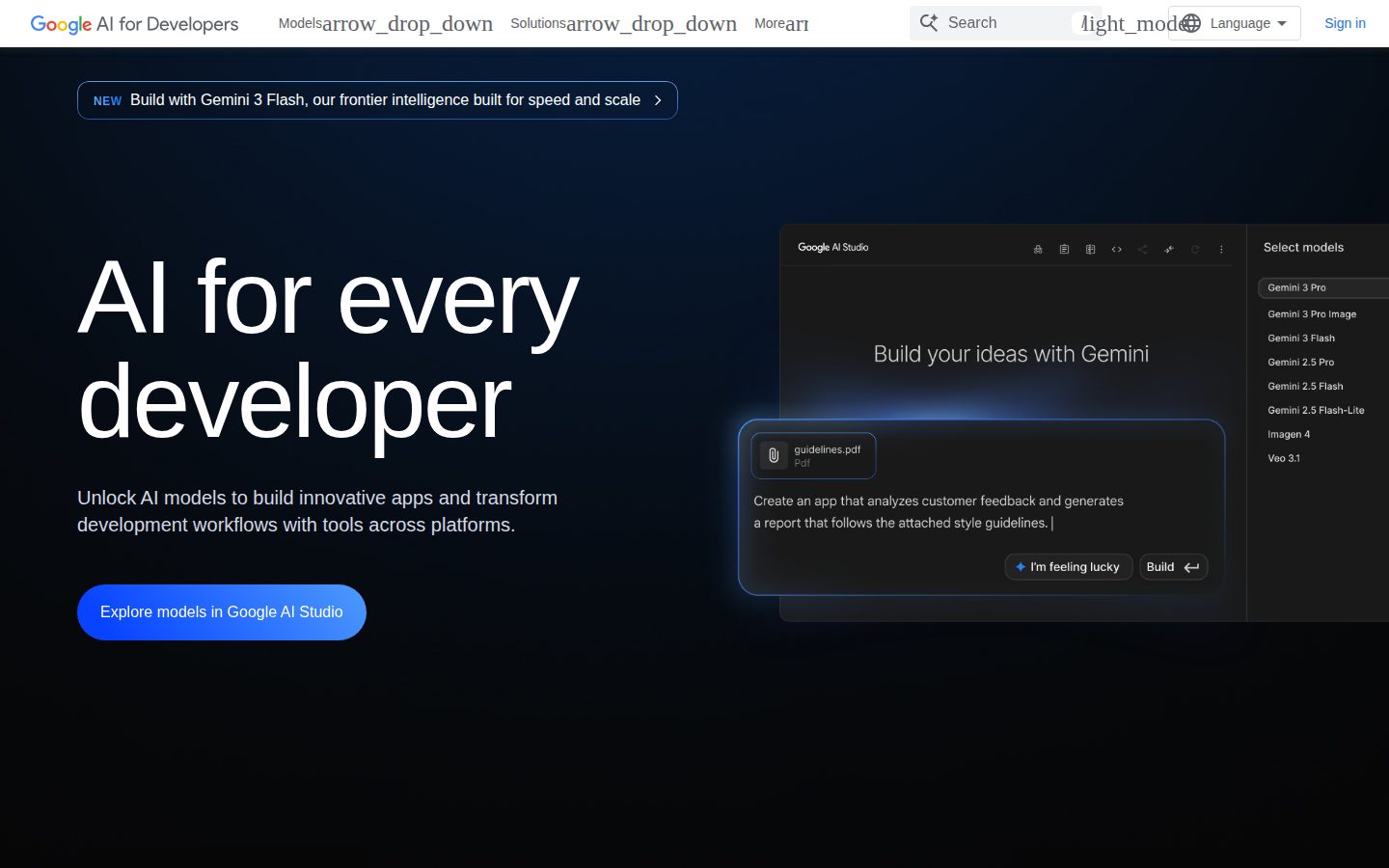
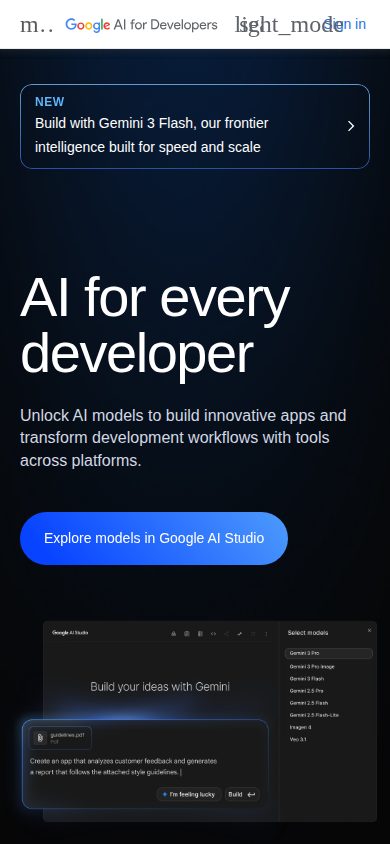
Google's AI platform providing access to Gemini language models via API
Google Gemini API is a developer platform that provides programmatic access to Google's Gemini AI models.
AI Panel Score
6 AI reviews
Reviewed
Google Gemini API is a developer platform that provides programmatic access to Google's family of Gemini large language models. The API enables developers to integrate advanced AI capabilities into their applications, websites, and services through standard REST API calls.
The platform supports various Gemini model variants, including text-only and multimodal models that can process text, images, and other input types. Developers can use the API for tasks such as text generation, content creation, question answering, code generation, and analysis of multimodal content. The API includes features like safety filters, adjustable model parameters, and structured output formatting.
The service is designed for developers, software companies, and organizations looking to incorporate AI functionality into their products. It competes with other AI API providers like OpenAI, Anthropic, and Microsoft Azure AI services in the growing market for AI-as-a-service platforms.
Google provides the API through its AI development platform with comprehensive documentation, code examples, and integration guides. The service follows a usage-based pricing model where developers pay based on the number of API calls and tokens processed.
Efficient bulk request handling for non-real-time workloads.
Build agentic workflows by connecting Gemini to external APIs and tools.
Processes up to 1,000-page PDFs with full multimodal comprehension.
Generate and edit highly contextual images natively with Gemini (Nano Banana model).
Real-time voice agent applications with low-latency interactions.
Inputs millions of tokens and derives understanding from unstructured images, videos, and documents.
Processes and analyzes images, videos, documents, and audio alongside text.
Generates human-like text responses from natural language prompts.
Creates video content from text or image inputs using Veo models.
Connects to Google Search, Maps, Code Execution, and Computer Use capabilities.
Constrains API responses to JSON or other defined data formats for automated processing.
For developers and small projects getting started with the Gemini API — no credit card required
For production applications requiring higher volumes and advanced features — usage-based pricing billed per 1M tokens
For large-scale deployments with custom needs for security, support, and compliance — powered by Vertex AI
Google Gemini API is the safest AI vendor bet, with the only real risk being platform lock-in.
“Google's viability removes the question a board usually stalls on. The catch is that deep usage quietly raises the cost of ever leaving Google Cloud.”
A board does not lose sleep over Google as a vendor. The Gemini API runs on the same infrastructure as Search and Cloud, and Google has shipped AI products for over a decade. Viability is the one question you can skip here.
The real call is whether this advances us or just swaps one model provider for another. Gemini's native multimodal range is wider than most rivals: the Live API handles real-time voice agents, and Nano Banana does conversational image editing inside the same API. Document Understanding parses 1,000-page PDFs without a separate pipeline. OpenAI matches the text quality, but Google bundles more input types under one key.
Pricing is usage-based and aggressive: Gemini 2.5 Flash runs $0.30 per million input tokens and $2.50 output. The catch is platform pull. Once prompts, caching, and grounding sit inside Google Cloud, switching costs climb quietly. Pilot two workloads for 60 days, confirm the per-call math, then commit.
Gemini sits alongside OpenAI and Anthropic as a default choice, with wider input-type coverage.
Choosing Google as an AI vendor reads as obvious and defensible to any board or peer.
Standard REST calls, a free tier, and aggressive usage-based pricing make integration fast and low-commitment.
Native multimodal breadth across Live API, Nano Banana, and 1,000-page document parsing advances more than cost-saving.
Google has shipped AI products for over a decade and runs the API on the same infrastructure as Search.
Teams who want broad multimodal AI from a vendor a board will never question.
Teams who need provider neutrality and want to avoid Google Cloud lock-in.
Gemini API bets on one model ladder and a Vertex AI graduation path, and both calls are sound.
“Gemini exposes a tiered model family behind a single REST surface, with a clear lift into Vertex AI for enterprise. The architecture scales, but a preview-heavy roster keeps the production contract moving under you.”
A platform CTO scoping an LLM provider through 2029 should read the model ladder first. Gemini exposes one REST surface spanning Flash-Lite, Flash, and Pro tiers, so you tune cost against capability per route without rewriting the integration. Gemini 2.5 Flash sits at $0.30 input per 1M tokens, and Long Context Processing scales past a million tokens on the same call.
The craft ceiling is real. Function Calling and Structured Outputs make agentic routing a primitive rather than a glued-on parser, and the Vertex AI tier is a genuine graduation path into Google Cloud IAM and compliance SLAs. Against OpenAI, the edge is multimodal breadth, with Veo for video and the Nano Banana image model under one key.
But the catch is roster churn. Gemini 3 Flash and 3 Pro ship as Preview tiers, so production systems track deprecations Google sets, not you — a standing migration tax on the dependency.
Backed by Google Cloud with Veo and Nano Banana, Gemini sits among the top three LLM API providers.
One REST surface for text, multimodal, and agentic routing matches how platform teams actually build.
Standard REST plus Built-in Tool Integration into Google Search, Maps, and Code Execution slots cleanly into a stack.
The Vertex AI path is durable, but Preview-tier models impose an ongoing deprecation-tracking cost.
A tiered model family with Function Calling and 1M-token Long Context Processing is best-in-class craft.
Platform teams who want one API spanning cost-tiered text, multimodal, and agentic workloads.
Teams who need a frozen model contract with long deprecation guarantees.
Gemini 2.5 Flash bills $0.30 input and $2.50 output per 1M tokens, with no seat cost.
“The Gemini API charges by tokens, not seats, and every developer rate is published. The real budget risk is the 8x output-to-input asymmetry, not the sticker.”
No seats, no minimum, no sales call for the developer tier. The docs indicate Gemini 2.5 Flash runs $0.30 per 1M input tokens and $2.50 per 1M output. Free Tier needs no credit card. Procurement won't fight this one.
The budget risk is the asymmetry. Output costs roughly 8x input, so a chatty agent reprices fast. The catch is the two billing paths: the Developer API and Vertex AI quote separately, and the docs say enterprise rates differ. Batch Processing API cuts both rates 50% on a 24-hour window, and Context Caching saves up to 90% on repeated input. Model those before forecasting.
ROI is legible. Token counts are metered per call, so cost-per-feature is measurable, not hand-wavy. Compare OpenAI's GPT-4o-mini, priced lower on output. Gemini's long-context window is the offsetting bet.
Free Tier needs no credit card, but Vertex AI splits into a separate Google Cloud billing path.
Pay-as-you-go with prepay or postpay options and no term lock for the Developer API.
Every developer-tier token rate is published per 1M tokens with no sales call required.
Per-call token metering makes cost-per-feature directly measurable.
The 8x output-to-input ratio makes year-3 cost volume-dependent and hard to cap.
Developers who want usage-based AI with no seat licenses.
Teams who need fixed, predictable monthly billing.
The Gemini API handles real multimodal work well, but model churn complicates production pinning.
“Structured Outputs and runnable docs make day-to-day integration smooth. But preview models shift under you and the strongest tier is paid-only.”
An engineer judges an AI API by the 2 a.m. incident where a malformed prompt returns garbage, not the demo. The Gemini API surfaces that case decently. Structured Outputs constrains responses to a JSON schema, so parsing logic stops guessing, and the docs ship runnable curl plus SDK snippets that match the actual response shape.
Workflow fit is real for multimodal work. Long Context Processing accepts millions of tokens, and Document Understanding chews through 1,000-page PDFs without a chunking pipeline you would otherwise hand-roll. Context caching cuts repeated input tokens by up to 90%, which matters once a RAG prompt stops being a toy.
The catch is the model churn. Gemini 3.1 Pro is paid-only with no free tier, and preview models like Gemini 3 Flash Preview shift under you. OpenAI's API versioning feels steadier for production pinning.
Structured Outputs and JSON-schema constraints make response parsing predictable past the demo glow.
Docs ship runnable curl and code examples that match the actual response shape.
Preview-model churn and Flash-only free tier add recurring friction across a working week.
Context caching, Function Calling, and million-token context scale cleanly from beginner to advanced.
Standard REST plus SDK snippets drop into existing apps without new habits or tooling.
Engineers who build multimodal or long-context features into production apps.
Engineers who need a frozen model version that never changes underneath them.
Gemini gives you text, image, video, and voice behind one key, with a generous free door.
“A developer API where one key reaches text, image, video, voice, and 1,000-page document parsing. The catch is that Pro models left the free tier in April 2026.”
Most AI APIs hand you a text box and a key and call it a day. Gemini gives you the whole pantry. One key reaches text, the Nano Banana image model, Veo video, and a Live API for real-time voice, plus document parsing that swallows a 1,000-page PDF. For a developer shipping more than a chatbot, that breadth saves real glue code.
The daily feel leans generous. Google AI Studio lets you experiment free, no credit card, and Flash-Lite starts at $0.10 per million input tokens, which is hard to argue with. OpenAI matches it on raw capability but rarely on price at the low end. Context caching quietly trims up to 90% off repeated input.
The catch arrived April 2026: Pro models left the free tier, so anything past Flash now means billing setup. And the lineup changes fast enough that pinning a version is its own small chore.
Structured Outputs and context caching show a team that sweated the things developers touch every day.
Function Calling and the multi-model lineup reward exploration, but the fast-changing model list adds churn by month three.
Mobile is not a use case for a developer API, so this scores neutral by calibration.
Google AI Studio gives a free, no-credit-card sandbox, so the first ten minutes feel like welcome.
Safety filters, adjustable parameters, and a Batch API with a 24-hour window signal solid production behavior.
Developers who want text, image, video, and voice from one API key.
Developers who need a stable model version that will not shift under them.
A serious model API backed by Google, but the version churn is the real cost.
“The Gemini API has Google's infrastructure and a usage-based floor of $0 to start. The catch is a deprecation cadence that retires models faster than most teams want to re-test.”
No funding question here. Google funds this. The graveyard worry isn't the company — it's the model lineup.
Gemini 1.0 and 1.5 are already gone, returning 404s. Gemini 2.5 Flash and 2.5 Pro are flagged for June 2026 retirement. That's the pattern to watch: pin a model in production and you're re-testing prompts every cycle. The product itself is strong. Long Context Processing handles millions of tokens, Function Calling covers agentic work, and Gemini 3 Pro Preview runs $2.00 input per 1M tokens — competitive against OpenAI's GPT line. But "Preview" labels on the newest models mean today's pricing isn't a promise.
Exit is reasonable. REST calls and Structured Outputs port to other providers with prompt rework, not a rewrite. The yellow flag is lock-in through Vertex AI if you lean on built-in Google Search grounding.
Long context and native multimodal are real edges versus OpenAI and Anthropic, not copycat features.
Standard REST and Structured Outputs port elsewhere, but Google Search grounding and Vertex AI create stickiness.
Google funding and a frontier model roadmap make this a safe three-year bet on the company itself.
Docs are concrete on pricing and limits, though "Preview" labels on flagship models hedge the real commitment.
Google has shipped AI infrastructure for years, but the rapid Gemini 1.0 and 1.5 shutdowns match a churn pattern.
Developers who want frontier multimodal models on Google infrastructure.
Teams who need a pinned model version stable for years.
Common questions answered by our AI research team
Yes, the Gemini API supports multimodal input processing, enabling applications to handle more than just text.
Yes, the Gemini API works via REST API calls, making it compatible with existing REST-based applications.