Open-source LLM observability for usage, cost, and latency monitoring
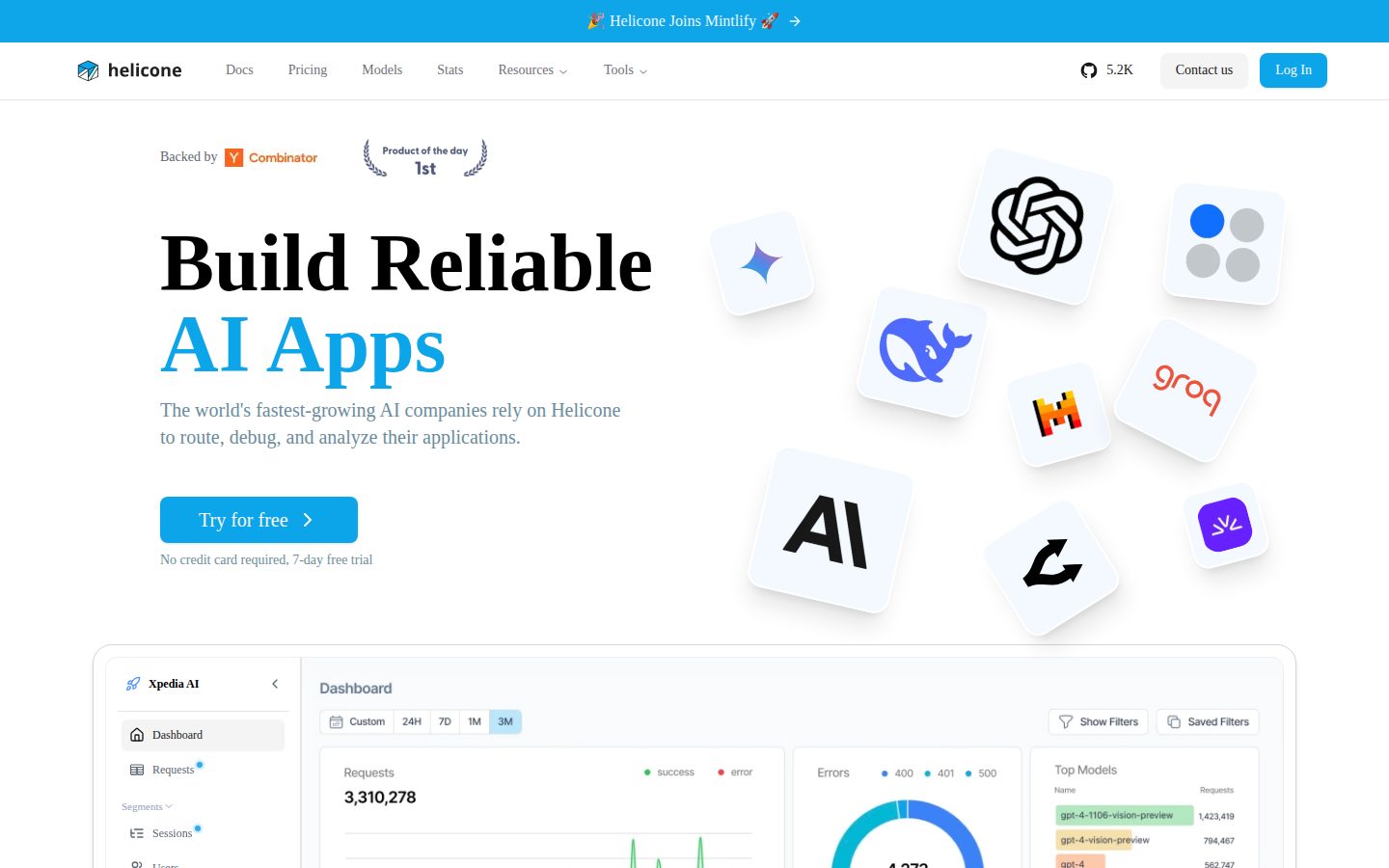
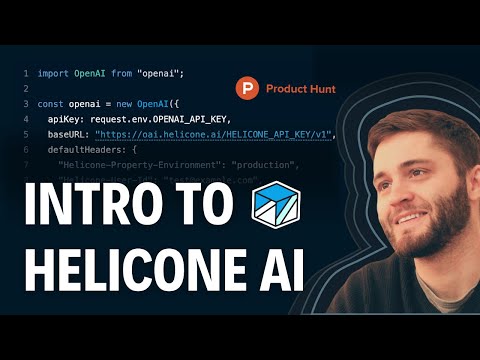
Helicone is an open-source observability platform for developers building and operating applications on large language models.
AI Panel Score
6 AI reviews
Reviewed
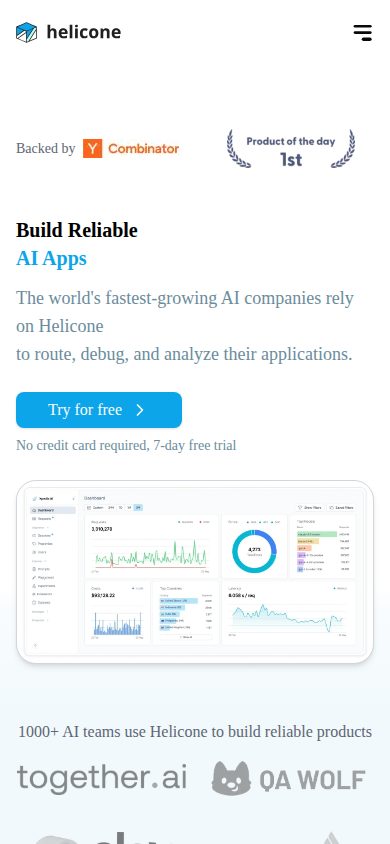
AI Editor ApprovedApproved and published by our AI Editor-in-Chief after full panel analysis.Developers integrate Helicone by routing their LLM API calls through Helicone's gateway, typically requiring only a one-line change to the base URL in existing code. From there, every request is logged and surfaced in a dashboard where users can view spend breakdowns by model, track latency over time, and inspect individual requests for debugging. Custom properties can be attached to requests to segment analytics by user, session, feature, or any other dimension meaningful to the team.
Beyond passive monitoring, Helicone includes features designed to reduce costs and improve performance. Request caching stores responses to repeated prompts to avoid redundant API calls. Model-swapping allows teams to redirect traffic between providers or model versions without redeploying. The platform integrates with popular AI frameworks and supports authentication via header-based tokens, making it compatible with most existing LLM workflows.
Helicone targets software developers and AI engineering teams who use models like GPT-4, Claude, or other hosted LLMs at scale and need visibility into operational costs and reliability. The product is open-source and can be self-hosted on your own infrastructure, or used as a managed cloud service. Competitors in the LLM observability category include Portkey, LangSmith, and Weights & Biases.
The open-source codebase is available on GitHub, enabling self-hosted deployments for teams with data residency or compliance requirements. Cloud and self-hosted configurations both support the same core feature set, with documentation covering quick-start setup, gateway integration, and advanced custom property tracking.

Allows developers to define and track custom metrics and properties for detailed analytics on LLM usage.
Tracks response times and performance metrics for AI model requests to identify bottlenecks.
Monitors and tracks spending and usage patterns across multiple AI models including GPT-3 and other LLMs.
Enables switching between AI model providers without requiring changes to the core application code.
Offers full source code access via a public GitHub repository, enabling community contributions and custom modifications.
Caches AI model requests to reduce redundant calls and lower API costs without changing core application logic.
Provides compatibility with popular AI frameworks and platforms to embed observability into existing workflows.
Acts as a proxy layer between the application and AI model providers to capture all request and response data.
Authenticates requests passing through the Helicone proxy using dedicated Helicone headers.
Supports deploying Helicone on your own infrastructure for organizations that require data sovereignty.
Kickstart your AI project.
For growing teams.
For scaling companies.
Custom-built packages for large organizations.
One-line integration, real cost visibility — a clean bet for LLM-heavy teams.
“Helicone routes LLM traffic through a proxy and surfaces cost, latency, and usage data with almost no integration lift. At $79/month for the Pro tier, it's a credible operational tool for teams spending real money on model APIs.”
The changelog shows active shipping. Open-source codebase on GitHub plus a managed cloud option means teams with compliance requirements aren't boxed out, and the self-hosted path is documented. No public funding data, but the meta describes them as powering the fastest-growing AI companies — that's a claim worth pressure-testing at renewal. LangSmith and Portkey are credible alternatives, so you're not betting on a monopoly here.
The one-line base URL change to get gateway integration running is real leverage. Request caching and model-swapping without redeployment are the two features that move this past passive logging into something operationally useful. That's the actual value prop — not dashboards, but fewer redundant API calls and faster provider switches.
Two things give me pause. One: Pro at $79/month adds usage-based pricing on top, and the pricing page doesn't define the overage math clearly. Two: 7-day data retention on the free tier and 1-month on Pro is thin for trend analysis. Team tier at $799/month jumps hard.
LangSmith owns the LangChain ecosystem and Portkey competes on routing features, but Helicone's self-hosted option is a real differentiator for regulated teams.
Open-source, self-hostable, and listed alongside LangSmith and Portkey — neutral to positive in any engineering conversation.
Gateway integration requires one base URL change; cost and latency dashboards surface immediately — payback is measurable within days.
Model-swapping and request caching actively reduce operating costs on LLM workloads — this advances teams, not just monitors them.
Active changelog and open-source fallback reduce lock-in risk, but no public funding data makes the 36-month bet harder to confirm.
AI engineering teams spending $10K+ monthly on model APIs who need immediate cost visibility and faster provider switching.
Your LLM usage is light or your data residency requirements demand contractual guarantees you can't get below the Enterprise tier.
Proxy-first LLM observability with real operational leverage, not just dashboards.
“Helicone's gateway architecture captures cost, latency, and usage data at the network layer — no SDK sprawl, no instrumentation debt. The open-source core plus self-hosted option makes this a serious contender for teams with compliance constraints.”
One-line base URL change for full request capture. That's the right integration philosophy — low coupling, high visibility. The gateway pattern means Helicone owns the observability plane without touching your application logic, which is architecturally clean. Request caching and model-swapping at the proxy layer are genuine force multipliers, not dashboard features.
The pricing tier structure tells you who they're building for. Hobby caps at 10,000 requests/month and 7-day retention — fine for prototyping. Pro at $79/month unlocks HQL and alerts but adds usage-based pricing, which creates cost unpredictability at scale. Team at $799 gets SOC-2, HIPAA, and 15,000 logs/min ingestion — that's where serious production workloads live. LangSmith competes here but stays closer to LangChain's ecosystem; Helicone is provider-agnostic by design.
If we adopt this, in 3 years our observability posture is shaped by Helicone's query model and retention limits. The open-source codebase hedges lock-in risk meaningfully — self-hosted Enterprise deployment exits the vendor dependency entirely. The tradeoff: you're betting the proxy layer stays performant as request volume scales.
Provider-agnostic where LangSmith isn't, more operationally focused than Weights & Biases — occupies a defensible middle position.
Provider-agnostic proxy with custom property tracking matches how AI engineering teams actually segment and debug production LLM traffic.
AI framework integrations and header-based auth mean low onboarding friction across GPT-4, Claude, and other hosted model stacks.
Open-source self-hosted path limits lock-in, but HQL adoption and custom property schemas create migration friction over time.
Gateway-layer architecture with model-swapping and caching built in shows systems thinking beyond passive logging.
AI engineering teams running multi-provider LLM workloads who need production-grade cost visibility without application-layer instrumentation.
Your compliance posture requires zero third-party network intermediaries and you won't operationalize a self-hosted deployment.
$79/month proxy layer with real caching ROI — usage-based overage is the unknown.
“Four tiers published, no sales call required. The 'usage-based pricing applies' footnote on Pro is the only number missing.”
$0 Hobby tier caps at 10,000 requests/month, 7-day retention, 1 seat. Functional for prototyping. Pro is $79/month flat — then usage-based pricing kicks in. No published overage rate. That's the invoice risk, not the sticker.
50 engineers won't all hit Helicone directly, but model costs will. 50-seat team on Pro: $79 × 12 = $948/year base. Add realistic overage on high-volume LLM traffic and year 3 could triple that estimate. Request caching is the offsetting lever — repeated prompts don't hit the provider API. Measurable ROI if your workload has prompt repetition. Compare to LangSmith, which bundles tracing into LangChain but lacks Helicone's model-swapping and gateway proxy architecture.
Team tier jumps to $799/month — $9,588/year — for SOC-2, HIPAA, and 15,000 logs/min. That's a 10x jump from Pro. Self-hosted deployment exists for data residency teams, but ops overhead is real. No published auto-renewal window in the evidence. Procurement should ask before signing annual.
Four published tiers, freemium entry point, no sales call required — procurement friction is low until Enterprise.
No public auto-renewal window or termination-for-convenience terms found in the evidence.
Three tiers fully published with limits; Pro's 'usage-based pricing applies' is unquantified, which is a gap.
Request caching and cost tracking per model provide direct, measurable savings — ROI story isn't hand-wavy here.
Base Pro cost is $948/year but unpublished overage rates make 3-year TCO modeling speculative for high-volume teams.
AI engineering teams at growth-stage companies who need proxy-layer cost visibility and can tolerate an unpublished overage rate.
You run high, variable LLM request volume and need a predictable monthly invoice before committing.
One-line proxy integration, real observability — engineers will actually keep it running
“Helicone routes LLM calls through a gateway with a single base URL change, capturing cost, latency, and request data without touching application logic. The open-source codebase and self-hosted option make it a serious option for teams with compliance requirements.”
The integration story is unusually honest. One base URL change, and every GPT-4 or Claude request is logged, costed, and inspectable. No SDK rewrap, no decorator pattern, no framework lock-in. Request caching and model-swapping both operate at the proxy layer — which means no redeployment cycle when you're testing a cheaper model against production traffic. That's the kind of architectural decision that saves hours, not minutes.
The Hobby tier's 10-minute ingestion cap and 7-day retention will hit a wall fast on any real workload. Pro at $79/month unlocks HQL — their query language — plus alerts, which is where the actual debugging workflow lives. Compared to LangSmith, the proxy-first approach means less instrumentation debt. The tradeoff: you're dependent on a gateway in your hot path, so latency overhead and gateway uptime become your problem too.
Docs ship with quick-start and custom property tracking coverage. The changelog exists — good sign that this isn't abandonware. Power users will want to know how HQL composes against high-cardinality custom properties at scale; the public evidence doesn't fully answer that.
Single base URL change lowers day-3 abandonment risk significantly; 10,000 requests/month Hobby cap will force an upgrade conversation sooner than teams expect.
Changelog and quick-start docs are present; custom property tracking is explicitly covered, suggesting docs are written for engineers not marketers.
Gateway-in-hot-path adds an operational dependency; authentication via Helicone headers is non-standard and requires header management discipline across environments.
HQL on the Pro tier at $79/month is the real power surface, but how it performs against high-cardinality custom properties at scale isn't publicly documented.
Proxy-layer architecture means zero changes to application logic for caching and model-swapping — fits existing LLM workflows without new habits.
AI engineering teams running GPT-4 or Claude at scale who need cost visibility and model-switching without touching application code.
Your architecture can't tolerate a proxy dependency in the critical path or your team needs deep trace-level instrumentation that LangSmith's SDK approach provides.
One URL change, full LLM visibility — this one earns its $79
“Helicone slots into your existing LLM workflow with almost no friction and surfaces real operational data fast. The free tier is genuinely useful; the Pro tier is priced like a tool someone actually thought about.”
The pitch is honest: change one line of code, route through the gateway, and every request is logged. Cost breakdowns by model, latency over time, individual request inspection — all of it shows up without you having to build anything. Custom property tracking lets you slice data by user or feature, which is the thing you actually want three months in when your bill is climbing and you can't tell why.
Request caching and model-swapping without redeployment are the features that separate this from passive logging. LangSmith gives you tracing; Helicone gives you levers. The 10,000 free requests on Hobby is a real free tier, not a teaser. Pro at $79/month is fair for growing teams. The jump to Team at $799 is steep.
The web-only platform is a real gap if you're on-call and want to check a spike from your phone. Not a dealbreaker for a dev tool, but worth knowing. Day three, you'll have strong opinions about the dashboard. They're mostly good ones.
Changelog is active and docs indicate thoughtful custom property tracking, but web-only delivery limits how polished the daily experience can feel across contexts.
Basic monitoring is immediate; HQL query language and custom property segmentation add depth that scales well into month three without blocking early progress.
Web-only platform with no mobile app listed — for an observability tool you might need during an incident, that's a real limitation.
A one-line base URL change to start capturing data is about as low-friction as onboarding gets in this category.
Gateway proxy architecture means reliability is load-bearing — the docs indicate a solid integration path, but no public uptime data to anchor confidence higher.
Dev teams running LLMs at scale who want fast cost and latency visibility without rebuilding their stack.
You need deep evaluation and tracing workflows that competitors like LangSmith are built around.
Solid proxy-layer play — three green flags, one real concern
“Helicone does what it says: one URL change, full LLM observability. The open-source backstop and clean pricing ladder make this easier to recommend than most in the category.”
Three tells. One: the meta description says 'fastest-growing AI companies' — the kind of superlative that ages poorly, but the rest of the landing page is surprisingly grounded. Two: changelog exists, pricing page is transparent, docs are live. That's the trifecta most LLMOps tools skip. Three: $79/month Pro tier is priced like a team that wants adoption, not a team optimizing for ACV.
The exit story is actually decent. Gateway integration means your core code barely touches Helicone — swap the base URL back, you're out. LangSmith locks you deeper through LangChain coupling. Portkey is the closest structural parallel; based on public positioning, Helicone's self-hosted option is the cleaner compliance story.
Real flag: 7-day retention on free, 1 month on Pro at $79. That's thin for incident retrospectives. Also no API listed in capabilities — custom property tracking is powerful only if you can pull data out programmatically. Watch that gap.
Request caching and model-swapping without code changes is a concrete edge over LangSmith; gap vs. Portkey is less obvious from public evidence.
One-URL-change integration means rollback is low-cost; self-hosted deployment option means data isn't fully hostage to their cloud.
No public funding data visible; changelog and tiered pricing up to $799/month Team suggest real revenue intent, but company provenance is unknown.
'Fastest-growing AI companies' in the meta is vague, but the pricing page and feature list are specific and match the product description without overclaiming.
Proxy-layer observability with open-source option matches patterns from durable infra tools; changelog and docs cadence suggest an active team, not vaporware.
AI engineering teams already hitting LLM costs who want observability without a major integration lift.
You need long data retention windows or robust API export without moving to the $799/month tier.
Common questions answered by our AI research team
Yes, there is a 7-day free trial with no credit card required.
Rate Limits is listed as a feature in the Monitor section of the dashboard.