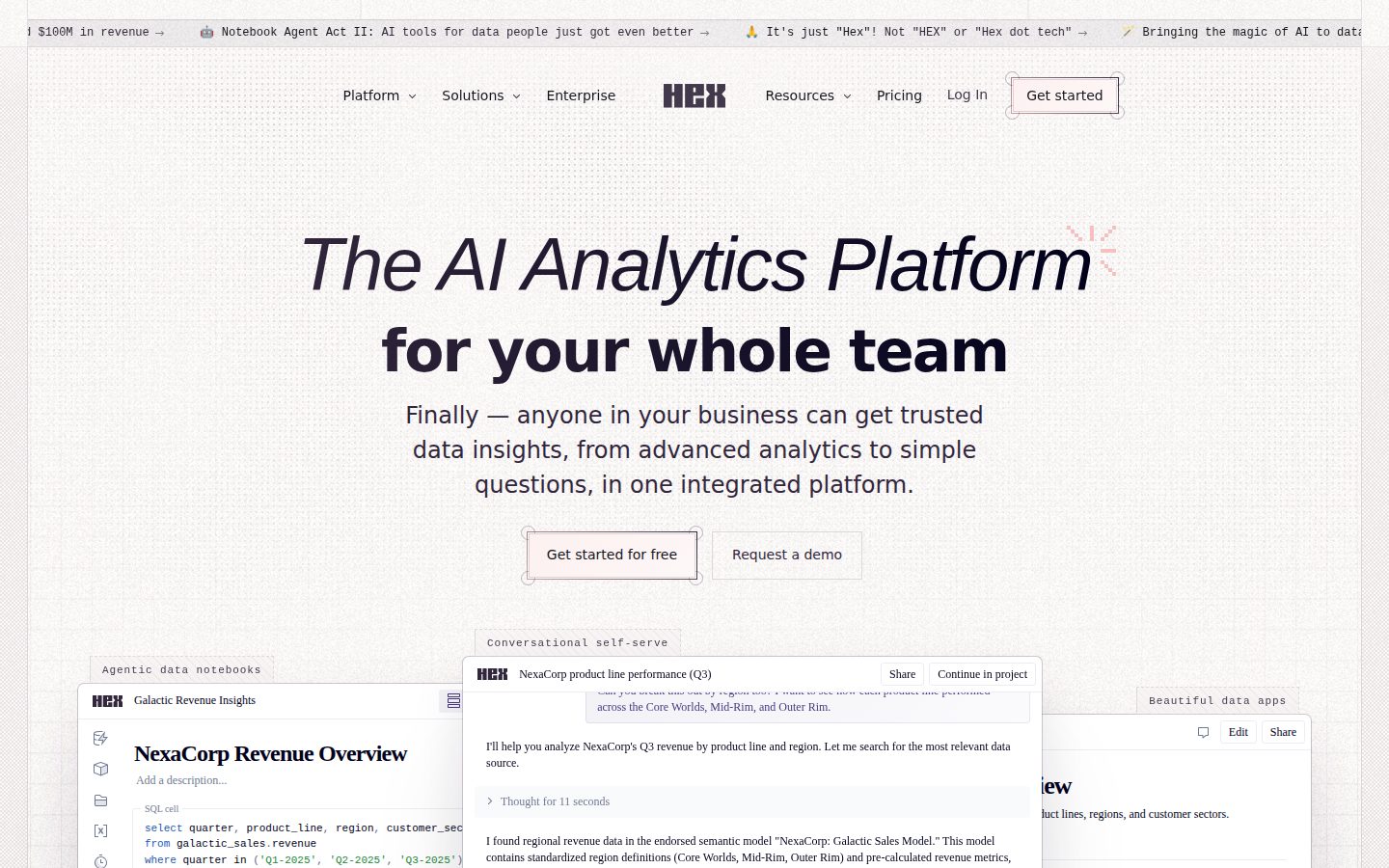
AI analytics platform for notebooks, self-serve answers, and data apps
Hex is an AI analytics platform for data teams and business users who need to analyze data, build reports, and answer questions.
AI Panel Score
6 AI reviews
Reviewed
In practice, users work in a notebook environment that supports SQL cells, Python cells, and visualizations side by side. An embedded AI agent interprets natural language prompts, queries connected data sources, and generates charts or summaries without requiring manual coding. Completed notebooks can be published as interactive data apps with filters and controls for non-technical stakeholders.
Hex includes a feature called Threads for conversational self-serve analytics, where business users can ask data questions in plain language and receive answers backed by governed semantic models. A Slack integration routes questions from Slack directly to the Hex agent, which replies with charts and narrative summaries in the thread. A Context Studio layer lets data teams define semantic models, add rules, and monitor agent answer quality through an observability dashboard that tracks conversation volume, warnings, and topic trends.
Hex targets data analysts, data engineers, and business intelligence teams at companies that want to reduce ad-hoc analyst requests by enabling broader self-serve access. It competes with tools such as Mode, Deepnote, Databricks Notebooks, Looker, and Sigma. Hex offers a free plan and paid tiers; the website lists public pricing. Named customers include Ramp, Figma, and Anthropic.
Hex runs as a web application and connects to common data warehouses and databases. It supports MCP (Model Context Protocol) integrations, allowing it to be accessed from tools like Claude and Cursor. Semantic models can be authored and synced within the platform to standardize metric definitions across teams.

A collaborative notebook environment with SQL and Python cells plus a built-in AI agent that can write queries, generate charts, and perform multi-step analysis on follow-up questions.
An authoring and management tool where data teams can create and sync semantic models, add rules, and link external context to improve AI agent accuracy and trustworthiness.
An AI agent embedded directly inside published data apps that can update filters and answer follow-up questions (e.g., switching customer sector or region) through natural-language conversation within the app.
An AI agent embedded in notebooks that automatically builds charts, writes SQL/Python code, and iterates on analysis based on natural-language prompts from the user.
A monitoring dashboard within Context Studio that tracks agent conversation volume, unique users, warnings, top topics, and per-conversation details across Notebook, Threads, and other agent sources.
A conversational analytics interface that lets non-technical users ask data questions in natural language and receive answers with auto-generated visualizations, usable via Hex directly or from Slack.
A one-click publishing action that converts a notebook into a shareable, interactive data application accessible to business stakeholders without requiring code access.
A built-in app publishing layer that turns notebooks into interactive, shareable data apps with filters, tabs, and embedded charts that any stakeholder can explore.
Endorsed, standardized data models that the AI agent references to ensure consistent metric definitions, region mappings, and pre-calculated metrics across all queries and apps.
Exposes Hex's conversational analytics capabilities to external tools such as Claude and Cursor via MCP connectors, enabling data queries from third-party AI environments.
Allows users to query Hex's AI agent directly from Slack, receiving answers and chart images posted back in the thread without leaving the messaging tool.
Free tier for hobbyists and small projects.
Per Editor/month — for individuals accelerating data work and solo workflows.
Per Editor/month — for companies collaborating with data.
Advanced security, governance, and dedicated support. Contact sales.
Hex's $172M cumulative raise with Anthropic, Figma, and Ramp as customers makes this a defensible three-year bet.
“Hex closed a $70M Series C in May 2025 led by Avra, bringing total raised to $172M with Sequoia and a16z back in for the round. The customer list — Anthropic, Figma, Coinbase, Ramp — answers the will-they-exist-in-three-years question without a pitch deck.”
Anthropic runs its data work on this. So does Figma. Hex closed a $70M Series C in May 2025 led by Avra, with Sequoia and a16z back in for the round — total raised now $172M. Founded December 2019 by Barry McCardel and Caitlin Colgrove. That's a defensible 36-month bet.
Context Studio is the real wedge. It's the semantic-model and governance layer that grounds the AI agent — what Mode and Deepnote don't have at this depth. Threads pipes natural-language questions from Slack into governed answers, which is where business-user self-serve usually breaks. Team tier runs $75 per editor per month.
The catch is the per-editor pricing model — at $75 a seat it adds up fast once you push past the data team, and Enterprise quotes happen behind sales calls. Pilot with the analytics pod for a quarter before standardizing.
Clear category leader in AI analytics versus Mode, Deepnote, Sigma, and Databricks Notebooks.
Anthropic, Figma, Coinbase, and Ramp on the logo wall make this board-defensible without explanation.
Slack Threads gets non-technical users self-serving in days, though Context Studio semantic models take setup time.
Combines notebooks, conversational self-serve, and semantic governance — real platform consolidation, not point-tool overlap.
Series C $70M in May 2025, $172M cumulative, six years in, Sequoia and a16z still on the cap table.
Data teams who need to combine analyst notebooks with governed self-serve analytics.
Small teams who do not need semantic models or governance.
Hex is the context-engine bet, and Threads grounded by semantic models is the moat Mode hasn't shipped.
“Founded 2019 in San Francisco by ex-Palantir trio Barry McCardel, Caitlin Colgrove, and Glen Takahashi, Hex raised a $70M Series C in May 2025 led by Avra with Snowflake Ventures, Sequoia, and a16z participating. For a Head of Data picking the AI analytics substrate through 2029, the call is whether a governed context layer beats Mode and Looker grafting agents over existing dashboards.”
Notebook on one side, Threads on the other, both reading from the same semantic model. That shape matters. Most AI analytics tools choose either the analyst workflow or the business-user prompt; Hex binds them to one Context Studio so the agent answers are reproducible across Notebook, Slack, and a published Data App.
Pricing reads like a deliberate fence around teams. Professional at $36 per editor unlocks Notebook Agent and 30-day version history; Team at $75 adds Threads, the Semantic Model Agent, and scheduled runs. Ramp, Figma, and Anthropic sit alongside Snowflake Ventures on the cap table — distribution signal Deepnote and Mode lack.
But the catch is warehouse gravity. Hex assumes a modern Snowflake or BigQuery substrate and a team willing to author semantic models in-platform; shops still standardizing on dbt will feel the duplication. For a Head of Data picking the AI-analytics workspace through 2029, the durable bet sits here.
Hex is defining the "AI analytics platform" frame against Mode, Deepnote, and Looker — named customers Ramp, Figma, and Anthropic anchor the segment.
Notebook plus conversational self-serve in one workspace mirrors how senior data teams actually split deep analysis and stakeholder requests.
Native connectors for Snowflake, BigQuery, Redshift, Databricks, Trino, plus MCP exposure to Claude and Cursor cover the modern stack.
A $70M Series C with Snowflake Ventures and Sequoia backing signals 3-year runway, with warehouse-stack lock-in as the durable constraint.
Context Studio grounds both Notebook Agent and Threads in the same semantic models — that is platform-grade craft, not a chat wrapper over SQL.
Head of Data teams standardizing AI analytics on a governed semantic layer.
Solo analysts who run ad-hoc SQL without a warehouse strategy.
Per-editor at $36 and $75, Explorer seats sit behind sales — that split is the procurement story.
“Hex prices Professional at $36/editor/month and Team at $75/editor/month, with Enterprise quoted custom. The $70M Series C from May 2025 at a $400M valuation funded the runway — the seat-model math is the actual concern.”
Two paid tiers are visible, one isn't. Professional is $36/editor/month. Team is $75/editor/month. Explorer seats — the read-mostly tier — route through Enterprise sales. That's where the bill actually scales.
20 editors × $75 × 12 = $18K/year on Team. Add Explorer seats for 100 business viewers and the model breaks open — no published rate. Compare Mode at roughly $30K-50K/year for similar team size. The Notebook Agent and Threads ship in-tier; Semantic Models in Context Studio gate Team and above.
The catch is compute. Medium compute is included; GPU and advanced add-ons are usage-based, so the invoice drifts. Hex raised a $70M Series C in May 2025 at a $400M valuation, led by Avra — runway funded. Anthropic, Figma, and Ramp are reference logos. Honest pricing page, opaque viewer math.
Self-serve checkout for Professional/Team, free Community plan lets buyers validate; Enterprise gates SSO and SOC governance.
Monthly billing on paid tiers per pricing page; auto-renewal and termination language not published.
Professional $36 and Team $75 are public per editor; Enterprise and Explorer viewer seats route through sales.
Reduces ad-hoc analyst tickets via Threads and Slack integration — payback story measurable for data teams.
Per-editor pricing is predictable but compute and Explorer add-ons are usage-based — invoice drifts above sticker.
Data teams who want one workspace for notebooks plus self-serve analytics.
Solo analysts who only need ad-hoc SQL at the lowest possible cost.
Threads routes governed self-serve questions from Slack to the same semantic models the analyst already owns.
“Threads and Notebook Agent share one Context Studio layer, so a business user's Slack question and an analyst's SQL cell pull from the same metric definition. But the Team plan at $75 per editor monthly gates Threads behind the upgrade, and Context Studio governance is real upfront work before any answer earns trust.”
An analyst's weekly fight is the same Slack question landing three times with three definitions of active customer. Hex's Threads routes that question against Context Studio's semantic models — same metric the analyst's SQL cell uses in the Notebook Agent. The ad-hoc backlog stops being where definitions diverge.
Semantic Models and Agent Observability cover the part analyst tools usually skip. Observability tracks topic trends and warnings across Notebook, Threads, and the App Agent, so an analyst sees which questions agents fumble before a stakeholder complains. Mode shipped notebooks-plus-BI first, but the governance layer wasn't connected to the conversational surface.
But Threads sits on the Team plan at $75 per editor monthly, and the semantic work is real upfront cost — Context Studio needs metric definitions, rules, and curation before any agent answer earns trust. Docs read analyst-fluent. Founded 2019, $70M Series C in May 2025, Anthropic and Figma already shipping.
Shared Context Studio reduces the definition-drift fight, though semantic model setup is real upfront work.
Docs reference governed semantic models and observability flows analysts actually run, not marketing concepts.
Context Studio curation and metric governance are ongoing analyst overhead, not a one-time setup.
SQL cells, Python cells, semantic models, and MCP connectors stack deep enough for advanced analyst workflows.
Slack, MCP, and notebook agents share the same semantic layer instead of forking context per surface.
Analysts who own a metrics layer their stakeholders already query through Slack.
Solo data hobbyists who want a free notebook for one-off Python work.
Hex finally treats the AI agent as a notebook citizen instead of a chatbot taped to a dashboard.
“Hex bundles agentic notebooks, conversational Threads, and Context Studio into one workspace with governed semantic models. Free Community plan caps at 5 notebooks, Professional is $36/Editor/month, and the Anthropic and Figma logos are real, not aspirational.”
An AI analytics tool either trusts your data team or replaces them. Hex picks the first one — Notebook Agent writes SQL and Python next to your cells, not behind a wall. You see what it ran. You can edit it. That adds up by month three.
Community is free with a 5-notebook cap. Professional runs $36/Editor/month, Team jumps to $75 for Threads and the semantic model agent. Context Studio is the part docs keep returning to: define metrics once, the agent stops inventing them. Customer logos read Anthropic, Figma, Ramp.
But the agent only earns its keep if someone curates that context. Point it at a messy warehouse with no semantic model and you get the plausible-but-wrong answers Looker pretends are insights. Founded 2019, $172M raised through a May 2025 Series C. Deepnote and Mode work, but neither stitches notebooks and conversational self-serve into one governed lane.
Agent Observability dashboard, MCP integration, and Threads-in-Slack suggest a team sweating the daily-use details.
Discoverable for analysts but agent accuracy depends on Context Studio investment business users will not do themselves.
Web-only by design — neutral score for a data analyst workspace where mobile is not the use case.
Notebook + SQL + Python + agent is a lot to surface in the first ten minutes for non-analysts.
Used in production by Anthropic, Figma, Ramp; $172M Series C funding signals durable engineering investment.
Data teams who want AI analysis grounded in governed semantic models.
Solo analysts who do not need conversational self-serve for business users.
AI analytics is the new lakehouse — Hex earns the benefit of the doubt, hedged on category gravity.
“Hex raised a $70M Series C led by Avra in May 2025, bringing total funding to $172M, and ships an AI analytics platform with notebook agents, Threads conversational self-serve, and a Context Studio governance layer used by Anthropic, Figma, and Ramp. The catch is category gravity — Looker has Google's distribution and Sigma is winning warehouse-native BI on price, so Hex's notebook-plus-BI position holds today but could compress in eighteen months.”
AI analytics is the new lakehouse — every BI vendor will claim it within 12 months. Hex still earns the benefit of the doubt. Notebook Agent isn't a chatbot wrapper, and Context Studio does the governance work nobody demos. $70M Series C from Avra in May 2025 buys two more years.
Pricing reads honestly. $36 Professional, $75 Team, free Community tier capped at 5 notebooks. Anthropic, Figma, Ramp on the logo wall — survives a churn audit. Semantic Models handle the metric-definition work Mode Analytics never finished before ThoughtSpot bought them for $200M in 2023.
But the category is brutal. Looker has Google's distribution; Sigma is winning warehouse-native BI on price. Hex sits between notebook and BI suite — a real position now, a squeeze in eighteen months. Exit's clean — SQL is portable. Worth a Team seat, hedged.
Notebook plus self-serve plus apps in one platform is real, but each piece has a larger named competitor.
SQL and Python notebooks export cleanly; Semantic Models are proprietary but core analytical artifacts transfer.
$70M Series C from Avra closed May 2025 with Sequoia and a16z follow-on, plus durable named customers.
Customer logos and pricing tiers are verifiable, though the "AI Analytics Platform" framing is category-buzz.
$172M cumulative funding, founded 2019, named enterprise logos — survivor pattern intact six years in.
Data teams who want notebooks and self-serve BI in one tool.
Solo analysts who only need a SQL notebook.
Common questions answered by our AI research team
Native connectors for Snowflake, BigQuery, Redshift, Databricks, PostgreSQL, MySQL, Clickhouse, MariaDB, Athena, MS SQL Server, and Trino. Flexible APIs for custom sources.
Yes. Notebook Agent assists with deeper analysis and creates charts automatically; Threads handles conversational self-serve queries. Both run via web, Slack, and CLI.
Yes. Data Apps turn notebook analyses into interactive dashboards with point-and-click configuration and built-in user filtering and exploration.
Yes, via Context Studio. Define standardized metrics and dimensions, attach governance rules and data quality checks, and link external context to improve AI accuracy.
Yes. Hex offers a freemium Community plan plus paid Team and Enterprise tiers. Paid pricing is shown on the public pricing page.
Company
Hex Technologies Inc.Founded
2019Pricing
From $36/moFree Plan
AvailableHex is a San Francisco-based data analytics platform that combines collaborative notebooks, SQL and Python editors, and AI-assisted analysis tools for data teams.