Dbt logo

Dbt Review

Visit

SQL-based data transformation tool for analytics engineering workflows

dbt is a command-line tool that enables data analysts and engineers to transform data in their warehouse using SQL.

dbt Labs·Founded 2016·From $100/moFree PlanAI AnalyticsAI CloudAI Data ToolsAI DevOps

AI Panel Score

8.4/10

6 AI reviews

Reviewed

AI Editor Approved

About Dbt

dbt is a command-line tool and framework designed for analytics engineering that enables data teams to transform raw data in their data warehouse using SQL. It allows users to write modular, reusable SQL code that can be version controlled, tested, and documented like software development projects.

The tool is primarily used by data analysts, analytics engineers, and data engineers who need to build reliable data transformation pipelines. dbt works with modern data warehouses including Snowflake, BigQuery, Redshift, and others, allowing teams to leverage the computational power of these platforms while maintaining development best practices.

Key capabilities include SQL-based transformations, automated testing of data quality assumptions, documentation generation, and lineage tracking. dbt also supports macros for reusable code, incremental model builds for performance optimization, and seeds for loading small reference datasets.

The product fits into the modern data stack as the transformation layer, sitting between data ingestion tools and business intelligence platforms. It has gained significant adoption in organizations implementing analytics engineering practices and seeking to apply software engineering principles to their data workflows.

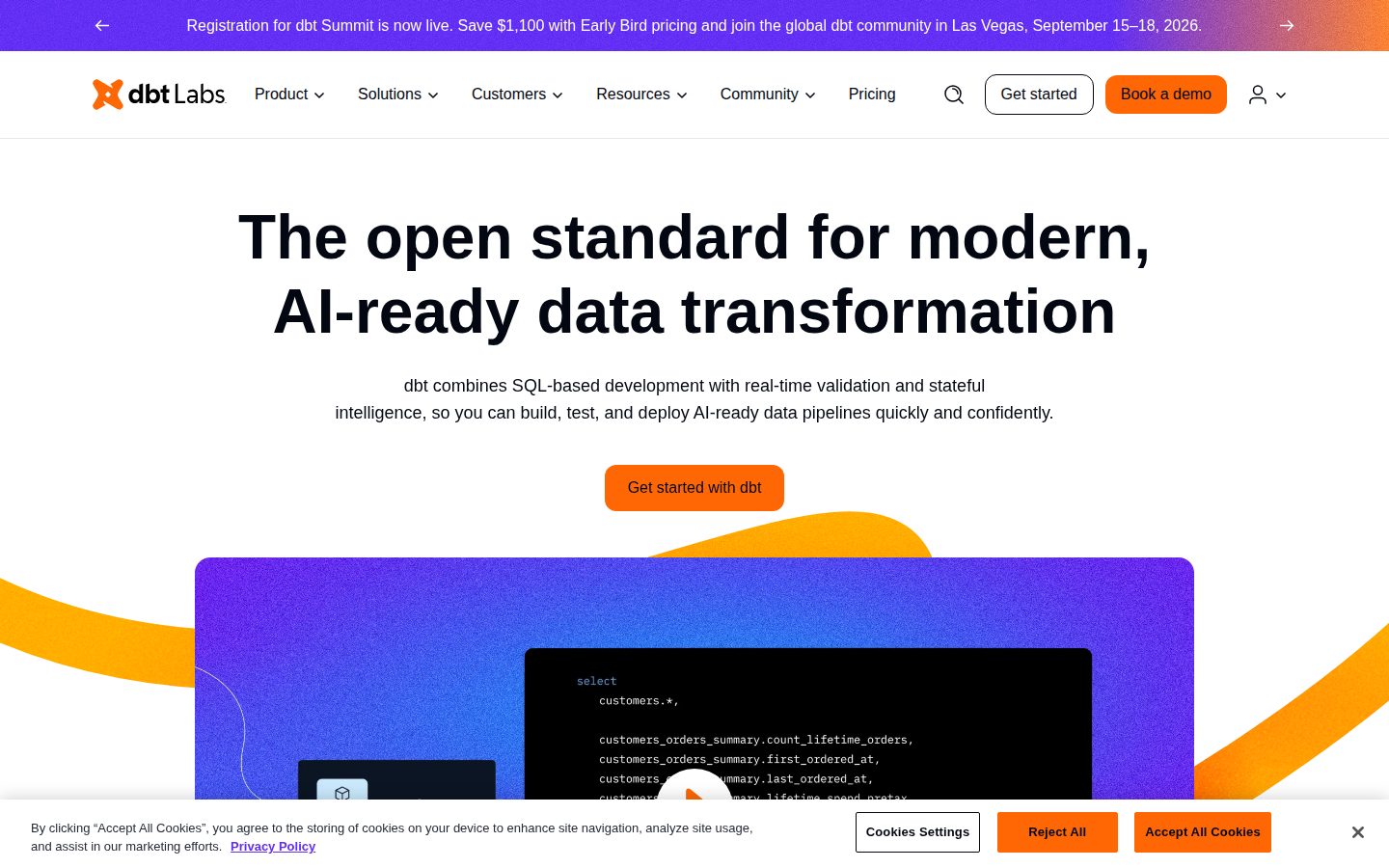
Features

Analytics

  • Column-Level Lineage

    Drill down to column-level lineage to trace where individual fields come from, how they are transformed, or when they are renamed across projects.

  • Interactive DAG Lineage

    Provides a live and interactive Directed Acyclic Graph (DAG) that shows how data flows and transforms across projects, with filtering by model type, materialization, or dependency.

  • dbt Semantic Layer

    Enables self-service analysis by providing a semantic layer that allows users to query governed metrics independently without waiting for data team involvement.

Automation

  • Automatic Model and Column Refactoring

    Automatically updates every downstream reference when a model or column is renamed, and previews all proposed changes before committing.

  • Stateful Intelligence via Fusion Engine

    Powered by the Fusion engine, automatically builds only the models that need to be updated in production pipelines—eliminating unnecessary compute and maintaining SLAs.

Collaboration

  • Version Control for Data Pipelines

    Applies software engineering practices to data transformation by making pipelines modular, tested, and version-controlled for team collaboration.

Core

  • IDE Extensions and Local Development

    Provides native local development experience through IDE extensions compatible with Cursor, Claude Code, Windsurf, and VS Code.

  • Multi-Dialect Compilation

    Compiles SQL logic across multiple data platform dialects, keeping logic portable as your data platform evolves.

  • SQL-Based Data Transformation

    Build data pipelines using modular, tested, and version-controlled SQL queries with native SQL comprehension and local validation that catches issues before they hit the warehouse.

  • dbt Catalog and Rich Metadata

    Rich metadata powers the dbt Catalog to improve governance, data lineage visibility, and trusted data for analytics and AI development.

Integration

  • Ecosystem Integrations

    Integrates with platforms including Tableau, Fivetran, OpenAI, Snowflake, Azure AI, and Databricks without storing your data, using open standards for secure and scalable data movement.

Preview

Dbt desktop previewDbt mobile preview

Pricing Plans

Developer

Free

The fastest way to get started with dbt

  • 1 Developer seat
  • 3,000 successful models built per month
  • 1 project
  • Browser-based IDE
  • Multi-factor authentication (MFA)
  • Job scheduling
Popular

Starter

$100/monthly

Pay as you go pricing for your first dbt project

  • 5 Developer seats
  • 15,000 successful models built per month
  • 5,000 queried metrics per month
  • 1 project
  • dbt Catalog basic
  • dbt Semantic Layer basic
  • dbt Copilot code generation
  • API access

Enterprise

Contact sales

Scale dbt to support your analytics and AI use cases

  • Custom Developer seat count
  • 100,000 successful models built per month
  • 20,000 queried metrics per month
  • 30 projects
  • dbt Catalog advanced
  • dbt Semantic Layer advanced
  • dbt Mesh
  • dbt Insights

Enterprise+

Contact sales

For maximum control over security and deployment

  • Custom Developer seat count
  • 100,000 successful models built per month
  • 20,000 queried metrics per month
  • Unlimited projects
  • PrivateLink
  • IP Restrictions
  • Rollback
  • Hybrid projects

AI Panel Reviews

The Decision Maker

The Decision Maker

Strategic bet, vendor viability, timing, adoption approval
8.5/10

dbt is the default transformation layer for serious data teams — and it's earned that.

dbt Labs owns the analytics engineering category. The free tier is real, the $100/month Starter plan is defensible, and the Fusion engine's stateful builds show they're still investing.

Column-level lineage, automatic downstream refactoring, and native VS Code and Cursor extensions — these aren't demo features. They're what a data team actually needs on Tuesday morning. The Starter plan at $100/month for five seats is cheap enough that finance won't ask questions.

The tradeoff: dbt is a transformation layer, not a full stack. You still need Fivetran or equivalent for ingestion, and a BI tool on top. Competitors like Coalesce or SQLMesh will pitch you on this gap. That's fine — most mature stacks already accept this architecture.

Enterprise pricing is opaque. PrivateLink and IP restrictions are locked to Enterprise+, which means security-conscious orgs will negotiate blind. That's the one number I'd pin down before signing anything.

Competitive Positioning8.5

Your peers are already on dbt; being late here is a gap, not an advantage — SQLMesh and Coalesce are real but distant alternatives.

Reputation Risk9.5

Adopting dbt is a credibility signal; not adopting it at this stage requires explanation to any technical board member or acquirer.

Speed to Value7.5

The browser-based IDE and 3,000 free monthly models get a solo analyst productive fast, but enterprise rollout across 30 projects takes real change management.

Strategic Fit8.5

The dbt Semantic Layer enables self-service analytics and AI-ready pipelines — this advances teams, it doesn't just automate what they already do.

Vendor Viability9.0

dbt Labs has category-defining market share, a freemium funnel that's clearly working, and continuous product investment evidenced by the Fusion engine and Copilot additions.

Pros

  • Column-level lineage and interactive DAG are production-grade governance tools
  • Fusion engine automatically limits unnecessary compute — no manual config required
  • IDE extensions for Cursor, VS Code, and Claude Code meet engineers where they work
  • $100/month Starter plan includes the Semantic Layer and Copilot — strong value

Cons

  • Enterprise+ security features like PrivateLink aren't available on standard Enterprise
  • Transformation-only — requires separate ingestion and BI tools to complete the stack
  • Enterprise pricing is custom, which means negotiation blind spots for budget planning

Right for

Data teams building on Snowflake, BigQuery, or Databricks who want software engineering discipline in their pipelines.

Avoid if

You want an all-in-one data platform and don't have appetite to integrate multiple tools.

The Domain Strategist

The Domain Strategist

Craft and strategy in the product's domain — adapts identity per category, same lens
9.0/10

dbt is the transformation layer every modern data stack is built around now.

dbt has become the de facto standard for analytics engineering, with the semantic layer and Fusion engine signaling serious architectural maturity. At $100/month for 5 seats and 15,000 models, the Starter tier is a no-brainer entry point.

Column-level lineage plus an interactive DAG isn't a nice-to-have — it's the foundation of any governance conversation with a CFO or CISO. The Fusion engine's stateful intelligence, building only what's changed without manual configuration, directly attacks the compute waste problem that kills warehouse budgets at scale. Someone on the dbt Labs team has run a real data platform before.

The Semantic Layer is the strategic bet worth watching. Self-service metrics without data team involvement is exactly what every Head of Data gets asked to deliver, and dbt Mesh at Enterprise tier suggests a serious answer to multi-team, multi-domain architectures that tools like Looker's LookML layer still struggle with.

The constraint worth naming: Enterprise and Enterprise+ pricing is opaque, and PrivateLink lives only at Enterprise+. If your security posture requires network isolation, budget accordingly. dbt Core remains open-source, but the features that matter at scale are firmly cloud-tier.

Category Positioning9.2

dbt sits at the center of the analytics engineering category it effectively created, with no credible single-tool competitor matching this surface area.

Domain Fit9.5

Native IDE extensions for Cursor, VS Code, and Claude Code show the team understands how analytics engineers actually work in 2024.

Integration Surface9.0

Direct integrations with Snowflake, Databricks, Fivetran, Tableau, and OpenAI cover the full modern data stack without third-party connectors.

Long-term Implications8.5

Adopting dbt means your transformation logic is portable across warehouse dialects via multi-dialect compilation, but Mesh and advanced governance lock you into dbt Cloud tiers over time.

Strategic Depth9.2

Column-level lineage, dbt Semantic Layer, and Fusion engine stateful builds represent genuine craft depth beyond commodity SQL transformation.

Pros

  • Fusion engine eliminates manual model dependency management at production scale
  • Column-level lineage closes the governance gap most BI tools leave open
  • Semantic Layer enables governed self-service without custom API work
  • $100/month Starter tier delivers 15,000 model builds and Copilot code generation

Cons

  • PrivateLink and IP restrictions gated to Enterprise+, making security-sensitive orgs pay a premium for basics
  • Enterprise and Enterprise+ pricing is undisclosed, creating budget risk for growing teams
  • 100,000 model build cap at Enterprise may constrain very high-frequency pipelines

Right for

Data teams running a modern warehouse stack who need governance, lineage, and semantic layer capabilities in one coherent system.

Avoid if

Your org has a single analyst, minimal transformation needs, and no roadmap toward self-service analytics.

The Finance Lead

The Finance Lead

Money, total cost of ownership, contracts, procurement math
7.8/10

$100/month flat for 5 seats — rare pricing honesty in the data tooling category.

Starter at $100/month for 5 seats is $20/seat. Enterprise and Enterprise+ pricing disappears behind a sales call.

Starter is $100/month flat. 5 seats, 15,000 model builds, dbt Semantic Layer basic, API access. $20/seat/month. 50-person team won't fit here — 10 developers might. Year 3 with modest seat creep: 12 seats × $20 × 12 = $2,880/year if Starter holds. It won't. Teams outgrow 1 project or 15K model limits and get pushed to Enterprise, where pricing vanishes entirely.

No published Enterprise rate. That's the real TCO risk. PrivateLink, IP Restrictions, Rollback — all Enterprise+ only, no sticker price visible. Compare to Fivetran, where enterprise pricing is similarly opaque. At least dbt's lower tiers are honest. Developer tier at $0 with 3,000 model builds is a genuine free tier, not vaporware.

Fusion engine's stateful builds cut compute waste automatically — that's real warehouse cost savings, not marketing math. Column-level lineage and automatic downstream refactoring reduce engineering hours. ROI is measurable if you baseline warehouse spend before and after. Contract terms aren't published; auto-renewal windows are unknown.

Billing & Procurement7.5

Starter is self-serve, pay-as-you-go, no sales friction; Enterprise requires vendor engagement and adds procurement overhead.

Contract Flexibility5.5

No published auto-renewal window, cancellation terms, or termination-for-convenience clause visible on pricing page.

Pricing Transparency7.0

Developer and Starter tiers are fully visible; Enterprise and Enterprise+ show $0 as placeholder with no actual rates published.

ROI Clarity8.0

Fusion engine's stateful builds and column-level lineage create measurable warehouse compute savings and reduced engineering rework hours.

Total Cost of Ownership6.5

Starter at $1,200/year is predictable, but Enterprise pricing opacity makes 3-year TCO modeling impossible without a sales call.

Pros

  • $0 Developer tier with 3,000 model builds is a real free tier
  • Starter at $100/month for 5 seats — $20/seat, competitive against comparable tooling
  • Fusion engine cuts unnecessary warehouse compute automatically
  • IDE extensions for VS Code and Cursor enable local dev without plan upgrades

Cons

  • Enterprise and Enterprise+ pricing unpublished — TCO modeling requires a sales call
  • PrivateLink and IP Restrictions locked to Enterprise+, tier unclear on cost
  • No published auto-renewal or cancellation terms
  • Single-project limit on Starter forces early Enterprise conversation for most real teams

Right for

Data teams of 2-5 engineers running 1 project who want predictable $100/month spend on a mature transformation platform.

Avoid if

You need multi-project setups, PrivateLink, or security controls — Enterprise+ pricing is a blank check until you sign.

The Domain Practitioner

The Domain Practitioner

Daily hands-on reality in the product's domain — adapts identity per category, same lens
8.5/10

dbt is the analytics engineering standard — the Fusion engine seals it

dbt has become the default transformation layer in the modern data stack, and the evidence shows a product that has grown into its ambitions. Column-level lineage, semantic layer, and stateful builds via Fusion aren't demo features — they're the daily workflow.

The $100/month Starter tier gets you 5 seats and 15,000 model builds. That's a real number — enough for a small analytics team to run production pipelines without hitting artificial ceilings. The Fusion engine's stateful intelligence — automatically detecting which models need rebuilding — is the kind of feature that only makes sense once you've watched a full DAG rebuild waste 40 minutes of warehouse compute on unchanged models. Docs indicate no manual configuration required. That's the right default.

Local development via VS Code, Cursor, and Claude Code extensions means analysts aren't locked into a browser IDE. That matters for anyone who lives in a terminal. The interactive DAG with column-level lineage puts dbt ahead of where Airflow's native observability sits — lineage at the column level is still rare.

The tradeoff worth naming: PrivateLink and IP Restrictions land only on Enterprise+, not Enterprise. Security-first orgs will pay custom pricing to get there. And the Semantic Layer is gated at Starter — solo Developer plan users hit that wall fast.

Day-3 Reality8.5

Stateful builds via Fusion and automatic downstream refactoring on column renames address the exact friction points that make daily dbt work tedious at scale.

Documentation Practitioner-Fit8.5

The feature descriptions use warehouse-native language — materialization types, incremental builds, DAG filtering — which reads like someone who has debugged a slow run, not someone who wrote a press release.

Friction Surface8.0

Automatic model and column refactoring that previews changes before committing removes a major class of breakage in multi-model pipelines.

Power-User Depth8.5

Column-level lineage, dbt Mesh, macros, semantic layer, and Fusion engine together represent a genuine progression from SQL writer to analytics engineer — the ceiling is high.

Workflow Integration9.0

Native IDE extensions for VS Code, Cursor, and Claude Code mean analysts stay in their existing local dev environment rather than adopting a new one.

Pros

  • Fusion engine stateful intelligence eliminates unnecessary full DAG rebuilds in production
  • Column-level lineage is rare at this price point — Starter at $100/month includes basics
  • Local dev via Cursor and VS Code extensions keeps analysts in their preferred environment
  • Deep Snowflake and Databricks integrations with no third-party connectors required

Cons

  • PrivateLink and IP Restrictions locked to Enterprise+, not Enterprise — security teams will notice
  • Semantic Layer gated above the free Developer plan — solo users hit the ceiling immediately
  • No free trial on paid tiers; evaluation path is limited to the 3,000-model Developer cap
  • API access starts only at Starter — automation workflows require paid commitment

Right for

Analytics engineering teams on Snowflake, BigQuery, or Databricks who need production-grade transformation pipelines with lineage and governance built in.

Avoid if

You're a solo analyst on the free tier expecting Semantic Layer access or API integrations without committing to $100/month.

The Power User

The Power User

Daily human experience, onboarding, polish, learning curve, reliability
8.2/10

The SQL transformation layer that actually treats your pipelines like real software

dbt is what happens when data work gets taken seriously. Strong tooling, real integrations, genuinely useful free tier — but this is not beginner territory.

The free Developer plan gives you 3,000 models per month and a browser IDE, which is legitimately useful for one person trying to learn the stack. Starter jumps to $100/month for 5 seats and unlocks the Semantic Layer and Copilot code generation — that's the tier where teams actually live. The Fusion engine's stateful builds are the quiet feature nobody talks about enough: automatically rebuilding only what changed, no config required. That's real time saved every single day.

Column-level lineage and the interactive DAG are the kind of features that feel like overkill until month two when your pipeline breaks and you need to trace exactly where a field got renamed. Compared to something like Matillion or raw Airflow DAGs, dbt's version-controlled, modular SQL approach just makes pipelines feel like real software.

The honest tradeoff: the learning curve is steep. This is a CLI tool at heart. The browser IDE helps, but anyone expecting Tableau-style approachability will bounce hard. Mobile is essentially irrelevant here — and for this category, that's fine.

Daily Polish7.5

The interactive DAG and column-level lineage show care, but the CLI-first nature means daily UX lives in your terminal, not a polished web surface.

Learning Curve6.8

Month three you'll feel powerful, but the first week involves a lot of documentation tabs and warehouse config before anything works.

Mobile Parity3.0

This is a command-line and IDE tool — mobile parity doesn't apply, and nobody should expect it to.

Onboarding Experience6.5

Free Developer tier lowers the barrier but this is fundamentally homework — SQL knowledge, warehouse setup, and CLI comfort are assumed before you start.

Reliability Feel8.5

The Fusion engine's automatic stateful builds and local validation before hitting the warehouse suggest a team that's obsessed with not breaking production.

Pros

  • Fusion engine auto-detects what needs rebuilding — no wasted compute, no manual config
  • Column-level lineage makes debugging pipelines genuinely less painful
  • Free Developer plan is real, not crippled — 3,000 models/month is workable
  • Native IDE extensions for Cursor, VS Code, and Claude Code feel current

Cons

  • CLI-first tool with a steep ramp — not approachable for non-engineering analysts
  • Starter plan at $100/month is fine but the pricing page lists Enterprise and Enterprise+ as 'Free' which seems like it means 'call us,' not actually free
  • Mobile experience is essentially nonexistent, though that's expected for the category
  • Onboarding assumes you already have a warehouse and SQL confidence — no hand-holding

Right for

Data and analytics engineers who want to apply real software practices to SQL pipelines on Snowflake, BigQuery, or Redshift.

Avoid if

You're a solo analyst without SQL fluency or warehouse access looking for a no-code data prep tool.

The Skeptic

The Skeptic

Contrarian. Watch-outs, deal-breakers, broken promises, category patterns
8.4/10

3,000 free models/month. Open standard. Category winner — with one pricing flag.

dbt is as close to an infrastructure standard as the transformation layer gets. The open-source core plus Cloud tier model has survived longer than most of its contemporaries.

Three tells before I open the pricing. One: no changelog linked on the site — odd for a product that sells developer trust. Two: Enterprise and Enterprise+ both list as 'Free' in the pricing table, which means 'call us' pricing hidden behind clean UI. Three: Starter is $100/month flat, not per-seat — five seats included, which is actually fair for small teams.

The Fusion engine's stateful builds and Column-Level Lineage are real differentiators. Looker's LookML and SQLMesh both play in this space. Neither has dbt's ecosystem depth — native Snowflake, Databricks, Fivetran integrations without third-party connectors is a genuine moat.

Exit portability is the honest upside. SQL models live in git. The core is open source. If dbt Cloud disappears, the transformation logic survives. That's rare. The tradeoff: the Semantic Layer and dbt Mesh features are Cloud-only — lock-in creeps in at the top tiers.

Competitive Differentiation8.2

Column-Level Lineage and the Fusion engine's stateful intelligence separate it from SQLMesh and basic Redshift transformation workflows.

Exit Portability8.5

SQL models in git means the core work is recoverable; Cloud-only features like dbt Mesh introduce partial lock-in at Enterprise tiers.

Long-term Viability8.0

No public funding data visible in evidence, but the tiered pricing structure, active feature set, and category-defining adoption suggest a team that's shipping — no changelog linked is the one flag.

Marketing Honesty7.5

'Open standard' is a strong claim, but the ecosystem adoption and open-source core make it defensible — not pure aspiration.

Track Record Match9.0

dbt Labs matches the pattern of tools that survived: open-source core, paid Cloud, deep integrations, named investor backing — not the pattern of Looker spinoffs or failed SQL abstraction layers.

Pros

  • Open-source core means transformation logic lives in git, not a vendor silo
  • 3,000 free models/month on Developer tier is a real free plan, not a demo
  • Fusion engine stateful builds eliminate unnecessary compute automatically — no manual config
  • Native IDE extensions for VS Code, Cursor, Claude Code — local dev is a first-class option

Cons

  • Enterprise pricing is opaque — 'Free' on the pricing page means 'call us'
  • No changelog linked publicly — odd for a developer-trust product
  • dbt Mesh and advanced Semantic Layer are Cloud-only, so lock-in grows with scale
  • No API access below the $100/month Starter tier

Right for

Data teams on Snowflake or Databricks who want software engineering practices in their transformation layer.

Avoid if

You need transparent enterprise pricing upfront or your stack sits outside the modern warehouse ecosystem.

Buyer Questions

Common questions answered by our AI research team

Pricing

What is the monthly cost per user for the Starter plan, and how many developer seats does it include?

The Starter plan costs $100 per user/month and includes five (5) developer seats.

Features

What problem does dbt solve?

dbt lets data teams transform raw warehouse data into reliable, version-controlled, tested models using SQL — the analytics engineering equivalent of git + tests for transformations.

Features

Does the Fusion engine's stateful orchestration automatically detect which models need to be rebuilt, or do I have to configure that manually?

According to the content, the Fusion engine automatically builds only the models that need to be updated with no rewrites or complex setup required — it is described as working automatically with 'stateful intelligence' in production pipelines.

Features

What is the difference between dbt Core and dbt Cloud?

Core is the open-source CLI for running transformations locally or in CI. Cloud adds a hosted IDE, scheduler, semantic layer, observability, and team collaboration features.

Security

Is PrivateLink and IP Restrictions available on the Enterprise plan, or only on Enterprise+?

PrivateLink and IP Restrictions are listed only as features of the Enterprise+ plan, not the Enterprise plan.

Pricing

How much does dbt Cloud cost?

dbt Cloud has a free Developer tier, Team starts at $100/developer/month, Business at $200, and Enterprise is custom — pricing scales with developer seats and platform features.

Integration

Which warehouses does dbt support?

dbt runs natively on Snowflake, BigQuery, Redshift, Databricks, Postgres, and other SQL warehouses — adapters keep transformations consistent across engines.

Setup

Can I develop dbt models locally using VS Code or Cursor, or am I limited to the browser-based IDE?

Yes, you can develop locally using VS Code or Cursor (as well as Claude Code and Windsurf) via native IDE extensions, in addition to the browser-based IDE.

Integration

Does dbt natively integrate with Snowflake and Databricks, or do those require third-party connectors?

The content lists Snowflake and Databricks as direct ecosystem integrations under 'Interoperable by design,' describing dbt as having 'deep ecosystem integrations' — no mention of third-party connectors being required.

Features

What is the dbt Semantic Layer?

The Semantic Layer defines metrics centrally so BI tools (Hex, Tableau, Mode) query consistent definitions of revenue, churn, etc., instead of each team rolling their own.

Product Information

  • Company

    dbt Labs
  • Founded

    2016
  • Pricing

    From $100/mo
  • Free Plan

    Available

Platforms

webmacwindowslinux

About dbt Labs

dbt Labs is a Philadelphia-based company that makes dbt, an open-source tool and cloud platform for transforming data in analytics warehouses.

Resources

Documentation
Blog

Also in AI Analytics