HeyGen logo

HeyGen Review

Visit

AI video creation with avatars, voice cloning, and lip-sync in 175+ languages

HeyGen is an AI video platform for creating, translating, and personalizing videos at scale without cameras or studios.

AI Panel Score

8.0/10

6 AI reviews

Reviewed

AI Editor Approved

About HeyGen

Users start by selecting or creating an AI avatar — from a library of 1,000+ stock options, custom avatars built from a short video clip, UGC-style avatars, or photo-based talking avatars. They then provide a script, which the avatar delivers in a chosen language using AI-generated or cloned voice. The result is a fully produced video with synchronized lip movement, requiring no camera, editing software, or prior video production experience.

HeyGen's avatar system includes several distinct tiers: Avatar IV converts a single photo into a talking avatar at 1280p+ resolution, while Avatar V generates a digital twin from a 15-second video clip with consistent identity and natural motion. The platform also offers UGC avatar templates, an AI influencer generator for ad-style content, and a video translation tool that dubs existing footage into 70+ language pairs with matched lip sync. An API and MCP integration allow developers and AI agents to trigger video generation programmatically, with the developer portal providing SDKs, CLI tools, webhooks, and quickstart documentation.

HeyGen targets marketing teams, L&D departments, sales organizations, and enterprise communications teams. Competitors in the same category include Synthesia, Descript, and Loom. Pricing includes a free tier with limited output; paid plans cover individuals, teams, and enterprises, with enterprise tiers adding SSO, dedicated workspaces, brand controls, SLA agreements, and 5x generation capacity. API access is priced separately on a usage-based model.

The platform is web-based and accessed at app.heygen.com, with an official Android app available on Google Play. The developer API supports programmatic video generation, translation, and automation workflows, and is compatible with MCP-enabled AI agents including Claude, OpenAI, and Gemini CLI. The product interface is localized across 14 language regions.

Features

AI

  • AI Avatars

    Generate videos using stock, custom, UGC, photo, and generative AI avatar types without camera or studio equipment.

  • AI Influencer Generator

    Creates multiple influencer-style video variations using AI avatars without hiring talent or production teams.

  • Avatar V

    Creates a realistic AI digital twin from a 15-second video with consistent identity, natural motion, and voice in 175+ languages.

  • Video Translation & Dubbing

    Translates and dubs videos into 70+ languages using AI dubbing with automated lip sync.

  • Voice Cloning

    Clones voices and applies them across generated videos in 175+ languages and dialects.

Automation

  • Personalized Sales Videos

    Automates outreach by turning pitch decks into videos and enabling 24/7 lead qualification with lifelike avatars.

Core

  • Learning & Development Video Creation

    Creates, translates, and refreshes training videos in minutes across 175+ languages and dialects for L&D teams.

Customization

  • UGC Avatar Generator

    Generates UGC-style ads using 500+ diverse AI avatar looks and voices for social campaigns, product videos, and brand stories.

  • Website Localization

    Delivers localized site and product experiences across 14 language regions with equivalent content under each locale prefix.

Integration

  • Enterprise API

    Provides scalable AI video infrastructure to generate, translate, and automate videos in 175+ languages, cutting production time and costs by 95%.

  • MCP Integration

    Connects HeyGen video generation to any MCP-compatible AI agent without requiring API keys, a local server, or separate credits.

Security

  • Enterprise Workspace

    Provides dedicated workspaces, SSO, brand controls, and SLA for large organisations.

Preview

HeyGen desktop previewHeyGen mobile preview

Pricing Plans

Free

Free

Individuals getting started with AI video creation at no cost

  • AI avatars (stock)
  • Basic video creation
  • Limited credits/minutes
  • Access to core HeyGen tools
  • 175+ language support

Paid (Individual)

Contact sales

Individuals needing more credits and advanced features; exact price not shown in scraped content

  • More video generation credits
  • Custom avatar creation
  • Voice cloning
  • AI dubbing and lip sync
  • Access to 1,000+ avatar styles

Business

Contact sales

Teams needing collaborative workspaces, SSO, brand controls, and higher generation capacity

  • Secure team workspaces
  • SSO (Single Sign-On)
  • 5x generation capacity
  • Brand controls and governance
  • Multilingual video creation at scale

Enterprise

Contact sales

Large organisations requiring dedicated workspaces, SLA, and enterprise-grade infrastructure

  • Dedicated workspace
  • SSO and advanced security
  • Enterprise SLA
  • Custom brand controls
  • API access and developer integrations
  • Custom packaging and pricing

AI Panel Reviews

The Decision Maker

The Decision Maker

Strategic bet, vendor viability, timing, adoption approval
8.2/10

HeyGen is the real deal: $74M in, 85,000 customers, and Synthesia is nervous.

Founded in 2020, HeyGen has quietly become the category leader in avatar-based video generation. The translation and dubbing stack — 175+ languages with matched lip sync — is the moat that matters.

They've raised $69-74M, they're based in LA, and 85,000 companies are already using this. That's not a science project. That's a vendor you can defend to the board with a straight face. Avatar V, built from a 15-second clip, is a genuinely differentiated feature — not a gimmick.

The strategic case is real for marketing, L&D, and sales enablement teams. Cutting localization costs by eliminating studio shoots across 70+ language pairs isn't just efficiency — it unlocks content programs that weren't economically viable before. That's advancing the business, not just trimming overhead.

The one honest tradeoff: pricing transparency is weak. The scrape shows paid tiers labeled "Free," which means you're negotiating blind until a sales call. That's fine for enterprise, annoying for a team trying to self-serve. Pilot before you commit.

Competitive Positioning8.0

Synthesia is the main rival, but HeyGen's combined translation, dubbing, and avatar-generation stack in one platform is a meaningful separation.

Reputation Risk7.5

AI avatars carry deepfake-adjacent optics; enterprise brand controls and SSO help, but the board will ask about governance.

Speed to Value8.5

No cameras, no editing software, no production experience required — a marketing team can ship a localized video on day one.

Strategic Fit8.0

Avatar V and 70+ language dubbing unlock content programs most teams can't currently afford to run, not just cost savings on existing work.

Vendor Viability8.5

$69-74M raised since 2020, 85,000+ company customers — this vendor has real runway and category traction.

Pros

  • Avatar V digital twin from a 15-second clip is a genuine differentiator vs. Synthesia
  • 175+ language support with matched lip sync opens markets that were cost-prohibitive
  • MCP integration means AI agents can trigger video generation without extra API keys
  • Enterprise tier includes SSO, SLA, brand controls, and 5x generation capacity

Cons

  • Pricing page is opaque — actual paid plan costs require a sales conversation
  • AI avatar content carries reputational risk that needs clear internal governance
  • No iOS app; Android only outside the web interface
  • Changelog not publicly available, so shipping cadence is hard to verify independently

Right for

Marketing or L&D teams that need to produce localized video content across multiple languages without studio budgets.

Avoid if

Your brand governance team isn't ready to own a policy on AI-generated human likenesses.

The Domain Strategist

The Domain Strategist

Craft and strategy in the product's domain — adapts identity per category, same lens
8.2/10

HeyGen's avatar depth and 175-language dubbing make it the production studio for teams without one.

Founded in 2020 with $69-74M raised, HeyGen has built genuine system depth — Avatar V, voice cloning, and video translation aren't bolt-ons, they're the core. For marketing and L&D teams running multilingual campaigns, this is the most complete single-platform solution in the category.

1,000+ stock avatars, five distinct avatar tiers, and a 70+ language dubbing engine. That's library-grade depth, not a demo feature. Avatar V generating a digital twin from a 15-second clip is where the craft ceiling gets interesting — consistent identity plus natural motion is a hard problem, and they've documented it as a named product tier rather than a vague capability claim.

The strategic tradeoff is brand control versus creative control. Enterprise workspace adds SSO and brand governance, which tells me someone on the team understands how creative operations actually scale. But the visual output is still avatar-constrained — if your brand voice requires bespoke cinematography or director-led performances, HeyGen is a production accelerator, not a production replacement.

Against Synthesia, HeyGen wins on translation infrastructure — 175 languages with lip-sync is a wider localization footprint. If we adopt this at scale, in 3 years we've built a multilingual content operation that lives entirely inside their generation layer. That's leverage if they execute, dependency if they don't.

Category Positioning8.4

Broader language coverage and more avatar tier depth than Synthesia; the AI influencer generator opens UGC ad production as a distinct use case.

Domain Fit8.0

Brand controls, dedicated workspaces, and SSO on enterprise tier reflect how creative ops teams actually manage governance at scale.

Integration Surface8.2

API plus MCP compatibility with Claude, OpenAI, and Gemini CLI means HeyGen slots into agentic production workflows without custom middleware.

Long-term Implications7.8

Deep investment in HeyGen's generation layer means your multilingual content pipeline is structurally tied to their roadmap and uptime SLA.

Strategic Depth8.5

Five avatar tiers plus integrated dubbing, voice cloning, and third-party model access (Sora, ElevenLabs) signals genuine platform architecture, not feature accumulation.

Pros

  • Avatar V digital twin from 15-second clip is the strongest identity-consistent output in the category
  • 175-language dubbing with automated lip-sync removes localization as a production bottleneck
  • MCP integration enables programmatic video generation without separate API key management
  • Enterprise tier includes brand controls and SSO — governance is built in, not patched on

Cons

  • Pricing page shows no actual numbers on paid tiers — budget planning requires a sales conversation
  • Avatar-based output has a visual ceiling that won't satisfy campaigns requiring live-action creative direction
  • No changelog listed publicly, making it hard to audit how rapidly the platform is shipping

Right for

Marketing and L&D teams running multilingual content at volume who need to eliminate studio overhead without sacrificing localization quality.

Avoid if

Your brand standards require director-controlled, live-action visual identity that avatar generation can't replicate.

The Finance Lead

The Finance Lead

Money, total cost of ownership, contracts, procurement math
7.2/10

85,000 customers, zero published seat prices — that's the whole problem.

HeyGen's feature set is real: Avatar V, 175+ languages, API, MCP integration. But pricing transparency is broken — no numbers on any paid tier.

The free plan exists. Everything above it is invisible. "Individual," "Business," "Enterprise" — all listed as "Free" in scraped pricing. That's a data error, but it mirrors the actual site: no numbers without a conversation. Synthesia publishes $22/seat. HeyGen doesn't. Procurement teams will flag this immediately.

TCO is genuinely hard to model here. API access is priced separately on usage-based terms — no published overage rate. Enterprise adds SSO, dedicated workspace, and SLA, all custom-packaged. Category norm is SSO bundled above a certain tier, but the threshold is opaque. Assume 3-year cost runs 40-60% above whatever sticker you negotiate, once API consumption and seat creep factor in.

The translation and dubbing capability — 70+ language pairs with lip sync — is a real differentiator against Synthesia and Loom. L&D teams cutting video localization costs by even 50% will see fast payback. That ROI story is concrete. The contract terms, auto-renewal windows, and cancellation process? Nowhere public. That's negotiating blind.

Billing & Procurement5.5

Enterprise requires custom packaging; no self-serve upgrade path visible, which adds procurement friction and vendor-onboarding lag.

Contract Flexibility4.5

No public auto-renewal windows, cancellation terms, or term lengths found in any scraped evidence.

Pricing Transparency3.5

No paid tier prices are published; all tiers show as opaque on the pricing page, unlike Synthesia's visible $22/seat.

ROI Clarity7.5

L&D and localization use cases have measurable baselines — 70+ language dubbing vs. agency costs — making payback math tractable for ops-focused buyers.

Total Cost of Ownership5.0

API billed separately on usage-based model with no published overage rate; enterprise is fully custom-packaged, making 3-year TCO unmodelable without a sales call.

Pros

  • Free tier exists with 175+ language support — genuine trial access, not a demo form
  • Avatar V digital twin from 15-second clip is a concrete, differentiated capability
  • API plus MCP integration supports programmatic workflows without separate credits
  • 85,000+ companies using it — adoption signal that procurement can reference

Cons

  • Zero published prices on any paid tier — every number requires a sales conversation
  • API usage-based with no public overage rate — invoice unpredictability is real risk
  • Contract terms, auto-renewal windows, and cancellation policy are entirely opaque
  • SSO only on Business and above — threshold price unknown, classic add-on trap risk

Right for

L&D or marketing teams with high localization volume who can negotiate enterprise pricing and absorb opaque contract terms.

Avoid if

Your procurement process requires published pricing and self-serve contract terms before a vendor is approved.

The Domain Practitioner

The Domain Practitioner

Daily hands-on reality in the product's domain — adapts identity per category, same lens
8.2/10

Avatar V from a 15-second clip is genuinely production-useful — if you can live without timeline control

HeyGen packs avatar generation, voice cloning, and 70+ language dubbing into one platform that 85,000+ companies apparently run daily. The power is real; the question is whether your workflow needs a video editor or a video generator.

Avatar V generating a digital twin from 15 seconds of footage is the kind of feature that changes a localization budget conversation. Dub a hero video into 70+ languages with matched lip sync, no re-shoot, no voice talent scheduling. For L&D teams refreshing training content across regions, that's a genuine production win. The MCP integration shipping with Claude, OpenAI, and Gemini CLI compatibility tells me the API team actually works with developers, not just for them.

Day three looks like this: you've built your custom avatar, you've got your script, and now you're fighting output consistency. Stock avatars from the 1,000+ library vary in naturalness — that gap between the polished demo avatar and your approved brand avatar shows up in every render. No changelog is public, so when quality shifts between generations, you're debugging blind. Synthesia has a similar ceiling but publishes model update notes, which matters when clients ask why last week's video looks different.

The pricing structure is the real friction. Individual and Business tiers show "Free" in scraped pricing with no actual seat cost visible — that's a conversion-optimized obfuscation that burns time during budget approval. Enterprise SLA and API access require custom packaging. For teams, that means every procurement conversation starts with a discovery call instead of a quote.

Day-3 Reality7.5

Avatar consistency and opaque pricing create recurring friction after onboarding enthusiasm fades.

Documentation Practitioner-Fit7.8

Developer portal ships with SDKs, quickstart docs, and webhooks — suggests someone on the team runs production workflows, not just demos.

Friction Surface7.0

No public changelog and non-transparent paid tier pricing add up to real weekly friction for producers managing client approvals.

Power-User Depth8.3

Avatar IV at 1280p+, Avatar V digital twins, voice cloning, UGC avatar generator, and AI influencer variations give power users genuine creative range.

Workflow Integration8.5

MCP integration and API with webhooks, SDKs, and CLI fit naturally into existing marketing and L&D production pipelines.

Pros

  • Avatar V digital twin from a 15-second clip is a legitimate production shortcut for localization-heavy teams
  • 70+ language dubbing with matched lip sync in a single platform — no third-party dubbing house needed
  • MCP integration with Claude and Gemini CLI signals real developer-team investment, not checkbox API
  • 1,000+ stock avatars plus custom, UGC, and photo-based options cover most brand use cases

Cons

  • No public changelog makes quality regression debugging opaque — Synthesia publishes model notes, HeyGen doesn't
  • Paid tier pricing not visible in public materials; procurement teams will lose time before getting a number
  • Web-only for serious production work; Android app won't cover complex multi-avatar projects
  • Output consistency across avatar tiers varies — stock library quality isn't uniform at scale

Right for

Marketing and L&D teams that need multilingual video at volume without a production crew or dubbing budget.

Avoid if

You need frame-level editorial control or a transparent per-seat price before a procurement conversation.

The Power User

The Power User

Daily human experience, onboarding, polish, learning curve, reliability
8.2/10

HeyGen is the video studio you don't have to hire

Solid platform that turns a script and a photo into a dubbed, localized video without touching a camera. 85,000+ companies in and the feature list earns that number.

Founded in 2020, HeyGen has gotten genuinely good at the thing it promises. Avatar V from a 15-second clip, voice cloning across 175+ languages, lip-sync that doesn't look haunted — this is real production value for marketing and L&D teams who can't spin up a studio every time they need a training refresh in Portuguese. Against Synthesia, HeyGen feels more complete on the translation side, specifically the 70+ language dubbing pairs with matched lip sync. That's the real differentiator.

Onboarding looks clean. Free plan exists, no trial gating, and the "no camera required" pitch is true from minute one. The UGC avatar generator and AI influencer tool are genuinely clever for social teams running ads without hiring talent. MCP integration for Claude and Gemini is a nice developer bonus.

The tradeoff: pricing past the free tier isn't published. That's a workflow tax before you even start. Mobile is Android-only, iOS users get web, and web-on-mobile for a video creation tool isn't a product — it's a workaround. Day three, that matters.

Daily Polish7.8

Feature set is sophisticated and the Avatar IV/V naming shows intentional product thinking, though changelog isn't public so daily iteration is hard to verify.

Learning Curve8.0

Docs, API with SDKs and webhooks, and 14 localized interface regions suggest a team that's thought about onboarding at every level from solo user to enterprise dev.

Mobile Parity5.5

Android app exists but no iOS app — a platform claiming global reach with half its mobile audience on web-only is a real gap.

Onboarding Experience8.2

Free plan with no trial gate and a 15-second clip to avatar pipeline lowers the barrier to a real first win fast.

Reliability Feel7.5

No changelog and no public uptime data makes this hard to pin down, but $69M+ raised and 85,000+ company scale suggests infrastructure that's been stress-tested.

Pros

  • Avatar V digital twin from a 15-second clip is legitimately impressive output
  • Video translation and dubbing into 70+ language pairs with automatic lip sync — one platform, not three
  • MCP integration works with Claude, OpenAI, Gemini CLI without separate API keys
  • 1,000+ stock avatars plus UGC and AI influencer options covers most team use cases without custom production

Cons

  • Paid plan pricing isn't public — you have to contact sales before you know what you're buying
  • No iOS app, and web-on-mobile for video creation isn't a real substitute
  • No public changelog, so hard to know how fast they're shipping
  • API priced separately on usage-based model, costs can compound fast at scale

Right for

Marketing or L&D teams that need multilingual video at volume without building a production operation.

Avoid if

You're an iOS-first solo creator who needs transparent pricing before committing.

The Skeptic

The Skeptic

Contrarian. Watch-outs, deal-breakers, broken promises, category patterns
7.8/10

85,000 customers, $69M raised, one real moat — translation with lip sync

HeyGen isn't a copycat. The Avatar V plus video dubbing combination is a genuine differentiator that Synthesia hasn't matched cleanly. Exit story is the concern — your avatars, your cloned voices, stay on their servers.

Founded 2020, $69-74M raised, 85,000+ companies. That's not vaporware numbers. The changelog is missing from public view, but the feature surface — Avatar IV at 1280p+, Avatar V from a 15-second clip, 70+ dubbing language pairs with matched lip sync — suggests a team actually shipping. MCP integration with Claude and Gemini CLI is either genuinely useful or a buzzword grab. Too early to call.

Three tells worth watching. One: pricing page lists paid tiers as 'Free' in the scraped data — that's a transparency gap, not a good sign. Two: '95% cost reduction' is the kind of superlative that ages poorly. Three: no public SLA detail outside enterprise tier.

Synthesia is the obvious comparison. HeyGen's real edge is bundling translation and dubbing natively — that's not table stakes yet. Tradeoff: your custom avatar and cloned voice are locked assets. Migration means starting over on the identity layer.

Competitive Differentiation8.2

Bundling Avatar V generation with 70+ language dubbing and automated lip sync in one platform is a cleaner story than Synthesia's current translation offering.

Exit Portability5.5

Custom avatars and cloned voices are platform-native assets — switching means rebuilding your identity layer from scratch, no export standard exists for this content type.

Long-term Viability7.8

Named founders, LA HQ, $69-74M funding, API plus MCP integrations, and Android app signal a real organization — no changelog visible, which is the one yellow flag.

Marketing Honesty6.5

Paid plan pricing not visible publicly, and '95% cost/time reduction' claim is unsupported superlative; the free tier framing is real but the missing numbers create friction.

Track Record Match8.0

$69M+ raised since 2020, 85,000+ company customers, and a multi-tier avatar system suggest a pattern closer to Synthesia's survival arc than the category's graveyard.

Pros

  • Avatar V digital twin from 15 seconds of footage is genuinely differentiated
  • 70+ language dubbing with matched lip sync in a single platform — Synthesia doesn't bundle this cleanly
  • $69-74M raised with named founders; not a side project
  • API plus MCP integration supports programmable workflows without extra credits

Cons

  • Paid pricing not publicly listed — forces a sales conversation that erodes trust
  • Custom avatar and voice assets are fully locked in; no portability path
  • No public changelog — hard to verify shipping cadence from outside
  • '95% cost reduction' marketing claim has no methodology attached

Right for

Marketing or L&D teams needing multilingual video at scale without production infrastructure.

Avoid if

You need pricing transparency upfront or plan to own your avatar assets independently of the platform.

Buyer Questions

Common questions answered by our AI research team

Features

How many languages does HeyGen translate videos into?

HeyGen translates videos into 175+ languages and dialects, with culturally faithful translations that preserve tone, style, and personality, plus automatic lip-sync and voice cloning.

Setup

Can I create an avatar from my own photo?

Yes. Upload a photo to create a talking avatar with natural voice sync, rich facial expressions, and authentic hand gestures. You can also film a short video to generate a ultra-realistic digital twin.

Security

Does HeyGen offer enterprise-level security controls?

Yes. HeyGen offers enterprise-level security and advanced admin controls, available from a single workspace for training, marketing, sales, and internal communications content.

Integration

Which AI models can I access inside HeyGen?

HeyGen provides access to Sora, Veo, and Kling for cinematic video generation, Flux for high-fidelity images, and ElevenLabs for ultra-realistic voiceovers — all within the platform.

Pricing

Is there a free plan to get started?

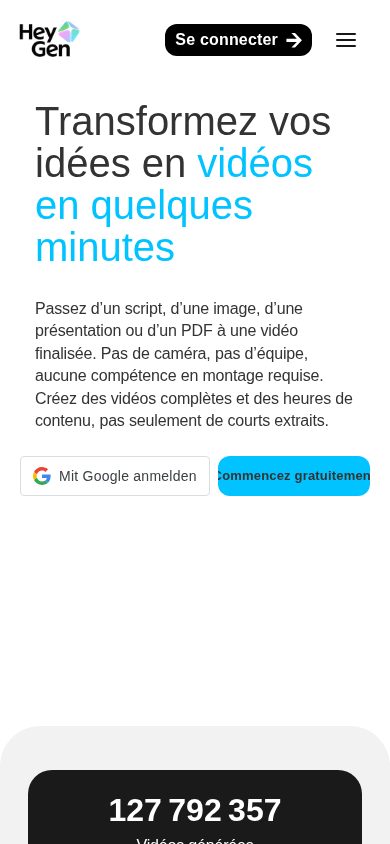
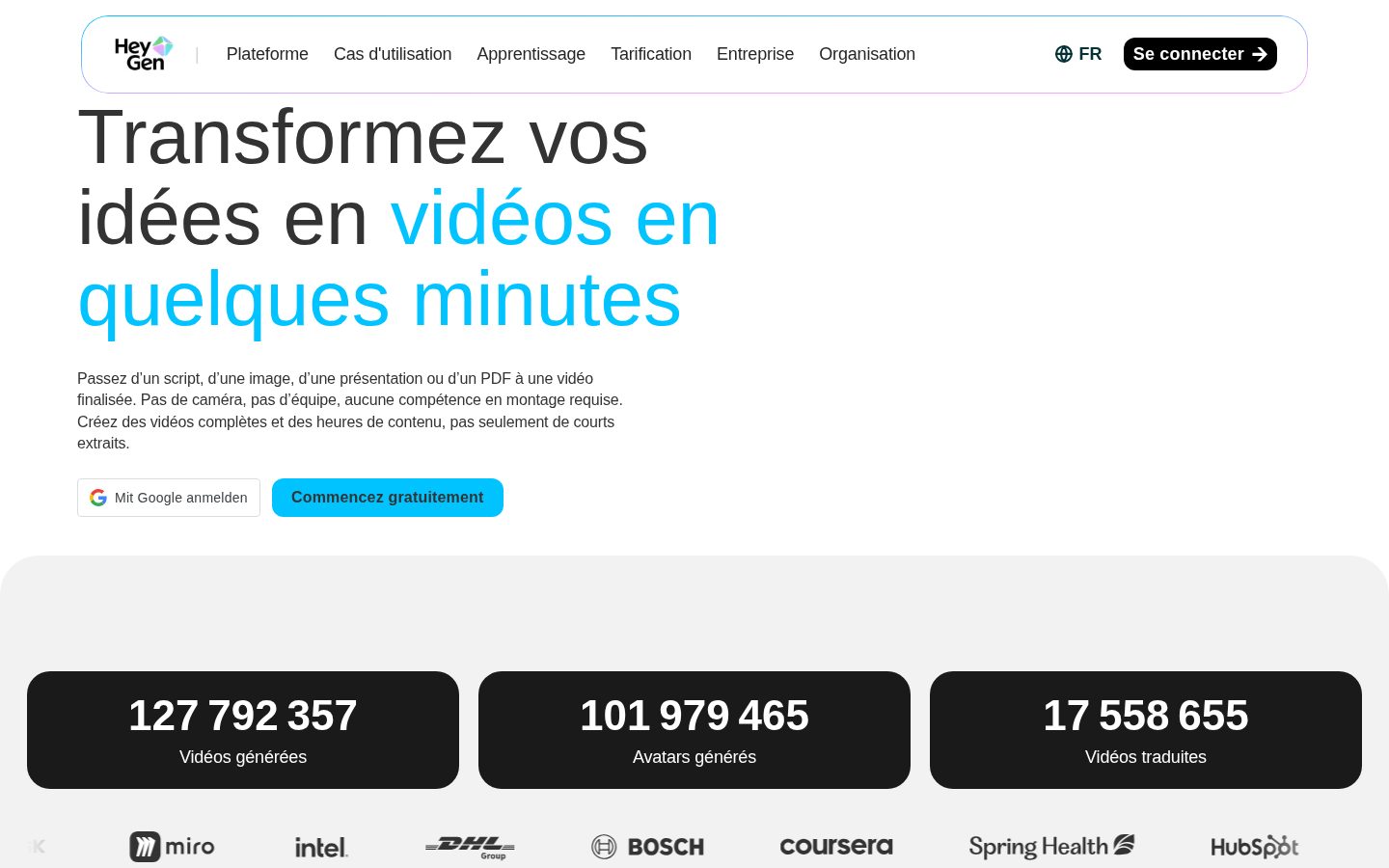
Yes, HeyGen has a free plan. The homepage prominently displays a "Commencez gratuitement" (Start for free) option with no camera, editing software, or production skills required.

Also in AI Video Generation