Eleven Labs logo

Eleven Labs Review

Visit

AI voice synthesis and cloning platform for realistic speech generation

ElevenLabs is an AI platform that generates realistic synthetic voices and clones existing voices from audio samples.

AI Panel Score

8.3/10

6 AI reviews

Reviewed

AI Editor Approved

About Eleven Labs

ElevenLabs is an artificial intelligence company that specializes in voice synthesis and cloning technology. The platform uses advanced machine learning models to generate highly realistic synthetic speech that closely mimics human vocal patterns, intonation, and emotional expression.

The service offers two primary capabilities: text-to-speech conversion using pre-built AI voices, and voice cloning that can replicate a person's voice from audio samples. Users can input text and generate speech in multiple languages, with the ability to control various parameters like stability, clarity, and emotional tone. The voice cloning feature requires only a few minutes of audio to create a synthetic version of someone's voice.

ElevenLabs targets content creators, game developers, audiobook producers, filmmakers, and businesses looking to add voice capabilities to their applications. The platform serves industries including entertainment, education, accessibility services, and marketing, where high-quality synthetic speech can replace or supplement human voice recording.

The company operates in the growing AI voice synthesis market, competing with services like Murf, Speechify, and traditional text-to-speech providers. ElevenLabs differentiates itself through the quality and emotional expressiveness of its generated voices, as well as its voice cloning capabilities that require minimal training data compared to traditional methods.

Features

AI

  • AI Image & Video Generation

    Creates or edits images and turns ideas into videos using leading models including Veo, Sora, Wan, Kling, and Seedance.

  • Music API

    Generates studio-grade music tracks using natural language prompts in any genre, style, or structure, trained on licensed data suitable for commercial use.

  • Sound Effects Generation

    Creates custom sound effects, soundscapes, and ambient audio, or allows searching an existing SFX library.

  • Speech to Text API

    Transcribes audio using the Eleven Scribe model with 98% accuracy, supporting speaker diarization and character-level timestamps.

  • Text to Speech API

    Converts text to speech using models optimized for consistency, latency, or emotional control across 29+ languages, with options including Eleven Flash (75ms latency), Eleven Multilingual, and Eleven v3.

  • Voice Cloning

    Clones a replica of a user's own voice, allows designing a voice from a prompt, or provides access to thousands of voices from a library.

Analytics

  • Agent Analytics

    Measures agent success rates and customer experience metrics, enabling optimization of conversation flows over time.

Automation

  • Agent Testing

    Simulates real-world conversations to validate that agents behave as expected before deployment.

  • Agent Workflows

    Handles complex conversation flows, applies business logic, and connects securely to external systems.

  • ElevenAgents

    Configures, deploys, and monitors conversational AI agents that operate across voice, chat, email, and WhatsApp in 70+ languages with ultra-low latency.

Security

  • Agent Guardrails

    Establishes behavioral and compliance rules that keep agent responses aligned with policy.

  • Content Moderation

    Actively monitors content generated with ElevenLabs technology and enforces consequences for misuse, with AI-generated audio provenance tracking.

Preview

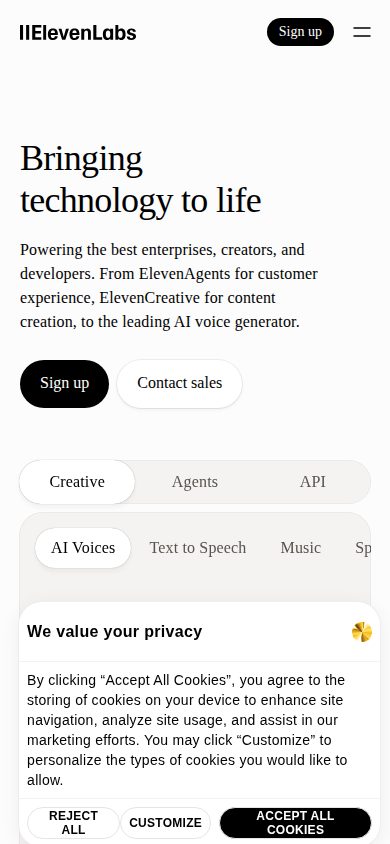
Eleven Labs desktop previewEleven Labs mobile preview

Pricing Plans

Free

Free

Build for free with basic features

  • 10k credits per month
  • Text to Speech, Speech to Text, Sound Effects
  • Voice Design & Music
  • 3 Projects in Studio
  • Image & Video

Starter

$6/monthly

For those who need commercial use and more projects

  • 30k credits per month
  • Commercial License
  • Instant Voice Cloning
  • 20 Projects in Studio
  • Music commercial use
Popular

Creator

$11/monthly

Popular plan for creators needing professional voice cloning

  • 121k credits per month
  • Professional Voice Cloning
  • Additional Credits
  • Everything in Starter
  • First month 50% off ($22 thereafter)

Pro

$99/monthly

For professionals needing high-quality audio output via API

  • 600k credits per month
  • 44.1kHz PCM audio output via API
  • 192kbps quality audio
  • Everything in Creator

Scale

$299/monthly

For businesses needing team collaboration and more voices

  • 1.8M credits per month
  • 3 Workspace seats
  • Team Collaboration
  • 3 Professional Voice Clones
  • Everything in Pro

Business

$990/monthly

For larger teams needing low-latency TTS and more seats

  • 6M credits per month
  • 10 Workspace seats
  • 10 Professional Voice Clones
  • Low-latency TTS as low as 5c/minute
  • Everything in Scale

Enterprise

Contact sales

Custom solution for large organizations with advanced needs

  • Custom number of credits and seats
  • Custom SSO
  • BAAs for HIPAA customers
  • Custom DPA/SLA terms
  • Elevated concurrency limits
  • Priority support

AI Panel Reviews

The Decision Maker

The Decision Maker

Strategic bet, vendor viability, timing, adoption approval
8.5/10

ElevenLabs at $330M ARR isn't the vendor-risk question — it's whether voice stays standalone.

ElevenLabs crossed $330M ARR with enterprise now 51% of revenue, so the existence question is closed. The harder call is whether voice synthesis stays a standalone procurement or gets bundled into the next OpenAI platform release.

ElevenLabs crossed $330M ARR by January 2026 — up 175% from $120M a year earlier. That settles the vendor-existence question. The harder call is whether voice synthesis is a standalone procurement or a feature OpenAI bundles into the next platform release.

The repositioning under Mati Staniszewski is ElevenAgents and the Eleven Scribe transcription layer, not the voice cloning that made the brand. a16z and ICONIQ co-led the $180M Series C at $3.3B in January 2025, and enterprise now runs 51% of revenue. Murf and Speechify never made that pivot.

The catch is the credit model. Pricing reads simple at $5 Starter and $11 Creator, but Pro at $99 and Scale at $299 burn through credits faster than seat math suggests on long-form audio. Run a 60-day Eleven v3 pilot on one production show. Don't standardize until the credit burn-rate prices out cleanly.

Competitive Positioning8.3

Clear leader versus Murf and Speechify on quality and breadth, but OpenAI and Google voice bundling is the medium-term threat.

Reputation Risk8.5

Backed by a16z, ICONIQ, NEA, and Sequoia with public enterprise logos — defensible to any board without a memo.

Speed to Value8.0

Free tier and $5 Starter let teams ship inside a week before procurement gets involved.

Strategic Fit8.2

ElevenAgents and Eleven Scribe extend the platform beyond voice cloning into agent and transcription workloads enterprises actually buy.

Vendor Viability9.0

$330M ARR by January 2026 with 580 employees and a $3.3B Series C close in January 2025 closes the runway question.

Pros

  • $330M ARR by January 2026, up 175% year-over-year — vendor-existence question is closed.
  • ElevenAgents and Eleven Scribe extend the platform beyond voice cloning into agent and transcription workloads.
  • Free tier and $5 Starter let teams pilot before any procurement conversation starts.
  • Enterprise revenue now exceeds consumer at 51%, signaling the upmarket motion is real.

Cons

  • Credit-based pricing burns faster than seat math suggests on long-form audio production.
  • OpenAI and Google bundling voice into broader platforms is the real medium-term pricing pressure.
  • Pro tier jumps from $11 Creator to $99 — the middle of the curve is awkward for small teams.

Right for

Content teams who need production-grade voice synthesis at scale.

Avoid if

Operators who only need basic text-to-speech for occasional internal use.

The Domain Strategist

The Domain Strategist

Craft and strategy in the product's domain — adapts identity per category, same lens
8.5/10

ElevenLabs went from cloning lab to the voice substrate, and Eleven v3 is the craft ceiling move.

Eleven v3 went GA in February 2026 with audio tags and 70+ languages, the same week the Series D closed at an $11 billion valuation. For any audio leader committing a brand voice library here, the question is whether the dubbing pipeline and the agent stack stay legibly separable in three years.

Eleven v3 shipped GA in February 2026 with inline audio tags — [whispers], [laughing], [sighs] — and 70+ languages, trained for prosody not just intelligibility. That's the craft ceiling move. Cartesia and Hume AI have shipped real expressive models, but the v3 catalog plus the cloning library is a different scale of asset.

The platform now wraps Scribe at 98% transcription accuracy, the Music API on licensed training data, and ElevenAgents on omnichannel voice. An $11 billion valuation and $500M ARR by April 2026 fund all four lanes. Pro at $99/month with 44.1kHz PCM is where most studios will land.

The catch is concentration. A brand voice library, dubbing pipeline, agent runtime, and music bed on one closed API is a single vendor decision dressed as four. Worth committing if voice quality is the moat. Keep a Cartesia fallback if latency or licensing is the hinge.

Category Positioning9.0

$500M ARR by April 2026 and an $11 billion Series D valuation make this the category-leader bet in voice AI.

Domain Fit8.5

Covers TTS, Scribe STT at 98% accuracy, Music API, and ElevenAgents — the full audio production pipeline an audio team works inside.

Integration Surface8.2

Broad API plus Python, JavaScript, and React SDKs land cleanly, with omnichannel agent surfaces across phone, chat, email, and WhatsApp.

Long-term Implications7.5

Closed API only and concentration of voice, dubbing, agents, and music on one vendor creates an exit cost few buyers will model on day one.

Strategic Depth9.0

Eleven v3 with audio tags and 70+ languages is best-in-class expressive TTS, ahead of Cartesia and Hume on catalog scale.

Pros

  • Eleven v3 with inline audio tags ships best-in-class prosody and emotional range across 70+ languages.
  • Full audio stack — TTS, Scribe transcription, Music API, ElevenAgents — covers the production pipeline end to end.
  • Pro plan at $99/month delivers 44.1kHz PCM API audio that most studios will accept as master quality.
  • Category-leader signals are real — $500M ARR by April 2026 and an $11B Series D back the roadmap.

Cons

  • Closed API only — no self-hosting or weight access for regulated or air-gapped workflows.
  • Concentrating voice library, dubbing, agents, and music on one vendor creates a single exit cost.
  • Credit-based pricing makes long-form audiobook and dubbing TCO harder to forecast than per-minute models.

Right for

Studios and enterprises who need the deepest expressive voice library in 70+ languages.

Avoid if

Teams who need on-prem deployment or self-hosted weights.

The Finance Lead

The Finance Lead

Money, total cost of ownership, contracts, procurement math
7.9/10

$5/month unlocks commercial rights at ElevenLabs — Murf charges $19, PlayHT closed entirely.

Seven tiers, all visible without a sales call, from Free to Business at $990/month. The credit system makes usage cost predictable, but Professional Voice Cloning sits behind the $22 Creator tier.

PlayHT shut down December 31, 2025. That's the relevant comparable. ElevenLabs raised $500M at $11B in February and reported $330M ARR — vendor risk is lowest in the category. Starter is $5/month for 30K credits and commercial rights.

Run the math: 50 creators on Creator at $22 × 12 = $13,200/year. Each gets 100K credits — roughly 100 minutes of Multilingual v2 output. Murf's Business tier is $39 for four flat hours. ElevenLabs charges per character; Murf charges per minute. Pick the model that matches your usage shape.

The catch is overage. No published per-character rate above tier limits — you renegotiate or upgrade. Professional Voice Cloning gates at Creator. Business at $990 unlocks low-latency TTS at 5¢/minute, but that's the only enterprise number published without a sales call.

Billing & Procurement7.7

Self-serve checkout up to $990/month removes procurement friction below the enterprise threshold.

Contract Flexibility7.5

Monthly billing is standard self-serve through Business at $990; Enterprise terms are opaque.

Pricing Transparency8.5

Seven tiers from Free to $990 Business are fully published; only Enterprise is gated behind sales.

ROI Clarity7.8

10K credits ≈ 10 minutes of Multilingual v2 makes cost-per-output measurable per workflow.

Total Cost of Ownership7.6

Credit-to-minute conversion is published, but no per-character overage rate creates year-3 forecasting risk.

Pros

  • Seven pricing tiers fully published from Free to $990/month — only Enterprise is gated.
  • Starter at $5 unlocks commercial rights — Murf charges $19, PlayHT closed entirely.
  • $330M ARR and $11B February valuation make vendor durability a non-issue.
  • Credit-to-minute conversion is published, so cost forecasting is straightforward.

Cons

  • No published per-character overage rate above tier limits — that is the invoice you can not predict.
  • Professional Voice Cloning gates at the $22 Creator tier; Starter only includes Instant Voice Cloning.
  • Enterprise pricing is sales-only — no published rate for SSO, BAA, or custom DPA terms.

Right for

Teams who need predictable credit-based pricing for high-volume voice generation.

Avoid if

Buyers who think in minutes rather than characters.

The Domain Practitioner

The Domain Practitioner

Daily hands-on reality in the product's domain — adapts identity per category, same lens
8.7/10

Flash v2.5 hits 75ms latency over WebSocket — the rare TTS that survives an agent's turn-taking loop.

ElevenLabs ships three TTS models tuned for different jobs — Flash v2.5 for agents, Eleven v3 for narration. The credit system and per-tier API gating still make rate planning a spreadsheet exercise.

Flash v2.5 ships ~75ms model inference over a streaming WebSocket. For a voice agent, that's the difference between a turn-taking loop that feels human and one where the user talks over the bot. Cartesia's Sonic at 90ms is close, but Eleven's 5,000+ stock voices win the cloning workflow.

The credit system is where the daily fight starts. 1 character equals 1 credit on Multilingual v2; Flash bills around half. Creator at $22/month gets 121K credits — fine for a podcast, brutal for a production agent fielding 200 calls a day. The API tier ladder is separate from the UI ladder.

Voice Library and Projects are the producer's win — drop a script, route to a cloned voice, export per-segment. The catch: Eleven v3 is the new flagship but doesn't stream in real time, so agents stay on Flash. Sequoia's $500M Series D at $11B in February 2026 is the durability signal.

Competitive Positioning8.7

Eleven v3 and 5,000+ voices across 70+ languages outpace Cartesia, PlayHT, and Murf on quality and breadth combined.

Reputation Risk8.5

Backed by a16z, Sequoia, ICONIQ, and Nvidia with 4.8/5 from 7,415 schema-rated reviews — defensible at any board meeting.

Speed to Value8.5

REST API, WebSocket streaming, SDKs, and a $5 Starter tier mean a working prototype ships in an afternoon.

Strategic Fit8.5

Best-in-class voice synthesis with a real-time path makes it the obvious pick for any product adding voice features.

Vendor Viability9.0

Sequoia-led $500M Series D at $11B valuation in February 2026 with Nvidia backing puts viability beyond reasonable doubt.

Pros

  • Flash v2.5 hits ~75ms latency over WebSocket — production-ready for real-time voice agents.
  • Voice Library spans 5,000+ stock voices across 70+ languages — broader than any direct competitor.
  • Starter at $5 and Creator at $22 let you prototype before committing to API Pro at $99.
  • Sequoia-led $500M Series D at $11B in February 2026 signals long-term durability.

Cons

  • Eleven v3 is the new flagship but doesn't support real-time streaming, forcing agents back to Flash.
  • Separate UI and API tier ladders make capacity planning a spreadsheet exercise.
  • Credit math gets brutal at scale — a busy production agent burns Creator's 121K monthly allotment in days.

Right for

Backend developers who integrate real-time voice agents into customer products.

Avoid if

Hobbyists who only need occasional short narrations under the free tier.

The Power User

The Power User

Daily human experience, onboarding, polish, learning curve, reliability
8.1/10

ElevenLabs nails the voice quality, but Eleven v3 can't run real-time and that catches teams off guard.

The Voice Library and Instant Voice Cloning are the parts that hook you in the first ten minutes. The catch is choosing between Eleven v3's expressiveness and Flash v2.5's 75ms latency — they're not the same model.

The Voice Library is the small thing the team sweated. Type a phrase, scrub through five thousand voices, hear the difference in seconds. Murf makes you commit before previewing at depth. The Free tier gives you 10k credits a month and lets Instant Voice Cloning go from a 30-second sample to playable output without a credit card. That's a generous welcome.

Day thirty is when the model picker matters. Eleven v3 went GA in March 2026 with Audio Tags for emotional beats — laughs, sighs, whispers — but it can't stream. Flash v2.5 streams at 75ms and runs your real-time agents, but it's flatter. You pick once, or you build two pipelines.

The catch is the credit math. 10k credits is roughly ten minutes of Eleven v3 audio, which evaporates by Wednesday on Free. Starter at $6 lifts you to 30k. Workable, but the grace period is short.

Daily Polish8.2

The Voice Library lets you scrub through five thousand voices in-browser before committing to a clone.

Learning Curve7.6

The Eleven v3 versus Flash v2.5 model picker is genuinely confusing past the first week.

Mobile Parity7.5

Backend voice API where mobile is downstream consumption, not a primary surface to evaluate.

Onboarding Experience8.4

Free tier with 10k credits and no credit card means Instant Voice Cloning is testable in minutes.

Reliability Feel8.0

Used by Twilio and Salesforce in production, with Eleven Scribe holding 98% transcription accuracy.

Pros

  • Voice quality and emotional range remain best-in-class across the synthesis market.
  • Free tier with 10k monthly credits and no credit card lets you test Instant Voice Cloning in minutes.
  • Eleven Scribe transcription hits 98% accuracy with speaker diarization built in.
  • Pricing tiers from $6 to $990 cover hobbyist through enterprise without weird gaps.

Cons

  • Eleven v3 can't stream, so real-time and emotional expressiveness need separate pipelines.
  • Credit math gets expensive fast for long-form audio production on lower tiers.
  • Professional Voice Cloning requires ID verification, which adds friction for legitimate fast use cases.

Right for

Content creators who need lifelike AI voiceover at low cost.

Avoid if

Teams who need streaming voice with full emotional expressiveness.

The Skeptic

The Skeptic

Contrarian. Watch-outs, deal-breakers, broken promises, category patterns
7.9/10

ElevenLabs hit $11 billion in February — past where most voice-AI vendors quietly pivoted.

$500M Series D at $11B in February 2026 with $330M ARR closing 2025 puts ElevenLabs past the voice-AI graveyard threshold. The yellow flag is the Vacker/Boyett voice-actor lawsuit — voice cloning's moat is now partly a consent-and-licensing question.

Voice AI was supposed to be a graveyard category. Most of the 2023 cohort either pivoted or went quiet. ElevenLabs is the one that ran — $500M Series D at $11B in February, $330M ARR closing 2025. That's distribution, not pitch math.

Eleven v3 and Eleven Scribe (98% transcription accuracy) are real product, not roadmap. The Music API trained on licensed data is the move that separates them from Suno's copyright fight. Creator at $11/month with Professional Voice Cloning is where actual creators land, not the $99 Pro tier.

But the yellow flag is the Vacker/Boyett lawsuit — two audiobook narrators allege the 'Bella' and 'Adam' voices were cloned from their work without consent. ElevenLabs pulled 'Bella.' Voice cloning's moat is a consent question now, not just a model question.

Competitive Differentiation8.0

Clear quality lead over Murf and Speechify; Music API's licensed-data stance differentiates from Suno.

Exit Portability7.0

API outputs are standard audio formats but custom-cloned voices don't port to any competitor.

Long-term Viability8.4

$11B valuation in February 2026, $330M ARR, IPO-track signaling and active shipping cadence.

Marketing Honesty7.8

Claims like 5,000+ voices in 70+ languages match the docs; some safety language is vaguer than the product.

Track Record Match8.2

Survived the 2023 voice-AI cohort and pulled to Series D while peers pivoted — strongest signal in the category.

Pros

  • Series D in February 2026 at $11B valuation with $330M ARR — strongest survival signal in voice AI.
  • Eleven Scribe ships 98% transcription accuracy, putting STT and TTS in one stack.
  • Music API trained on licensed data sidesteps the copyright exposure Suno carries.
  • Creator at $11 per month is genuinely usable, not bait-and-upgrade pricing.

Cons

  • Vacker/Boyett lawsuit alleges voice clones were trained on unconsented audiobook narrations.
  • Voice cloning has no clean exit — a custom voice doesn't port to a competitor.
  • Studio quality at 44.1kHz and 192kbps only unlocks at the $99 Pro tier.

Right for

Creators who need broadcast-quality synthetic voices.

Avoid if

Teams who need on-prem deployment for compliance.

Buyer Questions

Common questions answered by our AI research team

Features

What is the difference between Instant Voice Cloning on the Starter plan and Professional Voice Cloning on the Creator plan?

The content only mentions that Instant Voice Cloning is available on the Starter plan and Professional Voice Cloning is available on the Creator plan, but does not explain the specific technical differences between the two cloning types.

Pricing

Does the Pro plan's 44.1kHz PCM audio output and 192kbps quality apply to both the API and Studio, or only one of them?

Based on the pricing page, the 192kbps quality audio applies to both Studio and API — it is listed as '128 & 192 kbps (via Studio & API), 44.1kHz' for the Pro plan.

Security

How does ElevenLabs ensure AI-generated audio is identifiable, and what content moderation measures are in place?

ElevenLabs states three safety measures: Moderation (actively monitoring content generated with their technology), Accountability (misuse must have consequences), and Provenance (users should know if audio is AI-generated). These are listed as built-in safety features on the homepage.

Setup

Can ElevenAgents be deployed across phone, WhatsApp, and chat simultaneously, or do those require separate configurations?

The content states that omnichannel agents 'listen, read and interact just like humans would across phone, chat, email and WhatsApp,' implying simultaneous multi-channel capability, but does not specify whether separate configurations are required for each channel.

Integration

Which specific enterprise platforms like Twilio or Salesforce does ElevenLabs integrate with for deploying voice agents?

The content lists Twilio and Salesforce as trusted enterprises/developers on the homepage, but does not specify the nature of integrations for deploying voice agents with these or other platforms.

Also in AI Voice & Speech