HiddenLayer logo

HiddenLayer Review

Visit

Security platform for AI models, agents, and applications

HiddenLayer is a security platform for detecting and defending against threats to AI models and applications.

AI Panel Score

6.9/10

6 AI reviews

Reviewed

AI Editor Approved

About HiddenLayer

HiddenLayer works by first building an inventory of the AI models, applications, and assets in an organization's environment, then scanning those assets for vulnerabilities as they are built and deployed. Security teams use the platform to run continuous attack simulations against their AI systems, validating whether existing defenses hold up under adversarial testing. A runtime component, described as a firewall, sits in front of agentic and generative AI applications to monitor traffic, detect adversarial inputs, and respond to attacks as they happen.

The platform is organized around four core capabilities: AI Discovery, AI Supply Chain Security, AI Attack Simulation, and AI Runtime Security. Named use cases include model scanning to detect risks in third-party and proprietary models, red teaming to identify threats and validate defenses, AI guardrails for policy-based controls against misuse and data leakage, and protection for agentic and MCP (Model Context Protocol) systems against rogue autonomous behavior. HiddenLayer offers pre-built integrations into CI/CD pipelines, MLOps tooling, data pipelines, and SIEM/SOAR systems for deployment inside existing security workflows. The company states its research has led to over 50 disclosed CVEs and more than 30 issued patents.

} Wait, correcting formatting error below.

Features

Analytics

  • AI Threat Landscape Reporting

    Delivers quarterly research reports analyzing how AI threats and attack surfaces are evolving.

Core

  • AI Discovery

    Identifies and builds an inventory of the AI applications, models, and assets present in an organization's environment.

Customization

  • Role and Industry-Specific Solutions

    Offers tailored AI security guidance and controls for specific roles (CISO, AI Executives, Developers) and industries (Financial Services, US Federal, Technology).

Integration

  • Native Integrations

    Provides pre-built integrations into CI/CD, MLOps, Data Pipelines, and SIEM/SOAR tools for simplified deployment.

Security

  • AI Attack Simulation

    Continually identifies threats and validates defenses to safeguard agentic and generative AI applications at scale.

  • AI Guardrails

    Applies policy-based controls to prevent misuse, data leakage, and adversarial attacks on AI systems.

  • AI Runtime Security (Firewall)

    Monitors, detects, and responds in real time to adversarial threats targeting agentic and generative AI applications.

  • AI Supply Chain Security

    Analyzes, identifies risks in, and protects AI applications, models, and assets throughout the build process.

  • Agentic and MCP Protection

    Safeguards autonomous AI systems and protects against rogue or unintended agent behavior.

  • Model Scanning

    Detects hidden risks and vulnerabilities in third-party and proprietary AI models before deployment.

  • Red Teaming

    Identifies AI threats early and continuously validates the effectiveness of security defenses.

Preview

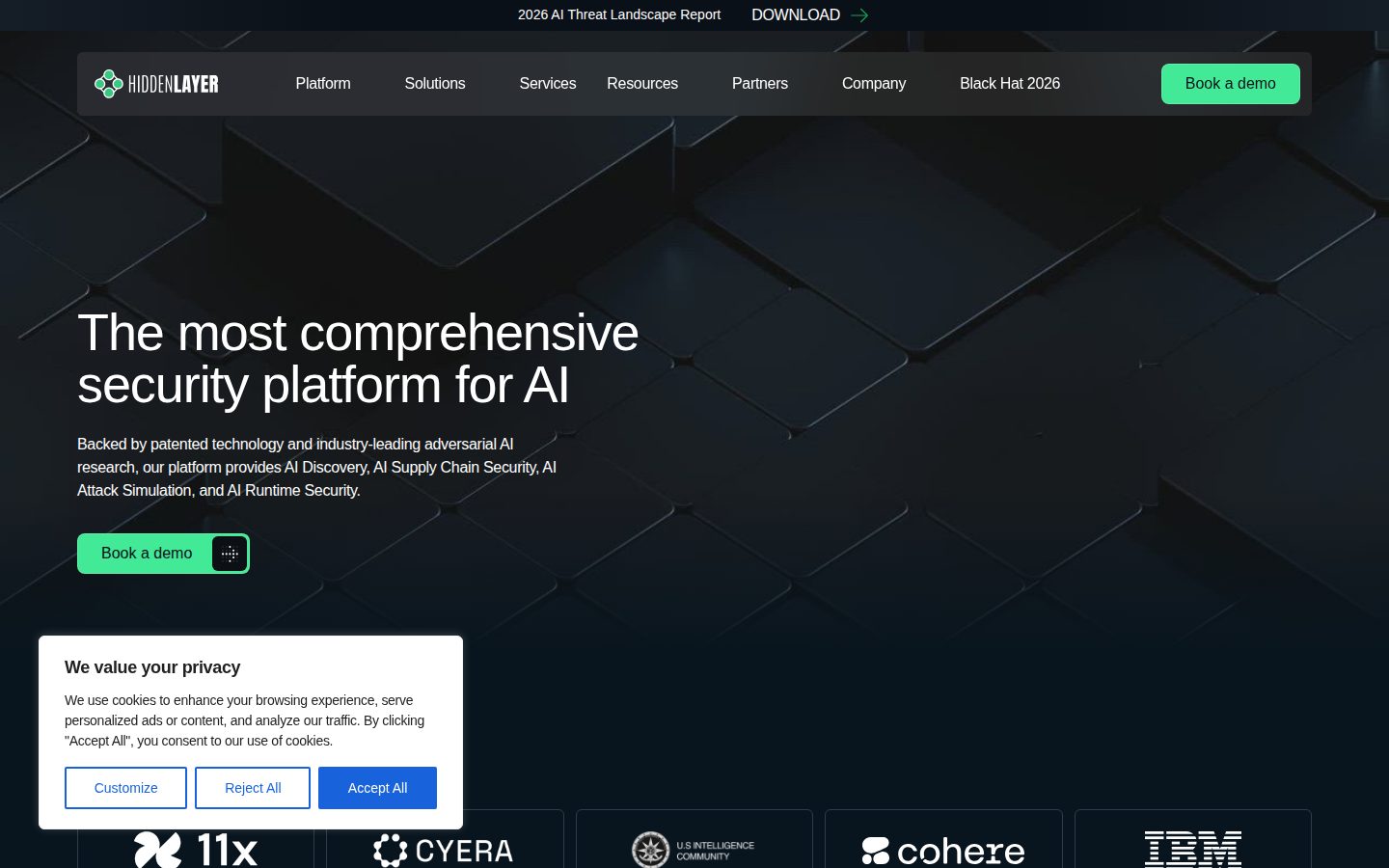
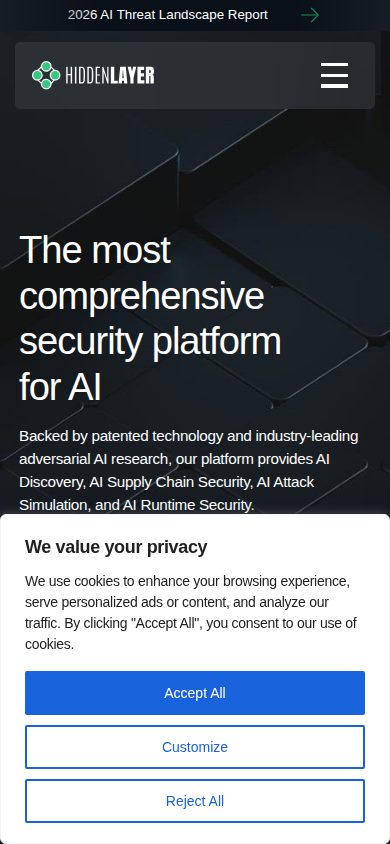
HiddenLayer desktop previewHiddenLayer mobile preview

Pricing Plans

Contact Sales

Contact sales

This page returned a 404 error and contained no pricing tiers or plan details; HiddenLayer's pricing is not publicly listed and requires contacting sales or booking a demo.

AI Panel Reviews

The Decision Maker

The Decision Maker

Strategic bet, vendor viability, timing, adoption approval
7.6/10

Real category, real research depth, but pricing opacity means the board sees a black box.

50 disclosed CVEs and 30 patents say this team actually breaks AI systems for a living. No public pricing and no free trial mean you're negotiating blind.

Four modules: Discovery, Supply Chain Security, Attack Simulation, Runtime Security. That's a full-lifecycle pitch, not a point tool, and the CVE count backs up the research claim.

Two things worry me. One: pricing page 404s, so every deal starts as a black-box negotiation. Two: agentic and MCP protection is brand new territory — Protect AI and Robust Intelligence (now Cisco) are circling the same space, and nobody has three years of runtime data yet.

Non-invasive firewall claim is smart positioning for security teams wary of touching model weights. This is a category that's about to matter a lot. Pilot it against one production agent workload before you sign anything company-wide.

Competitive Positioning8.0

Competes directly with Protect AI and Cisco's Robust Intelligence in a category still forming its winners.

Reputation Risk7.5

Gartner-recognized positioning reads as credible to a board, though sales-only pricing raises internal scrutiny.

Speed to Value6.5

Pre-built CI/CD, MLOps, and SIEM integrations shorten deployment, but no trial means no fast proof point.

Strategic Fit8.0

Agentic and MCP protection addresses a gap most security stacks don't cover yet, per the named use cases.

Vendor Viability7.0

50+ CVEs and 30 patents signal real research muscle, but no funding or team size disclosed in evidence.

Pros

  • Four-module lifecycle coverage from inventory to runtime defense
  • 50+ disclosed CVEs and 30 patents evidence real research depth
  • Non-invasive runtime firewall doesn't require access to sensitive model data
  • Native CI/CD, MLOps, and SIEM/SOAR integrations ease deployment

Cons

  • No public pricing, no free trial — every evaluation starts with a sales call
  • Agentic and MCP protection is unproven at scale industry-wide
  • Competes with Protect AI and Cisco's Robust Intelligence in a still-forming market

Right for

Security teams running production agentic or generative AI who need supply-chain scanning and runtime defense in one platform.

Avoid if

Skip if you need transparent pricing or a self-serve trial before committing budget.

The Domain Strategist

The Domain Strategist

Craft and strategy in the product's domain — adapts identity per category, same lens
7.9/10

Full-lifecycle AI security with real research depth, but no pricing transparency and a firewall claim I'd still want to pressure-test

HiddenLayer covers discovery through runtime defense with 50+ disclosed CVEs backing their research credibility. That's rare in a category full of vaporware, but enterprise procurement still runs into an opaque sales-only pricing model.

Four modules — Discovery, Supply Chain Security, Attack Simulation, Runtime Security — map cleanly onto how I'd actually structure an AI risk program: know what you have, vet what you import, test it, defend it live. Fifty-plus disclosed CVEs and 30+ patents is the kind of research signal that separates a security vendor from a compliance checkbox vendor like some of the model-governance-only players (Credo AI, for instance, stops well short of runtime defense).

The MCP and agentic protection use case is timely — most of my peers don't have a real answer for rogue agent behavior yet, and HiddenLayer naming it directly is a point in their favor. The "non-invasive, no data access" claim on the runtime firewall is attractive for a CISO worried about adding another party with model access, but it's also the kind of claim I'd need in the SOW, not the marketing copy.

Three-year risk: contact-only pricing means budget forecasting is opaque, and CI/CD, MLOps, SIEM/SOAR integrations are pre-built but unverified in production at scale.

Category Positioning8.0

Gartner-recognized and ahead of governance-only competitors like Credo AI on runtime and adversarial coverage.

Domain Fit8.0

Lifecycle coverage from inventory through runtime matches how mature AI risk programs are actually structured.

Integration Surface7.8

Native CI/CD, MLOps, and SIEM/SOAR integrations are named, but no public docs or API reference to verify depth.

Long-term Implications7.5

Sales-only pricing with no published tiers makes 3-year budget planning and renegotiation leverage harder to model.

Strategic Depth8.3

50+ disclosed CVEs and 30+ patents indicate genuine offensive research, not repackaged model-risk scoring.

Pros

  • Full lifecycle coverage from discovery to runtime defense in one platform
  • Strong disclosed research track record (50+ CVEs, 30+ patents)
  • Dedicated agentic/MCP protection ahead of most competitors

Cons

  • No public pricing — every deal starts as a sales negotiation
  • No visible docs, API reference, or changelog to vet integration depth pre-sale
  • Runtime firewall's non-invasive claim needs contractual verification, not just marketing language

Right for

Enterprises running production agentic or generative AI that need lifecycle coverage from model inventory through real-time runtime defense.

Avoid if

Avoid if you need transparent, self-serve pricing to build a defensible security budget without a sales cycle.

The Finance Lead

The Finance Lead

Money, total cost of ownership, contracts, procurement math
5.8/10

Zero pricing data. Zero tiers. One 404 page where the pricing table should be.

HiddenLayer sells four security modules with real depth — Discovery, Supply Chain, Attack Simulation, Runtime. But the number that matters, the invoice, doesn't exist anywhere public.

No pricing page. Literally — the evidence shows a 404. Contact sales is the only door in.

That means TCO modeling starts blind. Compare to Protect AI or Robust Intelligence-style competitors: also enterprise-sales-only, so HiddenLayer isn't unusual, just unhelpful for budgeting. 50 disclosed CVEs and 30 patents signal real research depth. Doesn't tell finance what year 1 costs, let alone year 3 with seat or model-volume growth.

Four modules — Discovery, Supply Chain, Attack Simulation, Runtime — each could be bundled or metered separately. No public tier structure means no way to know if agentic/MCP protection is add-on or included. Procurement will need a signed NDA before seeing a number. Budget for a long sales cycle, not a fast PO.

Billing & Procurement4.0

Sales-call-only onboarding, no self-serve path, standard enterprise procurement friction.

Contract Flexibility5.0

No public contract terms; category norm is annual enterprise deals with limited negotiation room pre-scale.

Pricing Transparency2.0

Pricing page returns a 404; no tiers, no starting price, contact-only.

ROI Clarity6.5

50 disclosed CVEs and red-teaming validation give measurable defense-posture signals, unlike vaguer AI security pitches.

Total Cost of Ownership4.5

Four modules could scale cost independently but no published metering makes 3-year math a guess.

Pros

  • Four distinct modules covering full AI lifecycle, not just runtime
  • 50+ disclosed CVEs suggest real research credibility
  • Non-invasive runtime firewall avoids sensitive data access per docs

Cons

  • No public pricing, tiers, or starting cost anywhere
  • Pricing page returns a 404 — not just hidden, broken
  • No free trial, so no way to test before the sales call

Right for

Enterprise security teams with budget authority who can absorb a long sales cycle.

Avoid if

Avoid if you need a comparable number before your first call with sales.

The Domain Practitioner

The Domain Practitioner

Daily hands-on reality in the product's domain — adapts identity per category, same lens
7.2/10

Model scanning and a runtime firewall for agentic AI, but pricing and docs are locked behind sales calls

HiddenLayer covers the full AI security lifecycle from model scanning to runtime defense, with real research behind it. But the day-to-day integration story is thin on public evidence.

50+ disclosed CVEs and 30+ patents is a real signal — this isn't a marketing team bolting 'AI security' onto a generic WAF. Model scanning for third-party models before deployment maps to a concrete supply-chain problem I actually lose sleep over: a compromised HuggingFace checkpoint in prod. The AIDR runtime firewall claiming no access to sensitive data is the right design for a security tool, since I don't want another vendor in my data path.

No public docs, no API reference, no pricing page — that 404 tells me evaluation starts with a sales call, not a sandbox. Compare that to how Wiz or even Cloudflare let you poke at capabilities before committing budget. SIEM/SOAR and CI/CD integrations are named but unverifiable without a demo environment.

Agentic and MCP protection is timely — most competitors are still catching up to non-deterministic agent behavior. Whether the guardrails generate alert fatigue at 3am is the real test, and nothing here answers that.

Day-3 Reality6.5

No trial or sandbox means day-3 experience is unverifiable from public evidence.

Documentation Practitioner-Fit5.8

No public docs, API reference, or changelog found in the scrape — can't assess practitioner depth.

Friction Surface6.8

Non-invasive firewall design is a friction win, but sales-gated onboarding adds upfront friction.

Power-User Depth7.8

Four-module architecture spanning discovery through runtime defense shows lifecycle depth beyond a point tool.

Workflow Integration7.5

Named CI/CD, MLOps, and SIEM/SOAR integrations suggest real workflow fit, though unproven publicly.

Pros

  • 50+ disclosed CVEs and 30+ patents back the research claims
  • Runtime firewall reportedly doesn't need access to sensitive data or models
  • Dedicated Agentic and MCP protection targets a genuinely current threat surface

Cons

  • No public pricing, docs, or API reference — evaluation requires a sales call
  • No free trial to test model scanning against your own supply chain before buying
  • Guardrail alert tuning and false-positive rates unverifiable from public materials

Right for

Security teams with agentic or MCP-based AI systems already in production who need supply-chain and runtime coverage in one platform.

Avoid if

You need to self-serve evaluate via docs or a sandbox before looping in procurement.

The Power User

The Power User

Daily human experience, onboarding, polish, learning curve, reliability
6.4/10

Serious security chops, but I can't tell you what a Tuesday with this thing actually looks like.

HiddenLayer's got the resume — 50-plus CVEs, 30-plus patents, four solid modules. But there's zero public evidence of what using it day to day feels like.

No pricing page (it 404s), no docs link, no free trial. That's not unusual for enterprise security tools that gate everything behind a demo call, same as Protect AI or Robust Intelligence in this space. But it means I'm grading the pitch, not the product.

The four-module setup — Discovery, Supply Chain Security, Attack Simulation, Runtime Security — reads coherent on paper. Model scanning and the non-invasive runtime firewall (their words: doesn't touch your sensitive data) are the kind of specific claims that suggest real engineering, not just marketing slides. Agentic and MCP protection is timely too, given how fast that surface is expanding.

Here's my actual problem: everything I'd want to know about the first hour, the tenth integration, the 2am false-positive alert fatigue — none of it's public. No changelog, no blog cadence, no user-facing docs. For a platform meant to sit inside CI/CD and SIEM/SOAR pipelines, that's a lot of trust to ask for sight-unseen.

Daily Polish5.5

No docs, changelog, or product screenshots publicly available to judge daily craft.

Learning Curve6.0

Four clearly named modules and pre-built CI/CD, MLOps, SIEM/SOAR integrations suggest a structured ramp for security teams already fluent in those tools.

Mobile Parity3.0

Platform listed as web-only; this is an ops/security console, so mobile isn't the point but there's no evidence of any companion access.

Onboarding Experience5.0

No free trial or self-serve path; onboarding is entirely sales-gated with no visible starter flow.

Reliability Feel6.5

50+ disclosed CVEs and 30+ patents signal real research depth, though no uptime or SLA data is public.

Pros

  • Four named modules cover full AI lifecycle from inventory to runtime defense
  • 50+ disclosed CVEs and 30+ patents back up the research claims
  • Runtime firewall reportedly works without touching sensitive customer data
  • Native integrations into CI/CD, MLOps, and SIEM/SOAR fit existing security workflows

Cons

  • No public pricing, free trial, or demo sandbox to kick the tires
  • No docs, changelog, or blog visible to judge product maturity over time
  • Sales-gated from step one, which is homework before you even see the product

Right for

Enterprise security teams with dedicated AI/ML risk budgets and a sales cycle they're already comfortable with.

Avoid if

You want to self-serve, see pricing upfront, or try before committing to a sales call.

The Skeptic

The Skeptic

Contrarian. Watch-outs, deal-breakers, broken promises, category patterns
6.7/10

"Most comprehensive" AI security platform, zero pricing page, zero docs link.

Solid category story on paper — 50 disclosed CVEs, 30 patents, four clean modules. But the site gives you nothing to verify it against, and that's a pattern I've seen before.

"The most comprehensive security platform for AI" is the H1. That's the kind of superlative I've learned to discount until proven otherwise — no docs, no API reference, no changelog visible on the site. For a security vendor, that's a real gap. You want to see how the runtime firewall actually behaves before buying it.

The substance is real, though. 50 disclosed CVEs and 30 patents is a specific, checkable claim, not vapor. Model scanning and MCP/agentic protection put them ahead of generic vendors like Protect AI on the agent-security angle specifically, though that space is filling fast.

Pricing is 'contact sales' with no tiers, no free trial. Fine for enterprise security, but it means no easy signal on how they scale down-market. Exit story is murky — SIEM/SOAR integrations help, but a runtime firewall in your AI traffic path isn't a drop-in swap after 18 months.

Competitive Differentiation7.2

MCP and agentic-specific protection is a real gap versus broader players like Protect AI or Robust Intelligence's old positioning.

Exit Portability5.5

Runtime firewall sits inline on agentic traffic; no migration tooling or export story mentioned anywhere.

Long-term Viability7.0

Gartner-recognized status and research output are strong signals, but no funding figures or team size disclosed.

Marketing Honesty5.8

"Most comprehensive" claim with no docs, API, or pricing page to substantiate it.

Track Record Match7.0

50 CVEs and 30 patents is a verifiable research signal, matching credible security vendors, not vaporware pitches.

Pros

  • 50 disclosed CVEs and 30 patents back the research claims
  • Dedicated MCP/agentic protection ahead of most category peers
  • Non-invasive runtime firewall design avoids data access concerns

Cons

  • No pricing page, docs, or API reference visible
  • Contact-sales-only model with no free trial to test claims
  • Inline runtime component makes an 18-month exit non-trivial

Right for

Enterprise security teams with budget for a sales cycle and real AI supply chain exposure.

Avoid if

You want to self-serve, see pricing upfront, or test drive before committing.

Buyer Questions

Common questions answered by our AI research team

Features

What are HiddenLayer's four core security modules?

HiddenLayer's platform is built on four core modules: AI Discovery, AI Supply Chain Security, AI Attack Simulation, and AI Runtime Security, covering the full AI lifecycle from inventory to real-time defense.

Security

Does HiddenLayer scan third-party AI models for risks?

Yes, model scanning detects hidden risks in both third-party and proprietary AI models before they're deployed, identifying vulnerabilities and hidden threats in the AI supply chain.

Features

Can HiddenLayer protect agentic and MCP-based systems?

Yes, HiddenLayer includes Agentic and MCP Protection as a dedicated use case, safeguarding autonomous systems and protecting against rogue behavior.

Integration

What integrations does HiddenLayer support for CI/CD?

HiddenLayer offers native, pre-built integrations into CI/CD pipelines, along with MLOps, Data Pipelines, and SIEM/SOAR tools for simplified deployment.

Security

Does HiddenLayer's runtime firewall need access to my data?

No, HiddenLayer's AIDR runtime firewall is non-invasive and provides real-time protection against adversarial attacks without needing to access a customer's sensitive data or proprietary models.

Also in AI Security