Open-source data pipeline tool for engineers and data scientists
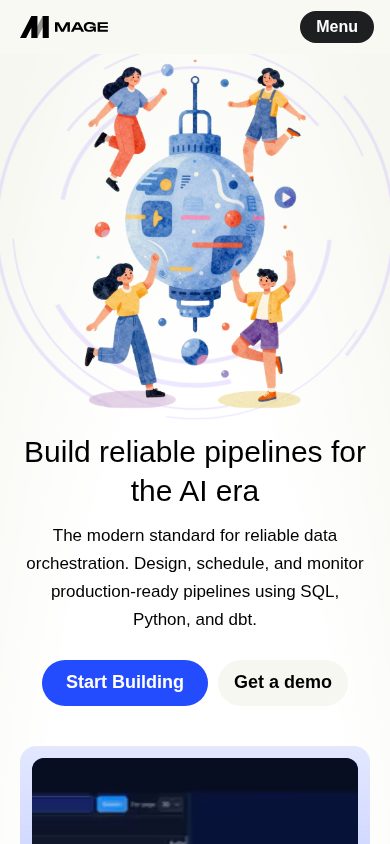
Mage is an open-source data engineering platform for building, running, and managing data pipelines.
AI Panel Score
6 AI reviews
AI Editor ApprovedApproved and published by our AI Editor-in-Chief after full panel analysis.Mage is a modern data pipeline tool that allows engineers and data scientists to build, orchestrate, and deploy data workflows. It supports batch and streaming pipelines with an interactive notebook-style interface alongside traditional code-based development. Mage integrates with popular data warehouses, databases, and cloud platforms.
Prepare, serve, and reuse versioned data outputs as execution context so AI systems act on current, reliable information.
Generate and optimize pipeline code using AI, with natural language debugging capabilities.
Trigger pipeline execution on schedules or real-time events with centralized run monitoring.
Support multiple teams with isolated workspaces, shared building blocks, and centralized observability.
Share datasets, execution outputs, and pipeline logic across teams and workflows without rebuilding.
Fix pipeline failures by backfilling data and rerunning only what changed without rerunning entire pipelines.
Run native batch, sync, and streaming pipelines with scheduling and managed execution.
Preserve execution state and history so runs can be inspected, reproduced, and recovered as data and logic evolve.
Deploy via fully managed cloud, hybrid cloud, private cloud, or on-premises to fit environment, security, and performance needs.
Build data workflows using SQL, Python, R, and dbt with full control over logic and execution order.
Validate schemas during ingestion from APIs, databases, and warehouses to ensure data consistency.
Platform is SOC2 Type II certified, indicating compliance with security and availability trust service criteria.
Get up and running with compute-based billing for pipelines
Prototypes and light workloads for collaborative teams
Automate your data stack with increased limits and faster AI responses
Larger scale workloads with more compute and workspace capacity
Full-scale enterprise deployment with maximum resources and customization
Airflow killer or Airflow lite — that's the real question at $500/month.
“Mage is open-source orchestration with a notebook interface, positioned against Airflow for teams who want less YAML and more shipping. The managed cloud tiers run $100 to $5,500/month, which is real money once you scale past prototypes.”
Open-source core, SOC2 Type II certified, deploys on-prem or managed cloud. That's a defensible compliance story for mid-market teams who can't hand data to a SaaS black box. The notebook-style interface plus SQL, Python, R, and dbt support in one workflow is genuinely differentiated from Airflow, which asks you to suffer first and ship second.
No public funding data and no support email on the site. Company name is unknown from the evidence. That's not automatically a red flag, but I'd want a direct conversation with the founders before committing the data team. Two things: who's on the cap table, and what's the 18-month roadmap?
The jump from Team at $500/month to Plus at $2,000/month is steep — 15K block runs to 50K, 250K AI tokens to 2M. Teams will hit that ceiling faster than they expect once pipelines proliferate. Pricing is designed to scale with you, which means it's also designed to grow your bill.
The AI sidekick and code generation features are real differentiators if the team actually uses them. But the open-source path is still free, which means a motivated team can self-host indefinitely. That's the honest tradeoff: managed convenience costs real money, and the DIY option exists if ops bandwidth allows.
Credible Airflow alternative with lower friction onboarding, though Prefect and Dagster are fighting the same battle with more visible funding.
SOC2 Type II certification and on-premises deployment options make this a defensible board conversation, especially for compliance-sensitive orgs.
Notebook-style development and backfills-plus-partial-reruns reduce pipeline debugging time compared to Airflow category norms.
SQL, Python, R, and dbt in one orchestration layer plus AI code generation advances data teams rather than just cutting costs on existing tooling.
No public funding data, unknown company details, and no support email listed — hard to assess 36-month survivability without more digging.
Data teams actively running away from Airflow's complexity who have bandwidth to validate a less-established vendor.
Your board needs a named, funded vendor on the data stack before they'll approve the contract.
Airflow's approachability problem, finally solved — but the ceiling question remains open.
“Mage brings notebook-style development to production orchestration, which is genuinely useful for teams burned by Airflow DAG complexity. The open-source core is real leverage; the managed pricing tiers are where the math gets harder to justify.”
The architecture here tells you a lot. Modular block-based pipelines, schema validation at ingestion, backfill and partial rerun support — these aren't marketing features, they're the decisions a team makes when they've actually run pipelines in production and watched them fail. The multi-language support across SQL, Python, R, and dbt in a single workflow is table-stakes for a modern analytics stack, and Mage has it. SOC2 Type II certification means compliance conversations with legal won't stall your evaluation.
The open-source self-hosted path is the real differentiator. If you have the infrastructure team to run it, you get serious orchestration capability at zero licensing cost — which is a meaningful wedge against both Airflow and commercial tools like Prefect or Dagster. The tradeoff is operational burden. Self-hosting Mage means owning upgrades, scaling, and incident response. For a 3-person data team, that's a real cost that doesn't show up on the pricing page.
Mage Pro's pricing jumps hard: $500/month buys you 15,000 block runs and 2 workspaces, while $2,000/month gets you 50,000 block runs and 6 workspaces. That's a 4x price jump for a 3.3x run increase — the workspace count is doing more work than the compute delta suggests. At $5,500/month for Business tier, you're in Dagster Cloud or Astronomer territory and the differentiation story needs to be much sharper.
The AI sidekick and code generation features are interesting but I'd treat them as productivity tooling, not infrastructure. The 50K token cap on the $100 Starter tier runs thin fast for any team doing active development. Where Mage earns long-term consideration is the deployment flexibility — hybrid, private cloud, on-prem options at Enterprise tier means it can follow your data governance posture as it evolves, not force you to bend governance to fit the tool.
Mage occupies a credible middle lane between Airflow's complexity ceiling and fully managed tools like Prefect Cloud, but Dagster's asset-based model is pulling serious enterprise attention in the same space.
Notebook-style development alongside production orchestration maps directly to how analytics engineers actually prototype and promote pipelines — this isn't a feature list built from surveys.
Native connectors to Snowflake, BigQuery, Redshift, Kubernetes, and dbt cover the majority of modern data stacks without requiring custom connector work for standard sources.
Open-source core limits vendor lock-in risk, but migrating off Mage Pro's managed infrastructure at scale would require real re-platforming effort given the workspace and cluster architecture.
Block-based modularity, schema validation, and partial rerun support show real pipeline engineering depth, though the AI features read as current-generation additions rather than architectural differentiators.
Data teams that want Airflow-class orchestration without Airflow's operational complexity and have the infrastructure maturity to self-host or justify the Plus tier spend.
Your data team is under three people and can't absorb the operational overhead of self-hosting or the $2,000/month floor for serious multi-workspace usage.
Open-source core is free; managed tiers run $100 to $5,500/month before overages.
“Mage publishes all five tiers without a sales call — rare at this price range. The overage model on Starter ($0.29/compute hour) is the number to watch.”
Four paid tiers, all visible. Starter at $100/month, Team at $500, Plus at $2,000, Business at $5,500. Enterprise is listed as free but requires custom negotiation — call that what it is. Pricing page exists and is readable. Procurement won't fight this one.
Self-hosted is genuinely free. That changes the TCO math significantly versus Apache Airflow on MWAA, which runs $0.49/environment/hour plus worker costs. A 5-engineer team self-hosting Mage on existing cloud infra could land near $0 in year 1. Move to Starter managed and year 3 at 30% seat/usage creep is roughly $1,560 annually — still manageable. Plus at $2,000/month is $24K/year before any k8s executor overages, which the docs indicate apply on top of base pricing.
The block run caps are the real constraint. Team allows 15,000 block runs/month; Plus allows 50,000. A data team running hourly pipelines across 20 datasets burns through those limits faster than the sticker price suggests. No published overage rate for block runs beyond tier limits — that's the invoice risk. SOC2 Type II certification is noted, which helps enterprise procurement. Contract flexibility terms aren't public.
SOC2 Type II certification and published tier structure reduce procurement friction; k8s executor overage billing adds unpredictability.
No public auto-renewal terms, cancellation windows, or termination-for-convenience clauses visible from public materials.
All five tiers with specific limits published on the pricing page — no sales call required for basic due diligence.
Block run and compute hour metrics give measurable usage anchors, but translating pipeline runs to business value requires internal benchmarking.
Self-hosted path is genuinely $0, but managed Plus at $2,000/month hits $24K/year with no published overage rate for block run overages.
Teams willing to self-host who want a free Airflow alternative with a clear managed upgrade path.
Your workloads are unpredictable and you can't tolerate an unquantified overage exposure on block runs.
Airflow's approachable cousin that starts charging hard at $500/month
“Mage brings notebook-style development and production orchestration into one interface, which is genuinely useful for engineers tired of context-switching between Jupyter and Airflow DAGs. The open-source self-hosted path is real, but the managed pricing tiers escalate fast once your team needs more than one workspace.”
The modular block architecture — data loader, transformer, exporter — maps to how data engineers actually think about pipeline construction. That's not marketing copy; it's a workflow decision that matters on day three when you're debugging a failed transformation at 11pm. Backfills and partial reruns without rerunning the entire pipeline is the kind of feature that earns genuine loyalty. Anyone who's babysitting an Airflow DAG through a backfill knows what that friction costs.
SQL, Python, R, and dbt all coexist in the same workflow. The docs indicate schema validation fires during ingestion from APIs, databases, and warehouses. That's the right place for it. What's less clear is connector coverage — the evidence doesn't confirm whether all those SaaS sources work out of the box or require custom code. That ambiguity is a real evaluation gap for teams with messy source landscapes.
The Starter plan at $100/month caps you at 700 core hours and one cluster. The Team plan at $500/month gives you 15,000 block runs but only 2 workspaces. For any team running dev and prod separately — which is every serious team — that pushes you toward Plus at $2,000/month fast. The open-source self-hosted path sidesteps all of this, but then you're owning infra, and that has its own daily cost.
No public changelog in the scraped evidence. For a data engineering tool where breaking changes in executor behavior or block APIs hit production pipelines, that's a friction surface that compounds quietly.
Partial reruns and execution history are genuinely useful daily features, but connector coverage ambiguity and unclear changelog visibility create real operational uncertainty.
The docs-available signal is positive and compute billing detail (fractional hours, k8s executor distinction) suggests practitioner authorship, but changelog absence is a gap.
Pricing tier walls at 15K block runs (Team) and single-workspace limits push real teams toward $2,000/month faster than the entry price implies.
Kubernetes executor support, multi-tenant workspaces, hybrid/on-prem deployment, and 50M AI token Enterprise tier indicate real depth beyond the beginner surface.
Notebook-style development alongside production orchestration removes a major context-switch that Airflow-based workflows force, with dbt integration built in.
Data engineering teams who want to escape Airflow's DAG complexity and can self-host or justify the $2,000/month Plus tier for multi-environment workflows.
Your pipeline count is high and your budget is fixed — block run caps will force a tier upgrade before your workload actually scales.
Airflow's friendlier cousin, but the pricing jump will surprise you
“Mage looks genuinely thoughtful for data engineers who've suffered through Apache Airflow's XML-era energy. The gap between the $500 Team plan and the $2,000 Plus plan is steep enough to make your finance team squint.”
The notebook-style interface is the real pitch here. Airflow asks you to think in DAGs and YAML before you've written a single line of logic. Mage at least tries to meet you where you are — write some Python or SQL, see it run, move on. The modular block approach with built-in data loading, transformation, and export steps reads like someone actually mapped out what engineers do all day. That's not nothing.
The pricing structure is where things get uncomfortable on day thirty. Starter at $100/month gives you 700 core hours and 50K AI tokens. Fine for one person tinkering. But the Team plan at $500/month caps you at 15,000 block runs, and if you outgrow that, you're jumping to $2,000/month for Plus. That's not a tier, that's a cliff. Teams in the middle of actual growth are going to feel that gap.
The AI sidekick and code generation features are real differentiators on paper — context-aware debugging sounds genuinely useful — but the website's pivot to 'AI-native data platform for the Enterprise' feels like a rebrand happening in real time. The open-source roots and the enterprise messaging don't quite harmonize yet.
No changelog linked in the evidence, no support email publicly visible. For a tool handling production pipelines, that gives me pause. SOC2 Type II certification helps. The missing operational transparency doesn't.
No changelog visible and no support email listed publicly suggests the small daily-care details may not be a priority for the team.
SQL, Python, R, and dbt support in the same workflow is powerful but means the tool has to serve multiple mental models simultaneously, which adds discovery complexity over time.
The platform lists web, Linux, Mac, and Windows support but a data pipeline tool with no mentioned mobile experience is almost certainly a desktop-first product.
The notebook-style interface and modular blocks suggest a gentler ramp than Airflow, and a free plan exists to remove commitment friction.
SOC2 Type II certification and backfill/partial rerun features signal production-grade thinking, but no public changelog makes version stability hard to assess.
Data engineers who want a lower-friction Airflow replacement and are comfortable self-hosting or can absorb the managed pricing.
Your team is mid-growth and likely to hit the 15,000 block run ceiling before you can justify a $2,000/month commitment.
Three green flags, two missing pieces, one pivot smell
“Open-source roots are real and the exit story is clean. But the website pivot from 'data pipelines' to 'AI data team' is the kind of repositioning that follows a funding crunch, not a product breakthrough.”
The tagline says 'open-source data pipeline tool.' The H1 says 'Your AI data team.' Those aren't the same pitch. That gap — between what the product page promised six months ago and what marketing says now — is the first thing I clock in any category with this many dead tools. Prefect pivoted. Dagster rebranded twice. Doesn't mean Mage follows. Means watch carefully.
The open-source core is the actual moat here. Self-hosted at zero cost, SOC2 Type II certified, on-prem deployment available, Python/SQL/R/dbt all supported. Exit portability is genuinely good — your pipeline logic isn't locked in a proprietary format. If Mage goes away, you're not starting from scratch. That's more than Airflow alternatives like Prefect can honestly say at equivalent price points.
Two flags I can't ignore: no changelog visible, no support email surfaced, no public funding data. The $5,500/month Business tier exists, but the Enterprise plan is listed as 'Free' with a contact gate — that's a pricing page that's really a sales funnel in disguise. Also, 700 core hours on the $100 Starter plan runs thin fast for anything production-grade. The jump to $500 is steep for teams that outgrow it quickly.
The notebook-style interface plus native dbt support is a real differentiator vs. Apache Airflow, but Prefect and Dagster have moved into similar territory with better-documented track records.
Pipeline logic in Python/SQL/dbt is largely portable; the open-source self-host option means no hard lock-in, which is better than most commercial competitors in this space.
No changelog, no listed investors, no support email, and an opaque company field — based on what's publicly visible, the operational transparency is below category norm for a paid SaaS at these price points.
The shift to 'AI-native data platform for the Enterprise' on the title tag while the product description still reads 'open-source pipeline tool' is a visible seam — the kind of superlative that ages poorly.
Open-source with a managed cloud tier matches the Airbyte/Prefect survival pattern, but the AI pivot without a changelog to back it mirrors tools that repositioned before stalling.
Data engineers who want Airflow's power without Airflow's setup burden and need clean exit options.
Your team needs vendor transparency, a visible support path, or confirmed shipping cadence before committing.
Common questions answered by our AI research team
The Team plan at $500/mo includes up to 15,000 block runs per month and 2+ workspaces, while the Plus plan at $2,000/mo includes up to 50,000 block runs per month and 6+ workspaces. The Plus plan also offers increased AI limits with 2M AI tokens (vs. 250K on Team) and 2+ clusters (vs. 1+ on Team), designed for automating your data stack rather than prototypes and light workloads.
Yes, Mage supports both batch and streaming pipelines, listed explicitly as 'Native batch, sync, and streaming' under its use cases. The platform supports SQL, Python, R, and dbt within workflows, as stated across the homepage: 'Across SQL, Python, R, and dbt, with full control over logic and execution.'
Yes, Mage is SOC2 Type II certified, as noted in the footer of the website. It can also be deployed on-premises ('Deployed in your data center for maximum data sovereignty and infrastructure control'), as well as in hybrid cloud and private cloud configurations, making it suitable for data residency and compliance requirements.
Compute hours are billed in fractions and are not rounded up to the next full hour. Additional on-demand usage charges only apply when running pipelines with the Kubernetes (k8s) executor; if using the default local_python executor, there are no additional usage costs.
Yes, Mage explicitly lists 'dbt modeling' as a product feature and supports connecting data from 'APIs, databases, warehouses, lakes, SaaS tools' as part of its ingestion capabilities. However, the content does not specifically address whether custom connectors are required or not for all source types.
Company
MagePricing
Freemium from 100.00Free Trial
AvailableFree Plan
AvailableBuild and run AI-powered data workflows that automate pipelines, orchestrate models, and scale analytics — all in one unified platform.