Kestra logo

Kestra Review

Visit

Open-source workflow orchestration for engineers and data teams

Kestra is an open-source workflow orchestration and scheduling platform for building data pipelines and automations.

Kestra Technologies·Founded 2021·FreemiumFree PlanFree TrialAI Workflow AutomationAI Data ToolsAI DevOps

AI Panel Score

7.4/10

6 AI reviews

AI Editor Approved

About Kestra

Kestra is an open-source, event-driven workflow orchestration platform that allows teams to build, schedule, and monitor workflows using a declarative YAML-based interface. It supports hundreds of integrations and can run tasks across distributed infrastructure. Kestra targets data engineers, platform engineers, and DevOps teams who need a scalable and language-agnostic automation tool.

Kestra is an open-source workflow orchestration platform designed to help engineering and data teams automate complex processes through a declarative, YAML-based configuration approach. Users define workflows as code, making pipelines version-controllable and reproducible without requiring knowledge of a specific programming language. The platform supports event-driven and scheduled triggering, allowing workflows to be initiated by time-based schedules, API calls, file arrivals, or messages from external systems. This flexibility makes it suitable for a wide range of use cases including ETL/ELT pipelines, data ingestion, infrastructure automation, and business process orchestration. Kestra ships with a built-in web UI that provides workflow editing, real-time execution monitoring, log inspection, and dependency visualization. This interface lowers the barrier to entry for teams that prefer a graphical view alongside the code-based workflow definitions. The platform offers a plugin ecosystem with hundreds of integrations covering databases, cloud storage providers, message queues, APIs, and scripting environments including Python, R, Node.js, and Shell. This broad compatibility allows Kestra to fit into existing technology stacks without requiring major changes. Kestra is available as a self-hosted open-source product and as a managed cloud offering. It competes with tools such as Apache Airflow, Prefect, and Dagster, differentiating itself through its language-agnostic YAML interface and emphasis on ease of deployment. The enterprise and cloud tiers add features such as role-based access control, audit logs, and dedicated support.

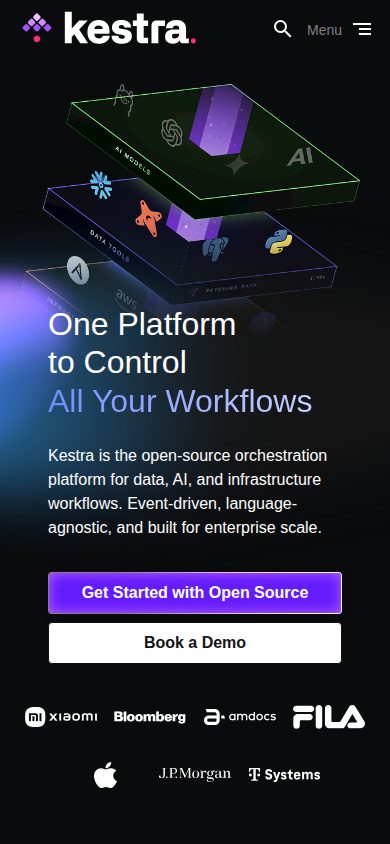
Features

AI

  • AI Copilot and Agentic Automation

    Use a built-in Copilot and AI agents to create, iterate, and automate workflows within an AI-native platform.

Automation

  • Event-Driven and Batch Scheduling

    Trigger workflows via cron schedules, events, webhooks, or messages from a single orchestration engine.

  • Retries, Timeouts, and SLAs

    Configure automatic retries, timeouts, and SLA enforcement to ensure workflow reliability in production environments.

Collaboration

  • Code and UI Collaboration

    Allow developers to work in code while non-technical team members use the UI, with both modes staying in sync on a single platform.

Core

  • 250+ Workflow Blueprints

    Jump-start workflow creation with a growing library of pre-built workflow templates covering data, cloud, AI, and infrastructure use cases.

  • API-First and CI/CD Native

    Trigger executions, manage workflows and resources through the API, and deploy updates via Git-driven CI/CD pipelines.

  • Any Language Task Execution

    Run tasks written in Python, Bash, Node.js, Go, or containers without refactoring existing code.

  • Declarative YAML Orchestration

    Write, version, review, and ship workflows using YAML-based declarative syntax.

  • Self-Hosted and Cloud Deployment

    Deploy Kestra on Docker or Kubernetes for free as open source, or use the managed Cloud offering for a production-ready scalable environment.

Integration

  • 1200+ Plugins

    Connect to cloud, data, infrastructure, CI/CD, ITSM, and messaging tools through a library of over 1,200 pre-built plugins.

Security

  • Multi-Tenancy and Isolated Workers

    Run workflows in isolated workers and dedicated task runners across hybrid, on-premises, and air-gapped environments.

  • RBAC and Audit Logs

    Control access with role-based permissions and maintain audit logs for governance and compliance, including SOC 2 support.

Pricing Plans

Open Source

$0/monthly

Production-ready orchestration for teams who want to self-host with no artificial limits.

  • Declarative, event-driven workflows
  • 1,200+ plugins
  • Unlimited flows & executions
  • Everything as Code & from the UI
  • Event-driven scheduling
  • AI Agents
Popular

Kestra Cloud

Free

Fully managed platform for teams who want zero infrastructure overhead and fast onboarding.

  • Fully managed hosting, upgrades & monitoring
  • Automatic scaling & high availability
  • Built-in security and governance features
  • Enterprise plugins included
  • SOC2 compliant
  • Pay-as-you-scale model

Enterprise Edition

Free

For mission-critical workloads requiring advanced governance, security, and enterprise support with SLA.

  • LDAP, SCIM & custom RBAC
  • Public/Cloud SSO & audit logs
  • Worker groups & task runners
  • External secret manager & storage isolation
  • Multiple tenants & plugin versioning
  • Enterprise support with SLA

AI Panel Reviews

The Decision Maker
The Decision MakerStrategic bet, vendor viability, timing, adoption approval
7.4/10

Kestra's 1,200-plugin open-source bet is real — enterprise pricing opacity is not.

Founded 2021, shipping fast, with a credible open-source moat and genuine language-agnostic differentiation. The growth story holds up; the enterprise pricing page doesn't.

Founded 2021. Competing directly against Airflow, Prefect, and Dagster — three categories where switching costs compound fast. The YAML-declarative approach isn't new, but 1,200+ plugins and air-gapped deployment support puts Kestra in conversations Prefect can't enter. That's a real wedge.

Two things bother me. One: the pricing page lists Enterprise Edition as 'Free' with no actual number attached. That's a sales call disguised as transparency. Two: no support email is publicly listed, which matters when I'm evaluating whether a founder picks up the phone at 2am.

The open-source tier is genuinely unlocked — unlimited flows, full plugin access, no artificial caps. That's the right move for adoption. But RBAC, SSO, and audit logs sit behind the enterprise wall, which means any regulated team hits that ceiling fast. The docs indicate cloud and enterprise tiers close those gaps, but you won't know the cost until you're already dependent.

No public funding data. That's the honest ceiling on my confidence. Pilot the open-source self-hosted build with one data team for 60 days. Don't commit to cloud or enterprise until they publish actual pricing.

Competitive Positioning7.0

Air-gapped deployment and YAML-native orchestration differentiates from Prefect, but Airflow's ecosystem maturity still wins in enterprise procurement rooms.

Reputation Risk7.5

Open-source orchestration with SOC 2 support and 1,200+ plugins is a defensible board-level answer; unknown enterprise pricing is not.

Speed to Value8.2

250+ pre-built workflow blueprints and a managed cloud tier with guided onboarding compress time-to-first-pipeline meaningfully.

Strategic Fit8.0

Language-agnostic task execution across Python, Go, Bash, and containers advances platform teams without forcing a runtime rewrite.

Vendor Viability6.5

Founded 2021, active changelog and GitHub presence, but no public funding data makes a 36-month runway call speculative.

Pros

  • 1,200+ plugins available in the free open-source tier — no artificial limits
  • Air-gapped and on-premises deployment is explicitly supported, rare at this price point
  • Language-agnostic task execution means no forced SDK adoption
  • YAML-as-code makes pipelines version-controllable without a Python prerequisite

Cons

  • Enterprise Edition pricing is unlisted — 'Free' on the pricing page means 'call us'
  • RBAC, SSO, and audit logs are locked to enterprise tier, which hits regulated teams immediately
  • No public funding data makes long-term vendor stability hard to assess
  • No visible support email raises a question about post-sales responsiveness

Right for

Platform or data engineering teams who want Airflow-level power without Python-only lock-in and can tolerate an opaque enterprise pricing conversation.

Avoid if

Your compliance team needs RBAC and audit logs on day one and your budget cycle can't absorb a surprise enterprise quote.

The Domain Strategist
The Domain StrategistCraft and strategy in the product's domain — adapts identity per category, same lens
7.8/10

Kestra's 1,200-plugin depth makes it a serious orchestration bet for engineering-led orgs.

Founded in 2021, Kestra has built genuine enterprise-grade orchestration infrastructure with RBAC, SOC 2, and air-gapped deployment support. The open-source core is unusually generous, which accelerates adoption but creates a monetization question worth watching.

1,200+ plugins and 250+ blueprints isn't marketing padding — that's the kind of integration surface that signals someone has actually mapped the enterprise data stack. The language-agnostic YAML approach means I can onboard a mixed team of Python engineers, dbt practitioners, and infrastructure folks without enforcing a runtime. That's an operational win. Airflow forces Python fluency across the board; Kestra doesn't. For ops leaders managing heterogeneous engineering teams, that lowers ramp cost meaningfully.

The tier structure is where I'd spend time in diligence. RBAC, SSO, and audit logs are gated behind Enterprise Edition, which lists as 'Free' on the pricing page — but no actual price is published. That's a negotiation, not a purchase. If compliance and access governance are day-one requirements, which they are for most teams past 50 engineers, the open-source tier isn't the real product. Cloud gets you governance included, which is cleaner operationally, but you're now on a pay-as-you-scale model with no anchor price.

If we self-host on Kubernetes today and grow to 200 workflows over 18 months, the path to Enterprise is locked behind a sales conversation. That's not unusual in this category — Prefect and Dagster both do it — but it means the total cost of ownership is opaque at planning time. The AI Copilot feature suggests the roadmap is moving toward agentic orchestration, which is the right direction. Founded in 2021, they're moving fast, but three-year platform bets need stable commercial terms, not just strong engineering.

Bottom line: the orchestration architecture is sound and the integration breadth is real. The operational risk isn't the product — it's pricing opacity at enterprise scale.

Category Positioning7.5

Sits credibly between Airflow's complexity and Prefect's developer-first simplicity, with the AI Copilot feature signaling a forward-looking roadmap.

Domain Fit8.0

Language-agnostic task execution across Python, Go, Bash, and containers matches how real engineering orgs actually operate without a uniform runtime.

Integration Surface8.5

1,200+ plugins covering dbt, Airbyte, Spark, Terraform, and Ansible means Kestra fits into most modern data and infrastructure stacks without forcing rewrites.

Long-term Implications7.0

YAML-as-code with Git-native CI/CD creates clean operational habits, but undisclosed Enterprise pricing makes 3-year cost planning unreliable.

Strategic Depth8.2

Declarative YAML orchestration with event-driven triggers, SLA enforcement, and isolated worker groups reflects production-grade thinking, not prototype tooling.

Pros

  • 1,200+ plugins cover the full enterprise data and infrastructure stack with no artificial limits on the open-source tier
  • Language-agnostic execution lets mixed engineering teams onboard without retraining or runtime standardization
  • SOC 2 compliance, air-gapped deployment, and external secrets manager support satisfy most enterprise security reviews
  • 250+ pre-built blueprints compress time-to-first-workflow dramatically compared to Airflow's cold-start experience

Cons

  • Enterprise Edition pricing is unpublished, making budget planning for compliance-required deployments impossible without a sales call
  • RBAC and audit logs are absent from the open-source tier, so governance-first teams can't evaluate the full product without entering a commercial conversation
  • Founded in 2021 means limited track record at the multi-year enterprise contract horizon
  • Pay-as-you-scale Cloud model has no anchor price, creating unpredictable OpEx as workflow volume grows

Right for

Engineering-led organizations that need flexible, multi-language orchestration across data and infrastructure without enforcing a single runtime.

Avoid if

Your procurement process requires fixed, published pricing before architectural commitment.

The Finance Lead
The Finance LeadMoney, total cost of ownership, contracts, procurement math
7.2/10

Open-source free tier with 1,200+ plugins, but Enterprise pricing is a black box.

Kestra's $0 open-source tier is real — unlimited flows, no seat tax, 1,200+ plugins included. Enterprise and Cloud sticker prices say 'Free' on the pricing page, which means sales call before you see a number.

Three tiers listed publicly. Two say 'Free' as the price. That's not transparency — that's a placeholder. Open Source is genuinely $0 and self-hosted. Enterprise and Cloud pricing require contact. Category norm for orchestration platforms: RBAC and SSO behind a paywall, and Kestra follows it. The open-source tier skips both.

TCO math depends heavily on deployment path. Self-hosted on Kubernetes: $0 license, but engineering hours to maintain aren't free. Call it 0.25 FTE annually for a 50-person data team — $20K-$30K loaded cost per year. Year 3 self-hosted lands around $60K-$90K in labor, not software. Compare to Prefect Cloud or Dagster Cloud, which publish per-run or seat pricing and shift that ops burden off your team. Different tradeoff, not a clear winner.

Cloud tier is 'pay-as-you-scale' with no published rate card. That's the real exposure — you can't model year 3 without a quote. 250+ blueprints and AI Copilot are included features worth noting, but they don't offset the forecast risk on Cloud billing. Air-gapped deployment support is a genuine differentiator for regulated industries, locked behind Enterprise with no visible price.

Billing & Procurement6.5

Open Source tier requires zero procurement; Enterprise and Cloud require a sales engagement with no published minimum commitment.

Contract Flexibility6.0

No published auto-renewal terms, cancellation policy, or term length visible on the pricing page — standard gap for this category.

Pricing Transparency5.5

Open Source is cleanly $0, but Enterprise and Cloud both show 'Free' as price — no rate card, no per-execution cost published.

ROI Clarity7.0

1,200+ plugins and language-agnostic execution reduce integration build time measurably, but no published benchmark data to anchor savings claims.

Total Cost of Ownership6.8

Self-hosted TCO is labor-dominated, not license-dominated; Cloud TCO is unmodelable without a quote given the 'pay-as-you-scale' model.

Pros

  • Open Source tier is genuinely unlimited — no flow caps, no execution limits, no seat fees
  • 1,200+ plugins available at $0 tier, including dbt, Terraform, Airbyte
  • Air-gapped deployment supported — rare in this category, valuable for regulated industries
  • YAML-based declarative syntax means no SDK lock-in and lower onboarding friction

Cons

  • Enterprise and Cloud pricing not published — 'Free' on the pricing page means call us
  • RBAC, SSO, and audit logs gated to Enterprise — procurement blocker for most security teams
  • Cloud 'pay-as-you-scale' model has no published rate card — year 3 cost is unforecastable
  • Self-hosted TCO is real labor cost, not license cost — easy to underestimate in initial budgets

Right for

Data engineering teams who can self-host, want $0 licensing, and have the ops capacity to manage Kubernetes deployments.

Avoid if

Your security team requires RBAC and SSO and you need a predictable Cloud invoice before signing anything.

The Domain Practitioner
The Domain PractitionerDaily hands-on reality in the product's domain — adapts identity per category, same lens
7.8/10

YAML-first orchestration that ops teams can actually own without fighting the runtime

Kestra gives operations teams a declarative, language-agnostic orchestration layer with 1,200+ plugins and real deployment flexibility. The open-source tier is genuinely capable, but governance controls — RBAC, SSO, audit logs — sit behind enterprise pricing with no public number attached.

YAML as the contract between ops and engineering is smart. No SDK lock-in means existing Python scripts, Bash jobs, and Terraform runs drop in without refactoring. That's a real ops win — the kind that keeps Monday morning from becoming a rewrite session. The 250+ blueprints lower the cold-start cost considerably. Founded 2021, so the plugin ecosystem at 1,200+ integrations is moving fast for a relatively young platform.

Day three is where the governance gap shows up. Open Source ships with unlimited flows and executions — genuinely no artificial limits — but zero RBAC, zero SSO, zero audit logs. For any ops environment with compliance requirements, that's not a free tier, that's a dev sandbox. Airflow and Prefect both have audit trails earlier in their access model. You will hit this wall the moment a security review starts.

The event-driven triggers — webhooks, file arrivals, cron, message queues — cover the standard ops patterns well. Retries, timeouts, and SLA enforcement are present, which means production incidents have some guardrails. The built-in web UI with real-time execution monitoring means on-call doesn't require CLI access to triage a stuck workflow. That's friction removed.

The cloud tier's pricing is pay-as-you-scale with no public starting number, which makes budget conversations harder than they should be. Self-hosted on Kubernetes is free but means your team owns upgrades, scaling, and incident response. Pick your cost: dollars or engineering hours.

Day-3 Reality7.5

Declarative YAML and 250+ blueprints reduce cold-start friction, but RBAC absence in the open-source tier becomes a daily blocker in any multi-person ops environment.

Documentation Practitioner-Fit7.8

Docs, changelog, and API references are all present, and the changelog shows active maintenance — signals a team that uses the tool, not just markets it.

Friction Surface7.0

API-first and Git-driven CI/CD deployment reduce operational overhead, but undisclosed cloud pricing creates recurring friction at budget and procurement cycles.

Power-User Depth8.0

Multi-tenancy, isolated workers, external secrets manager, and air-gapped deployment support indicate genuine depth for advanced infrastructure ops use cases.

Workflow Integration8.2

Language-agnostic task execution with dbt, Terraform, Ansible, and Spark plugins means existing scripts integrate without pipeline rewrites.

Pros

  • 1,200+ plugins covering cloud, data, ITSM, and messaging tools available in the open-source tier
  • Language-agnostic execution — Python, Bash, Go, Node.js, containers — no SDK required
  • Event-driven triggers cover the full ops pattern set: cron, webhooks, file arrival, message queues
  • Air-gapped and on-premises deployment supported with external secrets manager integration

Cons

  • RBAC, SSO, and audit logs are enterprise-only — open-source tier can't pass a basic compliance review
  • Cloud tier pricing is pay-as-you-scale with no public number, making budget approval cycles painful
  • Self-hosted path means your team owns infrastructure, upgrades, and on-call for the orchestrator itself
  • Enterprise plugin tier exists separately from the 1,200+ standard plugins — scope unclear without a sales call

Right for

Ops teams running mixed-language automation on Kubernetes who need deep integration coverage and can negotiate enterprise pricing for governance features.

Avoid if

Your environment requires audit logs and RBAC out of the box and you don't have budget cycles open for enterprise tier negotiation.

The Power User
The Power UserDaily human experience, onboarding, polish, learning curve, reliability
7.2/10

YAML-first orchestration that engineers will love and everyone else will need to learn

Kestra is genuinely powerful open-source orchestration with 1,200+ plugins and real deployment flexibility. But the daily experience is built for people who think in code, and that narrows the audience fast.

Founded in 2021, Kestra came at Airflow's weaknesses — clunky Python-only DAGs, painful deployment, steep ramp — and built something more language-agnostic. YAML-based workflows that run Python, Bash, Go, or containers without refactoring anything. That's not a small promise and the plugin count (1,200+, including dbt, Terraform, Airflow-killers like Airbyte) suggests they actually meant it.

The 250+ blueprints are the thing I'd watch on day one. Jump-starting with pre-built templates for data, cloud, and infrastructure use cases is the difference between feeling welcomed and feeling abandoned. The AI Copilot feature is listed front-and-center too, which suggests someone on the team understood that declarative config still needs a hand-holder.

Here's where it gets honest though: RBAC, SSO, and audit logs are locked behind Enterprise Edition. The open-source tier is genuinely generous — unlimited flows, full plugin access — but the moment you need governance, you're in pricing conversation territory. That's a real wall for teams who assumed 'open-source' meant 'fully governed.' Prefect and Dagster play the same game, so it's a category norm, but it still stings.

Mobile is listed as a supported platform, but a workflow orchestration tool living on a phone is mostly a monitoring story at best. Loading a YAML editor on mobile sounds like a choice nobody makes twice.

Daily Polish6.8

The built-in web UI with real-time execution monitoring and log inspection sounds solid, but no public evidence of sweat on empty states or micro-copy details.

Learning Curve6.5

Language-agnostic YAML is genuinely more approachable than Airflow's Python DAGs, but month three still requires understanding event-driven triggering and plugin wiring that has real depth.

Mobile Parity4.0

Listed as a supported platform, but a YAML orchestration tool on mobile is realistically read-only monitoring, not a real parallel experience.

Onboarding Experience7.5

Kestra Cloud's 'Fast Onboarding and Guided Experience' plus 250+ blueprints suggests the first ten minutes won't be blank-page paralysis.

Reliability Feel7.8

Retries, timeouts, SLA enforcement, and SOC 2 compliance are production-grade signals that the team has thought past the happy path.

Pros

  • 1,200+ plugins covers nearly any stack without custom connectors
  • Open-source tier has no artificial execution limits — genuinely usable for free
  • Language-agnostic task execution means no ripping out existing code
  • 250+ workflow blueprints cut first-week friction significantly

Cons

  • RBAC, SSO, and audit logs are Enterprise Edition only — governance costs extra
  • YAML-first approach will feel natural to engineers and foreign to everyone else
  • Mobile experience is almost certainly a monitoring viewer, not a real workspace
  • Starting price for Enterprise Edition is unknown, which makes budget planning a phone call

Right for

Data or platform engineering teams who want Airflow's power without Airflow's Python lock-in.

Avoid if

Your team expects non-engineers to build and own workflows without a code-first learning curve.

The Skeptic
The SkepticContrarian. Watch-outs, deal-breakers, broken promises, category patterns
7.2/10

Three green flags, two open questions — Airflow challenger with real substance

Founded 2021, open-source, 1,200+ plugins, YAML-native. The pitch is coherent and the bones are solid. What's missing is enterprise pricing transparency and long-term funding signals.

Three tells going in. One: 'One Platform to Run All Your Workflows' is the kind of headline that could belong to Airflow, Prefect, Dagster, or Temporal. Two: Enterprise Edition is listed as 'Free' on the pricing page — that's either a trial hook or a placeholder, and neither inspires confidence. Three: no support email visible, no funding round listed publicly. Category norm is a Series A announcement by year three. Kestra's at year four.

The differentiation isn't nothing. YAML-first, language-agnostic execution — Python, Go, Bash, Node.js without refactoring — is a real wedge against Airflow's Python lock-in. The 250+ blueprints and 1,200 plugins number is credible for a company this age, and the changelog cadence plus active GitHub suggest a live team, not vaporware. Air-gapped deployment with Vault-backed secrets is enterprise-grade positioning. Those aren't filler features.

The tradeoff worth naming: RBAC and audit logs are paywalled behind Enterprise. If you're evaluating this for anything compliance-sensitive on the open-source tier, that's a hard stop. Prefect and Dagster both offer some governance features at lower tiers. Exit portability is actually decent — YAML workflows are portable artifacts, not proprietary graphs. Worst case, you're re-hosting configs, not rewriting pipelines.

Competitive Differentiation7.0

Language-agnostic YAML execution is a real gap vs. Airflow's Python dependency, but Prefect and Dagster have closed distance on ease-of-use claims.

Exit Portability8.5

Declarative YAML workflows are file-based and version-controllable — migration off Kestra doesn't require rebuilding logic, just re-hosting it.

Long-term Viability6.5

No public funding data, no support email, no SLA page visible — could go either way for a 3-year bet, especially at enterprise scale.

Marketing Honesty6.5

Enterprise Edition listed as 'Free' with no visible pricing is evasive — category norm is at least a 'contact us' anchor price.

Track Record Match7.0

Founded 2021, active changelog, GitHub presence — matches pattern of surviving open-source orchestration tools, not the ones that quietly shut down.

Pros

  • 1,200+ plugins with dbt, Terraform, Airbyte, Spark confirmed in open-source tier
  • Air-gapped and on-premises deployment with external secrets manager support
  • YAML-based workflows are version-controllable and portable — clean exit story
  • Language-agnostic task execution without SDK lock-in is a genuine differentiator vs. Airflow

Cons

  • Enterprise pricing is opaque — 'Free' listing on pricing page signals incomplete transparency
  • RBAC and audit logs locked to Enterprise tier, meaning open-source isn't viable for compliance use cases
  • No public funding signals after four years — harder to make a long-term vendor bet
  • No visible support email or public SLA documentation based on available evidence

Right for

Data or platform engineering teams that want Airflow-level power without Python lock-in and are comfortable self-hosting.

Avoid if

You need enterprise governance features — RBAC, SSO, audit logs — without committing to an undisclosed Enterprise contract.

Buyer Questions

Common questions answered by our AI research team

Pricing

What is the difference between the Open Source, Enterprise, and Cloud tiers — specifically around RBAC, SSO, and audit logs?

The Open Source tier does not include RBAC, SSO, or audit logs. The Enterprise Edition adds Role-Based Access Control (RBAC) with fine-grained permissions and namespace-level controls, SSO (OIDC), LDAP, SCIM, and Audit Logs that record all activities made by all users on resources inside Kestra. Kestra Cloud includes built-in security and governance features including these enterprise capabilities as part of its fully managed offering.

Features

Does Kestra support running tasks in languages like Python, Bash, Node.js, and Go without requiring any refactoring of existing code?

Yes, Kestra explicitly states that teams can 'Run tasks in Python, Bash, Node.js, Go, or containers. No refactoring required.' It is described as language-agnostic and also supports SQL, shell, APIs, Terraform, dbt, Spark, and custom tools in the same workflows without forcing a runtime or SDK on teams.

Security

Can Kestra be deployed in air-gapped or on-premises environments, and what security controls like secrets management and storage isolation are available for those setups?

Yes, Kestra supports deployment on Cloud, On-Prem, and Air-Gapped environments, with the Enterprise Edition specifically noting support for 'Hybrid environments: Cloud, On-Prem, Air-Gapped.' Security controls available include a Secrets Manager (Internal, External & Read-Only) with support for external providers like Vault and AWS Secrets Manager, Namespace & Tenant-Level Secrets, and Storage Isolation to isolate access within a Kestra instance.

Setup

How quickly can a team get started with Kestra Cloud compared to self-hosting, and does it include a guided onboarding experience?

Kestra Cloud is described as offering 'Fast Onboarding & Deployment' where teams can 'Skip the setup phase and go straight to execution' with a 'ready-to-use production environment' so teams can start orchestrating immediately without weeks of installation and configuration. It includes a 'Fast Onboarding and Guided Experience' as a listed feature, and zero maintenance overhead, compared to self-hosting which requires managing your own infrastructure, upgrades, and configuration.

Integration

Does Kestra have native plugins for tools like dbt, Airbyte, Spark, Terraform, and Ansible, and are these available in the Open Source tier?

The content confirms Kestra has plugins for dbt, Airbyte, Spark, Terraform, and Ansible, referencing these tools directly in workflow examples and use case descriptions (e.g., 'Run ingestion, transformations, dbt, Airbyte, Spark' and 'Standardize Terraform, Ansible, CI/CD'). The Open Source tier includes '1,200+ Plugins' and 'Connect Kestra to 1200+ plugins' with no artificial limits, suggesting these integrations are available in the Open Source tier, though the content separately notes 'Enterprise Plugins' exist for enterprise-grade integrations.

Product Information

  • Company

    Kestra Technologies
  • Founded

    2021
  • Pricing

    Freemium
  • Free Trial

    Available
  • Free Plan

    Available

Platforms

weblinuxmacwindows

About Kestra Technologies

Kestra is a Paris-based open-source orchestration platform for scheduling and running data, AI, and infrastructure workflows.

Resources

Documentation
API
Blog
Changelog

Built With

Google Analytics

Also in AI Workflow Automation