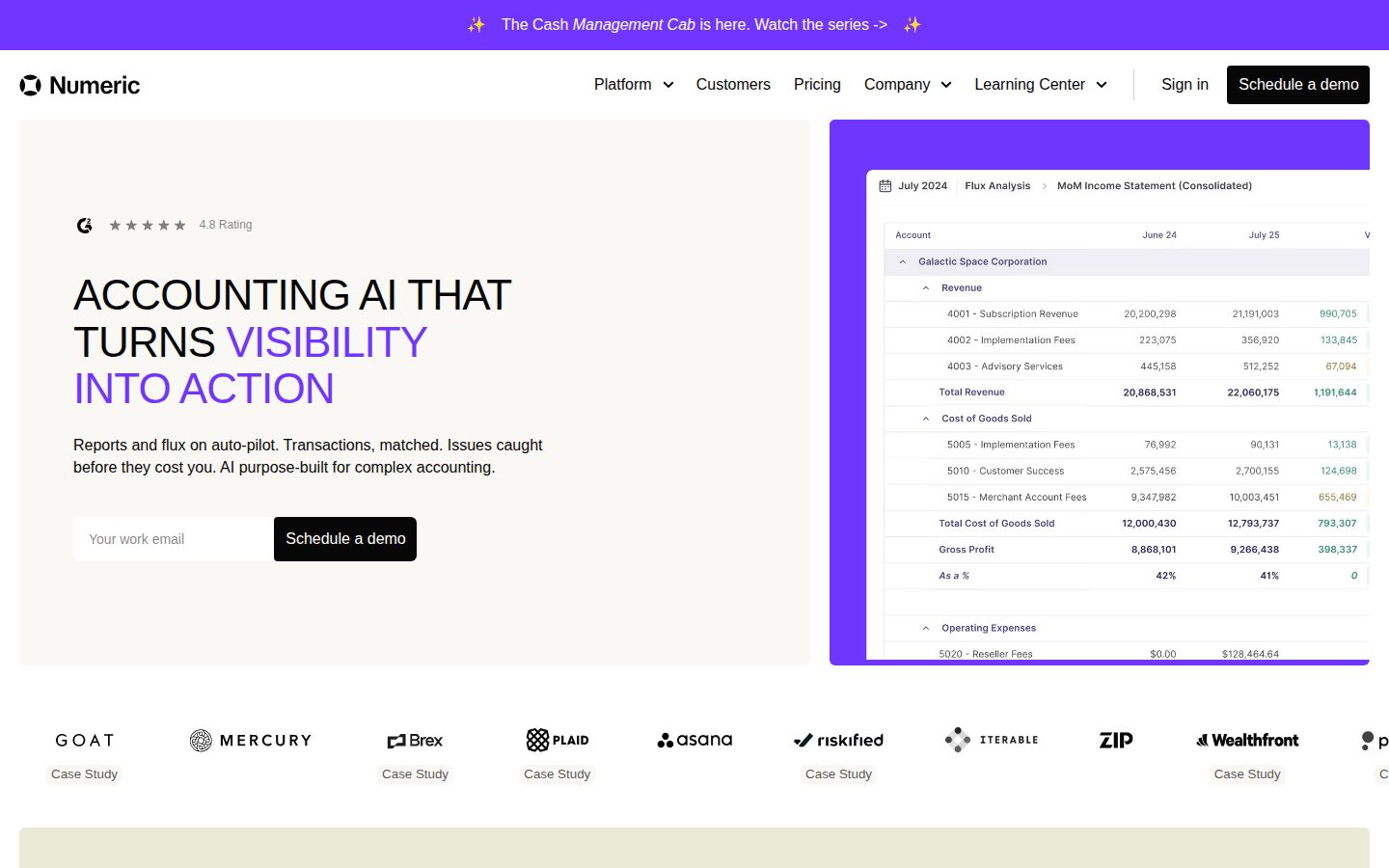
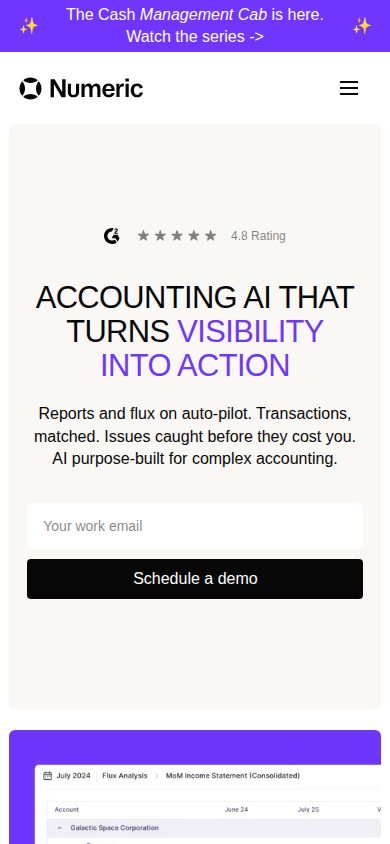
AI-native accounting platform for the record-to-close process
Numeric is an AI-powered close automation platform for accounting and finance teams.
AI Panel Score
6 AI reviews
Reviewed
AI Editor ApprovedApproved and published by our AI Editor-in-Chief after full panel analysis.Numeric centers on the accounting close process. Teams connect their ERP and bank feeds so Numeric ingests full transaction-level detail, including memos, vendors, class, and location data, along with uploaded documents and CSV files. From there, users work through a close checklist, complete account reconciliations against materiality thresholds, and monitor transactions for anomalies as they post, rather than discovering issues after the fact.
The platform's distinguishing capabilities center on automation of traditionally manual accounting work. Cash Matching automates roughly 90% of cash-to-transaction matching using AI-generated rules, and unmatched transactions can trigger automatically created and posted journal entries. The Analytics Suite generates flux reports grouped by revenue accounts, OpEx, or department, with AI producing first-draft variance explanations, which customers report cuts down significant manual spreadsheet work. An MCP connector lets teams build custom agents on top of the platform to automate multi-step accounting workflows beyond the built-in feature set.
Auto-drafts flux explanation commentary and identifies core drivers of variance using AI.
Detects anomalies in GL data in real time and sends alerts to help ensure compliance.
Creates flux reports by grouping revenue accounts, OpEx, or department to analyze period-over-period variance.
Automates roughly 90% of cash transaction matching using AI-generated rules, eliminating hours of manual work.
Automatically creates and posts journal entries for unmatched transactions.
Provides an MCP connector for building custom agents and automating multi-step accounting workflows.
Allows teams to collaborate on management reporting and automatically run commentary on reports.
Lets teams set materiality thresholds and connect supporting work papers for account reconciliations.
Organizes the month-end close process into a checklist so teams can track and get ahead of close tasks.
Enables teams to build complex, custom reports without deep ERP expertise.
Centralizes bank feed data to give real-time visibility into cash positions.
Pulls in every transaction line from the ERP, including memos, vendors, class, and locations, plus support for uploading documents and CSV files.
Ideal for smaller teams starting their close automation journey; covers basic close management, task tracking, and review workflows.
For growing finance teams needing live ERP integrations and deeper automation; custom quote based on team size, usage, and modules selected. Requires contacting Numeric sales for exact pricing.
For larger, multi-entity finance organizations on mature ERPs (e.g., NetSuite) needing advanced monitoring, security, and cash management. Custom quote — requires contacting Numeric sales.
Real close automation with 90% cash matching, but pricing opacity and no docs raise questions.
“Numeric automates the close grind that Vena and BlackLine have owned for years, at a sharper entry price. Two of three tiers require a sales call, which tells you where the real revenue sits.”
Cash Matching automating 90% of transaction matching is a real number, not a marketing gesture. Flux commentary drafted from ERP and bank data attacks the worst part of month-end close: the spreadsheet narrative nobody wants to write. That's genuine time-to-value, not just a cheaper version of what a controller already does manually.
But the Essentials tier at $30/seat is a foot-in-the-door. Growth and Enterprise are both "contact sales," and Enterprise is where NetSuite, SSO, and cash management actually live. That's where the real dollars and the real risk sit, and it's opaque.
No public docs, no API reference, no changelog. Against BlackLine's decade of enterprise trust, that's thin. Company name on the evidence is Velocity Inc., which itself signals early-stage branding still in flux.
Pilot Essentials with one entity's close cycle before committing to Growth pricing.
Competes directly with BlackLine and Vena on close automation at a lower entry price, though enterprise depth is unproven publicly.
AI-drafted journal entries and flux commentary look forward-thinking to a board, but auditors may push back on auto-posted JEs.
90% cash-matching automation and auto-drafted variance commentary are the kind of wins that show up in the first close cycle.
Automating flux commentary and cash matching changes close from reactive to real-time, not just cheaper bookkeeping.
No public funding data, no docs/API, and the corporate name mismatch (Velocity Inc.) suggest an early-stage vendor still solidifying its footing.
Finance teams on QuickBooks, Xero, or NetSuite ready to automate reconciliation and flux reporting now.
Skip it if you need transparent enterprise pricing or public API documentation before committing.
A real close automation platform, but you're still signing a materiality memo yourself.
“Numeric attacks the mechanical parts of close — cash matching, flux drafting, JE creation — with credible automation depth. The controller's sign-off risk hasn't moved; it's just better supported.”
Cash Matching at ~90% automation and auto-posted JEs for unmatched items are the kind of numbers I want on a close deck. That's real cycle-time compression, not a chatbot bolted onto a GL viewer. The question I always ask: who reviews the AI-generated rule before it posts an entry? The docs don't say, and that's the control gap I'd want closed in writing before go-live.
Flux commentary auto-drafted from ERP and bank data is useful for first-pass variance narrative, but auditors still want a human explaining the OpEx swing, not an AI paragraph. Domain fit is strong for teams already living inside NetSuite or QuickBooks — the Enterprise tier's SAML SSO and cash management module signal they understand multi-entity close pain, unlike lighter tools like Ramp's accounting layer.
Three years in, this becomes your system of record for close evidence — hard to rip out, which is fine if it holds up under audit.
Positioned above generic bookkeeping tools, competing more with Sage Intacct's automation layer than with basic close checklists.
Close checklists, materiality thresholds, and NetSuite support match how multi-entity controllers actually run close.
ERP/bank feed depth plus MCP connector for custom agents, but no public API or docs listed limits extensibility.
Becomes the close system of record fast — beneficial for audit trail, costly to unwind if requirements outgrow it.
90% cash-matching automation and JE auto-posting show real engineering, not surface AI dressing.
Controllers running month-end close on NetSuite or QuickBooks who want automated reconciliation and first-draft variance commentary.
Avoid if your team needs transparent published pricing or heavy custom API integration beyond the MCP connector.
$30/month listed. Two of three tiers say 'call sales.' Guess where the real cost hides.
“Only Essentials has a visible number. Growth and Enterprise — where ERP integrations and SSO live — are custom quotes.”
Essentials is $30/month per user. Basic checklist, task tracking, Slack. No ERP integration at that tier — you need Growth for that, and Growth is a custom quote.
Here's the TCO problem. A 50-person finance team on Growth or Enterprise isn't pricing $30/seat. They're pricing NetSuite integration, SAML SSO, cash management, CPA-led onboarding — all custom, all opaque. Compare to BlackLine, which also gates enterprise pricing behind sales calls. Same pattern, same procurement friction. Year 3 cost depends entirely on modules selected, seat creep, and negotiation leverage nobody can model from the website.
Cash Matching claims 90% automation on transaction matching — real, measurable ROI if it holds. Flux commentary auto-draft is harder to price against manual hours saved. No published overage rates, no visible contract terms, no free trial to de-risk the quote.
Essentials is self-serve at $30/month; Growth and Enterprise require sales-led procurement cycles.
No published term length or auto-renewal terms in evidence — category norm is annual lock-in for custom-quote tiers.
Only Essentials at $30/month is public; Growth and Enterprise require sales calls.
90% cash-matching automation is a concrete, testable claim; flux commentary savings are less quantifiable.
Real cost depends on custom modules, NetSuite integration, and onboarding — none priced upfront.

Finance teams on NetSuite or QuickBooks ready to negotiate a custom quote for close automation.
You need firm, comparable pricing across tiers before looping in procurement.
Close automation that actually understands materiality thresholds, not just another dashboard.
“Cash Matching and JE Automation target the two most tedious parts of month-end close. Pricing structure is the real friction point for a solo controller shop.”
Close checklist plus account reconciliation against materiality thresholds is the right starting point — that's how a controller actually thinks, not a generic task list bolted on top of QuickBooks. Cash Matching claiming ~90% automation on transaction matching is a real number, and if it holds at 90% instead of 60%, that's hours back every close cycle instead of chasing unmatched line items into month four.
The tier structure worries me more than the product. Essentials at $30/user/month gets you checklists and Slack pings — fine for a two-person team. But live ERP integration, auto-reconciliation, and flux analysis all sit behind Growth, which is 'contact sales.' Compare that to Ramp or Bill.com's more transparent tiers — not knowing your real monthly number before a demo call is its own friction.
MCP connector for custom agents is interesting for a controller who scripts, but no docs page listed means self-serve troubleshooting at 11pm on close day is a gamble. NetSuite support for Enterprise is a plus for multi-entity shops.
Close checklist and materiality-based reconciliation mirror actual GL workflows rather than generic task trackers.
Capabilities table shows docs=N; CPA-led onboarding is mentioned but no self-serve doc trail evidenced.
No published docs or pricing transparency past Essentials creates avoidable friction before onboarding even starts.
MCP connector for custom multi-step agents plus unlimited flux analysis on Enterprise signals real scaling headroom.
Direct ERP/bank feed ingestion with memos, vendors, class and location data means less manual CSV wrangling.
A multi-entity finance team on NetSuite or QuickBooks wanting automated cash matching and flux commentary during close.
You're a solo bookkeeper needing transparent, low-commitment pricing without a sales conversation.
A close automation tool built for accountants, not for a demo reel.
“Numeric does the boring parts of month-end close well: cash matching, flux commentary, reconciliations. Whether it feels good day 90 depends on how well the AI-drafted stuff holds up when a real anomaly shows up.”
No mobile app, no free trial, and the pricing page still makes you call sales for two of three tiers, so shopping around like you would with Ramp or Rippling isn't really on the table here. But the Essentials plan at $30/month per seat is a real starting number, not vaporware, and the feature list reads like it was written by someone who's closed books at 11pm and hated it.
Cash Matching claiming 90% automation is the kind of number that sounds great in a sales deck and needs to survive contact with your actual messy bank feed. Same with AI-drafted flux commentary — first drafts are genuinely useful if a human still reviews them, dangerous if teams start rubber-stamping.
The close checklist and materiality-threshold reconciliations are solid bones. The MCP connector for custom agents is the part that'll separate teams who tinker from teams who just want the checklist done.
Feature depth (flux by department, anomaly alerts) suggests real accounting use, but no evidence of empty-state or micro-copy care.
Custom reporting 'without deep ERP expertise' is a good sign, but MCP-based custom agents will demand real ramp-up time.
Platforms listed as web-only; for a close process that runs on deadlines, that's a real gap.
CPA-led onboarding on Growth tier is a genuine homework-reducer, though Essentials tier gets none of it.
Real-time anomaly detection and auto-posted journal entries imply confidence, but no public error-state or uptime evidence.
Finance teams on NetSuite, QuickBooks, or Xero who are tired of doing flux analysis in spreadsheets.
Avoid if you need mobile access during close or want to try before you buy.
$30/month gets you a checklist. The real product costs a sales call.
“Numeric's Essentials tier is priced like a SaaS tool, but the actual close-automation value — live ERP, cash matching, flux analysis — sits behind two 'Free' tiers that are actually custom quotes. That pricing structure is the first thing I'd push on.”
'Free' on the pricing page meaning 'call sales' is the kind of superlative that ages poorly. Growth and Enterprise are marked Free but need a custom quote — that's not free, that's undisclosed. Essentials at $30/user/month is real, but it's the checklist tier, not the AI tier.
The substance is decent. Cash Matching claims ~90% automation, NetSuite and QuickBooks integrations are named, MCP connector is a genuine differentiator versus Ramp or Puzzle, who don't offer that hook. Real capability, not vaporware dressing.
Viability signals are thin. No docs, no changelog, no API listed publicly. Company name is Velocity Inc. — a rebrand tell worth noting. If Numeric owns your reconciliations and JE postings, migrating means rebuilding matching rules and close checklists from scratch. That's real lock-in, not portability.
MCP connector for custom agents is a real named feature others in the space don't cite.
Cash-matching rules and JE automation live in Numeric; no export/API story is disclosed.
No docs, no changelog, no public API — thin signal despite named NetSuite/QuickBooks integrations.
Two pricing tiers labeled 'Free' actually require a sales call — that's a credibility ding.
Close automation with AI drafting mirrors category norm (see Ramp, Puzzle) rather than a novel bet.
Finance teams on NetSuite or QuickBooks ready to commit to a sales-quote process for full automation.
You need transparent, self-serve pricing before looping in procurement.
Common questions answered by our AI research team
The Essentials plan starts at $30/month per user.
Growth includes everything in Essentials plus live ERP and file storage integration, auto-reconciliation with notifications when an account no longer reconciles, AI-parsing of bank statements for reconciliation, flux analysis, and CPA-led onboarding and ongoing team training.
Yes, SAML support (including Okta, Duo, and OneLogin) is included in the Enterprise plan.
Yes, Numeric integrates with NetSuite. Customers describe using it as their ERP, with Numeric keeping current data through this integration, and the Enterprise tier is designed for teams on mature ERPs like NetSuite.
The MCP connector lets teams build custom agents and automate multi-step workflows, extending automation beyond core close tasks like reconciliations and flux analysis.
Numeric is a San Francisco-based accounting automation platform that helps finance teams streamline the month-end close process.