Mercury logo

Mercury Review

Visit

Business banking built for startups and online businesses

Mercury is a fintech banking platform for startups and entrepreneurs, offering checking, savings, cards, and payments.

AI Panel Score

8.3/10

6 AI reviews

Reviewed

AI Editor Approved

About Mercury

Users apply online in approximately 10 minutes with no in-person visits or paperwork required. Once onboarded, they can access checking and savings accounts with no minimum balances, create virtual cards instantly, send USD wire payments domestically and internationally at no fee, generate invoices, and manage team expenses — all from a single dashboard with a universal search bar for quick navigation.

Mercury highlights several specific capabilities on its platform: AI-powered bill pay that reads bills and auto-populates payment details, automatic receipt matching to card transactions, Mercury Treasury offering up to 3.66% yield through portfolios managed by J.P. Morgan Asset Management and Morgan Stanley, 1.5% unlimited cashback on business credit card spend with no personal guarantee required, and accounting integrations with QuickBooks, Xero, and NetSuite. Team management tools include granular user permissions, approval flows, card spend limits, and reimbursement workflows.

Mercury targets startups, SaaS companies, e-commerce brands, and agencies — businesses that operate primarily online and want to avoid traditional bank branches and fees. The core banking account is free with no monthly maintenance fees. Personal accounts are also available with a 3.25% APY savings option. Competitors in the business banking and fintech banking space include Brex, Relay, Novo, and Bluevine.

Mercury is available via web browser and mobile apps on iOS and Android. It reports over 300,000 business customers, claims that 1 in 3 startups choose Mercury, and processes over $20 billion in monthly transaction volume.

Features

AI

  • AI-Powered Bill Pay

    AI reads incoming invoices, automatically extracts and populates bill details, deduplicates entries, and supports multi-step approval workflows via Slack or the Mercury app before paying via ACH, wire, or check.

Analytics

  • Subscription & Vendor Management

    A dedicated dashboard surfaces all company subscriptions in one place with tools to identify and cancel duplicates, and enables scheduling of recurring vendor payments with full visibility into spend.

Automation

  • Expense Management & Reimbursements

    Control team spend with merchant-locked cards, custom card limits, approval workflows, and auto-attached receipt matching; process out-of-pocket reimbursements in bulk directly from the dashboard.

Collaboration

  • Role-Based Permissions & Team Controls

    Granular user permissions let admins grant view-only, limited, or full account access to teammates, bookkeepers, or CPAs, with approval flows and fund movement locks to maintain control.

Core

  • Business Checking & Savings Accounts

    Free FDIC-insured checking and savings accounts with no monthly fees, no minimum balance requirements, and no overdraft fees, available entirely online.

  • IO Credit Card & Virtual Cards

    Business charge card earning 1.5% cashback on all spend, with the ability to instantly spin up unlimited virtual cards per vendor or purpose with custom spending limits and controls.

  • Invoicing

    Send manual or recurring invoices with company branding, accept payments via credit card, Apple Pay, Google Pay, wire, or ACH transfer, with automatic reconciliation matching invoices to payments.

  • Mercury Treasury

    Idle cash can be invested in high-liquidity, lower-risk mutual funds managed by J.P. Morgan and Morgan Stanley, with automated sweeps between operating and treasury accounts for optimal yield.

Integration

  • Accounting Integrations

    Syncs seamlessly with QuickBooks, Xero, and NetSuite to categorize transactions with GL codes and push payments directly to accounting software for faster month-end close.

  • Read/Write Banking API & MCP Server

    Every account includes full read/write API access plus a terminal-native CLI and AI-ready MCP server, enabling automated payments, real-time balance queries, custom dashboards, and programmatic financial workflows.

Security

  • Extended FDIC Insurance via Sweep Networks

    Deposits are spread across up to 20 partner banks via sweep networks, providing eligible customers with up to $5 million in FDIC insurance without managing multiple accounts.

  • Fraud Protection & SOC 2 Security

    Automated fraud monitoring, MFA verification, dark web monitoring, phishing protection, industry-standard encryption, and SOC 2 compliance with independent auditing protect account holders.

Preview

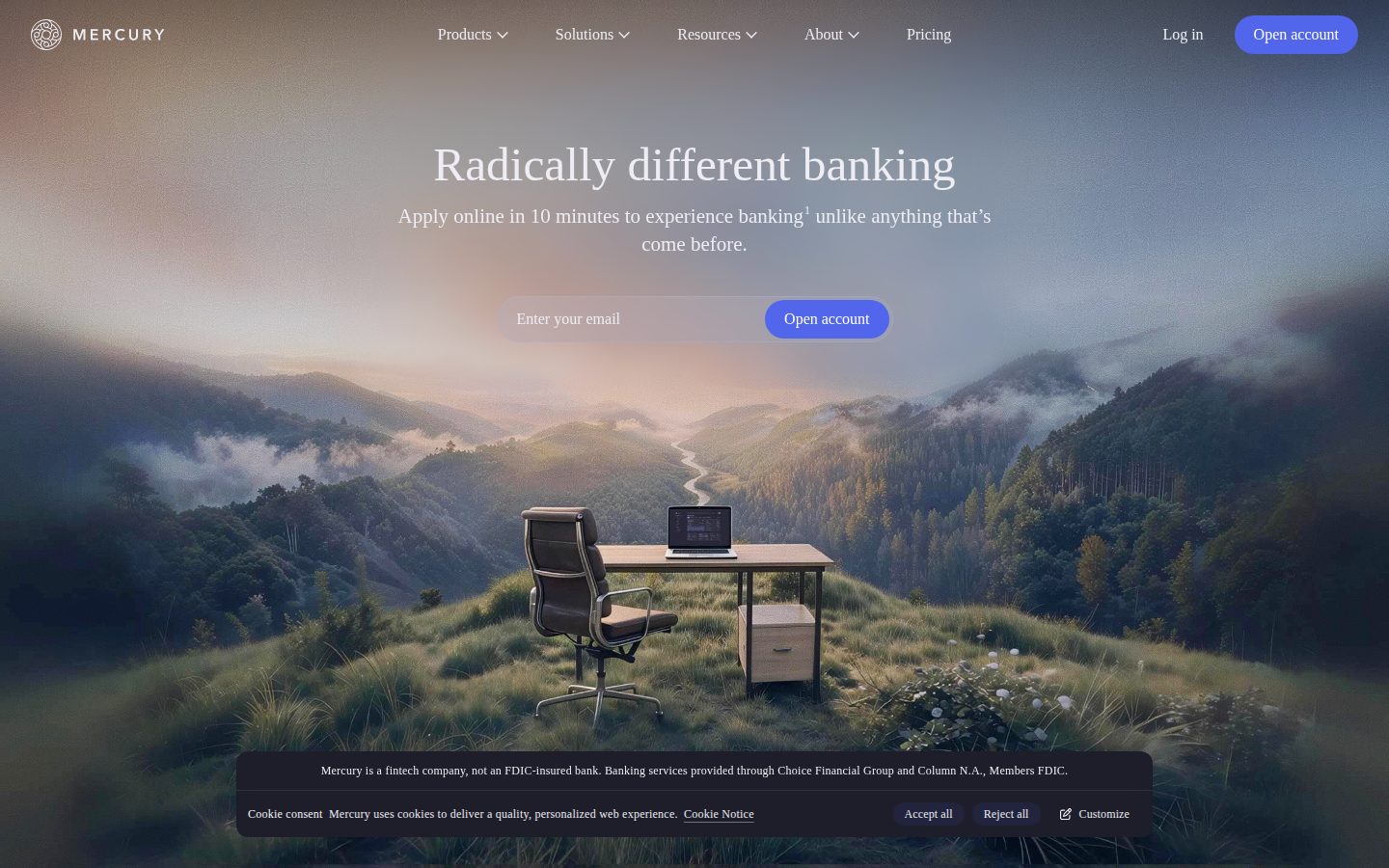
Mercury desktop previewMercury mobile preview

Pricing Plans

Popular

Mercury for Business

Free

Free business banking for startups and entrepreneurs with zero minimums and no monthly fees.

  • Free checking and savings accounts with zero minimums
  • No-fee USD wires and $0 maintenance fees
  • 1.5% cashback on credit card spend
  • Up to 3.66% yield with Mercury Treasury
  • AI-powered bill pay and transaction categorization
  • Up to $5M FDIC insurance through partner banks

Mercury for Personal

Contact sales

Personal finance account with high-yield savings, joint accounts, and unlimited free USD wires.

  • 3.25% APY on savings account
  • Joint accounts supported
  • Unlimited free USD wires
  • Personal finance management

Contact Sales

Contact sales

Dedicated account management and tailored solutions for qualifying businesses. No public price listed.

  • Dedicated account management for qualifying customers
  • Chat support for all customers
  • Granular user permissions and approval flows
  • Team spend controls and card limits

AI Panel Reviews

The Decision Maker

The Decision Maker

Strategic bet, vendor viability, timing, adoption approval
8.4/10

300,000 businesses and $20B monthly volume — Mercury's the default for startups.

Mercury has quietly become the category default for startup banking. Free accounts, no-fee wires, and real AI tooling at $0/month is hard to argue against.

Over 300,000 businesses and $20B in monthly transaction volume. That's not a niche product — that's a platform that's won the startup segment. The '1 in 3 startups choose Mercury' claim sounds like marketing until you check the adoption numbers. At zero monthly fees with free USD wires and 1.5% unlimited cashback, Brex has a harder story to tell at its price point.

The AI bill pay feature isn't a gimmick. It reads invoices, auto-populates payment fields, and routes through Slack approval flows before execution. That's real workflow automation, not a chatbot wrapper. The read/write banking API plus MCP server tells me their engineering team is thinking three years ahead.

The tradeoff: Mercury isn't a fit if you need SBA loans, physical branches, or a relationship banker who takes you to lunch. It's infrastructure for digital-first companies. If your finance team is two people and a QuickBooks login, this is the call.

Competitive Positioning8.0

Brex and Relay compete here, but Mercury's $0 pricing plus 3.66% Treasury yield via J.P. Morgan is a strong combination at the SMB tier.

Reputation Risk8.8

Mercury is the default name in startup finance conversations — adopting it looks sharp to a board, not experimental.

Speed to Value9.0

10-minute online application, no minimums, instant virtual cards — value starts day one, not quarter two.

Strategic Fit8.2

API access, MCP server, and accounting sync with NetSuite means this advances ops rather than just replacing a Chase checking account.

Vendor Viability8.5

$20B monthly volume and 300,000 customers suggest a business that isn't disappearing — banking infrastructure through Choice Financial and Column N.A. adds structural durability.

Pros

  • Free USD wires domestically and internationally — Brex can't match that at this price
  • AI bill pay with Slack approval flows is real automation, not cosmetic
  • Up to $5M FDIC coverage through sweep networks without managing multiple accounts
  • Read/write banking API plus MCP server shows genuine engineering investment

Cons

  • No loans or credit lines beyond the charge card — growth-stage companies will eventually need more
  • No in-person banking — dealbreaker for any business with physical cash needs
  • Enterprise pricing is opaque — 'Contact Sales' tier has no public anchor

Right for

Digital-first startups and SaaS companies that want serious banking infrastructure at zero cost.

Avoid if

Your business needs physical branch access, SBA loans, or a dedicated relationship banker.

The Domain Strategist

The Domain Strategist

Craft and strategy in the product's domain — adapts identity per category, same lens
8.2/10

Mercury delivers the financial operating layer that seed-to-Series-B CFOs actually need.

300,000 businesses and $20B in monthly transaction volume aren't vanity metrics — they signal a platform that's past the fragile startup phase. At $0 for the core product, the ROI math writes itself before you open a single dashboard.

The free tier includes no-fee USD wires, 1.5% cashback on all card spend, AI-powered bill pay, and up to $5M FDIC coverage through sweep networks. That's a treasury function, an AP function, and a spend control function bundled at zero marginal cost. Brex charges for comparable coverage and requires a higher-touch sales motion to unlock it.

The accounting integration surface — QuickBooks, Xero, and NetSuite plus a read/write API and MCP server — means your close process can be partially automated rather than manually reconciled. GL code categorization pushing directly to NetSuite is the kind of detail that signals someone on their team has actually done a month-end close. Mercury Treasury yielding up to 3.66% through J.P. Morgan and Morgan Stanley adds idle-cash yield without moving money off-platform.

The honest constraint: Mercury is built for online-native businesses with relatively clean transaction profiles. If you're running multi-entity consolidation, complex intercompany transfers, or need a commercial lending relationship, this platform won't carry you there. It's an excellent operational banking layer, not a full financial infrastructure replacement.

Category Positioning8.0

1-in-3-startups claim and $20B monthly volume put Mercury clearly ahead of Novo and Bluevine in the startup segment, though Brex competes more aggressively at growth-stage spend scale.

Domain Fit8.0

Granular user permissions, approval flows, fund movement locks, and bulk reimbursements mirror how a lean finance team actually operates at the 10-100 headcount stage.

Integration Surface8.5

Native QuickBooks, Xero, and NetSuite sync plus a full read/write banking API and MCP server puts Mercury ahead of Relay and Novo on integration depth for technical finance teams.

Long-term Implications7.5

If you scale to multi-entity or need commercial credit, you'll outgrow Mercury — but the API and NetSuite integration give you 2-3 years before that migration conversation is urgent.

Strategic Depth8.5

AI bill pay with deduplication, auto-receipt matching, and multi-step Slack approval flows show genuine AP workflow depth, not surface-level automation.

Pros

  • Zero-fee USD wires and $0 monthly fees eliminate the friction tax of traditional business banking
  • Mercury Treasury with J.P. Morgan and Morgan Stanley management turns idle cash into yield without a separate brokerage account
  • Read/write API plus MCP server enables programmatic financial workflows that no-code competitors can't match
  • Up to $5M FDIC coverage through sweep networks removes the multi-bank juggling act for cash-heavy balance sheets

Cons

  • No commercial lending product means you'll need a separate banking relationship the moment you want debt financing
  • Multi-entity consolidation isn't a documented capability — Series B+ companies with subsidiaries will hit the ceiling
  • Contact Sales tier has no public pricing, which complicates budget forecasting for teams evaluating enterprise controls

Right for

Seed-to-Series-A startups and online businesses that want a full AP, spend, and treasury layer without a traditional bank relationship.

Avoid if

Your finance stack requires multi-entity consolidation, intercompany transfers, or an integrated commercial lending relationship.

The Finance Lead

The Finance Lead

Money, total cost of ownership, contracts, procurement math
8.5/10

$0 base, $5M FDIC, 1.5% cashback — the math is unusually honest for fintech

Mercury's core account is genuinely free — no maintenance fees, no wire fees, no minimum balance. Year 3 TCO for a 50-person startup is effectively the opportunity cost of not being with a traditional bank.

$0/month base. No wire fees. No overdraft fees. No minimum balance. That's the pricing page claim, and the fee structure holds up to scrutiny — nothing paywalled behind a tier that's visible on the public pricing page. 1.5% cashback on the IO card is unlimited. Mercury Treasury yields up to 3.66% through J.P. Morgan and Morgan Stanley portfolios. That yield on $500K idle cash is roughly $18K/year — real number, not hand-wavy ROI.

The 'Contact Sales' tier has no published price. Dedicated account management and tailored solutions for qualifying businesses — qualifier undefined. That's the one opacity risk. Compare to Brex, which charges $12/seat for its enterprise controls. Mercury's model keeps the base free and upsells through relationship, not feature gating.

Tradeoff: Mercury is fintech, not a chartered bank. Deposits sit with Choice Financial Group and Column N.A. For a startup comfortable with that structure, the $0 TCO over 3 years against Brex's $12/seat × 50 × 36 = $21,600 is a clear number. No exotic contract terms visible. No auto-renewal risk on a free account.

Billing & Procurement8.5

Online application in 10 minutes, no paperwork, no procurement friction — procurement teams won't fight this vendor onboarding.

Contract Flexibility8.5

Free account implies no lock-in; no auto-renewal risk, no termination clauses visible on public materials.

Pricing Transparency9.0

Three tiers published without a sales call; the only opacity is the enterprise 'Contact Sales' tier with no price listed.

ROI Clarity8.0

1.5% cashback and up to 3.66% Treasury yield are measurable against actual spend and cash balances — not hand-wavy.

Total Cost of Ownership9.2

$0 base, $0 wires, $0 minimums — 3-year TCO for a 50-seat startup is structurally near-zero on the banking layer itself.

Pros

  • $0 monthly fee — no maintenance, no wire fees, no minimums
  • 1.5% unlimited cashback on IO card, auto-deposited
  • Up to $5M FDIC coverage via sweep network — 20x standard
  • AI bill pay and QuickBooks/Xero/NetSuite integrations included free

Cons

  • 'Contact Sales' enterprise tier has no published price
  • Fintech structure, not a chartered bank — deposits rely on Choice Financial Group and Column N.A.
  • Treasury yield (3.66%) is rate-environment dependent, not guaranteed
  • No published overage or fee schedule for edge cases like international FX

Right for

Startups and online businesses under 200 people that want zero-fee banking with Treasury yield and modern expense controls.

Avoid if

Regulated industries or enterprises requiring a chartered bank relationship and SLA-backed dedicated support at a published price.

The Domain Practitioner

The Domain Practitioner

Daily hands-on reality in the product's domain — adapts identity per category, same lens
8.2/10

Mercury turns startup banking into a spreadsheet you actually want to open

$0 entry with no minimums, no-fee wires, and 3.66% Treasury yield makes this serious competition for Brex in the early-stage segment. The AI bill pay and NetSuite sync suggest someone built this for operators, not just founders checking balances.

The $0 account with no overdraft fees and no wire charges is the floor, and it's a strong floor. Free USD wires alone saves most seed-stage companies $25-50/month versus legacy banks. The 1.5% cashback card with no personal guarantee removes a real barrier — most founders at Series A and below won't sign personal guarantees, and Brex's terms have tightened. Mercury's 300,000 customers and $20B monthly transaction volume aren't vanity metrics; they indicate the platform handles real cash velocity.

The AI bill pay that auto-populates invoice details and routes through Slack approval flows is genuinely workflow-native. That's the kind of feature that eliminates a Tuesday afternoon task. Mercury Treasury sweeping idle cash into J.P. Morgan-managed funds at 3.66% yield, automated, is money that previously sat at 0.01% in most startup checking accounts.

The gap: no public pricing on the enterprise tier, and the platform is fintech-infrastructure banking via Choice Financial and Column N.A. — not a chartered bank. For companies carrying $5M+ in deposits, that custodial layer warrants due diligence. The $5M FDIC ceiling via sweep networks is 20x standard, but treasury teams at growth-stage companies will want to read the sweep agreement before relying on it.

Day-3 Reality8.3

Universal search bar, zero-fee wires, and instant virtual cards are daily-use features with no reported friction ceiling on the free tier.

Documentation Practitioner-Fit7.5

API docs and MCP server availability signal engineering-grade documentation depth, though accounting workflow docs are unverified beyond feature listing.

Friction Surface8.0

No minimum balances, no monthly fees, and bulk reimbursements from the dashboard remove the most common weekly friction points in startup finance ops.

Power-User Depth8.1

Read/write banking API, programmatic payment flows, and GL-code categorization push well past consumer fintech depth into genuine CFO-and-controller territory.

Workflow Integration8.5

QuickBooks, Xero, and NetSuite sync plus Slack approval flows means the platform lands inside existing accounting and communication workflows, not beside them.

Pros

  • $0 account with no-fee USD wires domestically and internationally
  • 1.5% cashback with no personal guarantee — material for pre-revenue founders
  • Mercury Treasury at 3.66% yield via J.P. Morgan sweep, automated
  • Full read/write API plus MCP server for programmatic finance workflows

Cons

  • Fintech custodial structure, not a chartered bank — adds a layer of counterparty consideration for larger deposits
  • Enterprise tier pricing is opaque, contact-sales only
  • No free trial means onboarding commitment before full feature evaluation
  • $5M FDIC ceiling via sweep networks requires reading the sweep agreement

Right for

Seed-to-Series-B startups that want CFO-grade controls without paying for a CFO or tolerating a legacy bank's fee schedule.

Avoid if

Your treasury team needs a chartered bank relationship, direct Fed access, or deposit balances consistently above $5M.

The Power User

The Power User

Daily human experience, onboarding, polish, learning curve, reliability
8.4/10

Mercury makes business banking feel like it was built this decade

Free checking, no-fee wires, 1.5% cashback, and AI bill pay in one clean dashboard. For a startup or small online business, it's hard to argue with $0/month.

300,000 businesses, $20 billion in monthly transaction volume, and the core account is still free. That's not a loss leader — that's a product betting on expansion revenue from Treasury, credit, and eventually upsells. The AI-powered bill pay that reads invoices and auto-populates payment details is the kind of feature that sounds like a demo trick until you're doing month-end close and it's already filed three bills correctly.

The 3.66% Treasury yield through J.P. Morgan is genuinely useful for cash-rich startups sitting on runway. The $5M FDIC coverage via sweep networks is a real differentiator over Brex or Relay for anyone who's thought about deposit concentration risk. The 10-minute online application with no paperwork is exactly what it promises.

The tradeoff is real though: Mercury isn't a bank, it's a fintech layered over Choice Financial and Column N.A. That's fine until something goes wrong and you want a human. Mobile app exists on iOS and Android, but public evidence on feature parity is thin — category norm is that mobile lags web for complex approval flows.

Daily Polish8.5

Universal search bar, auto receipt matching, and AI bill pay deduplication all suggest a team that's thought about the daily grind, not just the demo.

Learning Curve8.2

Free tier includes everything from invoicing to team permissions to Treasury, so discovery happens naturally as the business grows without hitting paywalls constantly.

Mobile Parity7.0

iOS and Android apps exist but the evidence heavily features web capabilities — approval workflows and Treasury management likely work better on desktop.

Onboarding Experience9.0

10-minute online application with no in-person visits or paperwork is the right answer for every startup founder who's sat in a Chase branch for 45 minutes.

Reliability Feel7.8

SOC 2 compliance, automated fraud monitoring, and $20B monthly transaction volume suggest solid infrastructure, though no public uptime data available.

Pros

  • Genuinely free core account — no monthly fees, no minimums, no-fee USD wires
  • AI bill pay reads and auto-populates invoice details, not just a marketing claim
  • Up to $5M FDIC coverage is 20x standard, meaningful for funded startups
  • Read/write API plus MCP server built in — technical founders will actually use this

Cons

  • Fintech intermediary structure means you're not at a real bank when things get complicated
  • Mobile parity for complex workflows like approval flows is unconfirmed
  • No publicly listed pricing for the enterprise/dedicated account tier
  • 1-in-3 startup claim can't be independently verified — take it with appropriate skepticism

Right for

Early-stage startups and online businesses that want a clean, fee-free banking dashboard without ever setting foot in a branch.

Avoid if

You need in-person banking, a lending relationship, or you're in a regulated industry with complex bank compliance requirements.

The Skeptic

The Skeptic

Contrarian. Watch-outs, deal-breakers, broken promises, category patterns
7.8/10

300,000 customers and $20B monthly volume — this one has legs

Mercury is a real, shipping fintech with meaningful scale. Free tier with genuine depth: no-fee wires, 1.5% cashback, and $5M FDIC coverage isn't marketing fluff — it's the actual product.

Three tells I watch for: the '1 in 3 startups' claim is the kind of superlative that ages poorly, Choice Financial as the underlying bank means Mercury is still a middleware layer not a charter holder, and the personal account pivot is either smart diversification or focus drift. Could go either way.

What holds up: the read/write API plus MCP server is a real differentiator versus Brex and Relay. Changelog exists, pricing page exists, SOC 2 is listed. AI-powered bill pay that auto-extracts invoice fields is a named, specific feature — not vaporware framing. Treasury at 3.66% via J.P. Morgan and Morgan Stanley is a concrete yield product, not a vague 'earn more' promise.

Tradeoff worth naming: if Mercury loses its bank partnerships, accounts freeze. That's the fintech middleware risk. Brex survived it. Beam, Oxygen, and a dozen others didn't. Based on $20B monthly volume, they're probably past the fragile stage. Probably.

Competitive Differentiation7.8

Read/write API plus MCP server, no-fee international wires, and $5M FDIC coverage together form a bundle Relay and Novo can't match at $0/month.

Exit Portability6.5

Invoicing, bill pay history, and Treasury positions all live inside Mercury — clean data export isn't documented publicly, and switching bank accounts always has friction.

Long-term Viability8.0

Changelog active, API documented, SOC 2 audited, two named institutional asset managers in Treasury — the infrastructure signals aren't those of a team about to ghost.

Marketing Honesty7.5

'1 in 3 startups' is unverified, but core claims — $0 fees, 1.5% cashback, $5M FDIC — are specific and checkable against the pricing page.

Track Record Match8.0

300,000 businesses and $20B monthly transaction volume matches the scale pattern of durable fintech survivors, not the hype-then-freeze pattern of Oxygen or Lili.

Pros

  • Free tier includes genuinely useful features: $0 wires, 1.5% cashback, AI bill pay, $5M FDIC
  • Read/write banking API with MCP server — rare at this price point, real differentiator for dev-led teams
  • J.P. Morgan and Morgan Stanley-backed Treasury at 3.66% yield without leaving the dashboard
  • Changelog and pricing page exist — basic transparency signals that matter

Cons

  • Not a chartered bank — depends on Choice Financial and Column N.A., a real concentration risk
  • '1 in 3 startups' claim is unverifiable and the kind of stat that erodes trust when scrutinized
  • Exit portability is underdocumented — no public data export or migration path visible
  • Personal account expansion blurs the startup-focused positioning; could signal runway pressure

Right for

Seed-to-Series B startups that want free, API-accessible business banking without touching a branch.

Avoid if

You need a chartered bank relationship, SLA-backed uptime guarantees, or clear contractual data portability.

Buyer Questions

Common questions answered by our AI research team

Setup

How long does it take to apply for Mercury?

Applying for Mercury takes about 10 minutes online, with no in-person visits or paperwork required.

Integration

What accounting tools does Mercury sync with?

Mercury syncs with QuickBooks, Xero, and NetSuite, and uses AI-powered automations to help close books faster.

Security

How much FDIC insurance does Mercury provide?

Mercury provides up to $5M in FDIC insurance through partner banks and their sweep networks, which is 20x the usual coverage.

Pricing

Does Mercury charge fees for USD wire transfers?

USD wire transfers are $0 — Mercury charges no fees on USD payments sent domestically or globally.

Features

Can I earn cashback on Mercury credit card spending?

Yes, Mercury credit cards earn 1.5% unlimited cashback on all spend, automatically deposited into your account with no manual redemption required.

Product Information

  • Pricing

    Freemium
  • Free Plan

    Available

Platforms

webiosandroid

Connect

Resources

API
Blog
Changelog

Also in AI Finance