Chargebee logo

Chargebee Review

Visit

Subscription billing and revenue management for recurring businesses

Chargebee is a subscription billing and revenue management platform for SaaS, e-commerce, and other recurring-revenue businesses.

Chargebee·Founded 2011·From $599/moFree TrialAI FinanceAI AccountingAI Workflow Automation

AI Panel Score

8.1/10

6 AI reviews

Reviewed

AI Editor Approved

About Chargebee

In practice, users configure a product catalog with plans, add-ons, and pricing tiers, then set up checkout flows and trial management for new subscribers. From there, Chargebee handles the recurring billing cycle—generating invoices, processing payments through connected gateways, and managing upgrades, downgrades, and cancellations automatically. SaaS metrics such as MRR, churn, and ARR are tracked through a built-in reporting module.

Beyond core billing, Chargebee includes several distinct product modules. Chargebee CPQ handles configure-price-quote workflows for sales-assisted deals. Chargebee Receivables manages failed payment recovery through smart dunning and automated retry logic. Chargebee RevRec automates GAAP- and IFRS-compliant revenue recognition with audit-ready reporting. Chargebee Retention focuses on churn deflection by intercepting cancellation attempts and surfacing relevant offers. These modules can be used together or independently alongside the billing core.

Chargebee targets a range of business sizes, from early-stage SaaS startups to mid-market and enterprise companies in verticals including B2B software, AI/ML, media, e-commerce, and professional services. It competes with platforms like Zuora, Recurly, Stripe Billing, and Maxio. Pricing is available on its website and includes a free trial; plan costs vary by revenue volume and feature set, with enterprise pricing available on request.

Chargebee connects with 30+ payment gateways—including Stripe, Braintree, and Adyen—and supports payment methods such as cards, ACH, SEPA, and PayPal. Its marketplace lists 60+ integrations with CRMs, accounting tools, and analytics platforms. A REST API with official SDKs for Python, Ruby, Java, PHP, Node.js, .NET, and Go supports custom integrations, and a low-code drop-in checkout script is available for faster front-end implementation.

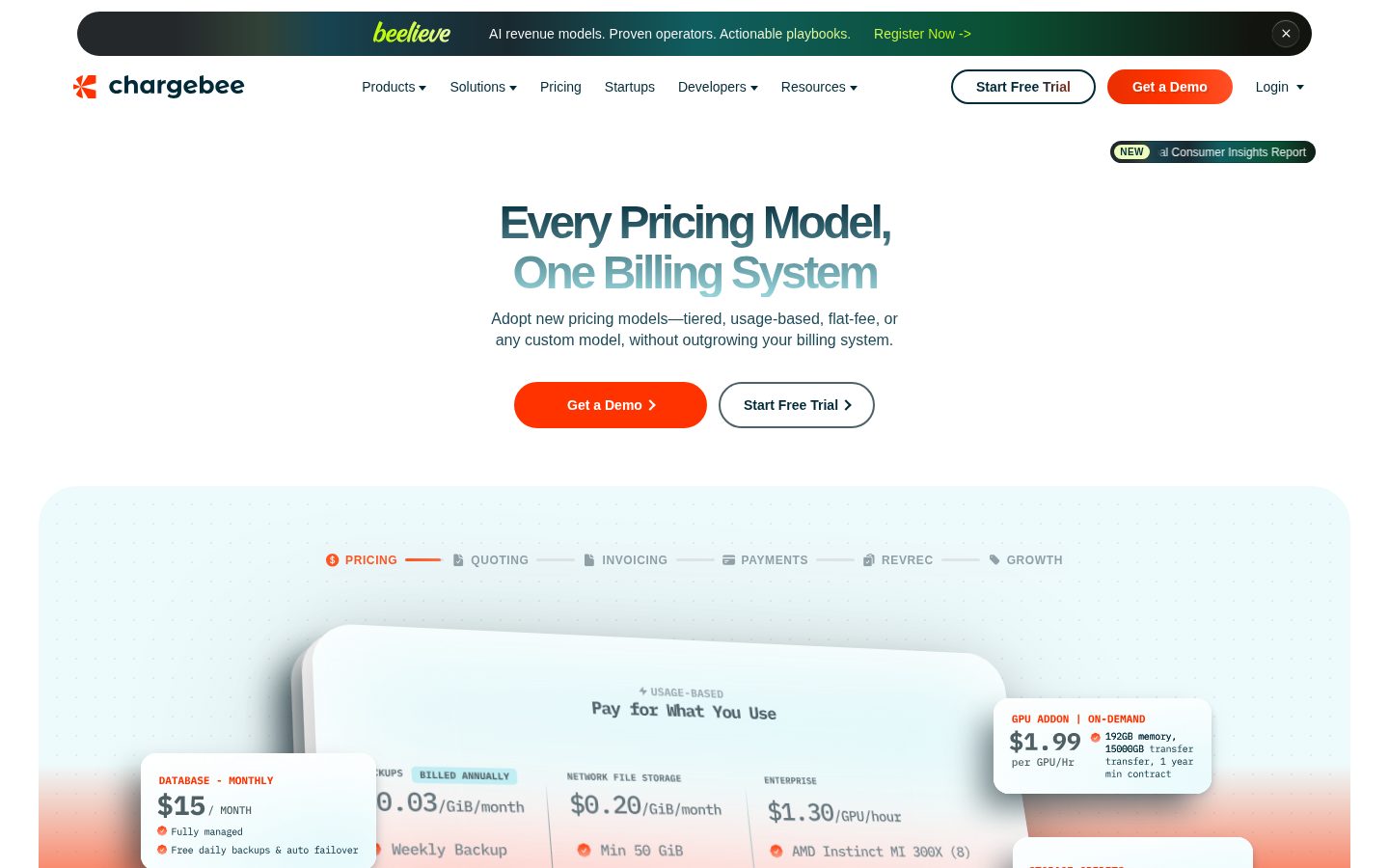
Features

Analytics

  • Reporting & Analytics

    Tracks SaaS metrics including MRR, churn rate, and subscription growth through comprehensive dashboards and reports.

Automation

  • Churn Retention

    Predicts churn risk, intercepts cancellation attempts, and presents targeted offers to retain customers and grow lifetime value.

  • Receivables & Dunning

    Recovers failed payments through automated retry logic and smart dunning workflows to reduce involuntary churn.

Core

  • CPQ (Configure, Price, Quote)

    Generates sales quotes for complex deals and aligns them with finance through a structured quote-to-cash workflow.

  • Checkout Experience

    Provides optimized hosted and drop-in checkout pages designed to maximize conversion rates for subscription sign-ups.

  • Entitlement Management

    Controls and provisions feature access for customers based on their active subscription plan.

  • Product Catalog

    Designs and manages plans, addons, and pricing tiers in a centralized catalog used to configure subscription offerings.

  • Revenue Recognition (RevRec)

    Automates GAAP and IFRS-compliant revenue recognition and produces audit-ready financial reports.

  • Subscription Management

    Creates, manages, and automates subscription lifecycles including trials, upgrades, downgrades, and cancellations across flexible billing models.

  • Time Machine

    Simulates and tests future billing scenarios in a sandbox environment before deploying changes to production.

  • Usage-Based Billing

    Implements metered and consumption-based pricing models that track and bill customers based on actual usage.

Integration

  • Payment Gateway Integrations

    Connects with 30+ payment gateways including Stripe, Braintree, and Adyen and supports cards, ACH, SEPA, PayPal, and local payment methods worldwide.

Preview

Chargebee desktop previewChargebee mobile preview

Pricing Plans

Starter (Billing)

Free

For startups monetizing early traction. Free for the first USD 250K of cumulative billing, then 0.75% on billing.

  • Flexible Billing (Usage-based, Subscriptions, Hybrid)
  • Checkout, Hosted-payments, Self-serve Portal
  • Custom Usage Metering and Aggregation
  • Multi-region Sales Tax Support
  • 35+ Payment Gateway Integrations
Popular

Performance (Billing)

$599/monthly

For teams seeking repeatably-efficient growth with subscription, usage-based, and hybrid sales models. USD 7,188/yr, billed monthly for up to USD 100K billing/mo.

  • Everything in Starter
  • Advance and Consolidated Invoices
  • Smart Dunning
  • Migration Support
  • Engineering Consultation

Enterprise (Billing)

Contact sales

For large businesses and organizations with advanced scalability needs. Custom pricing via sales.

  • Everything in Performance
  • Multi-Entity Support
  • Account Hierarchy
  • On-demand Discounting
  • Contract Terms

CPQ Lite

Free

For getting started with sales-assisted GTM motion. Free for the first 50 quotes. Available exclusively for Chargebee Billing customers.

  • Quote creation for Sales
  • Immediate Amendments for Existing Customers
  • Paid add-ons: Chargebee CPQ for Salesforce and HubSpot

CPQ

Contact sales

For high-velocity sales teams selling to midmarket and enterprise teams. Available exclusively for Chargebee Billing customers. Pricing via sales.

  • Everything in CPQ Lite
  • Quoting Controls for RevOps & Finance
  • Multi-product Quotes
  • Multi-year Ramped Quotes
  • Rule-based Approval Workflows

RevRec Performance

Contact sales

For finance teams looking for out-of-the-box revenue recognition automation. Available only to Chargebee Billing customers. Pricing on request.

  • Automated Revenue Recognition
  • Point-in-Time and Overtime (Ratable)
  • Multi-Currency Support
  • GAAP Revenue Reports
  • Journal Entry Mapping

RevRec Enterprise

Contact sales

For finance teams with multiple source systems, complex billing scenarios, and global scale. Custom pricing via sales.

  • Everything in RevRec Performance
  • Multi-Entity Support
  • Advanced Revenue Rules and SSP configurations
  • Usage-based and Contract-based revenue recognition
  • Multi-source integration with CRM, billing, and accounting systems

Growth Starter

Free

Launch subscriber growth experiments for free on enterprise-grade infrastructure. Exclusively for Chargebee Billing customers. Ideal for single-brand businesses with hundreds of subscribers.

  • Pricing Tables
  • Hosted checkout
  • Self-serve portal
  • No-code cancel pages

Growth Enterprise

Contact sales

Enterprise lifecycle monetization built directly on your billing system. Scalable custom pricing based on number of active subscribers.

  • Everything in Growth Starter
  • Multi-brand growth experiments
  • AI-powered offer builder
  • Trial conversion experiments
  • Upgrade, upsell, and cross-sell experiments

AI Panel Reviews

The Decision Maker

The Decision Maker

Strategic bet, vendor viability, timing, adoption approval
8.2/10

6,500 customers, $599/month, and a billing stack that actually connects to finance.

Chargebee isn't just a billing tool—it's the connective tissue between pricing, revenue recognition, and collections. For a recurring-revenue business past early traction, this is the default choice.

6,500+ businesses is a real number. Chargebee's been at this long enough to build CPQ, RevRec, and dunning as distinct modules—not duct-taped features. The free Starter tier up to $250K cumulative billing is a smart land-and-expand play that lets you evaluate before committing to $599/month.

The tradeoff is complexity. This isn't Stripe Billing with a few API calls. A team without a RevOps or finance ops owner will underuse it badly. The CPQ and RevRec modules require sales-to-finance alignment to deliver ROI—and that's an org readiness problem, not a product problem.

Vendor viability looks solid. Multi-module product depth, usage-based billing support for AI companies, 40+ payment gateways—this isn't a feature roadmap, it's a mature platform. Three questions answered: they'll exist, it advances you, and the board won't blink at the name.

Competitive Positioning8.0

Category peers are on Zuora or Stripe Billing—Chargebee sits between them in capability and complexity, which is exactly where most mid-market buyers need to be.

Reputation Risk8.5

Competes credibly with Zuora and Maxio—adopting Chargebee reads as a considered, defensible choice.

Speed to Value7.5

Drop-in checkout and free Starter tier accelerate initial deployment, but CPQ and RevRec modules need org alignment to pay back.

Strategic Fit8.0

Usage-based billing and RevRec automation advance revenue operations maturity, not just cost reduction.

Vendor Viability8.5

6,500+ customers across B2B SaaS, AI, and media signals durable market position—not a startup bet.

Pros

  • Free up to $250K billing—real evaluation runway before you commit
  • RevRec module handles ASC 606 and IFRS 15 automatically with audit-ready output
  • 40+ payment gateways and 100+ currencies cover international expansion without rework
  • Time Machine sandbox lets you test billing changes before they hit production

Cons

  • $599/month Performance tier requires finance or RevOps ownership to justify
  • Module sprawl—CPQ, RevRec, Retention, Receivables each require separate activation and alignment
  • No public changelog makes it harder to track product velocity before signing

Right for

Mid-market SaaS or AI companies with a finance owner ready to connect billing to revenue recognition.

Avoid if

You're a solo founder or early team that just needs invoices sent reliably every month.

The Domain Strategist

The Domain Strategist

Craft and strategy in the product's domain — adapts identity per category, same lens
8.2/10

Chargebee is the CFO's billing stack for subscription businesses that outgrow Stripe Billing.

At $599/month for the Performance tier, Chargebee delivers a quote-to-cash stack—billing, RevRec, dunning, CPQ—that most finance teams would otherwise stitch together from three separate tools. The ASC 606 automation and audit-ready reporting are the features that make this a finance-led decision, not just an engineering one.

The RevRec module handling ASC 606 and IFRS 15 compliance automatically is the line item that changes the conversation for me. That's typically a $50K-$100K implementation with a standalone tool or a painful spreadsheet exercise every quarter-end. Chargebee's 23+ dunning recovery tactics and smart retry logic also address involuntary churn at the process level, which shows up directly in net revenue retention numbers.

The tradeoff is real: the Performance plan caps at $100K monthly billing volume, and the next tier is custom enterprise pricing with a sales call. If you're scaling fast, you can hit that ceiling inside 18 months. Zuora owns the enterprise end of this category with deeper contract complexity handling, and that gap matters for businesses with multi-entity consolidation needs at scale.

If we adopt Chargebee at the Performance tier, in 3 years we have a system where finance, RevOps, and sales are working from one product catalog and one recognition ledger. The CPQ-to-RevRec connection—quotes flowing directly into recognition rules—is the architectural choice that prevents the spreadsheet sprawl that kills month-end close efficiency.

Category Positioning8.0

Chargebee sits between Stripe Billing (developer-first, thinner finance layer) and Zuora (enterprise-heavy, slower to implement), which is exactly the right position for mid-market SaaS CFOs.

Domain Fit8.5

Audit-ready ASC 606 and IFRS 15 reporting, journal entry mapping, and multi-currency support are exactly the controls a CFO needs before an audit or a fundraise.

Integration Surface8.1

60+ integrations including CRMs and accounting platforms, 40+ payment gateways, and a REST API with seven official SDKs give the finance stack real connectivity without custom engineering.

Long-term Implications7.8

The billing-core dependency for CPQ and RevRec modules creates lock-in at the ledger layer—switching costs compound as you build recognition rules and approval workflows into the platform.

Strategic Depth8.4

RevRec, CPQ, dunning, and churn retention as distinct but connected modules signals a platform built by people who understand the full revenue operations lifecycle, not just invoicing.

Pros

  • ASC 606 and IFRS 15 automation with audit-ready output removes a material close risk
  • CPQ-to-RevRec connection means sales quotes and recognition rules share one source of truth
  • 23+ dunning recovery tactics address involuntary churn at the process level, not just the symptom
  • Usage-based billing support future-proofs the billing model as AI and consumption pricing expands

Cons

  • Performance plan caps at $100K monthly billing volume—fast-scaling companies hit enterprise pricing territory quickly
  • RevRec and CPQ pricing is 'contact sales,' which makes total cost of ownership hard to model before you're committed
  • No changelog listed in public docs, which makes it harder to track platform stability and regression risk

Right for

Mid-market SaaS CFOs who need one system connecting billing, revenue recognition, and collections without a Zuora-scale implementation.

Avoid if

Your billing complexity requires deep multi-entity consolidation at enterprise scale where Zuora's contract management has a significant head start.

The Finance Lead

The Finance Lead

Money, total cost of ownership, contracts, procurement math
7.8/10

$599/month base, but RevRec and CPQ pricing require a sales call — model accordingly.

Chargebee covers the full billing stack: usage-based, flat-rate, hybrid, CPQ, dunning, RevRec. Starter tier is free through $250K cumulative billing, which is genuinely useful for early-stage teams.

Starter is free until $250K cumulative billing, then 0.75% on billing. Performance runs $599/month ($7,188/year) for up to $100K monthly billing volume. That's the honest sticker. The problem: RevRec and CPQ pricing both require a sales call. For a 50-seat team running $1M ARR, RevRec alone could add $20K–$40K/year based on category norms. Build that into year-3 TCO before signing.

The module depth is real. 23+ dunning recovery tactics, ASC 606 and IFRS 15 automation via RevRec, CPQ with multi-year ramped quotes, and a Time Machine sandbox for billing scenario testing. 40+ payment gateways, 100+ currencies. Stripe Billing and Recurly can't match the CPQ-to-RevRec stack depth out of the box.

The tradeoff: you're buying a platform, not a tool. Migration support is listed only at Performance tier. Auto-renewal terms and termination windows aren't published — that's a procurement flag. Get the contract language before you sign.

Billing & Procurement7.5

Three of nine plan tiers require a sales call, adding procurement friction, but the Starter free tier and Performance self-serve reduce onboarding cost for smaller buyers.

Contract Flexibility6.0

Auto-renewal windows and termination-for-convenience terms aren't published on the pricing page — category norm is 60-day notice, but unconfirmed here.

Pricing Transparency6.5

Starter and Performance tiers are published, but RevRec, CPQ, and Enterprise all require sales contact — opaque where costs compound most.

ROI Clarity8.2

MRR, ARR, and churn dashboards are built-in; 23+ dunning recovery tactics and RevRec automation produce measurable, auditable outputs.

Total Cost of Ownership6.8

$7,188/year base at Performance is visible, but RevRec and CPQ add-ons have no published rates; year-3 all-in is genuinely unpredictable.

Pros

  • Free through $250K cumulative billing — real runway for early-stage SaaS
  • ASC 606 and IFRS 15 RevRec automation with audit-ready reporting
  • 40+ payment gateways, 100+ currencies, 23+ dunning recovery tactics
  • CPQ with multi-year ramped quotes — Stripe Billing doesn't have this

Cons

  • RevRec and CPQ pricing opaque — requires sales call, complicates TCO
  • Auto-renewal and cancellation terms not published publicly
  • Migration support gated to Performance tier ($599/month minimum)
  • Platform complexity means real implementation cost not reflected in sticker

Right for

Mid-market SaaS teams running $500K–$10M ARR who need billing, RevRec, and CPQ in one system.

Avoid if

You need fully transparent all-in pricing before engaging sales.

The Domain Practitioner

The Domain Practitioner

Daily hands-on reality in the product's domain — adapts identity per category, same lens
8.2/10

Chargebee is the billing stack finance teams stop fighting after week one

At $599/month for the Performance tier, Chargebee covers the full revenue lifecycle—billing, dunning, RevRec, CPQ—without forcing a patchwork of point solutions. The depth is real, but the surface area means onboarding isn't trivial.

The product catalog and subscription lifecycle management are where Chargebee earns its keep. Configuring tiered, usage-based, and hybrid pricing in a single system—without duct-taping Stripe Billing to a separate RevRec tool—is the core value proposition, and the evidence supports it being genuinely functional. ASC 606 and IFRS 15 automation with audit-ready journal entry mapping is a serious capability for any finance team closing a Series B or heading into an audit. That's not table stakes; Zuora charges significantly more for similar compliance coverage.

The $599/month Performance tier caps at $100K monthly billing volume. Scale past that and you're in custom enterprise pricing territory with no published number—a real friction point when building internal budget cases. The CPQ and RevRec modules are gated add-ons priced separately, so the sticker price undersells total cost of ownership.

The 23+ dunning recovery tactics and Time Machine sandbox for testing billing scenarios suggest the docs and tooling are built by people who've actually watched involuntary churn eat into MRR. That's the tell. Recurly ships similar features but Chargebee's module depth for mid-market finance ops edges it out.

Day-3 Reality7.8

Multi-module architecture means post-demo configuration of RevRec plus CPQ plus dunning rules takes real setup time before daily workflows stabilize.

Documentation Practitioner-Fit8.0

Docs=Y and the existence of a Time Machine sandbox for billing scenario testing signals engineering and finance input, not just marketing copy.

Friction Surface7.5

CPQ, RevRec, and Retention are separate add-on modules with separate pricing requests, which means multiple sales conversations before you have a complete picture.

Power-User Depth8.8

Usage-based metering, multi-entity support, SSP configurations, rule-based approval workflows in CPQ, and 23+ dunning tactics give power users real leverage at scale.

Workflow Integration8.5

60+ integrations with CRMs and accounting platforms plus REST API SDKs in seven languages means it fits existing RevOps stacks rather than demanding a rebuild.

Pros

  • ASC 606 and IFRS 15 automation with audit-ready journal entry mapping—no manual recognition calculations
  • Starter tier free up to $250K cumulative billing, giving early-stage SaaS a genuine on-ramp
  • Time Machine sandbox lets finance teams test billing scenario changes before they hit production
  • 30+ payment gateways with ACH, SEPA, and local methods covers global revenue operations

Cons

  • Performance tier's $100K/month billing cap means growing mid-market companies hit opaque enterprise pricing fast
  • RevRec and CPQ are separate add-ons with pricing on request—total cost of ownership isn't transparent at the pricing page
  • No changelog listed publicly, making it harder to track platform changes that affect revenue recognition rules

Right for

Mid-market SaaS finance teams running usage-based or hybrid pricing who need billing, RevRec, and dunning in one auditable system.

Avoid if

You're a solo founder or early startup whose billing complexity doesn't justify $599/month before you've hit meaningful revenue scale.

The Power User

The Power User

Daily human experience, onboarding, polish, learning curve, reliability
8.1/10

Chargebee does billing's ugly plumbing work so you don't have to think about it

Serious subscription infrastructure for SaaS teams who've outgrown Stripe Billing's basics. At $599/month for Performance, you're buying a whole revenue ops stack, not just an invoicing tool.

6,500+ businesses running recurring revenue on this thing, and you can feel why. The product catalog, dunning logic, RevRec automation, CPQ — these aren't bolted-on features, they're distinct modules that actually talk to each other. The 23+ payment recovery tactics and 40+ gateway integrations aren't marketing padding. That's real operational depth for finance teams who are tired of reconciling spreadsheets at quarter-close.

The Starter tier is genuinely free through $250K cumulative billing, which is smart for early-stage teams. But the jump to $599/month Performance is where most growing SaaS teams land, and the complexity lands with it. Time Machine — their sandbox for testing billing scenarios before pushing live — shows someone on that team actually sweated the consequences of getting it wrong.

Mobile is web-only, which for a back-office billing tool is mostly fine. But the learning curve is real. This isn't Stripe's clean dashboard. Compared to Recurly, Chargebee's surface area is bigger, which means more power and more orientation time.

Daily Polish7.8

Time Machine sandbox and smart dunning workflows suggest careful product thinking, though no changelog is publicly visible to verify iteration pace.

Learning Curve6.8

Multiple distinct modules — CPQ, RevRec, Retention, Receivables — mean real power users will thrive at month three, but the first week requires genuine investment.

Mobile Parity5.5

Web-only platform — mobile isn't mentioned anywhere in the evidence, which for a billing ops tool is defensible but still a gap for on-the-go finance teams.

Onboarding Experience7.2

Free Starter tier and drop-in checkout script lower the entry barrier, but the full module surface area means early setup is homework, not a quick win.

Reliability Feel8.2

40+ payment gateways, 100+ currencies, and GAAP/IFRS audit-ready reporting suggest infrastructure-grade reliability baked into the core.

Pros

  • Starter tier is free through $250K in cumulative billing — genuinely useful for pre-scale SaaS
  • 23+ payment recovery tactics and smart dunning cut involuntary churn without manual work
  • RevRec module handles ASC 606 and IFRS 15 compliance automatically with audit-ready output
  • Time Machine sandbox lets you test billing changes before they touch real customers

Cons

  • Performance tier jumps to $599/month — steep if you only need core billing
  • Web-only, no mobile app for monitoring or approvals on the go
  • Module breadth means a real orientation period before you're running smoothly
  • Changelog not publicly available, so tracking product iteration requires digging

Right for

Growth-stage SaaS teams who need usage-based billing, revenue recognition, and dunning in one place without stitching together three separate tools.

Avoid if

You're a solo founder or tiny team who just needs clean recurring invoices — Stripe Billing will cost less and confuse you less.

The Skeptic

The Skeptic

Contrarian. Watch-outs, deal-breakers, broken promises, category patterns
7.8/10

6,500 customers, $599/mo entry, and a module stack that's actually coherent

Chargebee isn't pretending to be simple billing. The RevRec, CPQ, and Receivables modules stack logically — that's rarer than it sounds. The $599/month Performance floor is real money for early teams, but the free Starter tier buys time.

Three tells upfront. One: no changelog listed — can't verify shipping cadence from public evidence. Two: the pricing page mixes 'Free' labels on paid-on-request plans, which is confusing. Three: 'every pricing model, one platform' is the kind of headline Zuora was running in 2017. Doesn't disqualify them. Just watch it.

Where Chargebee earns credit: the module architecture is honest. RevRec for ASC 606 compliance, CPQ for sales-assisted deals, Receivables with 23+ dunning tactics — these aren't feature bullets, they're distinct workflows. Stripe Billing doesn't touch this. Recurly doesn't go this deep on CPQ. That's a real gap filled.

The exit risk is real though. Custom catalog structure, entitlement configs, and RevRec rules don't migrate cleanly. If you build deep on this stack, leaving hurts. That's not a dealbreaker — it's the category norm — but don't go in naive.

Competitive Differentiation7.8

CPQ plus RevRec plus dunning in one stack distinguishes it from Stripe Billing and Recurly, though Zuora competes here at enterprise scale.

Exit Portability5.5

Deep RevRec rules, entitlement configs, and CPQ workflows create real migration friction — category norm, but it's sticky by design.

Long-term Viability7.5

No public funding data visible, but 6,500 customers, API with 7 SDKs, and 60+ marketplace integrations suggest an operational business, not a startup on fumes.

Marketing Honesty7.2

Headline is broad but feature descriptions are specific; the 'Free' labels on sales-only plans are genuinely misleading on the pricing page.

Track Record Match8.0

6,500+ customers and a multi-module product depth match patterns of durable billing platforms like Maxio, not ones that quietly folded.

Pros

  • Module stack — RevRec, CPQ, Receivables — is coherent and independently deployable
  • 30+ gateway integrations and 100+ currencies covers most global expansion scenarios
  • Free Starter tier up to $250K cumulative billing gives real runway before $599/mo kicks in
  • Time Machine sandbox for testing billing changes before production is genuinely useful

Cons

  • No changelog visible — can't verify how actively the product ships
  • $599/mo Performance tier is steep for teams under $50K MRR
  • Migration off the platform is painful once RevRec and entitlement configs are established
  • Pricing page 'Free' labels on custom-priced plans create false expectations

Right for

Mid-market SaaS teams with hybrid pricing models who need billing, RevRec, and CPQ without stitching three vendors together.

Avoid if

You're pre-revenue or under $20K MRR — the free tier has limits and $599/mo is a lot of runway to burn on billing infrastructure.

Buyer Questions

Common questions answered by our AI research team

Features

What pricing models does Chargebee support?

Chargebee supports flat-rate, tiered, usage-based, per-user, multi-year, hybrid, and custom pricing models, all manageable within a single billing system.

Integration

How many payment gateways does Chargebee integrate with?

Chargebee integrates with 40+ payment gateways and supports 100+ billing currencies.

Features

Does Chargebee handle ASC 606 revenue recognition automatically?

Yes. Chargebee has built-in ASC 606 and IFRS 15 compliance rules that automate recognition timing and produce audit-ready documentation without manual calculations.

Features

Can Chargebee help reduce failed payments?

Yes. Chargebee offers 23+ recovery tactics including intelligent retry logic, card updates, and smart reminders to prevent payment failures and recover lost revenue.

Setup

Is there a free trial available for Chargebee?

Yes. Chargebee offers a free trial, accessible via the "Start Free Trial" option on its website.

Also in AI Finance