Paradox.ai logo

Paradox.ai Review

Visit

Conversational AI platform that automates recruiting, screening, and hiring workflows

Paradox.ai is a conversational AI recruiting platform for HR and talent acquisition teams.

AI Panel Score

7.7/10

6 AI reviews

Reviewed

About Paradox.ai

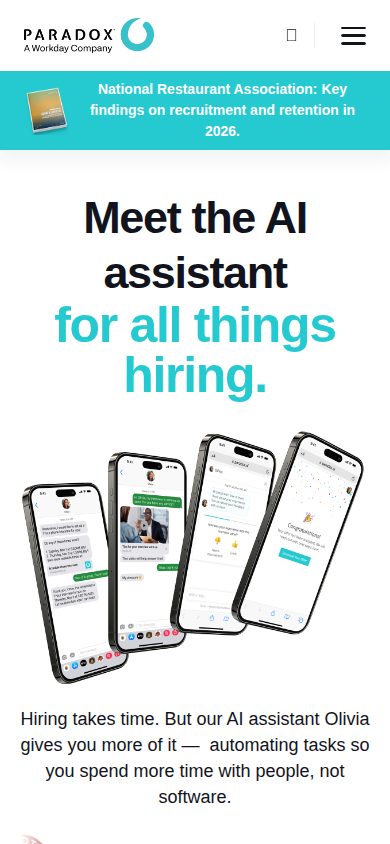
In practice, recruiters configure Olivia to handle candidate-facing tasks across the hiring funnel. When a job seeker lands on a career site or scans a QR code, Olivia initiates a conversation, asks qualifying questions, and — if the candidate meets criteria — books an interview directly on the recruiter's calendar without human intervention. Applications can be completed entirely through a text thread, removing the need for account creation or lengthy forms.

Paradox offers a suite of modular products built around this conversational model: a Conversational ATS for end-to-end applicant tracking, a Conversational CRM for nurturing passive candidates via SMS and email campaigns, Conversational Events for managing recruiting event registration and follow-up, and tools for recorded video interviews, onboarding, and candidate surveys. The scheduling module resolves availability across multiple participants and time zones automatically. The platform integrates natively with Workday, SAP, and Oracle, and maintains a broader partner directory covering additional HR and ATS systems, including an Indeed integration for job distribution.

Paradox targets mid-to-large enterprise HR and talent acquisition teams, with particular emphasis on high-volume and frontline hiring use cases — industries like retail, hospitality, and logistics where applicant throughput is high and recruiter bandwidth is limited. Pricing is not published; prospective customers book a demo for a custom quote. Named competitors include iCIMS, Phenom, Fountain, HireVue, Eightfold, and Workstream, among others.

The platform is web-based and accessible via browser, with candidate interactions supported across web, SMS, and WhatsApp. Security certifications include SOC 2 Type II, ISO 27001, GDPR compliance, and AES-256 encryption. Candidate-facing sessions are managed through olivia.paradox.ai.

Features

AI

  • Candidate Screening

    Olivia engages candidates 24/7 to screen applicants for qualifications through automated conversational interactions, reducing manual recruiter workload.

  • Conversational Career Sites

    Delivers mobile-first, AI-powered career site experiences with a built-in assistant that provides personalized guidance to help candidates discover and apply to jobs quickly.

Analytics

  • Candidate Surveys

    Collects structured feedback from candidates at key points in the hiring process through automated survey conversations.

Automation

  • Conversational CRM

    Enables recruiters to nurture passive candidates through automated SMS and email campaigns, rediscover past applicants, and build talent pipelines.

  • Conversational Events

    Automates recruiting event management by handling candidate registration, reminders, and follow-up communications through real-time AI-powered conversations.

  • Conversational Scheduling

    Automatically finds and confirms mutually available interview times across multiple participants and time zones, eliminating manual back-and-forth scheduling coordination.

Core

  • Conversational ATS

    A next-generation applicant tracking system that automates repetitive recruiting steps including screening, scheduling, and feedback collection through AI-powered conversations.

  • Onboarding

    Extends the conversational AI platform into the new hire onboarding process, guiding employees through onboarding tasks after the offer is accepted.

  • Recorded Video Interviews

    Allows candidates to complete recorded video interviews as part of the hiring workflow, enabling asynchronous assessment by recruiting teams.

Integration

  • HR System Integrations

    Connects natively with major HR platforms including Workday, SAP, Oracle, and Indeed to support the full talent lifecycle within existing tech stacks.

Mobile

  • Conversational Apply

    Transforms job applications into mobile-first text conversations via SMS, web, or WhatsApp, eliminating lengthy forms and logins so candidates can apply in minutes from any device.

  • Text Recruiting

    Engages candidates and drives job applications directly through SMS text messaging as a primary recruiting and application channel.

Preview

Paradox.ai desktop previewParadox.ai mobile preview

Pricing Plans

Contact Sales

Contact sales

Custom pricing for enterprise and mid-market organizations. All access is gated behind a demo/sales process with no public list prices.

  • Conversational ATS for automated screening and scheduling
  • Conversational Career Sites with mobile-first AI assistant
  • Conversational Apply via text, web, or WhatsApp
  • Conversational CRM for candidate nurturing and pipeline building
  • Conversational Scheduling across multiple participants and time zones
  • Integrations with Workday, SAP, Oracle, and other major HR systems

AI Panel Reviews

The Decision Maker

The Decision Maker

Strategic bet, vendor viability, timing, adoption approval
8.1/10

Olivia automates 90% of high-volume hiring — the board will want to see this.

Paradox targets the exact pain point where enterprise recruiting breaks down: frontline, high-volume hiring at scale. The Workday integration alone — automating 90% of the hiring process per their own docs — makes this defensible in most enterprise stacks.

No public pricing and no free trial means you're going into a negotiation blind. That's a procurement headache, but it's also standard for enterprise HR software. iCIMS and Phenom play the same game, so the board won't call it unusual. The real ask is making sure the contract doesn't trap you with seat floors or per-message fees on SMS volume.

The Olivia assistant — handling screening, scheduling, and Conversational Apply via SMS or WhatsApp — is the kind of feature retail and logistics ops leaders have been asking for. Not a nice-to-have. Reducing form-heavy application drop-off is a measurable outcome you can put in front of the board at 12 months.

The tradeoff: Paradox is purpose-built for high-volume, frontline hiring. If your recruiting motion is mostly senior or knowledge-worker roles, the ROI math gets thinner fast. Pilot in one high-volume business unit before any org-wide commitment.

Competitive Positioning7.9

Fountain owns the gig-economy niche; Paradox competes on enterprise integrations and breadth of modules, which is the stronger position for mid-to-large HR orgs.

Reputation Risk8.0

Peers in retail, logistics, and healthcare are already in this category; showing up with Paradox looks current, not experimental.

Speed to Value8.3

Automated interview scheduling and Conversational Apply eliminate the highest-friction recruiter tasks immediately upon deployment — payback is visible within a single hiring cycle.

Strategic Fit8.2

Conversational Apply and 24/7 automated screening directly advance recruiting capacity without adding headcount — that's advancement, not just cost savings.

Vendor Viability7.8

No public funding data, but SOC 2 Type II, ISO 27001, and native Workday/SAP/Oracle integrations suggest an established enterprise-grade operation — not a startup on fumes.

Pros

  • Workday, SAP, and Oracle native integrations — no custom middleware required
  • Conversational Apply via SMS and WhatsApp measurably cuts application drop-off
  • Full-funnel coverage: screening, scheduling, video interviews, onboarding
  • SOC 2 Type II and ISO 27001 — clears most enterprise security reviews

Cons

  • No published pricing — you're negotiating without a floor
  • No API docs or changelog publicly visible — harder to assess dev extensibility
  • ROI thins quickly outside high-volume or frontline hiring use cases
  • No free trial means you're committing on demo alone

Right for

Enterprise HR teams running high-volume frontline hiring in retail, logistics, or healthcare who are already on Workday or SAP.

Avoid if

Your recruiting is primarily senior or knowledge-worker roles where volume is low and relationship depth matters more than automation.

The Domain Strategist

The Domain Strategist

Craft and strategy in the product's domain — adapts identity per category, same lens
8.2/10

Olivia handles the volume work; your recruiters handle the relationships.

Paradox has built a genuinely complete conversational hiring stack — screening, scheduling, CRM, events, onboarding — around a single candidate-facing persona. For high-volume frontline hiring, it's one of the most purpose-fit platforms in the category.

The Conversational Apply module is the real differentiator here. Eliminating account creation and form walls for hourly candidates in retail, logistics, and hospitality directly attacks the drop-off problem those teams actually have. Fountain targets the same segment but stays narrower; Paradox's modular breadth — ATS, CRM, events, onboarding — means fewer vendors in your stack after year one.

Native Workday, SAP, and Oracle integrations are table-stakes for enterprise TA teams, and Paradox has them. The SOC 2 Type II and ISO 27001 certifications clear the infosec review. What's missing publicly: no docs portal, no changelog, no pricing transparency. Custom quoting at enterprise scale is normal, but the absence of even a baseline structure makes internal budgeting conversations harder.

The 3-year risk is Olivia becoming your candidate experience layer in a way that's hard to unwind. If Paradox changes pricing or the conversational model doesn't evolve with candidate expectations, you're re-platforming something candidates already know by name. Build that dependency awareness into your contract terms.

Category Positioning8.0

Sits above point solutions like Fountain and below full talent intelligence platforms like Eightfold — the right lane for high-volume enterprise TA.

Domain Fit8.8

WhatsApp and SMS application flows directly solve frontline hiring drop-off, the actual pain point for retail and logistics TA teams.

Integration Surface8.3

Native Workday, SAP SuccessFactors, Oracle, and Indeed integrations cover the core enterprise HR stack cleanly.

Long-term Implications7.5

Deep candidate-facing brand dependency on Olivia creates switching costs that compound after year two.

Strategic Depth8.5

Full-funnel conversational architecture — screening through onboarding — shows genuine product depth beyond a scheduling bolt-on.

Pros

  • Conversational Apply removes form and login friction for frontline candidates
  • Full-funnel modularity: ATS, CRM, events, onboarding in one platform
  • Enterprise-grade security: SOC 2 Type II, ISO 27001, GDPR, AES-256
  • Native integrations with Workday, SAP, Oracle, and Indeed

Cons

  • No public pricing — internal budget approval cycles get harder without baseline numbers
  • No public docs or changelog limits pre-sales technical diligence
  • Olivia as the candidate-facing brand creates meaningful platform lock-in
  • No free trial means full evaluation requires a sales cycle

Right for

Enterprise TA teams running high-volume frontline hiring who need to reduce recruiter admin without rebuilding their core HRIS.

Avoid if

You're a sub-500-employee company or primarily hiring knowledge workers where conversational volume automation isn't the bottleneck.

The Finance Lead

The Finance Lead

Money, total cost of ownership, contracts, procurement math
6.2/10

Zero published pricing, zero free trial — every number lives behind a demo wall.

Paradox.ai has real enterprise capability — Workday, SAP, Oracle integrations, 24/7 Olivia screening. The financials are completely opaque; no tiers, no floor price, no overage rates.

No pricing page. No trial. No published tiers. Procurement teams log a demo and wait. That's the model. For a platform targeting mid-to-large enterprise with high-volume frontline hiring, the opacity isn't unusual — but it means 3-year TCO is unmodelable without an NDA conversation. Category norm for this segment is $50K-$200K+ annually depending on seat count and module mix. Add Conversational ATS, CRM, Events, and onboarding — each likely a separate line item.

Workday and SAP integrations are named and documented. Those reduce implementation friction, but integration work still carries cost. Competitor Fountain publishes starting prices. Paradox doesn't. That asymmetry costs Paradox in competitive shortlists — procurement teams default to whoever shows numbers first.

The tradeoff: Olivia's 24/7 screening and mobile-first apply via WhatsApp and SMS are legitimate high-volume hiring value props. But without published overage rates or contract terms, the invoice risk is real. Auto-renewal windows and termination clauses — unknown publicly. That's not acceptable before signing.

Billing & Procurement4.0

No published invoicing model; procurement friction is high with mandatory demo-first buying motion and no trial period.

Contract Flexibility4.5

Auto-renewal windows and termination terms are not publicly disclosed — standard enterprise hostage risk.

Pricing Transparency1.5

No pricing page, no tiers, no floor — 100% gated behind a sales demo.

ROI Clarity6.5

Workday integration claims 90% automation of hiring process — a specific, testable number, though self-reported.

Total Cost of Ownership4.0

Multi-module architecture (ATS, CRM, Events, onboarding) suggests meaningful add-on cost; no public data to model year 3.

Pros

  • Native Workday, SAP, and Oracle integrations reduce implementation friction
  • Olivia operates 24/7 — real recruiter bandwidth math at scale
  • WhatsApp and SMS apply removes form drop-off for frontline roles
  • SOC 2 Type II and ISO 27001 reduce security review cycles

Cons

  • Zero published pricing — every number requires a sales call
  • No free trial; no sandbox to validate fit before contract
  • Module-based architecture likely means stacked annual costs
  • Competitor Fountain publishes rates; Paradox's opacity is a shortlist disadvantage

Right for

High-volume enterprise HR teams in retail or logistics already running Workday or SAP who can absorb an opaque procurement process.

Avoid if

Your finance team requires published pricing before executive approval — this vendor won't help you build the business case.

The Domain Practitioner

The Domain Practitioner

Daily hands-on reality in the product's domain — adapts identity per category, same lens
8.2/10

Olivia handles the screening queue so you can spend time on actual candidates

Paradox's conversational AI automates the highest-volume, lowest-value recruiter tasks — screening, scheduling, follow-up — with native integrations into Workday, SAP, and Oracle. The pitch is strongest for high-volume frontline hiring; enterprise professional roles will feel the ceiling faster.

The scheduling automation alone is worth evaluating. Olivia resolves availability across multiple participants and time zones without a single recruiter touchpoint — no more ping-pong email chains to book a panel interview. The Workday integration docs claim 90% of the hiring process automated via two-way SMS, which is an aggressive number, but even half that changes a recruiter's weekly calendar significantly. Conversational Apply via WhatsApp and SMS removes the form-fill dropout problem that kills retail and logistics pipelines.

Day-3 reality: configuring Olivia's qualifying questions is where recruiter judgment actually lives, and the evidence shows no changelog, no API docs, and no public documentation. That matters. If tuning screening logic requires a CSM call every time a job changes, that's friction stacking up weekly.

Compared to Fountain, which owns the deskless-worker funnel natively, Paradox plays broader — ATS, CRM, events, onboarding, video interviews. That breadth is a genuine advantage for a team wanting one conversational layer across the full funnel. But no pricing page means every conversation starts with a demo, which is its own kind of friction for busy TA leaders trying to build a business case fast.

Day-3 Reality7.8

Scheduling and screening automation are high-value daily wins, but no public docs or changelog suggests configuration changes depend on vendor support cycles.

Documentation Practitioner-Fit5.5

No changelog, no API docs, and no public documentation surface found — the evidence suggests marketing-facing content only.

Friction Surface7.5

Candidate-side friction drops sharply via Conversational Apply, but recruiter-side tuning and the no-trial, no-pricing access model adds procurement drag.

Power-User Depth7.8

Modular suite covering ATS, CRM, events, onboarding, and video interviews gives experienced TA ops teams real depth, but discoverability can't be confirmed without docs.

Workflow Integration8.5

Native integrations with Workday, SAP, and Oracle cover the major enterprise ATS stacks most TA teams are already running.

Pros

  • Conversational Scheduling eliminates the back-and-forth that eats recruiter hours at high volume
  • Workday, SAP, and Oracle integrations are native, not middleware hacks
  • WhatsApp and SMS candidate channels directly reduce drop-off in frontline and logistics pipelines
  • Full-funnel coverage — screening through onboarding — in one conversational layer

Cons

  • No public pricing; every evaluation starts with a demo, which slows internal business case building
  • No visible documentation or changelog suggests post-sales support dependency for configuration changes
  • No free trial means teams can't validate fit before committing to a sales cycle
  • Screening logic quality depends entirely on how well qualifying questions are configured upfront

Right for

High-volume TA teams in retail, hospitality, or logistics running Workday or SAP who need to automate screening and scheduling at scale.

Avoid if

You're hiring fewer than a few hundred roles annually or need transparent pricing to build a budget case without a sales engagement.

The Power User

The Power User

Daily human experience, onboarding, polish, learning curve, reliability
8.1/10

Olivia does the scheduling grunt work so your recruiters don't have to.

Paradox built a genuinely useful AI recruiting assistant around high-volume hiring, and the Workday and SAP integrations make it a serious option for enterprise TA teams. No public pricing is the main friction point for anyone trying to build a business case.

Olivia, the AI assistant at the center of everything here, is the product. Not a feature — the whole product. Candidates scan a QR code, text a number, or land on a career site, and Olivia screens them, books the interview, handles reminders. The docs indicate 90% of the hiring process can run without a recruiter touching it when Workday is in the stack. For retail, logistics, or restaurant chains running thousands of applications monthly, that's not a nice-to-have — that's the entire value proposition.

The module lineup is genuinely broad: Conversational ATS, CRM for passive candidates, Events, video interviews, onboarding. Compare that to Fountain, which focuses narrowly on frontline apply workflows. Paradox is trying to own the whole candidate journey conversationally. That ambition is mostly earned based on what's described, though configuring all those modules across a large enterprise is real work, not a weekend setup.

The zero public pricing is genuinely annoying. No free trial, no ballpark, just a demo form. That slows down every procurement cycle. And without a changelog or API docs visible, you can't tell how fast they're shipping.

Daily Polish7.8

Conversational Apply and mobile-first career sites suggest real attention to the candidate-facing surface, but no changelog means you can't verify how consistently the team sweats internal recruiter UI details.

Learning Curve6.8

The modular suite — ATS, CRM, Events, onboarding — is powerful but wide, and with no public docs or API visibility, the ramp for a new admin configuring enterprise workflows looks steep.

Mobile Parity9.0

SMS, WhatsApp, and web-based Conversational Apply are core product, not afterthoughts — candidates can complete full applications through a text thread with no account creation required.

Onboarding Experience6.5

No free trial and a demo-only entry point means the first ten minutes is a sales call, not the product — that's homework before you even start.

Reliability Feel7.9

SOC 2 Type II, ISO 27001, and AES-256 encryption suggest serious infrastructure investment; a dedicated olivia.paradox.ai subdomain implies production-grade separation of candidate sessions.

Pros

  • Olivia handles 24/7 candidate screening and interview scheduling without recruiter intervention
  • Native integrations with Workday, SAP SuccessFactors, and Oracle cover most enterprise HR stacks
  • WhatsApp and SMS apply removes the form-filling friction that kills frontline candidate completion rates
  • Module breadth — ATS, CRM, Events, onboarding — covers more hiring lifecycle than most point solutions

Cons

  • Zero public pricing means every evaluation starts with a sales call
  • No free trial — you can't actually feel the product before committing
  • No visible changelog or API docs makes it hard to judge shipping velocity or build-vs-buy decisions
  • Enterprise configuration across all modules will require dedicated admin time, not a quick setup

Right for

Mid-to-large enterprise TA teams running high-volume frontline hiring in retail, logistics, or hospitality who already run Workday or SAP.

Avoid if

You're a small company that needs transparent pricing and a self-serve trial before talking to sales.

The Skeptic

The Skeptic

Contrarian. Watch-outs, deal-breakers, broken promises, category patterns
7.2/10

Olivia is real. The pricing opacity is a yellow flag worth watching.

Paradox has a concrete named product, deep enterprise integrations, and a plausible wedge in high-volume frontline hiring. No published pricing, no changelog, no API docs — the transparency picture has gaps.

Three tells upfront. One: no pricing page, no free trial, no changelog visible. Two: 'get your candidates from hello to hired' — the kind of tagline that ages poorly. Three: no API docs listed, which matters if you're an enterprise buyer betting on customization.

The differentiation story is actually decent. Conversational Apply via WhatsApp and SMS is a real wedge against form-heavy ATS incumbents like iCIMS. The Workday and SAP native integrations suggest enterprise credibility, not just aspirational positioning. High-volume retail and logistics hiring is a genuine underserved pain point — Fountain and Workstream compete here but Olivia's conversational model is more developed based on the feature set visible.

Exit portability worries me. Candidate data lives inside Olivia's conversation layer. If you migrate off, those interactions, pipeline history, and CRM campaigns are at risk. No public data portability docs. For a 2-year contract at enterprise pricing — probably six figures — that's leverage you're handing over.

Competitive Differentiation7.8

WhatsApp and SMS-native apply flow is a real gap vs. iCIMS and legacy ATS players; Conversational Scheduling across time zones with zero account creation is a concrete differentiator.

Exit Portability5.5

No public data export docs and a proprietary conversation layer — candidate history and CRM pipelines are sticky; migration cost is opaque.

Long-term Viability7.0

No public funding data visible, no changelog, but SOC 2 Type II and ISO 27001 certifications plus Workday/SAP partnerships suggest an organization with real operational depth.

Marketing Honesty6.5

The 'hello to hired' framing is soft superlative territory; the feature descriptions are grounded but the site hides pricing and carries no changelog.

Track Record Match7.5

Named integrations with Workday, SAP, and Oracle plus 8 named verticals suggest real enterprise deployments, not vapor; pattern matches HireVue's survival arc more than Textio's quiet fade.

Pros

  • Olivia is a named, scoped product — not a vague AI layer
  • WhatsApp and SMS-native apply removes the biggest frontline hiring drop-off point
  • Native Workday, SAP, and Oracle integrations are enterprise table-stakes, and they have them
  • SOC 2 Type II plus ISO 27001 — security story is solid

Cons

  • No pricing page, no free trial — you're flying blind on cost until a demo
  • No changelog visible — can't verify shipping cadence
  • No API docs listed — customization story is unclear
  • Exit portability is murky; conversation-layer lock-in is real at enterprise scale

Right for

Enterprise HR teams running high-volume frontline hiring in retail, logistics, or hospitality who need WhatsApp-native apply and Workday integration.

Avoid if

You need transparent pricing, public API docs, or a clean migration path before signing a multi-year contract.

Buyer Questions

Common questions answered by our AI research team

Integration

Does Paradox integrate with Workday?

Yes. The Paradox for Workday integration enables candidate communication directly through SMS and automates 90% of the hiring process with two-way messaging and automated interview scheduling.

Features

Can candidates apply via WhatsApp?

Yes. Olivia engages candidates via text, web, or WhatsApp, converting form-heavy hiring workflows into mobile-first conversations.

Features

What industries does Paradox support?

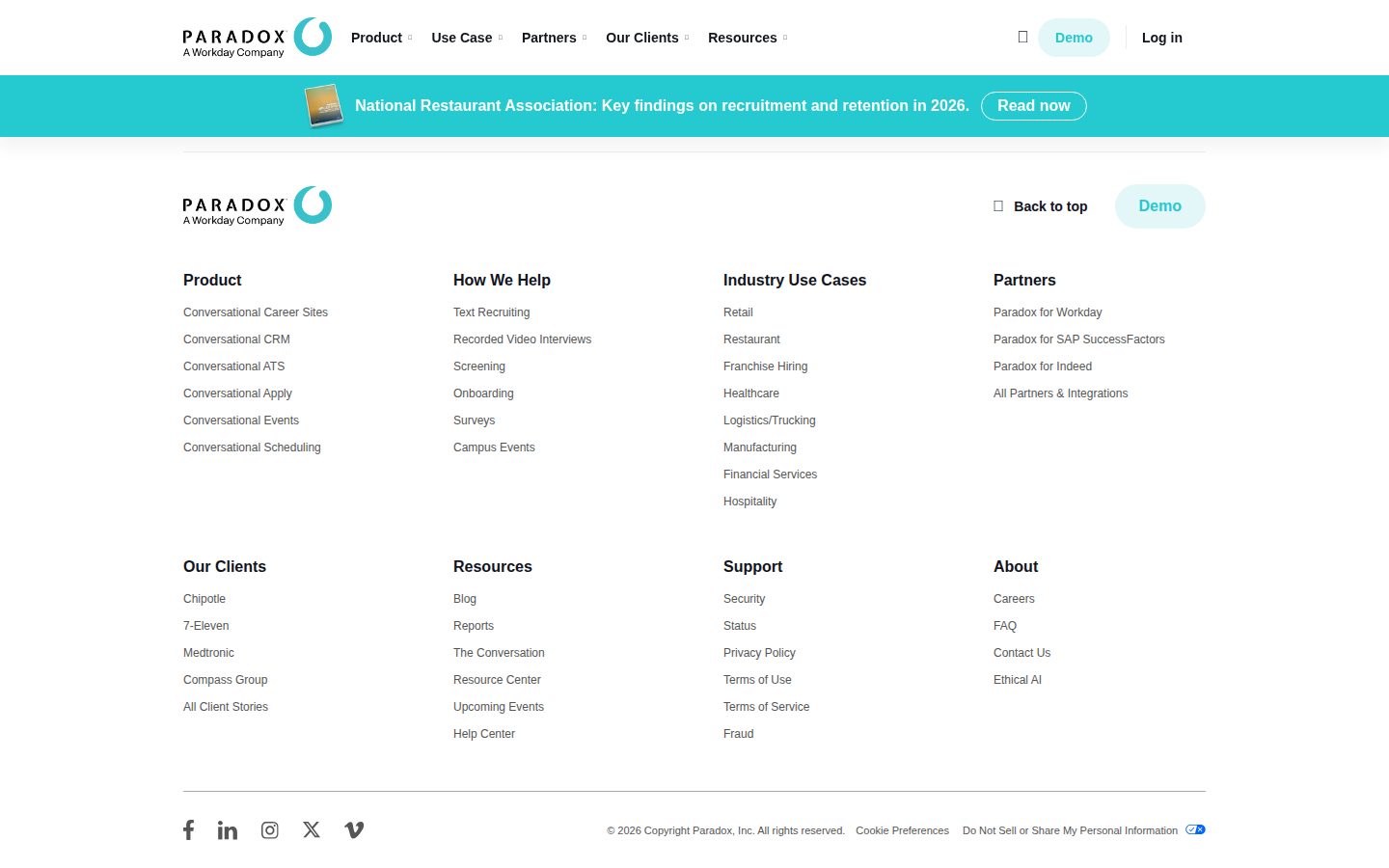
Paradox supports Retail, Restaurant, Franchise Hiring, Healthcare, Logistics/Trucking, Manufacturing, Financial Services, and Hospitality.

Integration

Does Paradox integrate with SAP SuccessFactors?

Yes. The Paradox for SAP SuccessFactors integration automates manual hiring tasks within SAP SuccessFactors.

Features

Can Paradox automate interview scheduling?

Yes. Conversational Scheduling automates interview scheduling to eliminate admin work, letting candidates choose the best available time slot.

Also in AI HR & Recruiting