Cloud hosting for web apps, APIs, databases, and background workers
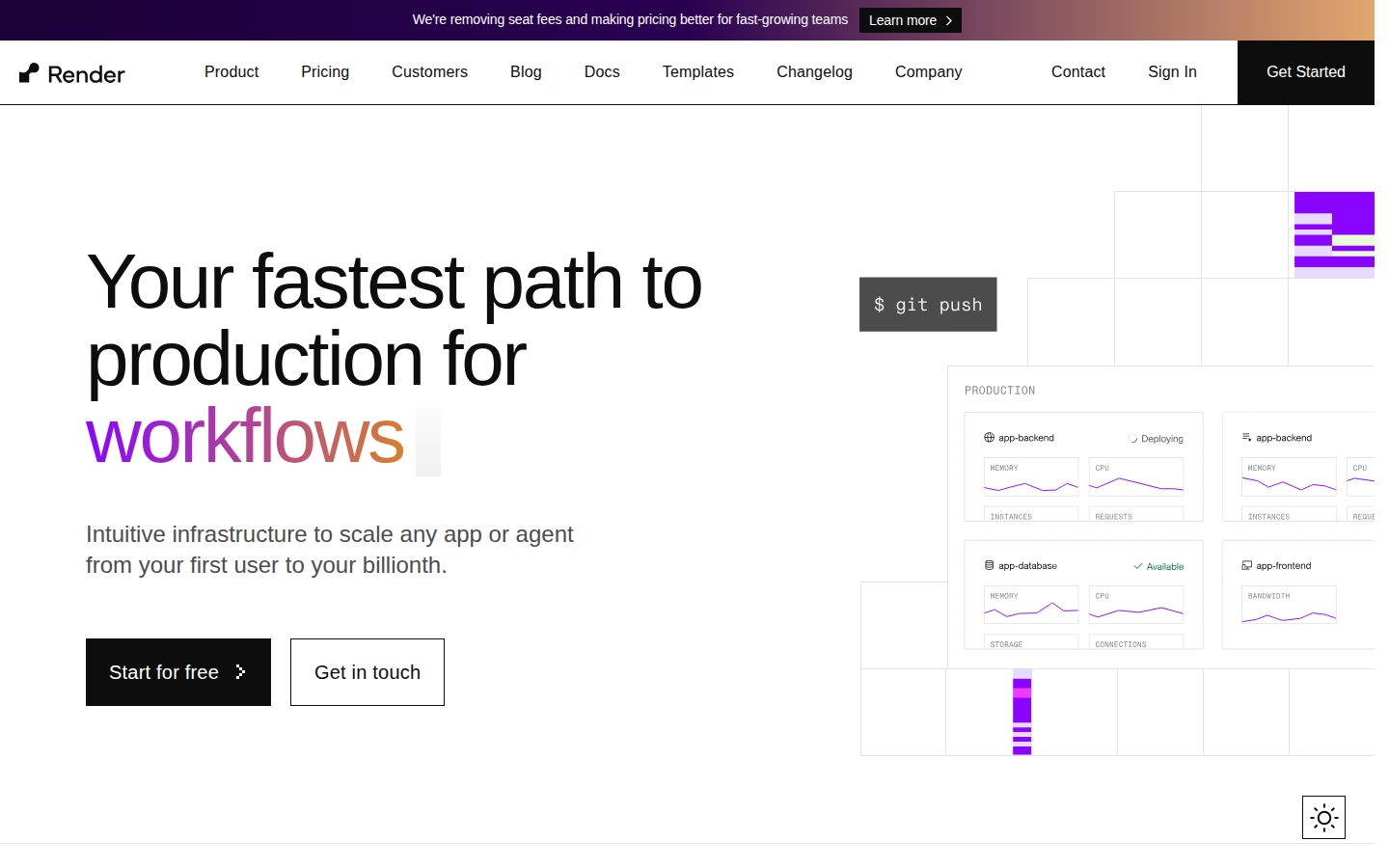
Render is a cloud application platform for deploying and scaling web services, static sites, databases, and background workers.
AI Panel Score
6 AI reviews
Reviewed
AI Editor ApprovedApproved and published by our AI Editor-in-Chief after full panel analysis.Users connect a GitHub, GitLab, or Bitbucket repository and Render automatically builds and deploys on every push to the linked branch. The platform detects the language or framework, runs the build pipeline, and serves the app at a public URL with TLS handled automatically. Deployments can also pull prebuilt Docker images from public or private registries. Infrastructure can be defined in a single YAML Blueprint file for repeatable, code-driven environments.
Render surfaces several platform-level capabilities beyond basic hosting: Preview Environments spin up disposable copies of a full production environment for pull requests; Render Workflows orchestrates long-running distributed tasks with TypeScript and Python SDKs; Private Link connects Render infrastructure to AWS-hosted services over a private network; and edge caching is available for web service static content. Observability tools include per-service metrics, log streaming to syslog-compatible providers, metric streaming to OpenTelemetry-compatible providers, health checks, webhooks, and Slack or email notifications. A REST API, CLI, Terraform provider, and MCP server allow programmatic and agent-driven management.
Render targets individual developers, startups, and engineering teams who want managed cloud infrastructure without operating Kubernetes or configuring cloud provider primitives directly. It competes with Heroku, Railway, and Vercel, and positions itself as an alternative to each. A free tier is available for web services and datastores with usage limits. Paid plans for workspaces are tiered as Free, Pro, Scale, and Enterprise, with database and compute resources priced based on instance type and storage independently.
The platform supports Node.js, Python, Ruby, Go, Rust, Elixir, PHP, and other runtimes natively, and any language via Docker. Services run in selectable AWS regions. Postgres databases include features such as read replicas, high availability with automatic standby failover, connection pooling, logical backups, and point-in-time recovery. Key Value stores run Valkey, a Redis-compatible engine. Compliance certifications include SOC 2 Type 2 and ISO 27001, and HIPAA-compliant configurations are supported.
Exposes Render resource management to LLM-powered coding agents such as Cursor, Codex, and Claude Code via the Model Context Protocol.
Visualizes CPU, memory, and application performance metrics in the dashboard and forwards logs to syslog-compatible providers and metrics to OpenTelemetry-compatible providers.
Automatically spins up a disposable copy of your full production environment to test proposed changes from a pull request before merging.
Lets you define and manage all your Render services, databases, and environment variables in a single YAML file checked into your repository.
Orchestrates chains of long-running, distributed tasks using a TypeScript or Python SDK, with support for local development and triggering task runs via the API.
Attaches custom domains to any Render service and automatically provisions and renews TLS certificates for HTTPS.
Serves static content from a global edge cache to reduce latency and origin load for web services deployed on Render.
Provisions Redis-compatible (Valkey-backed) datastores for use as caches, job queues, or session stores alongside your other Render services.
Provides fully managed, enterprise-grade PostgreSQL databases with support for read replicas, high availability standby failover, connection pooling, point-in-time recovery, and flexible independent storage/compute sizing.
Lets you instantly revert a service to a previously deployed build directly from the Render Dashboard.
Enables services to communicate securely over a private network without traversing the public internet, and connects Render infrastructure to AWS-hosted services via Private Link.
Integrates with your identity provider for SAML-based SSO and exports a timestamped audit log of all material actions performed across your organization's workspaces.
For building personal projects and prototypes.
For deploying production-grade apps and agents.
For teams that need advanced governance and compliance.
For teams that need dedicated support and uptime SLAs. Custom pricing.
Render is the post-Heroku default — well-funded, broadly scoped, and finally priced for production teams.
“Render closed an $80M Series C in January 2025 and a $100M extension in February 2026 at a $1.5 billion valuation, with founder Anurag Goel still running the show seven years in. That's a defensible 36-month bet against Vercel's frontend lock and Railway's smaller scope.”
Heroku coasted on inertia for a decade. Render is what developers actually moved to after Salesforce killed the free tier in 2022. $80M Series C in January 2025, then a $100M extension in February 2026 at a $1.5 billion valuation.
Preview Environments is the wedge — disposable copies of full production spun up per pull request, the workflow Vercel pioneered but priced for backend teams too. Render Postgres with read replicas, point-in-time recovery, and HA failover does what teams typically stand up Aurora to handle. Pro starts at $25 a month.
But the AWS-region lock is the catch — services run in selectable AWS regions only, so you're betting on someone else's cloud one layer up. Railway undercuts on small apps. Pilot one production service on Pro for a quarter before standardizing.
Broader scope than Railway, more backend-credible than Vercel, but neither category leader has been displaced yet.
Georgian, Bessemer, General Catalyst, and Addition on the cap table reads cleanly to any board.
Connect a Git repo, push, and Render Blueprints handle the rest in YAML — same-day production deploys are realistic.
Replaces Heroku and parts of AWS for teams that want managed Postgres plus web services without a platform team.
$258M total raised across Series C and extension at a $1.5B valuation, founder-led since 2018.
Engineering teams who want managed Postgres and web services without operating Kubernetes.
Solo developers who need the cheapest possible hosting for a throwaway side project.
Render bets the production seam on YAML Blueprints checked into the repo, not a console artifact.
“Founded 2018 in San Francisco by Anurag Goel, Render closed a $100M Series C extension at a $1.5B valuation in February 2026, bringing total funding to $258M. For a CTO picking the app platform through 2029, the call is whether managed-seam YAML beats Heroku's add-on drift or Railway's lighter footprint.”
Render's bet is the managed seam between Git and an AWS region, not a new control plane underneath. Render Blueprints push the whole environment into a YAML file checked into the repo, so the infra travels with the code. That's the piece a CTO has to defend in three-year planning.
Pro at $25 monthly opens autoscaling and Private Link; Scale at $499 unlocks HIPAA workspaces and SAML SSO. Render closed a $100M Series C extension in February 2026 at a $1.5B valuation led by Georgian, bringing total funding to $258M. Against Heroku's Salesforce-owned drift and Railway's lighter footprint, Render reads as the production-shaped middle.
But the catch is the AWS substrate. Regions are AWS regions and Private Link is AWS Private Link, so a 2029 multi-cloud move carries the managed layer and not the network shape. For a CTO picking the app platform through 2029, the durable bet sits here.
Sits cleanly between Heroku's legacy weight and Railway's lighter footprint as production-shaped middle.
Preview Environments and IaC Blueprints match how engineering teams actually ship to production.
REST API, CLI, Terraform provider, MCP server, and Private Link to AWS cover the senior's stack.
AWS substrate underneath means a 2029 multi-cloud pivot carries managed layer but not network shape.
Blueprints, Workflows, and the Render MCP Server show platform depth beyond basic hosting.
CTOs who want a managed deploy pipeline without operating Kubernetes.
Teams who need multi-cloud portability across non-AWS regions.
Pro to Scale jumps $474/month with nothing between — SSO is gated to the $499 tier.
“Render prices three tiers visibly — Hobby free, Pro $25/month, Scale $499/month — with Enterprise behind a sales call. Founded 2018 in San Francisco by Anurag Goel; $100M Series C extension at $1.5B valuation in February 2026, $258M raised total, led by Georgian.”
Pro to Scale jumps $474/month. $25 to $499 with nothing between. That's the gap that defines this pricing page. Hobby free. Pro $25. Scale $499. Procurement won't fight Pro. Scale needs justification.
Pro at $25/month includes 25 GB bandwidth, autoscaling, Preview Environments. Scale at $499 unlocks SAML SSO, SCIM, HIPAA workspaces, 1 TB bandwidth. SSO isn't a Pro add-on tax — it's gated entirely to Scale. Compare Heroku Performance dynos at $250/month and Railway's pure usage billing. Different unit, same procurement question.
The catch is compute and storage. Both bill independently per instance, outside the workspace tier. Hard to model year three without a service inventory. Founded 2018 in San Francisco by Anurag Goel. $100M Series C extension closed February 2026 at $1.5B valuation, led by Georgian — $258M raised total. Durable vendor, opaque compute drift.
Self-serve sign-up through Scale at $499/month; SAML SSO and SCIM gated to Scale tier.
Monthly billing on Pro and Scale with no published lock-in; Enterprise terms are sales-driven.
Hobby, Pro $25, Scale $499 visible without sales call; Enterprise hidden and compute/storage line items priced per instance.
Per-service metrics and managed Postgres replace measurable AWS or Kubernetes operating cost.
Workspace fee is predictable but compute and storage bill independently, making 3-year modeling hard without a service inventory.
Engineering teams who want managed cloud without operating Kubernetes.
Solo builders who need free always-on background workers.
Render Blueprints keep services, Postgres, and Workers in one yaml so deploy topology stops drifting from the repo.
“Render Blueprints define the full topology — web services, Postgres, Workers, cron — in one repo-checked yaml, and Preview Environments clone all of it per pull request. But the Hobby tier caps at 25 services and the Scale jump to $499/month is steep for a small team that needs SAML SSO.”
Connecting a repo to a managed platform usually hides tradeoffs in the dashboard — build cache misses, mystery cold boots, YAML that bends every quarter. Render Blueprints keep the whole topology in one yaml in-repo: web services, Postgres, Workers, and cron defined together. Preview Environments clone that full topology per pull request, not just the web service.
Render Postgres ships read replicas, HA standby failover, and point-in-time recovery on the managed tier. The side-Postgres-on-RDS escape hatch most Heroku shops keep is unnecessary here. Key Value runs Valkey, not Redis branded, but the wire protocol matches. Railway's onboarding is slicker, but its Postgres is thinner.
But the Hobby tier caps at 25 services and 5 GB bandwidth, and the jump to Scale at $499/month is steep for a four-person team that needs SAML SSO. Docs read engineer-fluent. Founded 2018 by Anurag Goel; $80M Series C led by Georgian in January 2025.
Blueprints plus Preview Environments cut the daily yaml-drift fight most managed platforms force.
Docs cover Blueprints, Workflows SDK, and Private Link with engineer detail, not marketing copy.
Real gaps remain — region selection limited to exposed AWS regions and Hobby cold-start behavior.
Workflows TypeScript/Python SDK, Private Link to AWS, horizontal autoscaling, and rollbacks scale beyond toy apps.
Git-push deploy, CLI, Terraform provider, and a Render MCP server cover engineer workflows natively.
Engineers who deploy multi-service apps from Git without operating Kubernetes.
Teams who need granular AWS primitive control beyond Render abstractions.
Render is what Heroku would be if Heroku had been built after Docker became boring.
“Render gives you Heroku-style git-push deploys plus managed Postgres, Preview Environments, and Blueprint YAML for infrastructure-as-code. Hobby is free, Pro starts at $25/month, and Scale jumps to $499 — the ladder is steep but the platform keeps up.”
Most platforms treat IaC like a checkbox. Render Blueprints lets you check a whole environment — services, databases, env vars — into one YAML next to your code. That's the choice you make when someone on the team has maintained a deployed system.
Hobby is free with 25 services. Pro is $25/month, Scale jumps to $499 once you need SAML SSO and HIPAA workspaces. Founded 2018 by Anurag Goel, $80M Series C led by Georgian in January 2025, then a $100M extension at a $1.5B valuation. Preview Environments spin a disposable copy of production per pull request.
But the meter gets loud once databases and bandwidth scale. Postgres pricing decouples from compute — honest, but another line to watch. Railway is friendlier for solo hackers, Fly.io is closer to the metal, Vercel owns the frontend. Render is the one you pick when the backend has to actually run.
Dashboard, log streams, and rollback flow feel built by people who ship to it, though a half-step behind Vercel's frontend polish.
Familiar PaaS shape the first hour; Blueprints and Workflows give depth to grow into by month three.
Dashboard works on mobile for monitoring but this is dev infrastructure — mobile isn't the use case to penalize.
Connect a Git repo and Render detects the runtime and ships a build — Heroku-style first-ten-minutes that still holds up.
Postgres HA standby failover, point-in-time recovery, SOC 2 Type 2, and ISO 27001 are real reliability signals, not marketing.
Small teams who ship backend apps from Git without operating Kubernetes.
Solo hackers who want the cheapest single-VM hosting available.
Render hit a $1.5B valuation in February while most PaaS rivals faded — narrow moat, real funding.
“Render closed a $100M Series C in February 2026 at a $1.5B valuation, on top of Bessemer's $50M Series B in June 2023 — $258M raised since Anurag Goel founded in 2018. The catch is the moat — Vercel owns Next.js, Railway undercuts on price, and Fly.io owns edge.”
Render MCP Server shipped. Render Workflows shipped. That's not a coasting vendor. Anurag Goel founded in 2018 — Bessemer led the $50M Series B in June 2023, then $100M Series C this February at a $1.5B valuation. $258M raised total. The cap table holds up.
Pro at $25/month gets Preview Environments, Render Blueprints YAML, horizontal autoscaling, and Private Link. Postgres has read replicas and point-in-time recovery. SOC 2 Type 2 and HIPAA workspaces on Scale at $499. The platform reads like infrastructure, not a toy.
But the moat is narrow. Vercel owns the Next.js lane, Railway undercuts on price, Fly.io owns edge compute. Render's bet is generalist PaaS — broader than each, deeper than none. Exit is clean: Docker images and Blueprints port. Worth the Pro tier, hedged on compression.
Generalist PaaS is broader than Vercel, Railway, or Fly.io individually but lacks a single defensible wedge.
Docker images, Render Blueprints YAML, and standard Postgres make migration off relatively clean.
$258M raised across rounds, $100M Series C in February 2026, consistent shipping cadence — durable signal.
Some superlative copy like "first user to your billionth" but the feature list backs the platform claims.
Eight years shipping, durable funding, profitable category survivor pattern fits — not the failure pattern.
Engineering teams who want managed PaaS without operating Kubernetes.
Frontend-only shops who already live inside Vercel's ecosystem.
Common questions answered by our AI research team
Yes, Render supports deploying Docker images. Docker support is listed as a core platform feature.
Render supports Static Sites, Web Services, Private Services, Background Workers, Cron Jobs, Render Postgres, and Render Key Value stores.
Yes, Render offers Autoscaling as a named platform feature for services.
Yes, Render automates the build, deploy, and scaling pipeline for web applications connected to Git repositories.
Yes, Render Postgres is a managed Postgres database offering, listed as a core service type on the platform.


Render is a San Francisco-based cloud platform for deploying and scaling web applications, APIs, databases, and background workers, positioned as an alternative to Heroku and AWS.