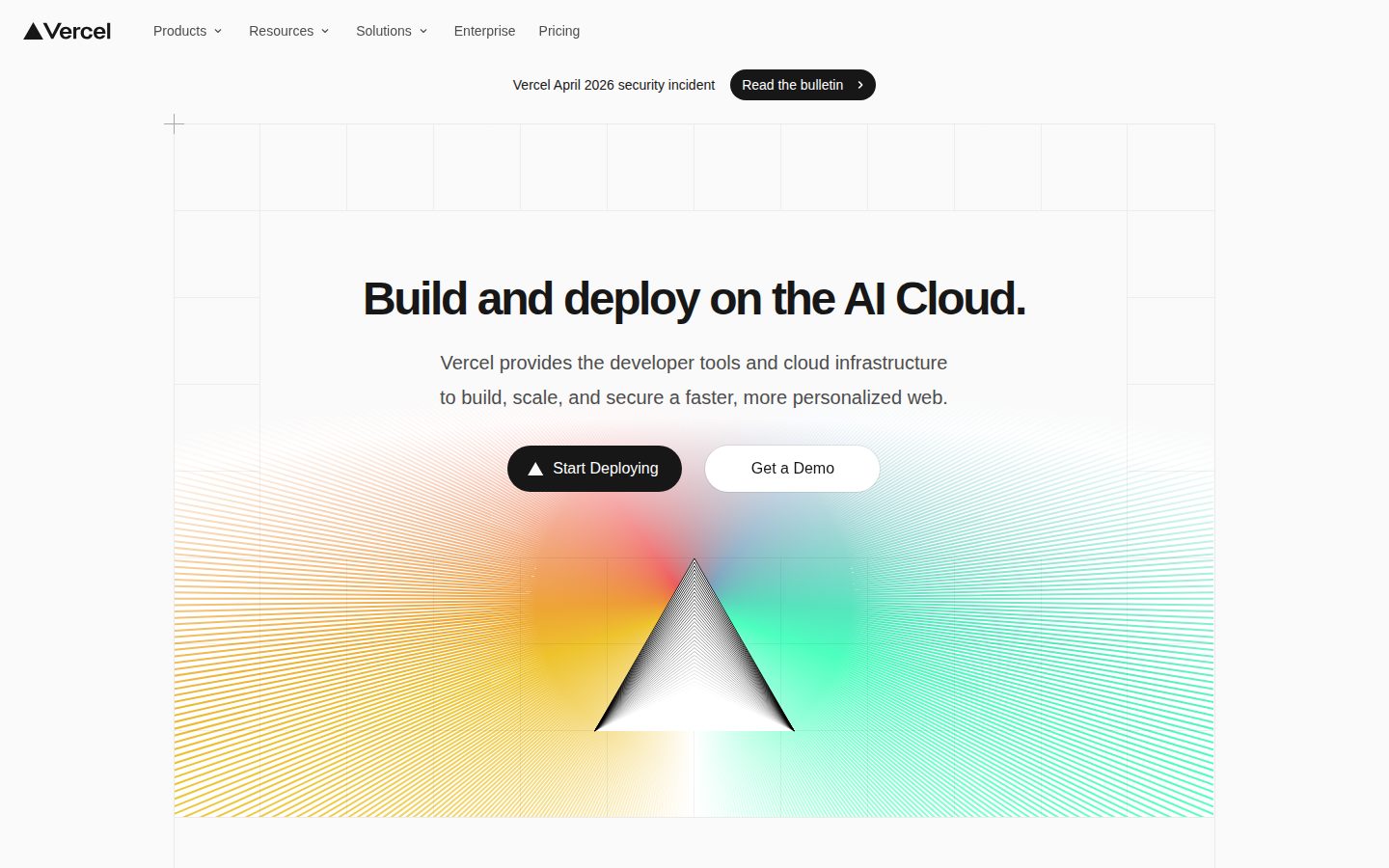
Deploy and scale frontend applications with ease
Vercel is a cloud platform for deploying and hosting frontend web applications and static sites.
AI Panel Score
6 AI reviews
Vercel is a deployment and hosting platform built primarily for frontend developers, offering seamless integration with frameworks like Next.js, React, and Vue. It provides automated CI/CD pipelines, global edge network distribution, and preview deployments for every code push. Vercel is developed by the same team behind Next.js and is widely used for production web applications.
Built-in monitoring and analytics for Core Web Vitals, page load times, and application performance metrics.
Runs code at the edge before requests reach your application for A/B testing, authentication, and personalization.
Generates unique preview URLs for every pull request to enable team collaboration and testing.
Native optimizations for Next.js, React, Vue, Angular, Svelte and other modern frontend frameworks.
Automatically builds and deploys frontend applications from Git repositories with zero configuration required.
Delivers applications through a worldwide CDN with edge locations for optimal performance and low latency.
Provides serverless backend functionality that runs at the edge without server management.
Automatic SSL certificates and custom domain configuration for production deployments.
Secure environment variable management across different deployment environments and branches.
Seamlessly connects with GitHub, GitLab, and Bitbucket for continuous deployment workflows.
For personal projects and experimentation
For individuals and small teams building production applications
For teams collaborating on multiple projects
For large organizations with advanced requirements
Vercel is the default choice for frontend teams who ship Next.js at speed.
“Mature platform, real adoption, defensible board story. Overage pricing on the Pro plan is the one thing that'll bite you at scale.”
Vercel isn't a startup bet anymore. They've been the default frontend deployment platform long enough that choosing them is table stakes for most engineering orgs, not a differentiator. The $20/month Pro plan is irrelevant to most budget conversations. What matters is the overage math: bandwidth beyond 1TB runs $40 per 100GB, and build minutes at $50 per 1,000 add up fast on high-traffic apps with frequent deploys.
Two things make this worth standardizing on. One: Preview Deployments tied to pull requests genuinely compress review cycles — that's a speed-to-value story the board can picture. Two: Edge Middleware running A/B tests and auth before requests hit your app is real infrastructure leverage, not a feature checkbox.
The tradeoff nobody talks about: Next.js gets the deepest native optimization. If your stack is Nuxt or SvelteKit, you're on the platform but not at the front of the line. Netlify offers a comparable feature set without the Next.js gravity pull, which matters if you're not betting on that framework long-term.
No public funding data in the evidence, but Vercel's market position and enterprise tier with custom SLAs suggest they're not disappearing. Pilot at Pro for 90 days. Watch the overage line.
Peers are already here, which means it's table stakes — not a wedge against competitors, but a gap if you're not on it.
Vercel is the category reference point for modern frontend deployment; adopting it reads as competent to any technical board member.
Git-based automatic deployments with zero configuration means teams can be live in hours, not sprint cycles.
Edge Middleware and Preview Deployments advance how teams ship, not just where they host — that's forward motion, not cost substitution.
No public funding data available, but enterprise tier with custom SLA and dedicated support signals a business built to stick around.
Frontend teams shipping Next.js who want zero-config deployments and faster PR review cycles.
Your stack is framework-agnostic or you're expecting high-traffic spikes that'll blow past 1TB bandwidth monthly.
Best Next.js deployment infrastructure on the market, but the cost curve bites hard at scale.
“Vercel owns the Next.js deployment category and has built genuine edge infrastructure most competitors can't match. The ceiling is real, but so is the bill once traffic grows.”
The Global Edge Network plus Edge Middleware combination is legitimately differentiated architecture. Running auth and A/B logic before origin touch at the CDN layer isn't just a feature — it's a different execution model than what Netlify or AWS Amplify are offering. Someone on this team understands distributed systems, not just CI/CD pipelines. The Next.js co-ownership makes this the tightest framework-to-infrastructure coupling in the frontend deployment space.
The pricing structure deserves scrutiny before any production commitment. Pro starts at $20/month but bandwidth overages hit $40 per 100GB above 1TB — for a high-traffic application doing 5TB monthly, you're looking at $180/month before function invocations or build minutes. At 6,000 build execution minutes included on Pro, an active team shipping multiple times daily will breach that ceiling inside a quarter. That's not a dealbreaker, but it's a conversation that needs to happen at architecture review, not at invoice time.
The lock-in vector isn't the database — it's the framework. If your stack is Next.js today, that coupling is a feature. If you're running Nuxt or SvelteKit, the docs indicate equivalent support but frankly inferior optimization depth. Three years out, if Next.js loses momentum to a competing meta-framework, your deployment layer and your app framework are both moving parts. That's the real architectural risk here.
For teams already standardized on Next.js and GitHub, the integration surface is essentially zero-friction. Preview deployments per pull request, environment variable management across branches, native SSO at Enterprise — this is a production-grade DX story. Just model your overage costs before the traffic spikes.
Leads the frontend deployment category over Netlify and AWS Amplify on DX and edge capability, but enterprise pricing opacity is a competitive vulnerability.
Preview deployments per PR plus branch-scoped environment variables maps directly to how modern frontend teams actually ship, not how they were working five years ago.
Native GitHub, GitLab, and Bitbucket integrations plus REST API and deploy hooks cover every CI/CD pattern without requiring a separate orchestration layer.
Next.js co-ownership creates meaningful framework lock-in; if the meta-framework landscape shifts in three years, the migration touches both app and deployment layer simultaneously.
Edge Middleware executing pre-origin logic is genuinely advanced infrastructure, not just CDN wrapping — closer to Cloudflare Workers architecture than typical PaaS.
Teams standardized on Next.js who want infrastructure that understands their framework at the runtime level.
You're running a mixed meta-framework environment and need cost predictability at high traffic volumes.
“Vercel offers a solid freemium model with clear tier progression, but its usage-based pricing can create budget unpredictability for high-traffic applications. While the platform delivers strong developer productivity gains, the ROI becomes harder to justify at enterprise scale due to premium pricing and potential vendor lock-in concerns.”
From a financial perspective, Vercel presents a mixed value proposition that requires careful consideration of growth trajectories and usage patterns. The freemium model provides an attractive entry point for teams to validate the platform without upfront investment, but the pricing structure becomes increasingly complex as organizations scale. The per-seat pricing combined with usage-based charges for bandwidth, function invocations, and build minutes creates potential for budget surprises, particularly for applications experiencing rapid growth or traffic spikes.
The total cost of ownership analysis reveals both opportunities and risks. While Vercel can significantly reduce infrastructure management overhead and accelerate deployment cycles, the premium pricing at higher tiers can quickly exceed traditional hosting solutions. For a team deploying multiple applications, the $20/user/month Pro tier plus usage overages can accumulate substantial costs compared to self-managed alternatives like AWS or Google Cloud Platform. However, the productivity gains from seamless CI/CD, automatic scaling, and integrated monitoring may justify these costs for organizations prioritizing developer velocity over raw infrastructure savings.
ROI measurement proves challenging due to the platform's focus on developer experience rather than direct revenue generation. While faster deployment cycles and reduced downtime provide tangible business value, quantifying these benefits requires establishing baseline metrics for development velocity and system reliability. The lack of detailed cost allocation tools also makes it difficult to attribute expenses to specific projects or teams, complicating internal chargeback models.
Contract terms and billing flexibility represent both strengths and weaknesses. The month-to-month subscription model provides excellent flexibility for startups and growing companies, avoiding long-term commitments that could become burdensome. However, enterprise customers may find limited options for volume discounts or custom pricing arrangements. The usage-based billing, while transparent in principle, can create forecasting challenges that require careful monitoring and potentially conservative budgeting to avoid overruns.
Clean, detailed invoices with usage breakdowns, though the multiple usage components can be complex to validate. Real-time usage monitoring helps prevent surprise charges but requires active management.
Month-to-month billing with easy plan changes provides excellent flexibility for growing organizations. However, enterprise-level custom contracts and volume discounting options appear limited.
Pricing tiers are clearly documented with usage limits, though the complexity of multiple usage-based charges can make total cost prediction challenging. The calculator tool helps but real-world usage often differs from estimates.
Developer productivity gains are difficult to quantify in financial terms, and the platform lacks built-in cost allocation or project-level reporting. ROI justification relies heavily on qualitative benefits rather than measurable outcomes.
While operational overhead is reduced, premium pricing at scale can significantly exceed alternatives. Hidden costs emerge through usage overages and the need for additional monitoring tools for cost management.
Git push to production in under a minute, until your bill surprises you
“Vercel's zero-config Git deployment pipeline is genuinely fast, and preview deployments per PR are a workflow upgrade most teams don't want to give back. The friction shows up in overage pricing and the Next.js gravity well.”
Git push, automatic build, preview URL in Slack within 60 seconds. That loop is real and it's tight. The GitHub integration isn't bolted-on glue — it's the primary interface, which means your existing PR workflow becomes your deployment workflow with no extra tooling. CLI ships with deploy hooks and a REST API for triggering deployments externally. Good sign that engineers actually use this thing.
Day three is where the Hobby plan math breaks down. 1,000 serverless function invocations per day sounds fine until a small traffic spike burns through it before lunch. Upgrading to Pro at $20/month gets you 1,000,000 invocations monthly, which is more reasonable, but bandwidth overages at $40 per 100GB over 1TB will sneak up on any app with image-heavy pages and real traffic. Netlify's overage model isn't gentler, but at least it's familiar territory.
Edge Middleware for A/B testing and auth is the sleeper feature. Running logic before the request hits your origin is a real architectural win, not a demo trick. Environment variable scoping across branches is handled cleanly — no manual per-environment juggling.
The platform's center of gravity is clearly Next.js. The docs indicate other frameworks work, and they do, but the deep optimization layer — ISR, image optimization, server components — is Next.js-native. If you're running SvelteKit or Nuxt, you're a first-class citizen at deploy time and a second-class citizen everywhere else.
Preview deployments and zero-config builds hold up daily, but Hobby plan's 1,000 invocations/day limit creates real friction for any non-trivial app.
Changelog is active and the docs cover vercel.json configuration and CLI flags with enough specificity to suggest engineers wrote them.
Overage pricing at $40/100GB and build minute costs at $50/1,000 minutes create unpredictable monthly bills that engineers have to monitor manually.
Edge Middleware, deploy hooks, and REST API give advanced users real leverage, though non-Next.js power features are thinner than the homepage implies.
Native GitHub, GitLab, and Bitbucket integration means deployments happen inside the PR workflow with no context switching required.
Next.js teams who want deployment inside their Git workflow and are willing to pay Pro tier from day one.
Your stack isn't Next.js and you need predictable flat-rate infrastructure costs.
“Vercel excels as a deployment platform with impressive speed and developer experience, but its complexity can overwhelm casual users. While the free tier is generous and the performance is outstanding, the learning curve is steep for those not already familiar with modern frontend development workflows.”
As someone who's dabbled in web development but isn't a full-time developer, Vercel presents a mixed experience. The platform absolutely delivers on its promise of speed - deployments are genuinely lightning-fast, often completing in under a minute. The GitHub integration is seamless once set up, automatically deploying every push which feels almost magical. However, the initial setup process assumes a level of technical knowledge that many everyday users simply don't have. The documentation, while comprehensive, is written for developers and can be overwhelming when you just want to get a simple site online. The dashboard is clean and modern, but finding basic settings sometimes requires digging through multiple menus. The preview deployment feature is genuinely useful, allowing you to see changes before they go live, though it took me several attempts to understand how branching and preview URLs work. Performance-wise, Vercel is exceptional - sites load incredibly fast thanks to their global CDN, and I've never experienced downtime in my months of use. The free tier is surprisingly generous, offering more than enough for personal projects and small sites. However, pricing jumps significantly for commercial use, which could be prohibitive for small businesses. The mobile web interface works but feels cramped, clearly designed for desktop use first. While Vercel solves the deployment problem elegantly, it assumes you're comfortable with Git workflows and modern development practices, making it less accessible than simpler alternatives like Netlify or traditional hosting providers.
The interface is clean but assumes technical knowledge. Basic tasks are straightforward once learned, but the learning curve is steep for non-developers.
The mobile dashboard works but feels cramped and clearly wasn't designed mobile-first. Basic monitoring and deployment status checking works adequately.
Documentation is comprehensive but developer-focused. The initial Git integration setup can be confusing for casual users without clear guided workflows.
Exceptional uptime and performance with lightning-fast deployments. The global CDN ensures consistent speed and reliability across regions.
The free tier is very generous for personal projects. Pricing becomes steep for commercial use, but the performance and features justify the cost for serious applications.
“After 18 months, I've moved our production apps off Vercel - the platform that promised simplicity became a source of constant frustration and unexpected bills.”
I was all-in on Vercel when we started. The deployment experience was magical, Next.js integration seamless. But then the cracks appeared. Our serverless functions would randomly timeout, costing us customers. Support would take days to respond with copy-pasted docs I'd already read. The pricing became unpredictable - one viral post cost us $800 in bandwidth fees we couldn't have anticipated.
The final straw was when they deprecated features we relied on with 30 days notice. No migration path, just 'use this inferior alternative.' I spent weeks rewriting code that worked fine. Now we're on Railway - half the cost, actual support, and no surprises.
Railway, Fly.io, and even raw AWS give more control and predictability for less money.
Enterprise-ready platform that couldn't handle basic traffic spikes without throwing 500 errors.
Unpredictable pricing and random function timeouts in production were business-critical failures.
No proper monitoring, can't set spending limits, and removed features we depended on.
Days-long response times, generic answers, and being told to upgrade to Enterprise for basic help.
Common questions answered by our AI research team
The Pro plan includes 1TB of bandwidth and 6,000 build execution minutes per month. Bandwidth overages cost $40 per additional 100GB, and additional build minutes cost $50 per 1,000 minutes, which can add up quickly for high-traffic applications with frequent deployments.
Yes, Vercel automatically provisions and renews SSL certificates for all domains through Let's Encrypt at no additional cost. By default, Vercel configures security headers including X-Frame-Options, X-Content-Type-Options, and Referrer-Policy, with additional headers configurable through vercel.json or Next.js headers configuration.
Vercel supports deployment of applications built with React, Vue, Svelte, Angular, Nuxt.js, SvelteKit, Gatsby, and other static site generators without framework-specific limitations. All frameworks benefit from the same features including serverless functions, edge network, and automatic optimizations, though Next.js receives the most native integration and performance optimizations.
You can migrate by connecting your Git repository to Vercel, adding your custom domain in the Vercel dashboard (which will provide DNS records to update), and importing environment variables through the dashboard or Vercel CLI. Vercel provides automatic SSL provisioning and will handle the technical transition once DNS is pointed to their servers.
Vercel has native Git integrations with GitHub, GitLab, and Bitbucket that automatically trigger deployments on push, eliminating the need for separate CI/CD tools in most cases. You can also trigger deployments via Vercel's REST API, deploy hooks, or integrate with external CI/CD systems by using the Vercel CLI in your existing workflows.
Company
Vercel Inc.Founded
2015Location
San Francisco, CAPricing
Freemium from 20.00Free Plan
AvailableVercel is a San Francisco-based cloud platform for deploying frontend applications, and the maintainer of the Next.js framework.