SentinelOne logo

SentinelOne Review

Visit

Endpoint, cloud, and identity security on a unified AI platform

SentinelOne is a cybersecurity platform for organizations seeking endpoint, cloud, and identity threat detection and response.

AI Panel Score

8.1/10

6 AI reviews

Reviewed

AI Editor Approved

About SentinelOne

SentinelOne operates through a lightweight agent deployed on endpoints — Windows, macOS, Linux — and cloud workloads. Security teams use a central console to monitor alerts, investigate incidents using behavioral data, and trigger automated or manual response actions such as isolating a device or rolling back changes caused by ransomware. The platform collects telemetry across the environment and maps activity to frameworks like MITRE ATT&CK.

Distinctive capabilities highlighted by SentinelOne include its Singularity platform, which unifies EPP, EDR, and XDR into one interface; a cloud-native application protection platform (CNAPP) covering CSPM, CWPP, and container security; and an identity security module addressing Active Directory threats and lateral movement. The platform also includes a data lake for long-term log storage and threat hunting, SIEM functionality, and managed detection and response (MDR) services for organizations that want a staffed security operations layer on top of the technology.

SentinelOne targets mid-market and enterprise organizations, including those in regulated industries that require detailed audit trails and compliance reporting. It competes with CrowdStrike Falcon, Microsoft Defender for Endpoint, Palo Alto Networks Cortex XDR, and Trend Micro Vision One. Pricing is not publicly listed; it is sold through direct sales and channel partners, with quotes based on seat count and modules selected. A free trial is available on request.

The platform supports deployment on Windows, macOS, and Linux endpoints, as well as Kubernetes clusters and major cloud providers (AWS, Azure, GCP). SentinelOne offers a REST API for integration with third-party SIEM, SOAR, and ticketing tools. Management is delivered via a web-based console with no on-premises infrastructure required.

Features

AI

  • Purple AI Security Analyst

    A generative and agentic AI security analyst that accelerates threat hunting, investigation, and response by providing correlated, summarized, and actionable guidance to analysts directly within the Singularity platform.

  • Static AI & Behavioral AI Threat Detection

    Uses built-in static AI and behavioral AI engines to detect and prevent a wide range of attacks — including malware, ransomware, memory exploits, and zero-days — in real time before they cause damage.

Analytics

  • Singularity AI SIEM & Data Lake

    An infinitely scalable, AI-powered SIEM built on the Singularity Data Lake that ingests and correlates native endpoint, cloud, and identity telemetry alongside third-party security and IT data from any source.

Automation

  • Automated Remediation & 1-Click Rollback

    Provides automated or one-click threat remediation and patented rollback functionality that surgically restores affected systems to a pre-attack state, minimizing Mean Time to Remediate (MTTR).

Core

  • ActiveEDR with Storyline

    An enhanced EDR capability that automatically constructs a visual representation of the full attack chain (Storyline), enabling security teams to understand the complete scope of an incident and take targeted remediation action.

  • Singularity Network Discovery (Ranger)

    Uses built-in agent technology to actively and passively map networks, delivering instant asset inventories, rogue device discovery, and IoT device fingerprinting and isolation from a unified interface.

Customization

  • Role-Based Access Control (RBAC) & Multi-Tenancy

    A SOC2 Type 2 certified management console with SSO, MFA, and RBAC authentication, plus unparalleled multi-tenant, multi-site, and multi-group hierarchy customization to match any organizational structure.

  • Storyline Active Response (STAR) Custom Detection Rules

    Allows security teams to create custom, automated detection and response rules that trigger estate-wide actions based on behavioral patterns, with up to 100 rules by default and expandable capacity.

Integration

  • Singularity Marketplace

    An ecosystem of one-click applications for intelligence, automation, and data integrations that extends SentinelOne across the broader security and IT stack without requiring custom code or complex configuration.

Security

  • Singularity Cloud Workload Security

    Extends runtime threat prevention, detection, and response across virtual machines, servers, containers, and Kubernetes clusters in public clouds, private clouds, and on-premises data centers.

  • Singularity Hologram (Deception Technology)

    A high-interaction deception and decoy technology module that lures in-network attackers and insider threats into revealing themselves by presenting fake credentials and honeypot environments.

  • Singularity Identity

    Delivers proactive, real-time defense against identity-based attacks including credential misuse, with real-time Active Directory and Azure AD attack surface monitoring and compromised credential monitoring on the dark web.

Preview

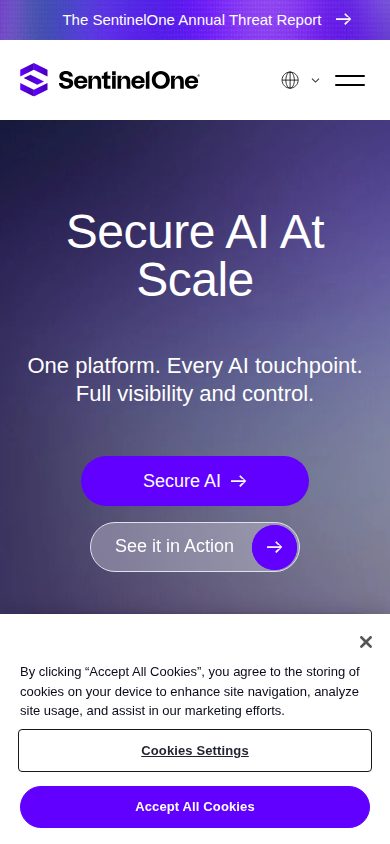
SentinelOne desktop previewSentinelOne mobile preview

Pricing Plans

Singularity Complete

$180/per endpoint

Essential AI Security for startups and growing businesses needing core endpoint and cloud workload protection.

  • AI-powered endpoint and cloud workload protection
  • Real-time threat detection and response
  • 14-day data retention
  • AI Security Assistant

Singularity Commercial

$230/per endpoint

Foundational AI Security for organizations needing identity protection, extended data retention, and proactive threat hunting.

  • Everything in Singularity Complete
  • Identity Detection & Response
  • 90-day data retention for extended analysis
  • Managed Threat Hunting for proactive threat discovery

Singularity Enterprise

Contact sales

Comprehensive AI Security for large enterprises requiring automated SOC capabilities, full forensics visibility, and expert onboarding. Contact Sales for pricing.

  • Everything in Singularity Commercial
  • Agentic AI SOC Analyst for automated triage
  • Full Visibility & Forensics for deep network data collection
  • Expert-led onboarding and training to accelerate adoption

AI Panel Reviews

The Decision Maker

The Decision Maker

Strategic bet, vendor viability, timing, adoption approval
8.6/10

SentinelOne is the default serious choice when CrowdStrike feels too expensive or too risky.

Publicly traded, category-proven, and shipping real AI capabilities inside a unified platform. The tradeoff is enterprise pricing and complexity that'll overwhelm teams without a dedicated security function.

SentinelOne is publicly traded, competes directly with CrowdStrike Falcon, and has been in market long enough to have real enterprise deployments in regulated industries. The Singularity platform unifies EPP, EDR, XDR, and identity into one console — that's not a roadmap item, the docs show it shipping today. At $179.99 per endpoint for the base tier, this isn't a budget tool.

Purple AI and the Storyline attack chain visualization are the standout differentiators. Automated 1-click rollback after ransomware is the feature your CISO will mention to the board. STAR custom detection rules — up to 100 by default — give security teams real flexibility without calling professional services.

The gap: no pricing transparency above the base tier, and Singularity Enterprise is contact-only. Teams without in-house SOC analysts won't extract full value without paying for MDR on top. Pilot with one environment before committing estate-wide.

Competitive Positioning8.5

Deception tech via Singularity Hologram and native CNAPP coverage differentiate it from Microsoft Defender's bundled-in approach.

Reputation Risk9.0

Board-defensible choice; SentinelOne is a named CrowdStrike alternative that analysts and peers recognize on sight.

Speed to Value7.5

Single-agent deployment accelerates onboarding, but STAR rules and Purple AI require analyst time to configure for real payback.

Strategic Fit8.5

Unified endpoint, cloud, and identity coverage on one platform advances security posture rather than just replacing a point tool.

Vendor Viability9.0

Publicly traded with multi-year enterprise contracts across regulated industries — they'll be here in 36 months.

Pros

  • 1-click ransomware rollback is a concrete, board-ready risk reduction story
  • Singularity Marketplace enables third-party integrations without custom code
  • Storyline attack chain gives analysts full incident scope without manual correlation
  • SOC2 Type 2 certified console with RBAC and multi-tenancy fits enterprise compliance requirements

Cons

  • Enterprise tier pricing is opaque — no public number above $229.99/endpoint
  • Full value requires in-house analyst capability or paid MDR add-on
  • Feature depth at the Commercial and Enterprise tiers will overwhelm lean IT teams
  • No public changelog — hard to track platform velocity from the outside

Right for

Mid-market or enterprise security teams with dedicated analysts who need unified endpoint, cloud, and identity coverage under one console.

Avoid if

Your security function is one part-time IT generalist who won't have time to configure STAR rules or hunt with Purple AI.

The Domain Strategist

The Domain Strategist

Craft and strategy in the product's domain — adapts identity per category, same lens
8.4/10

Singularity's unified coverage closes the gaps that CrowdStrike leaves across identity and cloud.

SentinelOne delivers enterprise-grade XDR with genuine CNAPP depth — not just endpoint bolted to cloud. The patented rollback and Storyline chain mapping are the kind of forensic capability that holds up during a board-level incident debrief.

ActiveEDR with Storyline is the architectural differentiator. Automated attack-chain construction means your analysts aren't manually correlating events at 2am — they're acting on a pre-mapped blast radius. The 1-click rollback is SOC-operationally significant; most competitors hand you detection and leave remediation to your team. Purple AI as an embedded SOC analyst accelerates triage velocity in a way that matters if you're running lean on headcount.

The platform architecture tells me someone made hard decisions about consolidation. EPP, EDR, XDR, CNAPP, identity, and SIEM on a single data lake isn't a product roadmap — it's a security architecture. The Singularity Data Lake feeding a native AI SIEM means correlation happens on the same telemetry store, not across API hops. STAR custom detection rules with 100-rule capacity let your red team operationalize intel directly into detection logic.

The tradeoff is consolidation risk. If SentinelOne is your EDR, SIEM, CSPM, and identity monitor simultaneously, a licensing dispute or outage has outsized blast radius. $179.99 per endpoint for Complete gets you 14-day retention — that's insufficient for most compliance frameworks; you're effectively required to land at Commercial or Enterprise to meet audit obligations.

Category Positioning8.5

Singularity's unified data lake architecture is structurally ahead of CrowdStrike's modular approach and more operationally cohesive than Microsoft Defender's Entra-fragmented identity story.

Domain Fit8.6

MITRE ATT&CK mapping, RBAC with multi-tenancy, SOC2 Type 2 certification, and MDR overlay match how enterprise security operations teams actually run.

Integration Surface8.3

REST API, Singularity Marketplace one-click integrations, and native SOAR/SIEM hooks cover the standard enterprise security stack without requiring custom engineering.

Long-term Implications8.0

Deep platform consolidation accelerates operational efficiency but creates meaningful vendor dependency — a three-year lock-in the CISO needs to price into the contract negotiation.

Strategic Depth8.8

Storyline, Purple AI, and deception technology via Singularity Hologram reflect security engineering maturity well beyond commodity EDR.

Pros

  • Storyline auto-constructs the full attack chain — reduces analyst triage time on complex incidents
  • 1-click rollback with ransomware recovery is a genuine operational differentiator
  • Singularity Identity covers Active Directory and Azure AD attack surface plus dark web credential monitoring
  • Single agent, single console across endpoints, cloud workloads, Kubernetes, and identity

Cons

  • 14-day data retention on the $179.99 Complete tier won't satisfy PCI-DSS, HIPAA, or SOC audit requirements — budget for Commercial minimum
  • No public pricing for Enterprise tier; cost modeling requires a sales cycle before you can build the business case
  • Full platform consolidation on one vendor elevates single-point-of-failure risk across EDR, SIEM, and CSPM simultaneously

Right for

Mid-market to enterprise security teams that want to consolidate endpoint, cloud, and identity detection on one data lake without running a separate SIEM.

Avoid if

Your organization needs on-premises deployment or has existing multi-year SIEM and SOAR investments that justify a best-of-breed point-solution approach instead.

The Finance Lead

The Finance Lead

Money, total cost of ownership, contracts, procurement math
7.2/10

$179.99/endpoint sticker exists, but Enterprise pricing disappears behind a sales call.

SentinelOne publishes two real tiers — $179.99 and $229.99 — then hides the Enterprise number. TCO visibility is partial at best.

$179.99/endpoint for Singularity Complete. $229.99 for Commercial, which adds identity and 90-day retention. Enterprise: contact sales. Three tiers, two real numbers. Procurement gets partial visibility — better than CrowdStrike Falcon, which publishes nothing, but not clean.

50 endpoints × $229.99 × 12 months = $137,994/year on Commercial. Add 20% seat creep by year 3, plus any MDR or marketplace add-ons from Singularity Marketplace. Year 3 all-in likely lands at $180K-$200K. No published overage rates, no public data retention upgrade pricing. That's the invoice risk.

The feature set is real: Purple AI, 1-Click Rollback, Storyline EDR, STAR custom rules. Identity module and CNAPP coverage require Commercial or above. No termination-for-convenience terms are publicly visible — standard enterprise hostage contract. Auto-renewal windows unknown from public materials.

Billing & Procurement6.0

Channel partner model adds negotiation surface but also adds procurement friction — no self-serve purchase path and no published payment terms.

Contract Flexibility5.0

No public auto-renewal terms, no termination-for-convenience language, and no self-serve cancellation process evident from available materials.

Pricing Transparency5.5

Two sticker prices published, but Enterprise hides behind sales — and no add-on or overage rates appear anywhere on the pricing page.

ROI Clarity7.5

1-Click Rollback and MTTR reduction are concrete, measurable outcomes; MITRE ATT&CK mapping gives audit-ready documentation for compliance ROI cases.

Total Cost of Ownership6.0

50-seat Commercial at $229.99 hits $138K/year before MDR, marketplace integrations, or seat growth — year-3 TCO is genuinely unpredictable.

Pros

  • Two real published price points — $179.99 and $229.99 — rare in enterprise security
  • 1-Click Rollback is a quantifiable MTTR reduction, not a vague AI claim
  • Singularity Marketplace reduces custom integration cost
  • SOC2 Type 2 certified console with SSO and MFA included — no SSO tax visible at current tiers

Cons

  • Enterprise tier pricing fully opaque — sales call required
  • No published add-on rates for MDR, extended retention, or marketplace apps
  • Auto-renewal and cancellation terms not publicly disclosed
  • Identity and full forensics locked behind Commercial and Enterprise tiers respectively

Right for

Mid-market security teams at 50+ endpoints needing unified EDR, cloud, and identity coverage under one agent.

Avoid if

Your budget is fixed and you can't absorb unpredictable Enterprise-tier and add-on invoice surprises.

The Domain Practitioner

The Domain Practitioner

Daily hands-on reality in the product's domain — adapts identity per category, same lens
8.4/10

Singularity's unified surface is real — but the alert noise on day three will test you

SentinelOne's single-agent model covering endpoints, cloud workloads, and identity in one console is genuinely compelling for security engineers tired of context-switching. The depth is there; the tuning work is not optional.

Storyline is the feature you notice first and keep using. The automatic attack-chain visualization in ActiveEDR means you're not manually correlating events at 2am — the platform constructs the full kill chain and surfaces it. STAR custom detection rules (100 by default, expandable) let you codify your environment's threat logic without custom integrations. That's real power-user depth that CrowdStrike Falcon makes you work harder to reach.

The $179.99/endpoint entry tier gives you 14-day retention. That's the friction point. Serious threat hunting requires the $229.99 Commercial tier for 90-day retention, plus Managed Threat Hunting. For compliance-heavy environments, budget accordingly. The SIEM and Data Lake sit at Enterprise tier — contact sales, no public number — so your true total cost is opaque until you're deep in the conversation.

Purple AI as an agentic SOC analyst is a genuine workflow accelerator for lean security teams, not a demo feature. The no-on-prem requirement simplifies deployment. The tradeoff: an automated-response platform with behavioral AI will fire on edge cases in your environment until you've tuned it. That tuning window is where most teams struggle, not the feature set.

Day-3 Reality7.8

Storyline and automated remediation hold up post-demo, but alert tuning for behavioral AI engines is a real time sink in week one and beyond.

Documentation Practitioner-Fit7.2

Blog is present but changelog and public API docs aren't surfaced in the scraped evidence — a gap that slows down engineers writing SOAR integrations or evaluating REST API behavior.

Friction Surface7.5

STAR rules and the Singularity Marketplace reduce integration friction, but opaque Enterprise pricing and 14-day retention at base tier create procurement and investigation workflow pain.

Power-User Depth8.6

STAR custom detection rules, Singularity Hologram deception tech, Purple AI analyst, and RBAC multi-tenancy give experienced SOC engineers meaningful advanced surface to work with.

Workflow Integration8.5

Single agent covering endpoints, cloud workloads, containers, and Kubernetes with a unified console matches how security engineers actually work across hybrid environments.

Pros

  • ActiveEDR Storyline auto-constructs full attack chains — cuts manual correlation time significantly
  • STAR rules let you codify behavioral detections estate-wide without custom code
  • Single agent covers Windows, macOS, Linux, Kubernetes, and cloud workloads simultaneously
  • 1-click rollback for ransomware is genuinely operationally valuable, not just a marketing claim

Cons

  • 14-day retention at $179.99/endpoint base tier is too short for most incident investigations — 90 days requires Commercial tier at $229.99
  • Enterprise tier pricing is fully opaque; SIEM and Data Lake access requires a sales conversation
  • No public changelog in evidence — hard to track what changed in the behavioral AI engines you're depending on
  • Behavioral AI tuning burden falls on your team post-deployment; expect false positive work before you reach steady state

Right for

Mid-market to enterprise security teams running hybrid environments who want endpoint, cloud, and identity coverage without managing three separate consoles.

Avoid if

You're budget-constrained and need long data retention, or you want transparent platform pricing before engaging sales.

The Power User

The Power User

Daily human experience, onboarding, polish, learning curve, reliability
8.2/10

One platform, real teeth — but plan on a learning curve

SentinelOne's Singularity platform covers endpoints, cloud, and identity from one console, which is genuinely useful. At $179.99/endpoint on the entry tier, you're getting serious capability, but not a quick setup.

The feature list here is not padded. ActiveEDR with Storyline actually visualizes the full attack chain — that's not marketing, that's the kind of thing a tired analyst at 11pm actually needs. Automated 1-click rollback for ransomware is the kind of feature that sounds like a demo trick until the day you need it. Purple AI as a built-in security analyst accelerating threat hunting is a real differentiator over CrowdStrike Falcon, which is the main name you're comparing against in this category.

The tradeoff is scope. This platform is wide — endpoints, Kubernetes clusters, Active Directory, dark web credential monitoring, deception tech via Singularity Hologram. That breadth is a strength for a mature security team. For a smaller team without dedicated SOC staff, the learning curve is real. The 100 custom STAR detection rules by default are powerful, but someone has to write them.

No public changelog, no visible pricing page, web-only management console. Mobile parity looks thin based on available evidence. Day three you'll know if your team has the bandwidth for this. Day thirty, you'll either love the depth or feel buried in it.

Daily Polish7.5

Singularity console appears well-constructed with SSO, MFA, and RBAC built in, but no changelog and sparse public docs suggest the polish is inconsistent across surfaces.

Learning Curve6.5

STAR custom detection rules, multi-tenant hierarchy, and MITRE ATT&CK mapping are powerful but take real time to configure and internalize for teams new to XDR.

Mobile Parity5.5

Platform evidence lists web, Windows, macOS, and Linux but zero mention of a mobile app or mobile-specific console experience — looks like a gap.

Onboarding Experience6.8

Enterprise tier includes expert-led onboarding, but the breadth of modules — CNAPP, identity, SIEM, deception — means first-week setup is serious homework without that hand-holding.

Reliability Feel8.5

SOC2 Type 2 certification and a cloud-native architecture with no on-premises infrastructure required signals a team that's thought hard about uptime and operational stability.

Pros

  • Storyline attack-chain visualization gives analysts real investigative context, not just raw alerts
  • 1-click rollback for ransomware is a genuinely useful safety net, not just a feature bullet
  • Single agent covers endpoints, cloud workloads, containers, and identity — no separate installs
  • $179.99/endpoint entry tier includes AI threat detection and 14-day retention out of the box

Cons

  • No mobile console experience visible — a real gap for on-call security work
  • Pricing requires a sales conversation above the base tier; no self-serve path for Enterprise
  • Platform breadth is a lot to absorb — smaller teams without SOC staff will feel it
  • No public changelog makes it hard to track what's actually improving over time

Right for

Mid-market or enterprise security teams that want endpoint, cloud, and identity coverage from one console and have the staff to use it.

Avoid if

You're a small team without dedicated security ops staff looking for something you can set up and mostly forget.

The Skeptic

The Skeptic

Contrarian. Watch-outs, deal-breakers, broken promises, category patterns
7.8/10

Solid category contender. Three flags before you sign the enterprise contract.

SentinelOne's Singularity platform is a credible, feature-complete alternative to CrowdStrike Falcon with real differentiation in rollback and deception tech. The pricing page exists — $179.99/endpoint for Complete — but Enterprise is 'contact sales,' which means negotiation risk on renewal.

Three tells on arrival. One: no public changelog visible. Two: 'Engineered for Advantage' is the kind of H1 that could belong to any vendor from 2019. Three: Enterprise tier listed as 'Free' in the pricing data — that's a placeholder, not transparency. Flag it.

The substance holds up better than the homepage suggests. ActiveEDR with Storyline is a named, differentiated capability — attack chain visualization beats most of what Microsoft Defender surfaces by default. 1-Click Rollback for ransomware is specific and patented, not vaporware. Purple AI as an agentic SOC analyst is a real bet, maybe ahead of CrowdStrike's comparable layer.

Exit portability is the honest concern. The Singularity Data Lake locks telemetry history. Fourteen-day retention on the base tier, 90 days on Commercial — switching means losing that hunting context. Not a dealbreaker. A real tradeoff.

Competitive Differentiation7.8

Patented rollback, Singularity Hologram deception tech, and STAR custom detection rules are concrete gaps vs. Microsoft Defender; less obvious vs. CrowdStrike Falcon.

Exit Portability5.5

Telemetry locked in Singularity Data Lake; 14-90 day retention tiers mean switching costs compound fast with time.

Long-term Viability8.2

Public company, mid-market to enterprise footprint, REST API, and MDR services layer suggest a 3-year-plus bet is reasonable.

Marketing Honesty6.5

'Built to Secure. Engineered for Advantage' plus no changelog and a broken Enterprise pricing entry are soft credibility issues.

Track Record Match8.5

SentinelOne survived the Symantec/McAfee graveyard era, went public in 2021, and is consistently named alongside CrowdStrike — that's a durable pattern.

Pros

  • 1-Click Rollback is patented and specific — not a checkbox feature
  • Storyline attack-chain visualization is genuinely useful for lean SOC teams
  • $179.99/endpoint base tier is publicly listed — rare for this category
  • REST API plus Singularity Marketplace reduce integration lock-in

Cons

  • No public changelog — hard to track shipping cadence
  • Enterprise pricing is opaque; renewal negotiation risk is real
  • Data lake retention on base tier is only 14 days — thin for forensics
  • Exit means losing hunting context that doesn't port cleanly

Right for

Mid-market security teams that need unified endpoint, cloud, and identity coverage without managing multiple vendor contracts.

Avoid if

You're a small team that will hit the base tier's 14-day retention ceiling and can't justify negotiating an Enterprise contract.

Buyer Questions

Common questions answered by our AI research team

Features

Does SentinelOne protect cloud workloads and containers?

Yes, SentinelOne covers cloud workloads and containers, alongside endpoints, as part of its unified security platform.

Security

Can SentinelOne detect and respond to threats automatically?

Yes, SentinelOne provides automated threat response, detecting and acting on threats in real time without requiring manual intervention.

Features

Does SentinelOne cover identity security in addition to endpoints?

Yes, SentinelOne extends beyond endpoints to include identity systems as part of its comprehensive security coverage.

Setup

Is SentinelOne managed from a single console?

Yes, SentinelOne is managed through a single agent and management console spanning all protected environments.

Features

Does SentinelOne use AI for real-time threat analysis?

Yes, SentinelOne uses AI natively to analyze and act on threats in real time, powered by Autonomous Security Intelligence.

Product Information

Platforms

webwindowsmaclinux

About SentinelOne, Inc.

SentinelOne is a publicly-traded cybersecurity company headquartered in Mountain View, California, providing AI-powered endpoint, cloud, identity, and data protection through the Singularity Platform.

Resources

Blog

Also in AI Security