AI accounting platform for audit and finance teams
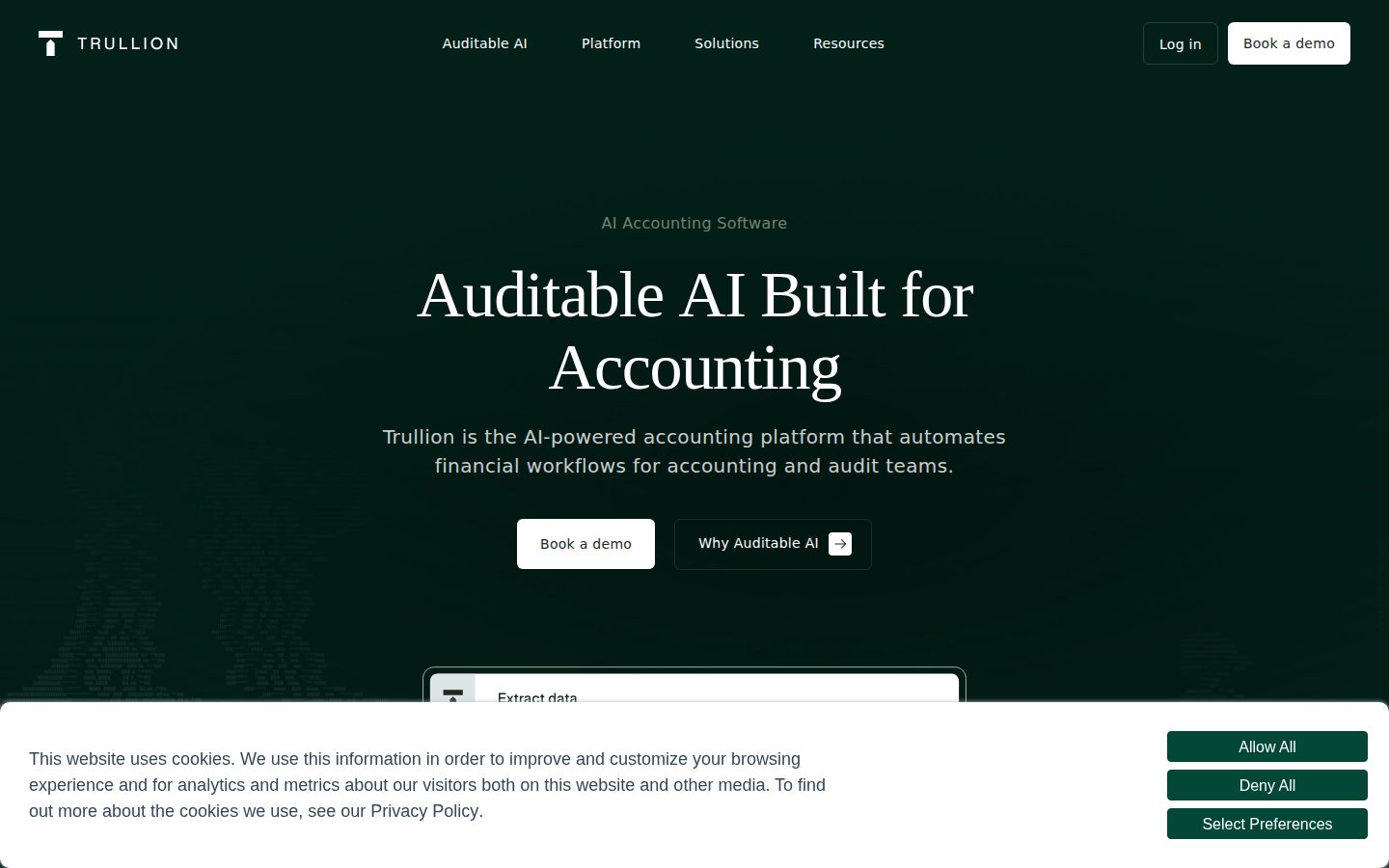
Trullion is an AI-powered accounting platform for corporate accounting teams, CFOs, and audit firms.
AI Panel Score
6 AI reviews
Reviewed
In practice, users work within Trullion to handle tasks such as data extraction from documents, lease accounting calculations, audit testing, and financial close reporting. The platform's agentic assistant, Trulli, surfaces answers and flags patterns across accounting data in real time, while built-in workflows guide teams through repeatable processes like evidence reconciliation and audit fieldwork without switching between separate tools.
Trullion's distinguishing capabilities include a knowledge layer that unifies internal guidelines, external accounting standards, and institutional knowledge to inform AI outputs. Lease accounting automation handles ASC 842 and IFRS 16 calculations with a full audit trail. For audit teams, the platform automates data extraction and substantive testing while keeping every conclusion linked to its source. The platform is described as purpose-built for accounting, with accounting standards and professional judgment guardrails embedded rather than applied as a generic overlay.
Trullion is aimed at external audit firms, internal audit functions, CFOs, and controllers at mid-to-large organizations. It positions against both manual spreadsheet-based processes and generic AI tools not designed for accounting compliance. Competitors in the broader accounting automation and audit technology space include Caseware, Workiva, and FloQast. Pricing is not disclosed publicly; prospective customers are directed to book a demo, indicating a sales-led, contact-for-pricing model.
Trullion is a web-based platform. It ingests both structured financial data and unstructured documents, centralizing them in a governed environment. No public API documentation or specific ERP integration details are listed on the homepage.
A suite of AI-powered tools specifically designed for audit fieldwork, automating testing and analysis processes.
An always-on AI assistant that surfaces answers, spots patterns, and makes sense of accounting data in seconds.
Provides CFOs with real-time visibility into finance operations and audit-ready reporting within a single platform.
Automates data extraction and testing for audit teams, enabling audits to scale without adding headcount while keeping every conclusion fully traceable.
Extracts data from structured and unstructured documents at scale, replacing manual data entry for audit and finance teams.
Automates finance operations workflows and strengthens accuracy and compliance across the enterprise by extracting data from documents at scale.
Standardizes lease accounting calculations, accelerates close, and maintains audit-ready records with full traceability for controllers.
Provides AI-powered workflows built specifically for CFOs and accounting firms to automate critical accounting and audit processes.
Extracts and reconciles audit evidence with a complete audit trail for internal audit teams, delivering accuracy and efficiency at every step.
Grounds every AI output in source documentation with full traceability, ensuring conclusions are auditable and aligned with accounting standards.
Unifies internal guidelines, external accounting standards, and institutional knowledge into a real-time knowledge layer to inform AI-driven outputs.
Combines assistants, workflows, and knowledge into one governed environment to eliminate silos across accounting and audit teams.
AI-powered accounting platform for accounting and audit teams including CFOs, controllers, internal audit, and audit firms. Pricing is available upon request via demo booking.
Built by ex-Big Four CPAs, Trullion solves the auditability problem generic AI ignores.
“Trullion automates lease accounting, audit fieldwork, and evidence reconciliation with traceable AI outputs. Contact-only pricing and no public API docs make it harder to evaluate before talking to sales.”
The founder story matters here. Built by former Big Four CPAs and ex-CFOs, not ML engineers who discovered accounting. That's a real moat against Workiva and Caseware, who've retrofitted compliance onto older architectures. Lease accounting automation covering ASC 842 and IFRS 16 with full audit trail is a concrete, defensible wedge.
Two things concern me. One: no public pricing, no changelog, no API docs. That's a sales-led motion that slows procurement cycles and makes integration planning opaque. Two: 'trusted worldwide' on the meta tag with no named customers or headcount tells me they're still building the reference list.
The Trulli agentic assistant surfacing answers in real time is the right bet for where audit workflows are heading. But this is a bet. Pilot it with one audit engagement before you standardize the firm.
Traceability and accounting-native guardrails differentiate it from Caseware and FloQast, which weren't designed around explainable AI outputs.
Ex-Big Four founders and an auditability-first design make this a defensible board conversation, though no named enterprise customers are public.
Lease accounting automation and evidence reconciliation have clear, measurable payback at close — but contact-only sales adds weeks to procurement.
Automates substantive testing and ASC 842 calculations, advancing audit capacity without headcount — that's forward motion, not just cost savings.
No public funding data, no headcount disclosed — founder pedigree is strong but runway is unverifiable.
Mid-to-large audit firms or controllers running ASC 842 compliance who need traceable AI outputs their auditors will actually accept.
Your team needs ERP integration details or a transparent pricing model before engaging with a vendor.
Purpose-built audit trail architecture that Workiva charges enterprise rates to approximate.
“Trullion is built by former Big Four CPAs around the exact compliance architecture controllers need: ASC 842 and IFRS 16 with source-linked outputs, not a generic LLM with accounting labels. The contact-only pricing is the main unknown, but the platform's depth signals mid-market and above.”
The Knowledge Layer is the structural tell here. Unifying internal policies, external standards, and institutional judgment into a single governed environment isn't a feature — it's the right foundation for a close process. If we adopt this, in 3 years we have a documented, searchable audit-ready knowledge base instead of tribal memory living in senior staff heads. That's durable infrastructure.
Lease accounting automation covering ASC 842 and IFRS 16 with full traceability is exactly where controllers get burned on audits. The docs indicate every conclusion links back to source documentation — that's the auditability posture regulators expect and what generic AI tools structurally can't deliver. FloQast handles close management well; Trullion appears to go deeper on substantive testing and evidence reconciliation.
The integration surface is the open question. No public API documentation and no listed ERP connections mean we can't evaluate the data pipeline before a demo. That gap matters for any close process running on NetSuite or SAP. Contact pricing also makes budget forecasting opaque until late in the sales cycle.
Sits above FloQast on audit depth and targets the same compliance-critical segment as Workiva without Workiva's enterprise pricing structure — a credible gap to occupy.
ASC 842 and IFRS 16 automation with audit fieldwork suite maps directly to the controller and external auditor workflow without requiring process redesign.
No public API documentation and no listed ERP integrations means the data ingestion story is unverifiable without a sales engagement.
If the knowledge layer accumulates institutional standards over time, switching costs compound favorably — but ERP integration opacity creates a 12-month evaluation risk.
Knowledge Layer plus source-traceable outputs suggests accounting-native architecture, not a generic AI wrapper — built by former Big Four CPAs per their own claims.
Controllers and audit firms at mid-to-large organizations who need defensible, source-linked AI outputs and can't use generic tools for compliance work.
Your team needs verified ERP integration or wants to evaluate technical architecture before entering a vendor sales cycle.
No published price, no trial, no API docs — contact sales for everything.
“Trullion targets mid-to-large accounting teams with purpose-built AI for ASC 842, IFRS 16, and audit workflows. Pricing is fully opaque; expect a sales cycle before you see a number.”
Zero pricing transparency. No tiers, no ranges, no per-seat figure anywhere on the site. Category norm for enterprise accounting software, but Workiva and Caseware at least publish edition structures. You're walking into a demo blind on cost. Budget $80K–$200K annually for this category at 50-user scale — that's a reasonable prior, not a quote.
TCO risk is real. No public API documentation means integration costs are unknown. No ERP connector details published — that's a procurement conversation that can add $30K–$80K in services before go-live. No free trial means you're committing on demo evidence alone. Year-3 all-in could be 2× year-1 sticker once implementation and renewal escalators land.
The traceability angle — every AI output linked to source documentation — is the right differentiator for audit compliance. Trulli agentic assistant and the Knowledge Layer are credible features for this buyer. But no changelog, no API docs, and contact-only pricing means procurement friction is high. ROI story depends entirely on what the sales team can prove.
Demo-gated pricing plus unknown implementation costs means procurement cycle is long and expensive before a PO is signed.
No public contract terms; no free trial and no termination-for-convenience language visible — category norm for enterprise, still a risk.
No tiers, no ranges, no per-seat data — contact-only model with zero public pricing signals.
Headcount-reduction narrative for audit scaling is plausible, but no published case study data or quantified benchmarks to validate.
No API docs or ERP integration specs published; implementation services cost is a black box.
Mid-to-large audit firms or corporate controllers who need defensible, traceable AI outputs for lease accounting and audit fieldwork.
Your procurement team needs published pricing and a trial before budget approval.
Purpose-built audit DNA beats Workiva's breadth for lease-heavy close cycles
“Trullion's ASC 842/IFRS 16 automation with full audit trail hits the exact place spreadsheets break down for controllers. Built by former Big Four CPAs, so the guardrails feel designed by people who've survived a December 31 close, not retrofitted by product managers.”
The Knowledge Layer is the detail that matters. Unifying internal memos, external standards, and institutional judgment into a single governed layer means Trulli isn't hallucinating against ChatGPT's training data — it's reasoning against your actual accounting policies. That's the gap every audit partner worries about with generic AI. Trullion addresses it structurally, not just in marketing copy.
Day-three reality is where the contact-for-pricing model bites. No public pricing, no free trial, no API docs visible — so an Accounting Manager can't quietly pilot this before bringing it to the CFO. Compare that to FloQast, which lets practitioners evaluate before the sales cycle starts. Onboarding here runs through demos, which slows practitioner adoption even when the tool is right.
For audit fieldwork and lease accounting at mid-to-large orgs, this is genuinely strong. The traceability story — every AI conclusion linked to source documentation — is non-negotiable in any environment where auditors will review the work. The friction is procurement friction, not product friction. Teams that clear the demo gauntlet likely find a tool they can actually close in.
Trullion and Trulli assistant appear workflow-native for repeatable audit cycles, but no changelog or public docs suggest the iteration cadence practitioners need post-onboarding.
Blog exists but no changelog or technical docs are publicly accessible, which means practitioners can't self-serve answers to implementation questions.
No public API documentation and a sales-only entry point add procurement and integration friction before day one even starts.
The Knowledge Layer unifying internal guidelines with external accounting standards suggests meaningful depth for controllers and audit leads who customize guardrails.
Lease accounting automation covering ASC 842 and IFRS 16 maps directly to existing controller workflows without requiring process reinvention.
Controllers and audit firms at mid-to-large organizations running ASC 842 lease portfolios who need AI outputs their external auditors will actually accept.
Your team needs a self-serve trial or transparent pricing before engaging sales.
Built by ex-Big Four CPAs, and you can feel it
“Trullion does something genuinely hard: it makes AI outputs in accounting actually auditable. Purpose-built for the CFO and audit world, not retrofitted from a generic AI layer.”
The founding story matters here. Former Big Four CPAs and ex-CFOs built this, which means someone has actually sat through a lease accounting close at 11pm. That shows up in the feature set — ASC 842 and IFRS 16 automation with a full audit trail isn't a checkbox, it's the core product. The Trulli agentic assistant plus a Knowledge Layer that bakes in accounting standards directly is the kind of thing Workiva and Caseware haven't fully cracked yet.
No public pricing, no free trial, no API docs visible — that's three friction points before you've seen a single screen. Sales-led, contact-for-pricing means this isn't for a 10-person team trying to move fast. That's a real constraint.
Daily polish and mobile parity are basically unknowable from public evidence — no changelog, no docs. Web-only, no API listed, which for an accounting workflow platform heading into 2025 feels like something they'll need to answer soon.
No changelog and no public docs mean there's no evidence the team is iterating on small details — can't confirm either way.
Built-in workflows for repeatable processes like evidence reconciliation suggest the product guides you rather than dumps features on you.
Web-only platform with no mention of mobile — for audit fieldwork that happens in the field, that's a gap worth naming.
No free trial, no self-serve, demo-only entry — that's homework before you've seen the product at all.
The explainable and traceable outputs feature with full audit trail suggests the team has thought hard about trust and data integrity.
Mid-to-large accounting teams, controllers, and external audit firms who need AI with a real audit trail.
You want self-serve onboarding, transparent pricing, or a tool that works beyond a desktop browser.
Solid niche play — three missing signals keep me from committing
“Purpose-built for accounting compliance in a way Workiva and FloQast aren't. But no changelog, no API docs, and no public pricing are three yellow flags in one vendor.”
Built by former Big Four CPAs. That's actually a differentiator — category history shows generic AI tools entering accounting usually die on auditability. Trullion's Knowledge Layer unifying ASC 842 / IFRS 16 guardrails into the workflow is the right instinct. Caseware never modernized this well. FloQast is close-focused, not audit-focused. There's a real gap here, maybe.
No changelog visible. That's the one I watch most. Means I can't verify shipping cadence. No API documentation either — so ERP integration is a demo conversation, not a self-serve answer. Sales-led pricing with zero anchor is a trust ask I'm not sure this team has earned yet publicly.
Exit portability is the honest concern. If they fold in 18 months, your audit trail data is in their governed environment with no documented extraction path. That's the tradeoff for the unified platform story. Build accordingly.
Lease accounting automation with full ASC 842 / IFRS 16 traceability plus audit fieldwork in one platform is a real gap vs. Workiva's reporting focus and FloQast's close focus.
No documented API, no export specs — your audit trail and lease accounting data are inside their governed environment with no visible self-serve exit path.
No changelog, no public funding data, no pricing page — not enough public signals to call this a confident 3-year bet based on visible evidence.
'Trusted worldwide' with no customer count or logos cited is the kind of claim that invites skepticism, but the product description avoids most superlatives and the Big Four founder background is checkable.
Domain-specific AI built by practitioners is the pattern that survives — matches Veeva in life sciences, not the generic-AI-enters-vertical graveyard.
Mid-to-large companies with dedicated controllers or external audit relationships who need auditable AI, not just fast AI.
You need transparent pricing, self-serve integration, or a documented data portability path before signing.
Common questions answered by our AI research team
Yes. Trullion is designed for audit teams to scale audits without adding headcount by automating data extraction and testing, increasing capacity while keeping every conclusion fully traceable.
Trulli is Trullion's always-on agentic AI assistant. It surfaces answers, spots patterns, and makes sense of accounting data in seconds, functioning like an additional staff member.
Yes. Trullion's AI outputs are explainable and traceable back to source documentation, operating within accounting guardrails to address auditability concerns that generic AI tools do not handle.
Trullion was built by former Big Four and top-firm CPAs, as well as former CFOs, who have direct experience with late nights, manual testing, and spreadsheet-heavy accounting work.
Yes. Trullion automates lease accounting for controllers by standardizing calculations, accelerating close, and maintaining full traceability to keep teams audit-ready.
Trullion is a New York-based accounting AI platform that automates lease accounting, revenue recognition, and audit workflows for finance teams and auditors.