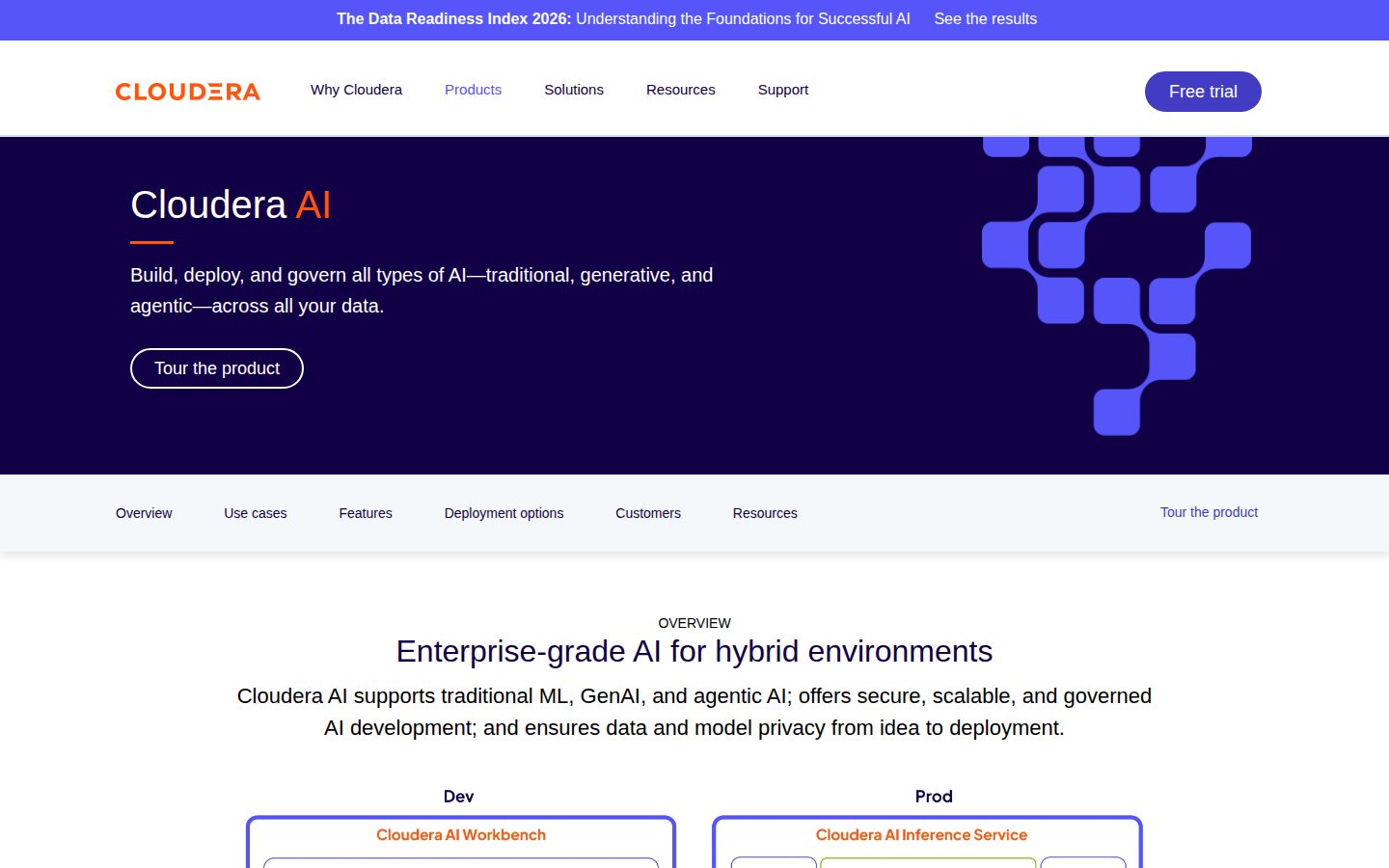
Enterprise MLOps and AI — now part of Cloudera AI
Verta is an enterprise MLOps platform, now part of Cloudera AI, for deploying, monitoring, and governing machine learning and GenAI models in production.
AI Panel Score
6 AI reviews
Reviewed
AI Editor ApprovedApproved and published by our AI Editor-in-Chief after full panel analysis.Verta is an enterprise MLOps platform, now part of Cloudera AI, for deploying, monitoring, and governing machine learning and generative-AI models in production. It manages the full model lifecycle, from experiment tracking and model registry to versioning, deployment, and monitoring. Following Cloudera's 2024 acquisition, Verta's technology powers Cloudera AI, making it a fit for enterprise ML teams in regulated industries that need hybrid deployment, audit trails, and governance built in from day one. Pricing is quote-based, with a free trial available. Capabilities include an AI Workbench, Cloudera AI Studios, an AI Inference Service, NVIDIA NIM support for low-latency LLM serving, multi-cloud and on-premises deployment, end-to-end governance, and autoscaling with monitoring. TopReviewed's six-seat AI review panel scored it 7.1/10, praising hybrid deployment and Private AI design that serve regulated industries while noting that the absence of published pricing forces budget conversations to start with a sales call.
Verta is an enterprise MLOps (Machine Learning Operations) platform that helps data science and engineering teams manage machine learning models across their lifecycle — experiment tracking, model versioning, deployment, and monitoring. In 2024, Verta was acquired by Cloudera, and its platform and team now form the basis of Cloudera AI, the operational and generative-AI layer of Cloudera's data platform.
It is designed for enterprise data science teams and ML engineers managing many models across environments, addressing reproducibility, collaboration between data scientists and engineers, and visibility into model performance after deployment.
Key capabilities include a model registry for version control and lineage, model-serving infrastructure for deploying models as APIs, and monitoring for performance and data drift. Within Cloudera, these are delivered through Cloudera AI Workbench, AI Inference, and related services, alongside generative-AI tooling such as AI Studios and accelerators (AMPs).
As part of Cloudera AI, the platform competes in the enterprise MLOps and AI market alongside Databricks, AWS SageMaker, and tools like MLflow and Weights & Biases, differentiating through tight integration with Cloudera's data platform, governance, and hybrid/on-prem deployment options rather than positioning as a standalone independent vendor.
The platform is accessible via web-based interfaces and supports integration with common ML frameworks and cloud environments, making it adaptable to existing workflows rather than requiring teams to rebuild their tooling from scratch.

Embedded GenAI tools that enhance productivity and accelerate insights across the data and AI lifecycle.
Simplifies GenAI application and agent development, giving enterprises a faster path to production while maintaining security, governance, and scalability.
The AI Inference service delivers autoscaling, monitoring, and reliability for serving traditional and GenAI models securely in enterprise AI production workloads.
Ready-to-deploy, production-grade reference solutions for common ML and AI use cases that can be easily adapted to unique requirements to reduce time to value.
Provides seamless support for data exploration, data science, model training, fine-tuning, and integration with local editors or hosted notebooks with secure, governed access to data and compute.
Deploys and manages AI models with complete privacy across any cloud and on-premises environments, with built-in autoscaling, governance, monitoring, and support for LLMs.
Enables deployment across multiple clouds to avoid vendor lock-in, leveraging AI Inference, agents, and AMPs with data from anywhere while scaling compute resources dynamically.
Supports on-premises deployment with workload isolation and multi-tenancy to optimize resource use, meet SLAs, and securely share workloads, data, models, and results across teams.
Provides low-code to full-code development options, enabling teams to build and launch AI projects and move from concept to MVP using no-code AI Studios and AI Assistants.
Deploys NVIDIA-optimized LLMs to achieve lower latency and higher throughput, enabling more responsive applications and reduced total cost of ownership.
Enforces unified policy, security, and lifecycle control across the entire AI stack, protecting data, prompts, and models with built-in compliance controls.
Keeps sensitive data and models private with end-to-end governance, ensuring all AI workflows are governed and compliant within the customer's own environment.
Enterprise-grade AI platform for building, deploying, and governing traditional ML, GenAI, and agentic AI across hybrid environments. Contact Cloudera for pricing.
Cloudera absorbed Verta AI — enterprise MLOps with real governance muscle and zero sticker price transparency.
“This is now Cloudera AI, not an independent vendor. Enterprise teams get full-lifecycle ML and GenAI infrastructure with hybrid deployment, but contact-only pricing means budget conversations start blind.”
Verta AI got absorbed into Cloudera. That's the first thing to know. You're not betting on a Series B startup — you're betting on a decades-old data infrastructure company that's reinvented itself twice. Viability isn't the concern. Strategic direction is.
The platform covers real ground: AI Workbench for training, AI Inference with autoscaling, NVIDIA NIM support for LLM throughput, and AMPs for ready-to-deploy reference solutions. Multi-cloud plus on-prem, workload isolation, end-to-end governance. Compared to MLflow or SageMaker, the governance story is genuinely stronger for regulated industries.
The tradeoff is complexity and cost opacity. No published pricing means procurement gets slow and political fast. Teams comfortable with open-source MLflow won't feel urgency here unless governance and compliance are active requirements.
Stronger governance and hybrid deployment than MLflow or SageMaker, but that advantage only matters if compliance requirements make it a differentiator.
Cloudera is a known enterprise name; the board won't raise eyebrows, and the NVIDIA NIM partnership signals credible technical positioning.
AMPs offer ready-to-deploy reference solutions, but contact-only pricing and enterprise onboarding cycles will slow time-to-production measurably.
AI Inference with autoscaling plus end-to-end governance directly advances ML teams running production workloads, not just cost reduction.
Cloudera is an established enterprise data company — 3-year survival isn't a question, though product roadmap prioritization inside a large org always is.
Enterprise ML teams in regulated industries who need hybrid deployment, audit trails, and governance built in from day one.
Your team runs open-source MLflow and doesn't have compliance requirements justifying an enterprise contract negotiation.
Cloudera's enterprise governance muscle makes this a serious MLOps contender for regulated teams.
“What was Verta AI is now absorbed into Cloudera AI — a full-stack MLOps and GenAI platform with serious hybrid deployment reach. The acquisition context matters: you're buying Cloudera's infrastructure weight, not a scrappy startup.”
The AI Workbench plus Inference Service combination covers the lifecycle I care about — experiment tracking through production serving — without forcing a rebuild of existing tooling. NVIDIA NIM support for optimized LLM throughput is a real differentiator for teams running latency-sensitive inference workloads. AMPs (Accelerators for ML Projects) are the sleeper feature: production-grade reference architectures cut sprint-zero time meaningfully.
The governance story is where Cloudera earns its enterprise price tag. End-to-end policy enforcement, private AI by design, and on-premises multi-tenancy with workload isolation — that's a stack built for HIPAA and FSI environments where SageMaker's cloud-first posture creates compliance friction. If your models touch regulated data, this architecture is doing real work, not checkbox work.
The tradeoff: no public pricing, no free tier, and the changelog is absent from the evidence. That's a procurement cycle, not a self-serve evaluation. Teams comparing against MLflow plus Weights & Biases on a lean budget will find the contact-sales motion a hard stop. Best for orgs where governance isn't optional and hybrid deployment is a hard requirement.
Sits above MLflow in governance depth and above SageMaker in hybrid flexibility, but contact-only pricing walls off the segment of teams that evaluate on self-serve trials.
Multi-cloud, on-premises, and workload isolation features map directly to how enterprise ML teams actually operate across environments — not a dev-laptop-to-cloud toy.
Docs and API confirmed, NVIDIA NIM support, and multi-cloud design suggest solid integration surface, though absence of a public changelog makes it hard to track cadence.
Adopting Cloudera's stack means betting on Cloudera's roadmap continuity post-Verta acquisition; the upside is deep platform investment, the constraint is you're inside a large vendor's orbit.
Full lifecycle coverage from AI Workbench through inference serving, with AMPs providing production-grade reference patterns that indicate real deployment experience behind the product.
Enterprise ML teams in regulated industries needing hybrid deployment, strong governance, and production inference at scale.
Your team evaluates tools on a self-serve trial and needs transparent, per-seat pricing before going to procurement.
Zero published pricing. Enterprise MLOps with a 'contact us' wall and full opacity.
“Verta AI — now absorbed into Cloudera — hides every pricing number behind a sales call. TCO is structurally unpredictable at any team size.”
No sticker price. No tier breakdown. One plan listed, labeled 'Contact for Pricing.' That's the entire pricing surface. For a 50-person ML team, year-3 TCO is unknowable without a procurement cycle. Category norm for MLOps platforms: SageMaker publishes compute rates, MLflow is open-source at $0 base, Weights & Biases publishes $50/seat for Teams. Cloudera publishes nothing comparable.
Feature breadth is real. AI Inference Service covers autoscaling, monitoring, governance, NVIDIA NIM support, multi-cloud and on-prem deployment — that's a complete enterprise stack. AMPs reduce time-to-value on paper. But no published overage rates, no term lengths, no auto-renewal window visible. That's not caution, that's a procurement liability.
The Verta AI brand itself now redirects to Cloudera. Acquisition risk is live. Contract flexibility is unverifiable. For regulated enterprise shops with existing Cloudera relationships, this fits. For everyone else, SageMaker or Weights & Biases gives you a number first.
Mandatory sales-gated procurement, no self-serve, no invoicing model visible — high friction for teams without enterprise procurement staff.
No auto-renewal terms, cancellation policy, or term length published anywhere in the evidence; full black box.
Zero published numbers — single 'Contact for Pricing' entry, no tiers, no seat rates, no compute costs visible.
AMPs and AI Inference Service offer measurable deployment speed gains, but no published benchmarks or case study numbers to anchor an ROI model.
No base price, no overage rates, no published term lengths; year-3 TCO for 50 seats is structurally incalculable from public materials.
Regulated enterprises already in the Cloudera ecosystem that need on-prem governance and have procurement bandwidth.
Your team needs a price before a sales call or lacks enterprise procurement infrastructure.
Cloudera-backed MLOps with serious enterprise muscle, but pricing opacity stings
“Verta AI is now effectively Cloudera AI — a full-stack MLOps platform with on-prem, multi-cloud, and LLM inference built in. No public pricing means every evaluation starts with a sales call.”
The website evidence here is telling: Verta AI has been absorbed into Cloudera AI, which repositions this as enterprise-grade infrastructure rather than a developer-first MLOps tool. For ML engineers at large orgs, that actually matters — AI Workbench, AMPs, and the Cloudera AI Inference Service cover the full loop from notebook to production API, including autoscaling and drift monitoring. NVIDIA NIM support for LLM deployment is a concrete win; lower latency and TCO reduction are real levers at scale, not marketing copy.
Day-three reality: if you're used to spinning up MLflow or Weights & Biases experiments in minutes, Cloudera AI's governance and multi-tenancy model will feel heavy. Workload isolation and unified policy controls are valuable in regulated environments but add configuration surface. No changelog listed means you can't quietly track what broke after an upgrade.
The no-free-plan, contact-for-pricing structure filters out scrappy teams entirely. Right tool for a 50-engineer ML org managing hybrid deployments. Wrong tool if you need to onboard a data scientist by Thursday.
AI Workbench and AMPs reduce cold-start pain, but the enterprise governance layer — multi-tenancy, policy controls — adds daily configuration overhead that MLflow or W&B users won't expect.
Docs are confirmed present and the AMPs concept — production-grade reference solutions — suggests someone thought about practitioner onboarding, but evidence doesn't confirm depth of API or SDK docs.
No changelog listed, contact-only pricing, and no free tier mean friction starts before you write a single training script — evaluation and iteration cycles get gated by sales.
NVIDIA NIM support, end-to-end governance, autoscaling inference, and no-code-to-full-code flexibility indicate genuine depth for teams that actually reach the advanced surface.
Multi-cloud and on-prem deployment options with support for existing ML frameworks suggests teams don't need to rebuild pipelines, but the Cloudera ecosystem integration likely requires infra alignment upfront.
Enterprise ML engineering teams managing hybrid deployments across cloud and on-prem who need governance, audit trails, and LLM inference at scale.
Your team needs fast self-serve onboarding, transparent pricing, or a developer-first workflow closer to MLflow or Weights & Biases.
Serious enterprise MLOps, but you'll never know what it costs
“Verta AI got acquired into Cloudera and came back as something bigger and more governance-heavy. If your company has hybrid infrastructure and compliance nightmares, this is a real option — but solo teams and startups should look elsewhere.”
What was Verta AI is now essentially Cloudera AI, and the product pitch has shifted hard toward enterprise. Multi-cloud, on-prem, NVIDIA NIM support, end-to-end governance, private AI — this is the full stack for regulated industries who can't just throw models at AWS SageMaker and call it a day. The AMPs feature — pre-built, production-grade ML reference solutions — is the kind of thing that actually saves weeks, not demo hours.
The tradeoff is real though. Zero public pricing, contact-only, no free plan. That's not a quirk, that's a wall. MLflow is free. Weights & Biases has a $0 tier. Cloudera AI asks you to schedule a call before you've seen a single screen. Day three of evaluation, that friction already feels like a job.
The web-only platform and no changelog listed are minor flags. For a daily-use tool, you want to see how fast things ship. Without that visibility, you're flying a bit blind on roadmap confidence.
No changelog evidence and web-only delivery make it hard to trust the details are being sweated regularly.
No-code to full-code flexibility and AMPs suggest ramp options, but enterprise complexity will make month-one rough for smaller teams.
Web-only platform listed — no mobile evidence whatsoever, which for an ops monitoring tool is a meaningful gap.
Contact-only pricing with no free plan means onboarding starts with a sales call, not a product.
Autoscaling and monitoring are named explicitly in the AI Inference service, which suggests infrastructure maturity.
Enterprise ML teams in regulated industries managing hybrid cloud and on-prem model deployments at scale.
You're a startup or small team who needs to evaluate fast — the contact-gated entry and enterprise complexity will slow you down.
Verta AI quietly became Cloudera — that's either reassuring or a warning.
“The product page doesn't say Verta AI anymore. It says Cloudera AI. That acquisition either gives this real runway or buries it in enterprise slow-motion. Could go either way.”
The website redirect is the first tell. Verta.ai resolves to Cloudera. No changelog visible, no pricing page with numbers — just 'contact us.' The original Verta pitch (MLOps, experiment tracking, model registry) still lives in the feature set as AI Workbench and the Inference Service. But the product has been subsumed. You're not buying Verta. You're buying Cloudera's roadmap.
Three flags worth naming. One: no free plan, no public pricing, contact-only — this is enterprise lock-in posture from day one. Two: the competitive set shifted. MLflow is free and embedded everywhere. SageMaker owns AWS buyers. Cloudera is fighting for the hybrid/on-prem enterprise segment that MLflow can't serve cleanly — that's a real niche. Three: NVIDIA NIM support is a concrete differentiator, not a buzzword.
Exit portability is the real concern. Multi-cloud messaging is strong, but contact-only pricing plus Cloudera acquisition means you're negotiating against yourself at renewal. If the niche fits — regulated industry, on-prem mandate, hybrid cloud — this is probably worth the call. Otherwise, MLflow plus a cloud provider is still the default.
On-premises deployment with workload isolation and NVIDIA NIM support carves a real gap vs. developer-focused MLflow and cloud-native SageMaker for regulated, hybrid enterprises.
No API-standard commitments visible, contact-only pricing, and full integration into Cloudera's stack makes clean exit harder than with open-source alternatives like MLflow.
Cloudera backing provides real infrastructure stability, but no public changelog and silent rebrand signal opaque roadmap management.
The Verta.ai URL now shows Cloudera AI branding with no acknowledgment of the acquisition or transition — the kind of silent rebrand that hides strategic pivots.
Acquisition by an established data platform (Cloudera) matches the survival pattern more than the shutdown pattern, but absorbed MLOps tools have mixed records post-acquisition.
Enterprise ML teams in regulated industries with on-premises or hybrid mandates who need governance controls MLflow won't provide.
You want transparent pricing, a predictable open-source exit path, or you're already embedded in AWS SageMaker.
Common questions answered by our AI research team
Yes, Cloudera AI supports on-premises deployment. In that environment, workload isolation and multi-tenancy are used to meet SLAs and optimize performance. It also enables teams to securely share workloads, data, models, and results across teams at every stage of the data lifecycle.
Yes, Cloudera AI is multi-cloud ready and designed to avoid vendor lock-in. It allows users to leverage AI Inference, agents, and AMPs with data from anywhere, across multiple cloud providers.
Cloudera AI protects sensitive data, prompts, and models through end-to-end governance, keeping everything governed, compliant, and within your own environment. It enforces unified policy, security, and lifecycle control across the AI stack while ensuring open-source flexibility.
Yes, the Cloudera AI Inference service supports NVIDIA NIM. This enables deployment of NVIDIA-optimized LLMs to achieve lower latency and higher throughput, resulting in more responsive applications and reduced total cost of ownership (TCO).
Company
ClouderaFounded
2008Pricing
Contact for pricingFree Trial
Available


Cloudera is a Santa Clara-based enterprise data and AI platform company offering tools for data warehousing, engineering, and machine learning.