Track, compare, and optimize your machine learning experiments
Comet ML is a machine learning experiment tracking and model management platform.
AI Panel Score
6 AI reviews
Reviewed
AI Editor ApprovedApproved and published by our AI Editor-in-Chief after full panel analysis.Comet ML is an experiment tracking and MLOps platform designed to help data science and machine learning teams manage the complexity of iterative model development. It provides tools to automatically log training metrics, hyperparameters, datasets, code snapshots, and model artifacts, giving teams a centralized record of every experiment run.
The platform integrates with widely used ML frameworks including TensorFlow, PyTorch, scikit-learn, Hugging Face, and others, typically requiring only a few lines of code to instrument an existing workflow. Experiments are captured in real time, and results can be visualized through an interactive web dashboard that supports side-by-side comparison of runs.
Comet ML targets individual data scientists as well as larger ML engineering teams working in enterprise environments. Its collaboration features allow multiple users to share experiment data, annotate results, and maintain a shared model registry, which supports reproducibility and knowledge transfer across teams.
Beyond experiment tracking, Comet offers model production monitoring capabilities that alert teams to data drift and performance degradation after deployment. This positions it as a broader MLOps tool rather than a standalone experiment logger.
Comet ML competes in the MLOps space alongside tools such as MLflow, Weights & Biases, and Neptune.ai. It offers a cloud-hosted service as well as self-hosted deployment options for organizations with data residency or security requirements.

Auto-scores new versions of LLM apps, agents, or AI features against a defined dataset using metrics for hallucination, context precision, and relevance.
Scores production data as it is created to detect and mitigate new issues in real time across deployed AI applications.
Automatically generates and tests prompts for steps in an agentic system, recommending top performers based on example datasets and desired metrics.
Allows users to spot check and annotate traces to label what is working and what is not, pinpointing areas for iteration and improvement.
Enables subject matter experts to be invited directly into the platform to collaborate on human review of traces.
Accepts a dataset to define a quality benchmark and uses it to scale testing and scoring of LLM application versions.
Logs traces to capture and organize an application's LLM calls, providing observability across complex GenAI systems including context retrieval and tool selection.
Generates new test datasets from production monitoring data to inform the next iteration cycle of an AI application.
Download, install, & run Opik your way
Solid MLOps foundation pivoting hard toward LLM ops — catch it mid-transition.
“Comet ML started as experiment tracking and is repositioning as an AI agent control plane. The pivot has real legs, but the product identity is split right now.”
The $179 starting price and 25k free spans tell me they're serious about landing individual practitioners first. The 40+ framework integrations — LangChain, CrewAI, OpenAI, Google ADK — mean setup friction is low. That matters when you're trying to get adoption before a contract conversation happens.
The pivot is the real story. They've shipped Automated LLM Eval Metrics, production monitoring with online evals, and six prompt optimization algorithms including Bayesian and MIPRO. That's not an experiment tracker with AI features stapled on. That's a different product than what they were two years ago. Weights & Biases is the obvious comp, and Comet is closing that gap faster than I'd have expected.
The tradeoff: HIPAA is enterprise-only, and there's no changelog visible publicly. For regulated industries or teams that track vendor velocity closely, that's a pause. Self-hosted OSS option with full feature parity partially covers it.
Six prompt optimization algorithms and 40+ integrations give a differentiated angle, but Weights & Biases has stronger brand recognition with enterprise buyers today.
Competes directly with Weights & Biases; adopting Comet reads as a credible, informed choice, not a budget shortcut.
Few-lines-of-code instrumentation and real-time experiment dashboards mean teams see value inside a single sprint.
LLM trace logging and production test dataset creation advance GenAI teams — this isn't just cost reduction on existing workflows.
No public funding data visible; time-in-market is solid but runway confidence is limited without disclosed financials.
ML teams actively building LLM applications who need experiment tracking and production monitoring in one platform.
Your org is in a regulated industry and can't commit to enterprise tier before validating fit.
Comet has quietly pivoted to LLM observability, and the bet is credible.
“Comet ML started as experiment tracking but the product evidence shows a deliberate repositioning around LLM evaluation, agent tracing, and production monitoring under the Opik brand. The 40+ framework integrations and 6+ native prompt optimization algorithms signal genuine engineering depth, not surface-level GenAI opportunism.”
The feature architecture here is coherent. Automated LLM eval metrics covering hallucination, context precision, and relevance — plus production online evals — means Comet is building the monitoring loop that MLOps teams actually need post-deployment. That's a harder problem than experiment tracking, and harder problems create stickier products. The OSS self-host option with true codebase parity is a serious enterprise unlock; HIPAA compliance gated to Enterprise is the expected tradeoff.
The 25k spans per month free tier is tight for any team running multi-step agent workflows at scale. Pro bumps to 100k with customizable limits, which is workable for a mid-size team but watch the ceiling as agent call volume compounds. Weights & Biases has more mature experiment tracking depth; Comet's differentiation is increasingly the LLM eval and agent observability layer.
If we adopt this in 2025, in 3 years we have either a well-integrated AI control plane or a cautionary tale about a platform mid-pivot. The trajectory looks right — agent tracing, SME annotation workflows, dataset-driven regression testing — but execution continuity matters here more than category.
Positioned between MLflow's open-source gravity and Weights & Biases' experiment-tracking depth, with a differentiated LLM observability angle that's genuinely less crowded.
Human feedback annotation plus SME collaboration on trace review maps directly to how senior ML teams actually triage production model failures.
40+ integrations covering LangChain, CrewAI, Google ADK, and OpenAI means instrumentation cost is low across most modern GenAI stacks.
OSS self-host with feature parity reduces lock-in risk, but the mid-pivot identity means the roadmap carries more uncertainty than Weights & Biases at the same stage.
Six-plus native prompt optimization algorithms including MIPRO and Bayesian approaches shows real investment beyond basic logging.
Teams building and operating LLM-powered applications who need the evaluation-to-production monitoring loop in one platform.
Your stack is primarily classical ML with no LLM components — Weights & Biases or MLflow will serve you better.
$179/month entry, 25K free spans, OSS escape hatch — math works at small scale
“Comet ML publishes a free tier with 25K spans/month and a Pro entry point, with OSS self-hosting available. Enterprise pricing is opaque, and HIPAA compliance gates behind a sales call.”
Free tier: 25K spans/month. Pro bumps to 100K with customizable limits — that's the right architecture for growth. OSS self-hosting is true feature parity, same codebase. For a 10-person team self-hosting, year-3 cost is near zero except infrastructure. Cloud Pro at $179/month × 12 = $2,148/year before overages. Add 2-3 seats of enterprise tooling and you're past $10K fast.
The HIPAA gap is real. SOC 2, ISO 27001, HIPAA all locked to Enterprise — no published price. That's a procurement blocker for healthcare or fintech teams. Weights & Biases publishes tiered pricing more cleanly. MLflow is free but you own the ops burden entirely.
ROI is measurable: experiment count, drift alerts, eval scores via Automated LLM Eval Metrics are logged and queryable. That's auditable value. Contract terms aren't published — auto-renewal window unknown. Procurement teams should ask before signing.
HIPAA and enterprise compliance gated to unpublished Enterprise tier adds procurement friction for regulated industries.
No published auto-renewal window or termination terms — standard risk for SaaS, but nothing in the evidence confirms negotiation room.
Free and $179 Pro tiers visible; Enterprise pricing requires a sales call, and overage rates aren't published on the pricing page.
Automated LLM Eval Metrics, drift detection, and span logging produce quantifiable outputs that tie directly to model quality and incident reduction.
OSS self-hosting at feature parity holds year-3 costs near infrastructure-only; cloud path to $10K+ annually for mid-size teams with compliance needs.
ML teams under 20 seats who can self-host or tolerate cloud costs under $5K/year.
Your procurement requires HIPAA compliance or published contract terms before vendor approval.
Serious LLM observability depth, but classic ML experiment tracking feels like yesterday's product
“Comet ML has pivoted hard into LLM/agent observability with Opik, and the feature set is genuinely deep. The 25k span free tier and 40+ framework integrations make it easy to instrument, but the product identity is mid-transition.”
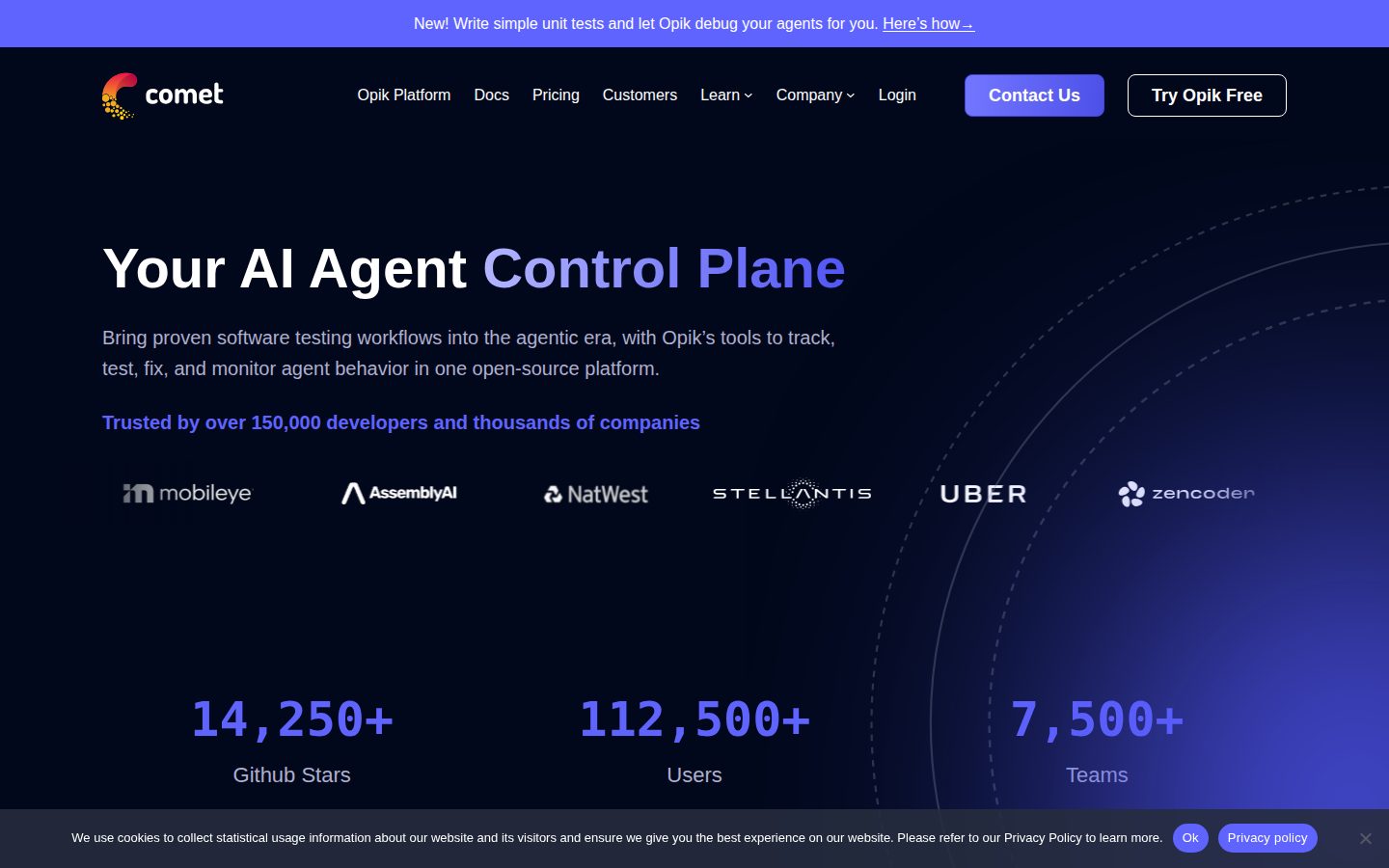
The scraping tells an interesting story: the H1 is 'Your AI Agent Control Plane,' not experiment tracking. Comet has repositioned around LLM observability and Opik. That's strategically coherent but creates day-3 confusion if you came for traditional ML experiment logging. The six-plus prompt optimization algorithms — Evolutionary, MIPRO, GEPA among them — suggest actual ML depth, not just a dashboard wrapper.
Workflow fit is strong for LLM engineers. Trace logging, production online evals, and dataset-based testing are the three-loop cycle I actually run: instrument, evaluate, iterate. The 40+ framework integrations including LangGraph and CrewAI means instrumentation won't block you. Self-hosted OSS with claimed feature parity removes the data residency argument that kills deals.
The gap versus Weights & Biases is discoverability. W&B's power features surface naturally in the sidebar. Comet's advanced prompt optimization and SME collaboration workflows look buried. HIPAA locked to Enterprise-only is a real constraint for healthcare ML teams evaluating at the $179 starting price.
Automated LLM eval metrics and trace logging reduce daily instrumentation overhead, but the product's pivot from experiment tracking to agent control plane creates navigation friction for users who came for one and got the other.
Docs flag is Y and buyer Q&A reveals algorithm-level specificity (MIPRO, GEPA, Hierarchical Reflective Optimizer by name), which reads like someone who actually optimizes prompts wrote the docs, not just a technical writer.
25k spans/month on the free tier is a tight ceiling for any real agent workflow — a single multi-step agent run can burn hundreds of spans — pushing teams to $179/month sooner than expected.
Six-plus prompt optimization algorithms including Bayesian and evolutionary methods, plus production dataset creation from live monitoring data, is a genuinely advanced feedback loop that MLflow doesn't offer natively.
40+ integrations including LangChain, LangGraph, and CrewAI means the instrumentation step is rarely the bottleneck; the few-lines-of-code promise appears architecturally real based on the OSS codebase claim.
LLM engineers building and monitoring agentic systems who need production observability plus automated prompt optimization in one platform.
Your team needs HIPAA compliance without an Enterprise contract negotiation, or you're running traditional tabular ML experiments and want Weights & Biases-style run comparison depth.
Serious MLOps muscle, but the rebrand from experiments to agents is a lot to take in
“Comet ML has quietly grown from experiment tracker into a full AI developer platform with LLM evals, agent tracing, and production monitoring. At $179/month for Pro, it's priced for teams, not solo tinkerers.”
The pitch has shifted. What used to be 'track your training runs' is now 'control plane for AI agents.' That's a real product change, not just marketing. Opik — Comet's open-source core — logs LLM traces, runs automated evals against hallucination and relevance metrics, and lets subject matter experts annotate traces directly in the platform. The 40+ framework integrations, including LangChain, CrewAI, and OpenAI, mean you're probably not writing custom connectors.
The free tier caps at 25k spans per month, which is fine for exploration, not fine for anything real. Weights & Biases still owns the experiment-tracking mindshare in most ML shops, so Comet is betting the agentic AI angle is their opening. It might be.
The tradeoff is cognitive load. This is a platform now, not a tool. Day three is going to feel heavier than day one's demo glow suggests. No changelog visible publicly, and mobile is web-only, so don't expect to review runs from your phone.
The interactive dashboard and side-by-side run comparison suggest real care, but no public changelog makes it hard to know how actively rough edges get filed down.
The pivot from experiment tracker to full agent control plane means month one includes a lot of new surface area — six-plus optimization algorithms alone require real orientation time.
Web-only platform with no mentioned mobile app — reviewing traces or checking production drift alerts from a phone isn't really an option.
A few lines of code to instrument an existing workflow is the right promise, and 40+ framework integrations means most people won't hit a dead end in the first hour.
Real-time experiment capture and production monitoring alerts are load-bearing features — no public uptime data in the evidence, but category norm for cloud MLOps is generally solid.
ML engineering teams who are actively building and shipping LLM-powered applications and need experiment tracking plus production observability in one place.
You're a solo data scientist who just wants lightweight experiment logging and doesn't need the full agent observability stack.
Identity crisis at $179: experiment tracker turned 'AI Agent Control Plane'
“Comet ML landed as an experiment tracker, then pivoted hard into LLM observability under the 'Opik' brand. The product may be fine. The story they're telling today barely resembles what they were two years ago.”
Three tells up front. One: the H1 says 'AI Agent Control Plane' but the product description says experiment tracking. Two: no changelog listed in the evidence. Three: 'Opik' appears throughout the buyer Q&A but never in the product description — two brand names, one confused pitch.
The feature set is real. LLM trace logging, 40+ framework integrations, 6+ prompt optimization algorithms including Bayesian and MIPRO — that's not vaporware. The 25k spans free tier and OSS self-hosting with true feature parity are concrete offers. HIPAA locked behind Enterprise is a category norm, not a knock. Weights & Biases does the same.
What worries me: the pivot from classical MLOps to LLM eval is exactly the move Neptune.ai and Seldon made under pressure. Could go either way. Exit portability is decent — OSS codebase, standard logging, no lock-in traps visible. But if you came for scikit-learn experiment tracking, the roadmap isn't pointed at you anymore.
40+ integrations and 6+ prompt optimization algorithms are real, but Weights & Biases and MLflow cover similar ground with larger installed bases.
True OSS self-hosting with stated feature parity and standard framework integrations means migration pain is low if things go sideways.
No public funding data visible, no changelog, and a mid-pivot brand identity ('Opik' vs 'Comet ML') are soft yellow flags on commitment depth.
The landing page H1 ('AI Agent Control Plane') doesn't match the product description ('experiment tracking and model management') — that's a material gap.
MLOps pivots toward LLM eval mirror Neptune.ai's trajectory; some survived, some didn't — no changelog in the evidence makes cadence hard to verify.
LLM app teams wanting OSS-backed observability with production monitoring and no vendor lock-in.
You're primarily doing classical ML experiment tracking and want a team that isn't mid-pivot.
Common questions answered by our AI research team
The Free Cloud plan includes 25k spans per month. On the Pro plan, this increases to 100k spans per month and also offers customizable monthly span limits, allowing it to be expanded further.
Yes, Opik supports automated prompt optimization with native support for 6+ optimization algorithms, specifically: Evolutionary, Few-Shot Bayesian, MetaPrompt, Hierarchical Reflective Optimizer, MIPRO, and GEPA, with more to come.
HIPAA compliance is only available on the Enterprise tier. The content lists SOC 2, ISO 27001, ISO 9001, HIPAA, and GDPR compliance exclusively under the Enterprise plan.
Yes, you can self-host Opik using the open-source version, which is free to download, install, and run. The content states it is 'True OSS: same codebase as the hosted versions,' indicating feature parity with the cloud-hosted product.
Opik integrates with 40+ AI frameworks, model providers, and AI gateways. The content specifically names LangChain, OpenAI, Google ADK, LangGraph, and CrewAI as examples of supported integrations.
Comet is a New York-based MLOps company providing experiment tracking, model evaluation, and production monitoring for machine learning and AI teams.