Build, deploy, and scale ML models on Google Cloud infrastructure
Google Vertex AI is a managed machine learning platform for building, deploying, and scaling AI models.
AI Panel Score
6 AI reviews
Reviewed
AI Editor ApprovedApproved and published by our AI Editor-in-Chief after full panel analysis.Google Vertex AI is a fully managed, end-to-end machine learning platform hosted on Google Cloud. It consolidates what were previously separate Google Cloud ML services into a single environment, covering the full model lifecycle from data ingestion and labeling through training, evaluation, deployment, and monitoring. Users can work with structured data, images, text, and video across both AutoML and custom training approaches.
The platform targets data scientists, ML engineers, and developers building production-grade AI applications. It supports popular frameworks including TensorFlow, PyTorch, scikit-learn, and XGBoost, and provides managed notebook environments, pipelines, and experiment tracking to support collaborative and reproducible ML workflows.
Vertex AI includes a Model Garden, which provides access to first-party Google foundation models such as Gemini, as well as open-source and third-party models. Through the Generative AI Studio, users can prototype, fine-tune, and deploy large language models and multimodal models without needing to manage underlying infrastructure.
On the MLOps side, Vertex AI offers Feature Store for sharing and serving ML features, Model Registry for version control, and Model Monitoring to detect training-serving skew and data drift in production. These capabilities are intended to help teams move models from experimentation to production more consistently and at scale.
Vertex AI competes directly with AWS SageMaker and Azure Machine Learning in the cloud ML platform market. Pricing is usage-based, varying by compute resources consumed, model type, and API calls made, with no flat monthly subscription required. Google Cloud's free tier includes limited Vertex AI credits for new accounts.

Provides access to the latest Gemini multimodal models capable of understanding and combining text, images, video, and code inputs to generate outputs.
A catalog of 200+ generative AI models including first-party (Gemini, Imagen, Chirp, Veo), third-party (Anthropic's Claude), and open models (Gemma, Llama 3.2).
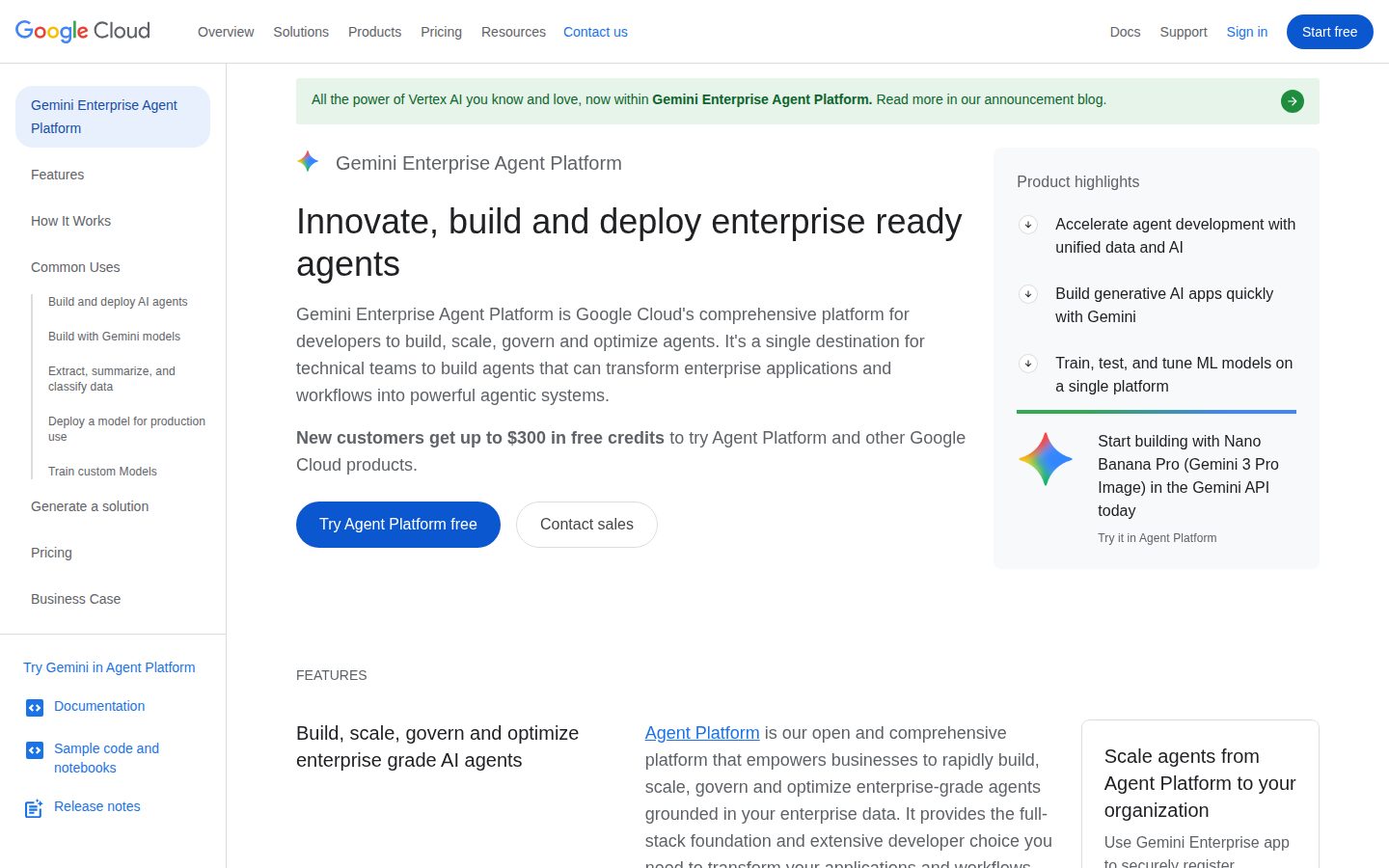
A full-stack platform for building, scaling, and governing enterprise-grade AI agents grounded in enterprise data.
A prompt and testing environment where developers can experiment with Gemini models using text, images, video, or code inputs.
Enterprise-grade tools for objective, data-driven assessment and comparison of generative AI models.
Continuously monitors deployed models for input skew and drift to detect degradation in model performance.
A purpose-built MLOps tool for identifying and comparing the best-performing models for a given use case.
Workflow orchestration tool that automates and standardizes ML project workflows across the development lifecycle.
A managed service for serving, sharing, and reusing ML features across teams and models.
A centralized repository for managing, versioning, and tracking any ML model throughout its lifecycle.
Integrated notebook environments (Colab Enterprise or Workbench) natively connected to BigQuery for unified data and AI workloads.
Managed infrastructure for training ML models and deploying them to production using open source frameworks and optimized AI hardware.
AutoML model training and prediction for image classification and object detection
AutoML model training and inference for tabular classification/regression
Time series forecasting with AutoML, tiered prediction pricing
ARIMA+ forecasting model training and prediction via BigQuery ML
Custom model training on CPU-based Compute Engine machine types
Custom model training with GPU/TPU accelerators attached to machine types
Machine types with fixed GPU counts (GPU price included)
Generative AI models and foundation model APIs on Vertex AI — see separate pricing page
Google's bet on unified ML is real, and 200+ models in one catalog proves it.
“Vertex AI is a mature, full-stack ML platform backed by Google's infrastructure and model portfolio. The Model Garden alone — 200+ models including Claude and Llama 3.2 — changes the vendor conversation.”
Google. Profitable. Not going anywhere. Vertex AI consolidates what used to be six separate Cloud ML services, and the changelog shows steady shipping. Vendor viability isn't the question here.
Two things to watch. One: deployed AutoML endpoints charge even with zero predictions — you must manually undeploy or you're burning money overnight. Two: H100 training at $9.797/hour plus management fees adds up faster than teams expect when experiments run long. SageMaker has the same problem, but that's not an excuse.
For teams already on Google Cloud with BigQuery workloads, the Vertex AI Notebooks integration and Feature Store make serious sense. The Generative AI Studio lets you prototype against Gemini without touching infrastructure. That's real speed to value. Teams not on GCP will pay an adoption tax that takes time to offset.
Exclusive Model Garden access to Gemini 3 Pro and Veo isn't available on SageMaker — that's a real differentiation for multimodal use cases.
Telling the board you're on Vertex AI reads as responsible — it's the defensible choice next to AWS SageMaker and Azure ML.
Generative AI Studio cuts prototype time, but the always-on endpoint billing model creates budget surprises that slow adoption in cautious orgs.
Model Garden with 200+ models including third-party options like Claude means this advances AI capability, not just cost reduction.
Google Cloud is a $36B+ annual revenue business — Vertex AI isn't a product they abandon.
Teams already on Google Cloud who need production-grade MLOps plus access to Gemini and multimodal foundation models.
Your stack is AWS-native and you're not willing to pay the cross-cloud data egress and tooling migration tax.
The most complete MLOps surface in cloud, if you're already living in GCP.
“Vertex AI has closed most of the gap with SageMaker on MLOps depth and opened a real lead on foundation model access via Model Garden's 200+ models. If your data is in BigQuery and your team runs TensorFlow or PyTorch, this is the default choice.”
Feature Store, Model Registry, Pipelines, Model Monitoring — that's the full MLOps stack, not a checklist of half-built services. The Gen AI Evaluation Service and Vertex AI Studio together give teams a credible path from prototype to production on LLMs without spinning up separate tooling. Someone at Google has shipped real ML infrastructure before; this isn't duct-taped together.
The tradeoff worth naming: endpoint billing doesn't stop when predictions stop. A deployed AutoML model accrues charges at rest — you must explicitly undeploy to stop costs. For teams running many experimental endpoints or doing burst-and-idle workloads, that's a real budget control problem that SageMaker handles more gracefully with serverless inference.
If we adopt this and stay on GCP, in 3 years we have deep BigQuery-Vertex integration, access to first-party Gemini and third-party Claude via a single API surface, and an MLOps workflow that's genuinely hard to replicate on-prem. If we're multi-cloud or AWS-primary, the integration story loses most of its force.
Competes directly with SageMaker and Azure ML, but Model Garden's first-party Gemini access plus Claude availability gives it a differentiated generative AI position neither competitor currently matches.
Supports TensorFlow, PyTorch, scikit-learn, XGBoost, managed notebooks via Colab Enterprise, and Pipelines for reproducibility — matches how production ML teams actually operate.
Native BigQuery connectivity, Colab Enterprise notebooks, and a unified API for both classical ML and Gemini-era generative workloads is the strongest integration story in the category.
Deep BigQuery and GCP integration compounds positively over time, but creates meaningful switching cost if the org ever goes multi-cloud.
Full lifecycle coverage from labeling through drift monitoring, plus Model Garden with 200+ models including Anthropic's Claude — library-grade depth, not feature-lite.
Data science teams building production ML and LLM applications on GCP with BigQuery as their data backbone.
Your organization is AWS-primary or actively multi-cloud and can't commit to GCP as the ML runtime.
200+ models, H100s at $9.79/hour, and an idle-endpoint billing trap to watch.
“Vertex AI is usage-based with granular public pricing — no sales call required. The idle-endpoint charge is the budget risk most teams miss.”
Pricing page is genuinely detailed. H100 80GB at $9.797/hour plus $1.469 management fee. AutoML tabular training at $21.252/node-hour. ARIMA+ at $250/TB × candidate models × backtesting windows — that last multiplier compounds fast. Three dimensions visible without a procurement conversation. Rare for this category. AWS SageMaker buries comparable detail.
The TCO trap: deployed AutoML endpoints bill continuously, zero predictions or not. Team runs 5 idle endpoints for a month — that's real spend, not a rounding error. Year-3 cost depends entirely on compute mix and how disciplined the team is about undeploying models. No flat cap, no ceiling. Forecasting budgets here requires engineering discipline, not just finance work.
Contract flexibility is straightforward — pay-as-you-go, no auto-renewal window, no termination-for-convenience clause to fight. Procurement friction is low. The tradeoff: no committed-use discount is visible on the pricing page, so large training budgets may negotiate offline with Google Cloud reps.
Standard GCP billing applies — invoiced monthly, no onboarding fee, integrates with existing Google Cloud procurement relationships.
Usage-based with no published auto-renewal terms or lock-in; cancel anytime by stopping usage and undeploying endpoints.
Granular per-resource rates publicly listed — CPU, GPU, TPU, AutoML, and GenAI tiers all visible without a sales call.
Model Monitoring and Gen AI Evaluation Service provide measurable performance signals, but revenue impact math remains on the buyer.
Idle endpoint billing plus ARIMA+ multipliers make year-3 TCO genuinely hard to model without engineering input.
ML teams already on Google Cloud who need a fully managed MLOps platform with broad foundation model access and public compute pricing.
Teams without ML ops discipline to manage endpoint lifecycle will bleed budget on idle deployments.
200+ models, real MLOps depth — but idle endpoints will quietly drain your budget
“Vertex AI is a serious production ML platform with genuine depth across training, pipelines, and generative AI. The idle-endpoint billing model is a real operational trap that SageMaker doesn't punish you for as harshly.”
Model Garden ships 200+ models including Gemini, Claude, and Llama 3.2. That's not a demo catalog — that's a working foundation for teams who need model optionality without managing inference infrastructure. Feature Store, Model Registry, and Model Monitoring cover the MLOps surface that most teams bolt together from five different tools. Pipelines plus Colab Enterprise notebooks means the experiment-to-production handoff has actual structure, not just vibes.
The billing model demands attention. Deployed AutoML endpoints charge continuously whether or not predictions are made — you must undeploy to stop the meter. At $2.002/hour for object detection endpoints, a forgotten staging deployment costs $1,441/month. That's not a bug, it's a policy. H100 training at $9.797/hour plus $1.469 management fee per hour adds up fast during long fine-tuning runs.
Docs indicate solid framework coverage — TensorFlow, PyTorch, scikit-learn, XGBoost. The changelog is absent from public evidence, which makes tracking breaking changes harder than it should be. Power users will find real depth in Vertex AI Evaluation and the Gen AI Evaluation Service. Day-three reality: this is a platform you can actually live in, but cost hygiene has to be part of your daily workflow.
Deep MLOps tooling holds up past the demo, but idle-endpoint billing and absent public changelog create ongoing operational vigilance requirements.
Docs are present and API coverage is confirmed, but no public changelog makes it harder for ML engineers to track deprecations and runtime changes.
Idle endpoint charges, management fees on top of GPU costs, and ARIMA+ billing that also incurs a pipeline run fee — small friction points compound across a working week.
Gen AI Evaluation Service, Feature Store, Model Registry, and 200+ Model Garden entries give serious practitioners genuine advanced surface area to work with.
Colab Enterprise notebooks natively connected to BigQuery, plus Vertex AI Pipelines, means the training-to-deployment loop has real structural support.
ML engineering teams already on Google Cloud who need a full MLOps stack with serious generative AI model access.
Your team runs many long-lived staging endpoints or does heavy iterative AutoML experimentation without strict cost controls.
The serious ML platform that makes you earn it before it pays off
“Vertex AI is a genuinely complete ML platform — Model Garden, Feature Store, pipelines, monitoring, 200+ foundation models. But it was built for teams who already know what they're doing, not people finding their footing.”
The feature list here is real. Model Garden with 200-plus models including Claude, Llama, Gemini, Imagen — that's not marketing fluff. Vertex AI Pipelines, Feature Store, Model Registry, drift monitoring. These aren't half-baked. Compared to AWS SageMaker, Vertex actually feels more consolidated, less like seventeen services pretending to be one. And the BigQuery integration for ARIMA+ forecasting is genuinely useful if your data already lives in Google Cloud.
The pricing will catch you though. Deployed AutoML endpoints charge continuously whether or not a prediction fires. Forget to undeploy? The meter runs. H100 training clusters hit $101/hour for an 8-GPU config. Nobody's calling this cheap. These are enterprise numbers, and the docs make that clear if you read carefully — but new users won't read carefully on day one.
Mobile parity is basically nonexistent — this is a web-only platform and that's fine, nobody's training models on their phone. The real learning curve is month one versus month three. Month one is homework. Month three, if you've committed, it clicks. Not a tool you casually evaluate.
Vertex AI Studio and the notebook environments feel considered, but the pricing gotcha around always-on endpoints suggests someone wasn't sweating the daily-user experience enough.
Month one is steep; the platform consolidates what were previously separate Google Cloud ML services, and that history shows in the navigation and mental model required.
Web-only platform with no stated mobile experience — acceptable for ML workflows but worth naming honestly.
Free trial exists but no flat free plan, and usage-based pricing with management fees layered on GPU costs makes the first hour feel like budgeting homework, not exploration.
Google Cloud infrastructure backing a fully managed platform — category norm suggests high uptime, and the managed notebook and pipeline environments are designed to remove operational overhead.
ML engineering teams already in Google Cloud who need a single platform from data prep through production monitoring.
You're an individual or small team still figuring out your ML workflow — the pricing model will punish experimentation.
200+ models, Google's infrastructure, one billing surprise waiting for you
“Vertex AI is a real platform — not vapor. The Model Garden breadth and GCP infrastructure integration are genuine differentiators. But the endpoint billing model will catch teams off guard.”
Three tells from the pricing page alone. One: AutoML endpoints charge even when idle — you must undeploy to stop the clock. Two: ARIMA+ training runs $250/TB multiplied by candidate models AND backtesting windows — that math compounds fast. Three: no changelog listed, which on a platform this complex is a yellow flag for operational visibility.
The Model Garden at 200+ models — including Claude, Llama 3.2, and Gemini natively — is the clearest gap vs. SageMaker. AWS doesn't match that first-party/third-party breadth in one catalog. Feature Store, Model Registry, and Model Monitoring form a credible MLOps spine. This isn't a demo product.
Exit portability is the real concern. TensorFlow and PyTorch models are portable. But if your pipelines, Feature Store, and Agent Builder all run on Vertex primitives, migration gets expensive fast. Google has sunsetted cloud products before. Not a reason to avoid — reason to architect defensively.
Model Garden's 200+ models including Claude and Llama 3.2 alongside native Gemini is a real moat SageMaker and Azure ML don't replicate at this breadth.
Open frameworks (PyTorch, TensorFlow) are portable, but Vertex Pipelines, Feature Store, and Agent Builder create deep GCP lock-in that's costly to unpick.
Google Cloud is a $33B+ revenue business and Vertex is clearly a strategic bet — no funding risk, but Google's history of sunsetting products keeps this from scoring higher.
Enterprise-ready claims are substantiated by actual MLOps tooling depth, but idle endpoint charges are buried — that's a real cost behavior the landing page doesn't surface.
Unified ML platform consolidating scattered services matches the pattern of durable category tools like SageMaker, not the pattern of things that got shut down.
ML engineering teams already on GCP who need a full MLOps stack with broad foundation model access.
You're cost-sensitive, cloud-agnostic, or need predictable monthly spend — the usage-based model bites hard at scale.
Common questions answered by our AI research team
Yes. According to the pricing page, you pay for each model deployed to an endpoint, even if no prediction is made. Charges continue to accrue as long as the model remains deployed.
Vertex AI provides access to 200+ foundation models, and the homepage explicitly mentions Gemini 3 Pro (referred to as 'Nano Banana Pro (Gemini 3 Pro Image)'), which is available via the Gemini API and can be tried in Vertex AI.
Yes, you can use Spot VMs with Vertex AI custom training. They are billed according to Compute Engine Spot VMs pricing, with additional Vertex AI custom training management fees on top of infrastructure usage costs.
To stop incurring charges for a deployed AutoML model endpoint, you must undeploy the model. The pricing page explicitly states: 'You must undeploy your model to stop incurring further charges.'
Yes. The ARIMA+ pricing section references the BigQuery ML pricing page for additional details, and each ARIMA+ training and prediction job also incurs the cost of one managed pipeline run as described in Vertex AI pricing.
Company
Google CloudFounded
2008Pricing
Usage-basedFree Trial
AvailableEnterprise ready, fully-managed, unified AI development platform. Access and utilize Vertex AI Studio, Agent Builder, and 200+ foundation models.